Earth Day: If the Sun, Moon and Stars Could Speak

Day or night, we are here above you.  We speak a universal language understandable to all people, and we share our message with every part of the world.

But we aren’t really interested in talking about ourselves.

It is our pleasure and joy to serve our Maker for your benefit and His glory.  He has perfectly equipped us for our tasks.

One of your poets once said it this way:

The heavens declare the glory of God,
            and the sky above proclaims his handiwork.
Day to day pours out speech,
            and night to night reveals knowledge.
There is no speech, nor are there words,
            whose voice is not heard.
Their voice goes out through all the earth,
            and their words to the end of the world.
In them he has set a tent for the sun,
which comes out like a bridegroom leaving his chamber,
            and, like a strong man, runs its course with joy.
Its rising is from the end of the heavens,
            and its circuit to the end of them,
            and there is nothing hidden from its heat.[1]

We were here before you were, but our Maker was here before us and will be here when we’re gone.  For you, He has us mark the days and seasons.  We give light for you to see, warmth for your comfort, and energy for your food to grow.

He asked us to tell you of His power and His love for you.  We are not here by accident, and neither are you.  Whoever you are, the sun rises for you and the rain falls in its time.  He ensures it.


The Apostle Paul says that God’s “invisible attributes, namely, his eternal power and divine nature, have been clearly perceived, ever since the creation of the world, in the things that have been made.[2]

Today, rejoice in the regularity of the heavens, which declare to all people in all times and places that the eternal God cares about them.


[1] Psalm 19:1-6
[2] Romans 1:20

Called to Be Our Consecrated Selves

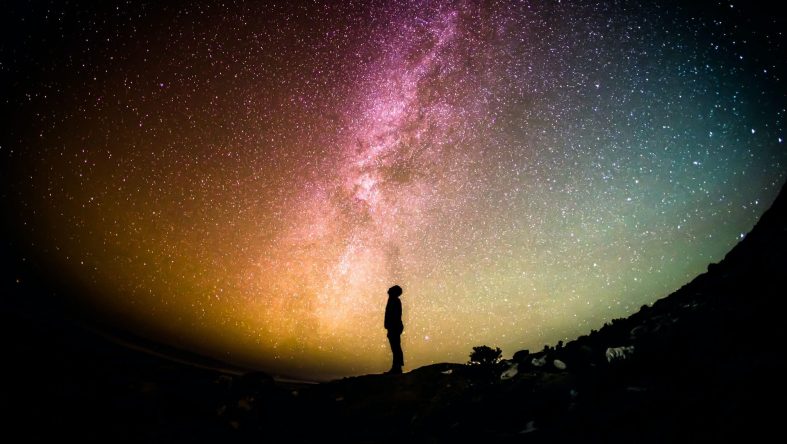
Photo by Greg Rakozy on Unsplash

People have moments where they wish they had a greater role in the world around them.  We see other people around us, or in stories from the Bible or in the news, and think we’d like to be more like them.  More influential, more effective, more powerful.  For example, what if I could be a prophet or an apostle?  Or in our modern world, maybe a “social media influencer”?  “Be yourself” is often the advice for finding contentment when we feel like this, but the Bible says we are “to be conformed to the image of his Son.”[1]  So, should we be ourselves, or should we be like Jesus?  What will give us contentment?  While not a full answer, the call of Jeremiah the prophet offers some help.

Jeremiah was not a prophet by accident, because Jeremiah 1:4-5 says:

“Now the word of the LORD came to me, saying,
‘Before I formed you in the womb I knew you,
            and before you were born I consecrated you;
            I appointed you a prophet to the nations.’”

Here, God calls Jeremiah both to conform his ways to God’s, and also to his own specific task.  Like Jeremiah, every Christian is known by God and called to do His will.  Only God knows why we were each made the way we were made, and in a way God calling us to serve Him is like Him saying “stop living like you’re an accident of a random, purposeless world.”  It is because we were made, not just evolved, that we have purpose, and God has “consecrated” us to that purpose.

Stop living like you’re an
accident of a random,
purposeless world.

But each of us was made differently, also on purpose.  Unlike Jeremiah, my fellow travelers on this blog probably aren’t prophets, and that is part of why Jeremiah needed to be a prophet.  His job wasn’t to call everyone else to be a prophet, but to serve everyone else by calling them to find their own purpose in God.  Jeremiah wanted all of God’s people to take whatever He has endowed them with and dedicate it to Him.  Likewise, being “conformed to the image of” Jesus does not mean we should all be carpenters, but that we should apply His righteousness to every task He puts before us.

Therefore, God’s people should never live like they are an accident.  We are all a valuable work of creation, made to find our good and His glory in His amazing design.  We will find our true selves in the One who made us, and God’s people will have unity in Christ’s character, combined with diversity in the infinite creativity of the people He created.

Be yourself, and also be like Jesus.

For we are his workmanship, created in Christ Jesus for good works, which God prepared beforehand, that we should walk in them.” – Ephesians 2:10


[1] Romans 8:29

Will Green Be Greener in Paradise?

Psalm 98:7 declares: “Let the sea roar, and all that fills it; the world and those who dwell in it!” In Romans 8:19 Paul adds that “the creation waits with eager longing for the revealing of the sons of God.”

Pastor James Montgomery Boice connects these ideas and says, “The world will one day be renewed.”  Nature already shows God’s glory, but it also, like mankind, is not yet as it shall be.  Boice adds: “I think of the way C.S. Lewis developed this idea in The Lion, the Witch, and the Wardrobe. In the first section of that book, when Narnia was under the power of the wicked Witch of the North, the land was in a state of perpetual winter. Spring never came. But when Aslan rose from the dead, the ice began to melt, flowers bloomed, and the trees turned green.”[1] Creation shares the hope of mankind – regeneration in a future paradise at the coming of its Lord!

Even now, we get an occasional glimpse of nature that’s somehow better than what we’re used to, and perhaps it is a glimpse of the paradise beyond the renewal of all things.  We were recently in Wales, on Mount Snowdon and a nearby trail in Llanberis, and below are some pictures from that day.  Some of these show the many brilliant shades of green, which seemed more glorious than the greens near our home in the U.S. We don’t often see rocks interact with the greenery like this here.

So, will paradise be even greener than this?  Will it seem like a perpetual winter has finally lifted?  I’m eagerly waiting to find out someday. In the meantime, enjoy these:


[1] From “April 19.” James Montgomery Boice and Marion Clark. Come to the Waters: Daily Bible Devotions for Spiritual Refreshment.  (2017).

The God Who Puts Food on the Table

There are many reasons to praise God, many ways that He blesses us.  One of these is given in Psalm 111:5, and it’s something we shouldn’t take for granted:

He provides food for those who fear him;
            he remembers his covenant forever.

While this may be a reference specifically to God providing manna and quail to the Israelites when they wandered in the wilderness, it applies more broadly to any food provided to anyone at any time.  Therefore, we should praise Him whenever we have something to eat.

But He doesn’t just deliver food from the grocery store to us.  He provides everything required for food to exist in the first place.  He designed everything involved in the growth of what we eat.  Sunlight, rain, soil conditions and nutrients, all have a role in the growth of fruits and vegetables.  All of these roles act the way they need to be by design.  Food doesn’t exist by change and is not an accident of a blind nature.

Then add what’s needed to produce the meat we may eat.  First, those plants need to contain what animals need to eat and grow.  The animals need to be able to not only digest those things, but then to turn them into something edible for us.  Again, all ordained by God, the intelligent creator of our universe, who “provides food for those who fear him.”

Also, He is not only a God who designs and provides, but a God of mercy, “For he makes his sun rise on the evil and on the good, and sends rain on the just and on the unjust.”[1]  He provides food even for those who do not praise Him and give thanks to Him, so they might come to know Him by His mercy towards them.

Those who fear God, praise and thank Him for the food He provides, the complexity of the world He designed, and His mercy toward all His people.  But also, to reflect His character, provide food for those in need, showing them the mercy and love of the God who puts food on our tables.

He provides food for those who fear him;
            he remembers his covenant forever


[1] Matthew 5:45b

The Body of Christ is Irreducibly Complex

Among the various camps in the debate between creation and evolution is a set of ideas called intelligent design (ID).  A key part of ID is “irreducible complexity,” a term that comes from the book Darwin’s Black Box, by Lehigh professor Michael Behe.[1]

In short, irreducible complexity argues that evolution by chance, without an intelligent designer driving it, is unreasonable because the multiple systems in a complex organism like a human body – circulatory, digestive, endocrine, muscular, respiratory, and so on – are all interdependent on each other.  The circulatory system alone, with the heart pumping blood through an elaborate system of arteries and veins, is difficult to imagine developing by chance occurrence, but a chance evolution of that system alongside all the other parts it is dependent on is even more far-fetched.  All systems evolving together in lockstep without failing is a much more difficult problem to explain scientifically without a Creator.  The circulatory system takes what the respiratory and digestive systems take in and deliver it to the other systems that use it.  Without the other parts, it has no function and cannot survive and further evolve.

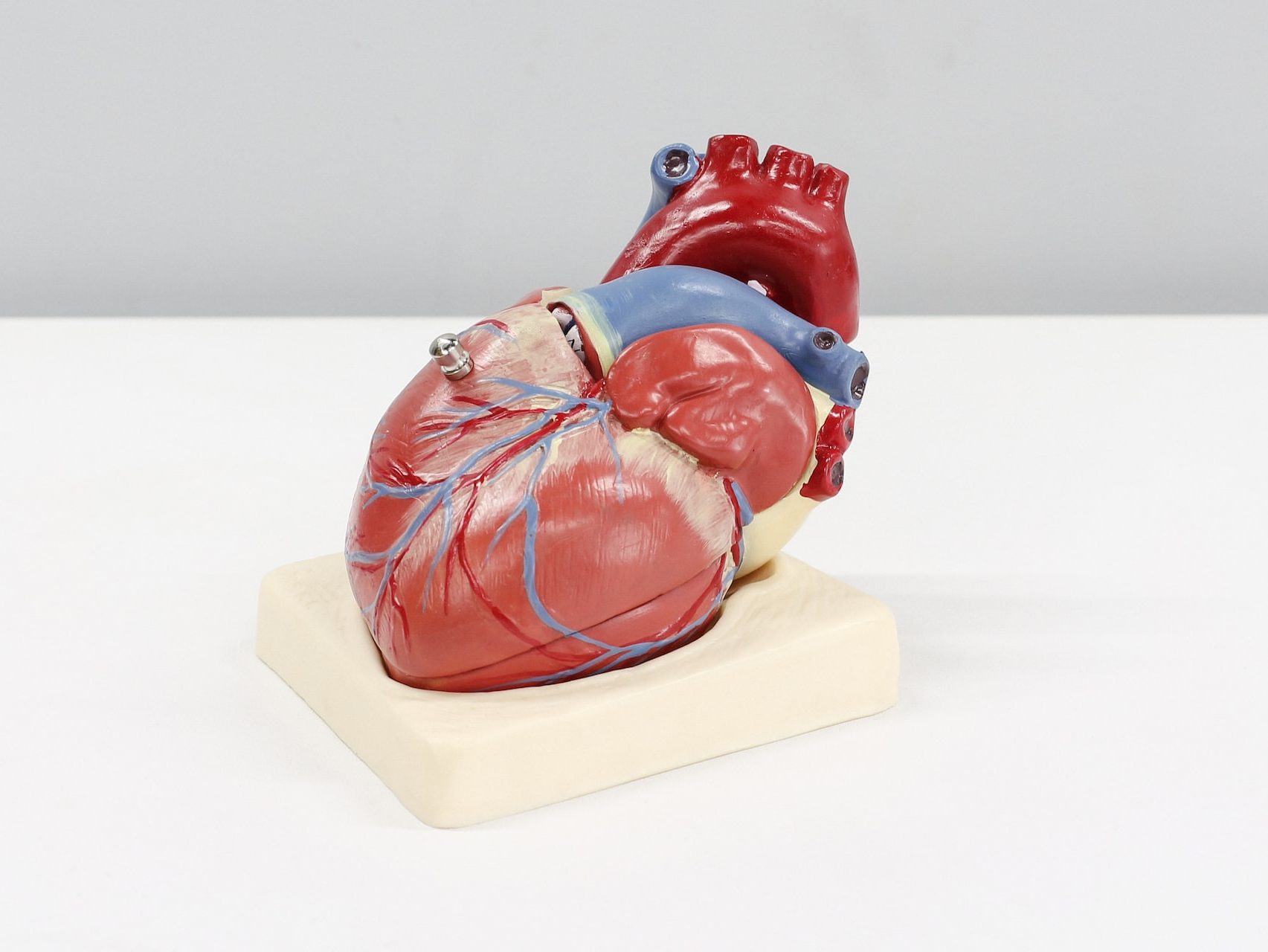
An isolated, inanimate, heart. Photo by Ali Hajiluyi on Unsplash

However, my intent here is not to prove intelligent design, but to consider the apostle Paul’s words about the church as the body of Christ.  In 1 Corinthians 12:12, he wrote: “For just as the body is one and has many members, and all the members of the body, though many, are one body, so it is with Christ.”  He continues that no part of the body can say it is not a part of the body because it has a different function than another part (1 Cor. 12:15-16), and also that no part of the body can say it doesn’t need all of the other parts (1 Cor. 12:21).  Those who are in Christ Jesus cannot be divided.

Paul follows his description of the body with 1 Corinthians 13, a powerful statement on the supremacy of love, and in context a gentle rebuke to the idea that a body can survive as individual, unrelated units.  In a human body, any part can only survive by serving the other parts.  Even an organ as incredibly complex and important as a heart cannot survive if it decided to pump blood only for itself.  Where would it get its nutrients?  How would it flee from danger?  As Paul wrote: “If the whole body were an eye, where would be the sense of hearing? If the whole body were an ear, where would be the sense of smell?” (1 Cor. 12:17).  Even an organ as important as the heart is useless in isolation.  It gets its very life and purpose by what it does for the body.

As Jesus said to His disciples in John 13:34-35 – “A new commandment I give to you, that you love one another: just as I have loved you, you also are to love one another.  By this all people will know that you are my disciples, if you have love for one another.

As the song says, they will know we are Christians by our love, and the church Jesus came to build is irreducibly complex.  There is no appendix[2] in the church, which is the body of Christ.


[1] Behe, Michael.  Darwin’s Black Box (1996).
[2] While we commonly think of this organ as useless, God as our Maker didn’t put it there by accident.