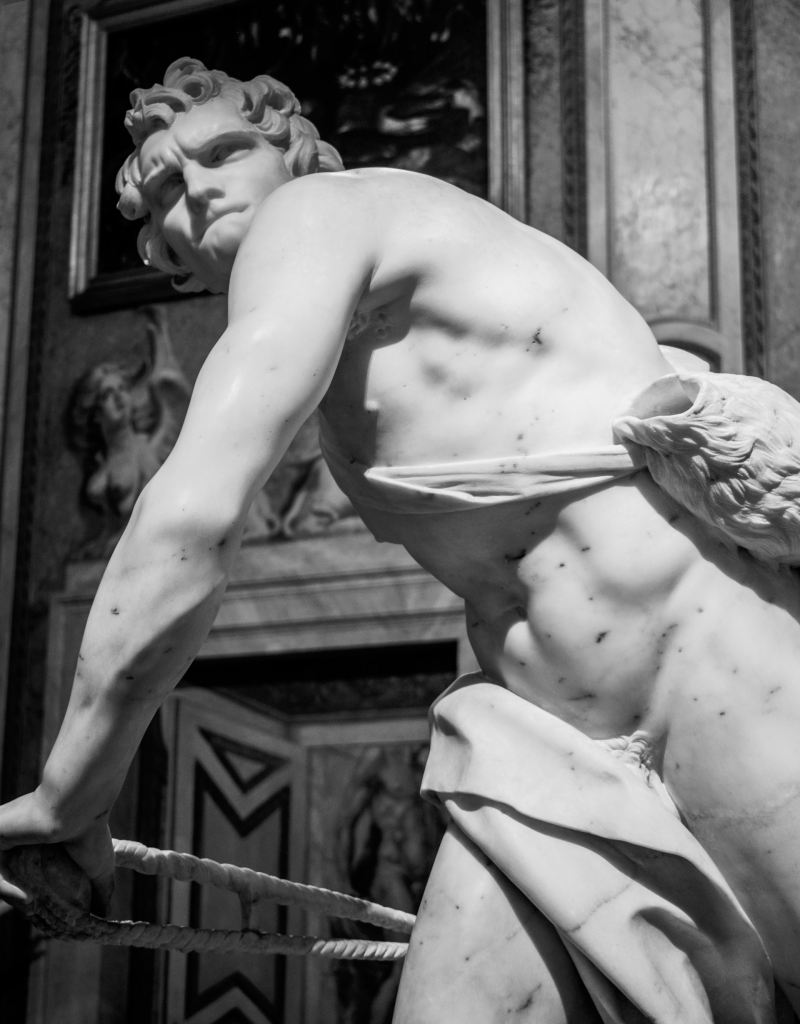
David’s Spiritual Battle with Goliath

David’s defeat of Goliath is such a popular story that it has become a cliché.  For example, unbalanced games in sports where one team is much better than the other are referred to as “David vs. Goliath.”  In these cases, the storyline is about whether a seemingly physically inferior opponent can beat a physically superior one.  However, this misses the point of the story – that it was a spiritual battle.

On one side of the battle, we have false gods.  After David decided to fight and was approaching Goliath, 1 Samuel 17:43 says: “And the Philistine [Goliath] said to David, ‘Am I a dog, that you come to me with sticks?’ And the Philistine cursed David by his gods.”  But even though Goliath invoked his gods in curses, he was counting on his size and strength advantage to win the battle.  He was not actually relying on “gods,” and did not expect to win “by his gods”, but by the god of worldly strength and dominance.

On the other hand, David was clear that this was a battle between true and false gods.  In 1 Samuel 17:26, David says “What shall be done for the man who kills this Philistine and takes away the reproach from Israel? For who is this uncircumcised Philistine, that he should defy the armies of the living God?” and also in verse 37 David says “The LORD who delivered me from the paw of the lion and from the paw of the bear will deliver me from the hand of this Philistine.”  David was actually trusting in and relying on his God for victory, unlike Goliath who just used his gods’ names in vain.  David knew his relative physical weakness against Goliath was not relevant.

So, to Goliath the battle was David vs. Goliath, but to David it was the true God vs. false gods.  And that’s why David won. David wanted to beat Goliath so “that all this assembly may know that the LORD saves not with sword and spear. For the battle is the LORD’S, and he will give you into our hand.” (verse 47)

People also curse us by their gods when we refuse to live by those gods’ standards.  These may be gods of wealth or convenience or rebellion, and many of our spiritual battles are against this world’s gods.

Does it sometimes seem foolish not to make choices based only on what’s best financially?  Is it sometimes inconvenient to worship?  Is it sometimes inconvenient to love our families, congregations, and neighbors?  Is it tempting sometimes to sin “only once” or if we think nobody will find out?

These are battles we all face, but we’re not going to win by doing better by the world’s gods’ standards, but by relying on the true God.  So, a question for us is: do we see these challenges as spiritual battles between true and false gods?  Or do we invoke God in name only like Goliath did, and then rely on our own strength?

The key to the battle between David and Goliath is that David won because 1) he knew his God is real, and 2) because he actually relied on Him.  We can win the same way and overcome the giants that seek to overthrow us.

For we do not wrestle against flesh and blood, but against the rulers, against the authorities, against the cosmic powers over this present darkness, against the spiritual forces of evil in the heavenly places.” – Ephesians 6:12

God’s Justice is Good

Many of the Bible’s Psalms are beautiful songs of praise, but some are harder to read, including what are called “imprecatory” Psalms.  To “imprecate” is to curse, and in the case of these Psalms, the writers curse the enemies of the writer and of God.  Psalm 58, written by David, uses some very harsh language, such as “O God, break the teeth in their mouths” (in vs. 6) or “Let them be like the snail that dissolves into slime, like the stillborn child who never sees the sun.” (vs. 8).  These harsh phrases may be hard to read, but they’re part of the Bible and worth taking some time to understand.

These curses have a context, and for the imprecations in Psalm 58, the context is injustice due to bad worldly judges.  Verses 1 and 2 say:

“Do you indeed decree what is right, you gods?
            Do you judge the children of man uprightly?
No, in your hearts you devise wrongs;
            your hands deal out violence on earth.”

Every day in the news we can easily find injustices to complain about, just as David did, and in many of our hearts, we feel some of the emotions David must have felt.  Much of what passes as news today might be categorized as imprecatory.  David’s curses continue in verses 3 through 8, including the phrases quoted above, but in verse 9, after writing of how wicked and dangerous his enemies are, David notes how quickly God (not David) can sweep them away if He chooses:

Sooner than your pots can feel the heat of thorns,
            whether green or ablaze, may he sweep them away!

This image is not chosen at random, but to make a specific point.  Dry thorns catch fire very quickly, and so when God judges, the unjust judges will be swept away “Sooner than your pots can feel the heat”. Not sooner than the food in your pot cooks, or sooner than the water in your pot boils, but much sooner than that.  A watched pot never boils, they say, but here the result is immediate.

The Psalm closes in vs. 11 with relief that ultimately, there will be true and complete justice, and:

Mankind will say, ‘Surely there is a reward for the righteous;
            surely there is a God who judges on earth.’”

God’s justice is good because when God judges, He judges rightly, unlike the imperfect, or corrupt, judges of the world from the beginning of the Psalm.  If the things on the news we complain about are truly unjust, God will take care of them “Sooner than your pots can feel the heat.”  Also, when people pursue right actions instead of injustice, God will reward them “Sooner than your pots can feel the heat.”  Judgment by God is good news because He is fully just.  Without such a perfect judge, we only have imperfect judges to judge the imperfections and evils of the world.

Another part of the context is that when David prays in vs. 7 – “Let them vanish like water that runs away; when he aims his arrows, let them be blunted” – he is not vowing to take vengeance himself, but being honest about his frustration and trusting that God will take care of everything when the time comes.  On verse 7 John Calvin commented: “Let us not cease to pray, even after the arrows of our enemies have been fitted to the string, and destruction might seem inevitable.”

Therefore, trust God to take vengeance on evil, even when it seems powerful and triumphant.  Each and every sin will be borne by either the sinner or on the cross.  None will be ignored, and in God’s time, all will be resolved “Sooner than your pots can feel the heat.”  Until then, justice is delayed while God calls His people back to Himself with an offer of patient grace and mercy.

Listen to His call, not only to return to Him, but to patiently trust Him to deal out perfect justice.

Faithful Affliction

Sometimes the Bible surprises us by explaining things differently than how our natural instincts would like.  In the case of Psalm 119:75, there are two words that we might not think of together:

“I know, O LORD, that your rules are righteous,
            and that in faithfulness you have afflicted me.”

How often do we associate God’s faithfulness with affliction?  Don’t we usually associate it with our blessings?  Yet there it is: “in faithfulness you have afflicted me.”

Earlier, in verse 71, David wrote:

“It is good for me that I was afflicted,
                        that I might learn your statutes.”

Then he says the benefit he gets from learning this is more than “thousands of gold and silver pieces”. Since we benefit from discipline, would God be unfaithful if He did not discipline us?  Or do we only consider Him faithful when things seem to go well?

My son, do not despise the LORD’S discipline
            or be weary of his reproof,
for the LORD reproves him whom he loves,
            as a father the son in whom he delights.” – Proverbs 3:11-12

He is faithful, always.  Even in affliction.  Perhaps especially.

Mercy for Mephibosheth

The English writer Samuel Johnson noted that “the true measure of a man is how he treats someone who can do him absolutely no good.”  There is a great example of this in the story of King David and Mephibosheth in the book of 2 Samuel.

Before becoming king, David had a deep friendship with Jonathan, the son of King Saul who despised David and persistently tried to kill him.  In response, David did not try to kill Saul, but relied on God to keep his promise that David would become king and eventually Saul was killed in battle against the Philistines.  Soon after, David was anointed king and surprisingly asked: “Is there still anyone left of the house of Saul, that I may show him kindness for Jonathan’s sake?[1]  Mephibosheth, a lame son of Jonathan, was found, given Saul’s land and servants to work it, and also given a place at David’s table.

There are at least 3 ways David’s treatment of Mephibosheth did David no good from a worldly perspective:

  • It was typical for kings to wipe out the entire family of political rivals to remove any threats from claims to the crown.  David, showing mercy to Mephibosheth instead, took a risk by keeping a descendant of Saul alive.
  • Mephibosheth, lame in both feet, was limited in what service he could offer to David.  He was not a great warrior and otherwise had little to offer David.  However, David had mercy on him because of his love for Mephibosheth’s father Jonathan, not because of what he could get in return.
  • David restored Saul’s land to Mephibosheth, land that David could have kept for himself.  Instead, David fed Mephibosheth from his own possessions for the rest of his life.  Mercy for Mephibosheth had an economic cost to David.

While from this worldly perspective David might seem foolish, from an eternal perspective he was wise, foreshadowing the teaching of Jesus in Matthew 5:43-45 –

You have heard that it was said, ‘You shall love your neighbor and hate your enemy.’  But I say to you, Love your enemies and pray for those who persecute you, so that you may be sons of your Father who is in heaven. For he makes his sun rise on the evil and on the good, and sends rain on the just and on the unjust.”

Are there Mephibosheths in our lives who could be shown mercy, regardless of the worldly impact on us?


[1] 2 Samuel 9:1

Perfecting Faith Through Struggle

King David wrote many Psalms during the difficult times in his life.  Psalm 18, written “on the day when the LORD delivered him from the hand of all his enemies, and from the hand of Saul,[1] is a song David wrote to praise God for His deliverance from difficulties in the past.  David describes the depths of the troubles he faced in verses 4 and 5:

The cords of death encompassed me;
            the torrents of destruction assailed me;
the cords of Sheol entangled me;
            the snares of death confronted me.”

There were many moments where David faced enemies seeking to kill him, a situation we may never face.  But, like David we all face struggles and, while not literally life-threatening, some of them may feel like what David describes.  Our enemies may be external or internal, physical or spiritual, and Psalm 18 can be applied to them all.  David magnifies the powers that assailed him, which John Calvin wrote, “enhances and magnifies so much the more the glory of his deliverance. As David had been reduced to a condition so desperate that no hope of relief or deliverance from it was apparent, it is certain that he was delivered by the hand of God, and that it was not a thing effected by the power of man.”  David was truly in a desperate situation and sometimes we are too.

So, how can this Psalm help us in our struggles?  I’m going to focus on a only a few of the Psalm’s 50 verses, including verses 1 to 3:

I love you, O LORD, my strength.
The LORD is my rock and my fortress and my deliverer,
            my God, my rock, in whom I take refuge,
            my shield, and the horn of my salvation, my stronghold.
I call upon the LORD, who is worthy to be praised,
            and I am saved from my enemies.

Note that these verses come before the ones quoted earlier because before coming to God with his problems, David contemplated who God is and what he has learned about Him from experience.  When we’re struggling, we should also take the time to contemplate the nature of our God so we can get the right perspective.

David uses some military metaphors to tell us about God.  David says God is a rock, a fortress, a shield, a horn, and a stronghold.  These tell us that God:

  • is a rock, immovable by our enemies and our problems.
  • is a fortress and stronghold, a secure place to flee from our enemies, where they cannot get in.
  • is a shield that protects us from harm.  Our enemies weapons can’t pierce God’s protection.
  • is a horn, with all the power we need to defeat our enemies.  A horn was a symbol of might in the Bible.

God is all these things for us too!

In verse 7, David added that when God answered his call for help, “the earth reeled and rocked; the foundations also of the mountains trembled and quaked, because he was angry.”  God’s power, His “horn”, is so powerful that even the earth fears it, but we need to learn to trust in it, and it alone.

There is no sure way to learn to trust a fortress or shield, other than to test them in battle.  C.S. Lewis wrote that “God allows us to experience the low points of life in order to teach us lessons that we could learn in no other way.”  When we’re fighting an external battle against an enemy or against painful circumstances.  When we’re fighting an internal battle against temptation, a bad habit, an addiction, or maybe an unattractive character trait, God can teach us about who He is through the pain of those battles, and we can learn to trust Him more.

Although we will not defeat all of our enemies while we live in this world, and we may be frustrated knowing God is powerful enough to win, but we still fail anyway, we know that:

The steadfast love of the LORD never ceases;
            his mercies never come to an end;
they are new every morning;
            great is your faithfulness.”[2]

He is faithfully by our side in every struggle, and eager to restore us when we fall, even if it’s every day.  But most importantly, we know that He is working in all things -even our fiercest battles – to perfect us and that He will not fail.  Even if we are unfaithful at times, He remains faithful always, and it’s His faithfulness that makes the difference.

If you’re fighting something today, remember that God is your rock, fortress, shield, horn, and stronghold, and you can trust Him.

And I am sure of this, that he who began a good work in you will bring it to completion at the day of Jesus Christ.”  – Philippians 1:6


[1] Psalm 18:0 (title)
[2] Lamentations 3:22-23