Jesus was Born to Overthrow King Herod, but How?

The story of Herod and the three wise men is familiar to most who celebrate Christmas.  After the birth of Jesus in Bethlehem, the wise men came looking for Him, having seen a star they believed signaled His coming.  Arriving in Jerusalem, they asked “Where is he who has been born king of the Jews? For we saw his star when it rose and have come to worship him.[1]  Word of this search made it to Herod, the then-current king of that region under Rome’s authority, and his first instinct was to eliminate what he saw as a threat to his own power.  In Herod’s eyes, only he was king of the Jews.

Herod came up with a simple plan: to use the wise men to help him find this threat.  “And he sent them to Bethlehem, saying, ‘Go and search diligently for the child, and when you have found him, bring me word, that I too may come and worship him.’”[2]  However, the wise men were warned in a dream not to return to Herod, so they went home after visiting Jesus.  “Then Herod, when he saw that he had been tricked by the wise men, became furious, and he sent and killed all the male children in Bethlehem and in all that region who were two years old or under, according to the time that he had ascertained from the wise men.”[3]

Herod believed so strongly in the necessity of the power of Rome and of his place in it that he was willing to commit mass murder.  If he couldn’t find the one child he wanted, he’d just kill them all.  He feared Jesus (or His followers) would overthrow him as king, and he was right but in the wrong sense.  Jesus would overthrow Rome.  He was born to overthrow every earthly kingdom – that is inevitable.

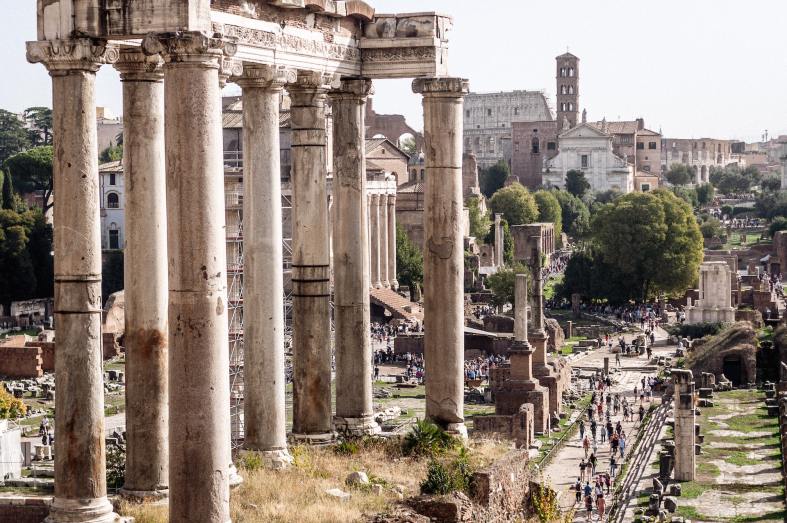
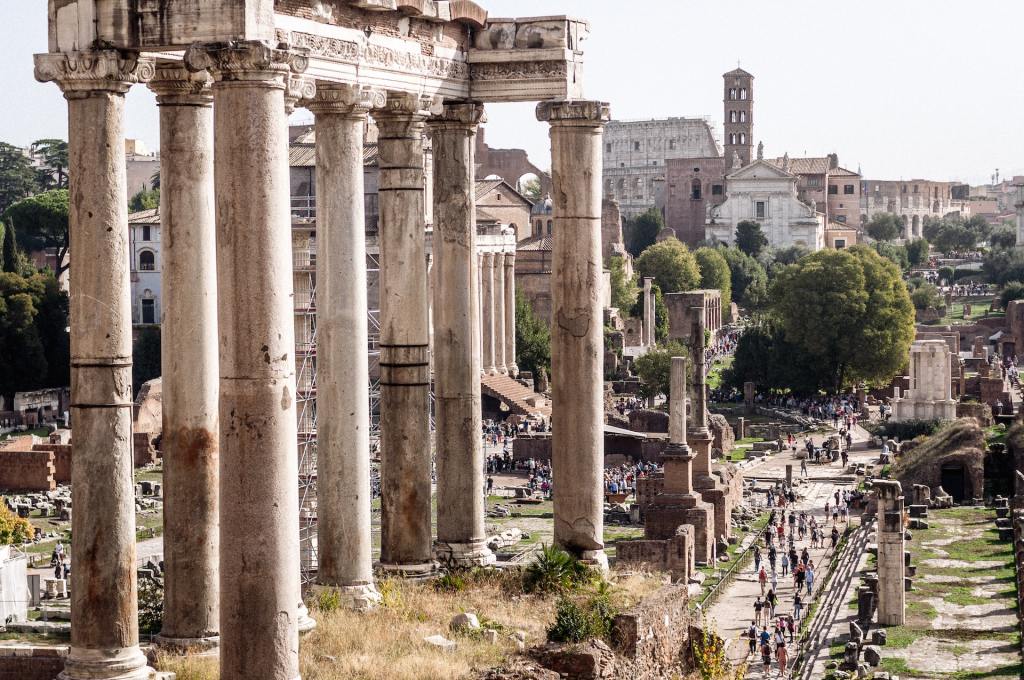
Much of Rome is already in ruins. Photo by Giu Vicente on Unsplash

Isaiah 40:17 proclaims that “All the nations are as nothing before him, they are accounted by him as less than nothing and emptiness.”  The word “emptiness” here is the Hebrew “bohu,” part of the phrase “tohu va’bohu” translated as “without form and void” in Genesis 1:2.  This phrase represents empty things with no eternal value or purpose.  So, while Isaiah doesn’t use the whole phrase from Genesis, he uses “less than” for emphasis instead.  When compared to God’s eternal purposes, all that every nation has ever devised and achieved is less than useless.  God has nothing to learn from our political and economic visions – He transcends them all.  No nation can or will accomplish what God has accomplished and will accomplish.

Therefore, Jesus’ other mission was to overthrow Herod’s dominion over Herod.  But Herod was determined to resist.  His heart was so hard that he preferred to hang on to a government willing to commit mass murder to preserve its own self-centered ways.  He thought he could preserve the façade of “Pax Romana,” the idea that worldly government can solve all of our problems, even while he, as an agent of Rome, was killing innocent children.  Herod saw it as in his own best interest, and in the interest of Rome, but this is one of many examples of “a way that seems right to a man, but its end is the way to death.”[4]

Jesus can overcome death only by overthrowing our views of our own “best interest” and what “seems right.”  He was not born and did not die and rise again just to overthrow Rome, but He came so we would have a way to overthrow ourselves and death itself.  Jesus will establish the only government that will matter in eternity: His Kingdom.  The soul of Herod, and of all of us, will outlive every society that ever existed, and ever will, on this earth.  The nations are all “accounted by him as less than nothing and emptiness.”  While Herod could find hope in Jesus if he wanted to, Rome itself never had any hope.

Therefore, the question Jesus asks all people is: Will we let Jesus overthrow us or will we, like Herod, go to great lengths to resist Jesus and try to preserve a world that is doomed to fail?

Isaiah 9:6 says “and the government shall be upon his shoulder.”  His Kingdom will be the only government we need, and He alone is uniquely qualified to establish and rule it.

For to us a child is born,
            to us a son is given;
and the government shall be upon his shoulder,
            and his name shall be called
Wonderful Counselor, Mighty God,
            Everlasting Father, Prince of Peace.”


[1] Matthew 2:2
[2] Matthew 2:8
[3] Matthew 2:16
[4] Proverbs 14:12, 16:25

The Destiny of the Wealth of Nations

Here in the United States, the year 1776 is celebrated as the political beginning of the nation, because the Declaration of Independence was approved on July 4 of that year.  Also in 1776, The Wealth of Nations by economist and philosopher Adam Smith was published and is foundational to our nation’s economy.  Its full title of An Inquiry into the Nature and Causes of the Wealth of Nations shows its purpose was to explore what makes some nations more well-off than others, with Smith concluding that capitalism, especially the elements of free trade and competition, was the best system.  I won’t argue here for capitalism or about where wealth comes from, but about where wealth is destined to end up.

Interestingly, the phrase “wealth of the nations” appears in the Bible 3 times, all in Isaiah 60 and 61, and the phrase “wealth of all the surrounding nations” appears once, in Zechariah 14.[1]  All of these references describe the future reign of the Messiah when all nations and peoples will acknowledge Him as Lord and dedicate their wealth in tribute to Him.

Isaiah 60:4-5 is the first mention of the phrase, and it says:

Lift up your eyes all around, and see;
            they all gather together, they come to you;
your sons shall come from afar,
            and your daughters shall be carried on the hip.
Then you shall see and be radiant;
            your heart shall thrill and exult,
because the abundance of the sea shall be turned to you,
            the wealth of the nations shall come to you.”

The next few verses read like an inventory of goods (camels, gold, flocks, ships, lumber) and places (Midian, Sheba, Kedar, Tarshish, Lebanon), showing that no thing and no place is excluded from the tribute to God.  Wealth from every source belongs to Him.

In the same chapter, verse 11 declares about the eternal city of God:

Your gates shall be open continually;
            day and night they shall not be shut,
that people may bring to you the wealth of the nations,
            with their kings led in procession.”

When we inquire into future of wealth, rather than its past and its sources, we find that the wealth of the nations is all His.  We own nothing.  We are only stewards and caretakers, regardless of what economic system we live in or believe in.

The earth is the LORD’S and the fullness thereof,
                        the world and those who dwell therein” – Psalm 24:1

Soli Deo Gloria


[1] It may be where Smith got his title idea, or it may just be coincidence.

God Has a Plan for Your Life

In a commonly quoted Bible verse, the prophet Jeremiah says in Jeremiah 29:11 – “For I know the plans I have for you, declares the LORD, plans for welfare and not for evil, to give you a future and a hope.”  But who was Jeremiah talking to and what were God’s plans at that time?  God was about to exile Israel from the Promised Land and take away all of their cherished (and God-given) political and religious institutions.  Jerusalem and the temple would be torn down and burned by the Babylonians, while God would tell the Jews to love their brutal enemy, and to be a blessing to them[1], contributing to the prosperity of the Babylonian kingdom.  After 70 years of exile, Jerusalem and the temple would be rebuilt, but disappointing: “many of the priests and Levites and heads of fathers’ houses, old men who had seen the first house, wept with a loud voice when they saw the foundation of this house being laid”.[2]

This is not the plan I would wish on any of us, but it was God’s will at the time, to discipline His people.  Clearly, God has different plans for each one of us – specific to us and not a photocopy of specific Biblical people or situations.

The prophet Isaiah provides an excellent picture of how God has plans for each of us individually.  Right after declaring that God would lay a new cornerstone, a new foundation, in Zion[3] (later revealed to be Jesus), he declares in Isaiah 28:23-26:

Give ear, and hear my voice;
         give attention, and hear my speech.
Does he who plows for sowing plow continually?
         Does he continually open and harrow his ground?
When he has leveled its surface,
         does he not scatter dill, sow cumin,
and put in wheat in rows
         and barley in its proper place,
         and emmer as the border?
For he is rightly instructed;
         his God teaches him.

Isaiah describes how a farmer works diligently with God-given wisdom to plant his crops.  The farmer does things step by step, plowing, then sowing each plant according to its kind.  Some crops grow best in rows, and some are suitable as borders.  Everything is in its time and place.  Isaiah then continues with verses 27-29:

“Dill is not threshed with a threshing sledge,
         nor is a cart wheel rolled over cumin,
but dill is beaten out with a stick,
         and cumin with a rod.
Does one crush grain for bread?
         No, he does not thresh it forever;
when he drives his cart wheel over it
         with his horses, he does not crush it.
This also comes from the LORD of hosts;
         he is wonderful in counsel
         and excellent in wisdom.

Here, some crops need to be threshed or even crushed, but other crops do not.  All of the farmer’s work is done with God’s wisdom.  Yet is Isaiah only concerned with crops?  No, because the context in Isaiah is a story of Judah’s discipline, followed by a restoration. Just as a farmer’s wisdom in dealing with crops is from God, in the same way God knows how to deal with His people skillfully, to each as needed.

The Reformation Study Bible notes on verse 29: “Yet the Lord is wiser than any good farmer…and knows exactly the methods to use to cultivate His harvest—when to judge and when to restore His people.”  As different grains need to be planted and treated differently, so God treats each person according to His own intentions for them and to their own needs.  After laying the cornerstone of Jesus Christ, God, like a farmer, knows how to deal with each of His people individually, giving each exactly what they need when they need it, building His family diligently, step by step, and with infinite wisdom.

Therefore, when Jeremiah says: “For I know the plans I have for you, declares the LORD, plans for welfare and not for evil, to give you a future and a hope,” he declares the general principle that for each of us, God has a plan, a future, and a hope.  The Lord delivers us from evil and provides for our welfare in eternity for all time, after our sojourn in this world is complete.

For every meal, thank a farmer, but for every opportunity to grow in Christ, in good times and in bad, thank the Lord for His wisdom in dealing with you as an individual.  Only He, as Creator, knows best how we are broken and how we are intended to be.

And I am sure of this, that he who began a good work in you will bring it to completion at the day of Jesus Christ.” – Philippians 1:6


[1] Jeremiah 29:7
[2] Ezra 3:12
[3] Isaiah 28:16

Home is Where God Is

Only one of the 150 Psalms is written by Moses (Psalm 90), and it begins with this verse:

Lord, you have been our dwelling place in all generations.

Moses lived a long life in many places, starting in Egypt, fleeing to Midian, returning to Egypt, then leading the exodus from Egypt, and spending 40 years wandering the wilderness on the Sinai Peninsula.  However, Moses died without entering the Promised Land of Canaan.

Moses had many earthly dwelling places yet was never home.  He tells us in Psalm 90:1, “Lord, you have been our dwelling place in all generations.”  Why?  Moses knows that the only true dwelling place of God’s people is with the Lord Himself. 

As long as we are on this earth, we are “sojourners and exiles[1] Only in the next world are we, and His people “in all generations,” from Adam to Moses to now and into the future, finally home with Him.


[1] 1 Peter 2:11

A Better Country

In Hebrews chapter 11 there is a list of Biblical figures who “by faith” were obedient to God, but it also says that, in this life, their faith was not fully rewarded.  Everyone mentioned in the chapter “died in faith, cnot having received the things promised[1]  But these faithful examples knew that God wouldn’t fail them.  In this world, they would be unfulfilled, “but as it is, they desire a better country, that is, a heavenly one.[2]

Their obedience was motivated not by current, earthly reward, but by future rewards in a new heaven and new earth.  Although Peter tells us “Beloved, do not be surprised at the fiery trial when it comes upon you to test you, as though something strange were happening to you,[3] Paul wrote “For I consider that the sufferings of this present time are not worth comparing with the glory that is to be revealed to us.”[4]  In this world, we will have trials and experience persecution, which means that much of what a Christian has to be thankful for is in the future.

However, our faithful actions can be motivated by a future hope, just as those listed in Hebrews 11 were.  Because of the unchanging character of God, and His faithfulness, we can be so sure of our heavenly future that we can be thankful for it now.  God promises “a better country” and He is trustworthy.

Do we desire this “better country”?  While we wander in this world, do we believe that “a better country” is possible?  Do we believe God when He says He has promised us our place in it?  Jesus said “In my Father’s house are many rooms. If it were not so, would I have told you that I go to prepare a place for you?[5]

If we trust God for our future in eternity, we have much more to live for and to be thankful for than we have right now!  When you count your blessings, don’t forget the ones in the future that you can count on.

Desire a better country.”


[1] Hebrews 11:13a
[2] Hebrews 11:16a
[3] 1 Peter 4:12
[4] Romans 8:18
[5] John 14:2