Godly Habits for Leaders and Others

All the people benefit from leaders and rulers who fear God.  In Deuteronomy, when God reluctantly says Israel may set a king over them in the future[1], He also required the king to have specific habits to cultivate a fear of God in them:

And when he sits on the throne of his kingdom, he shall write for himself in a book a copy of this law, approved by the Levitical priests.  And it shall be with him, and he shall read in it all the days of his life, that he may learn to fear the LORD his God by keeping all the words of this law and these statutes, and doing them, that his heart may not be lifted up above his brothers, and that he may not turn aside from the commandment, either to the right hand or to the left, so that he may continue long in his kingdom, he and his children, in Israel.”  (Deuteronomy 17:18-20, emphasis mine)

These requirements have several parts.  First, the king was to “write for himself in a book a copy of this law.”  “This law” refers to what we now think of as the first five books of the Bible – all 187 chapters of it.  Imagine the time that would take, but this tedious exercise was designed to help the king internalize the message.  Quickly skimming over the Bible would not do.

Second, the king had to get this copy “approved by the Levitical priests,” to make sure nothing was added or left out, but also to remind the king that His authority is subject to God’s authority, as intermediated by the priests at that time.  Regardless of what laws the king might pass, God’s laws would always reign supreme and eternal.

Third, the king was to “read in it all the days of his life,” because it takes time and effort to dig the treasures of wisdom out of the Bible.  However, it is worth the effort because Psalm 19:10 tells us these truths are:

More to be desired are they than gold,
                        even much fine gold;
sweeter also than honey
                        and drippings of the honeycomb.

Also, the king would be surrounded by reminders of his worldly greatness every day, so constant meditation on the law would show him his reliance on God.  The king needs a constant reminder that he is under God, whose law applies to everyone.

These habits exist “that he may learn to fear the LORD,” which leads to “doing” the law.  Even the king is expected to do what God commands, not just tell others to.  With “doing” as the objective, the king will remain humble and learn the fear of God, because we may be able to know God’s word, but doing it is the real challenge and we can only succeed by His grace.
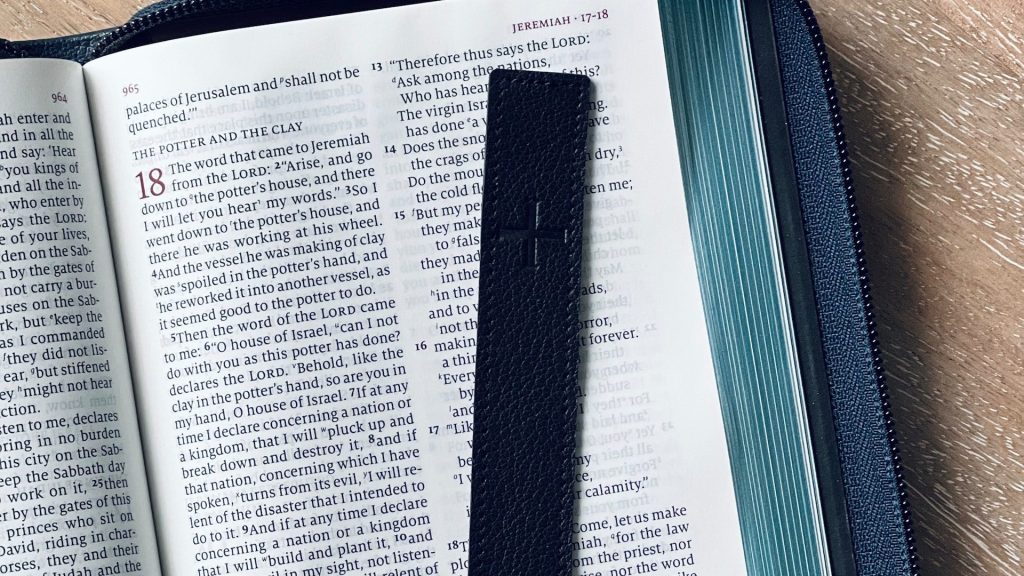
These habits also exist to make sure the king does not err “either to the right hand or to the left.”  This encouragement is later echoed in Moses’ words in Joshua 1:7-8, but what does it mean?  I think it means that without constant saturation in God’s word, we can fall into a trap of not following God’s positive will, but instead defining ourselves by what we’re against.  In trying to avoid one sin, we drift too far in the opposite direction and into another, equally destructive, sin.  Instead, positive obedience coming from the fear of God should be better than fine gold and “sweeter also than honey.”  Truth is often subtle and not as black-and-white as we’d like it to be.

Most of us aren’t kings, but we can apply the passage from Deuteronomy in our prayers.  1 Timothy 2:1-2 “First of all, then, I urge that supplications, prayers, intercessions, and thanksgivings be made for all people, for kings and all who are in high positions, that we may lead a peaceful and quiet life, godly and dignified in every way.”  But what shall we pray for them?  As Deuteronomy suggests, we should pray that they know God, fear God, and obey God, that they may be humble, and we may prosper.

Also, are you a leader?  Do you serve in a position of authority at your church, workplace, or other organization?  These habits will benefit you and those you serve anywhere.  (In societies where we can easily get a Bible, we don’t need to create our own copies of it, but we should seek to internalize as much of the Bible as possible, through memorization and other means.)  As Solomon wrote in Psalm 127:1 –

Unless the LORD builds the house,
            those who build it labor in vain.
Unless the LORD watches over the city,
            the watchman stays awake in vain.

If you’re not a leader, these habits are beneficial for you as well, as Psalm 128:1 says:

Blessed is everyone who fears the LORD,
                        who walks in his ways!

Amen.


[1] Deuteronomy 17:14-15

When Rights Collide

For a time, Moses was the sole judge over Israel, deciding right and wrong in countless cases brought by the people.  This was a massive burden and brought him to exhaustion, until his father-in-law Jethro urged Moses to delegate some of the responsibility.  Jethro tells Moses to find some able, trustworthy men, and in Exodus 18:22, he says “And let them judge the people at all times. Every great matter they shall bring to you, but any small matter they shall decide themselves. So it will be easier for you, and they will bear the burden with you.”  Moses was to act essentially as a court of appeal for hard cases.  What kind of “great matter” might Moses get?

Deuteronomy 17:8 might be one example: “if any case arises requiring decision between one kind of homicide and another, one kind of legal right and another, or one kind of assault and another, any case within your towns that is too difficult for you, then you shall arise and go up to the place that the LORD your God will choose.”

What the Bible recognizes here is that the right solution isn’t always obvious.  The Bible recognizes that things can get messy.  Life isn’t always as black-and-white, right-versus-wrong as we might think.  There are complex situations where rights conflict with rights, rather than a simple right versus wrong.  Each side of the case – the plaintiff and the defendant – might be at fault.

For example, suppose one person assaulted another without provocation, but in return the other retaliated in an unjustified way.  Should both complaints cancel each other out, and no judgement declared either way?  Or should the judge enforce the penalty for both crimes independent of each other?  If one penalty is greater than the other, should a judge subtract one penalty from the other and enforce the difference on the person with the greater crime?  Would that be justice for either person?

Sometimes there aren’t easy answers, even based on God’s perfect, revealed law.  All of us are sinful and justice requires we be punished for the times we have violated some kind of legal right, committed come kind of assault, or harmed someone in another way.  What solution can untangle all of these competing claims for justice?

The only viable answer is forgiveness, but forgiveness doesn’t come free, or cheap.  For our violations against God, the cost of forgiveness was Jesus’ suffering and dying on the cross.  For our sins against each other, God demands that we forgive others as we have been forgiven by Him.  We are to bear the cross of not only our sins, but the sins of others.  Forgiveness is hard because it sometimes means not demanding that our rights be respected.  Sometimes it means our sense of justice might be violated.  Yet forgiveness is what our Lord demands.

As Jesus said in Matthew 6:14-15, “For if you forgive others their trespasses, your heavenly Father will also forgive you, but if you do not forgive others their trespasses, neither will your Father forgive your trespasses.

Moses may have been able to be the court of appeal for Israel, to bear the burden of every “great matter” of the time, but only Jesus could bear the burden of every matter for all time.  He asks us to follow His example, even when we think we have the right to do otherwise.

Bible in a Year: Week of July 1-7

Fellow travelers:

Below are the chapters to read this week if you’re following along in my Bible in a year schedule, divided into morning and evening readings.  Follow along any way you want: you can just do the evening reading, flip the morning and evening, or read it all.  Whatever works for you and your schedule!  It doesn’t have to be Bible in a Year for everyone.

This week we finish Mark and Deuteronomy and move on to Luke and Joshua.

Monday, July 1
Morning: Ecclesiastes 3, Mark 16
Evening: Deuteronomy 30

Tuesday, July 2
Morning: Ecclesiastes 4, Luke 1
Evening: Deuteronomy 31

Wednesday, July 3
Morning: Ecclesiastes 5, Luke 1
Evening: Deuteronomy 32

Thursday, July 4
Morning: Ecclesiastes 5, Luke 3
Evening: Deuteronomy 33

Friday, July 5
Morning: Ecclesiastes 6, Luke 4
Evening: Deuteronomy 34

Saturday, July 6
Morning: Ecclesiastes 7, Luke 5-6
Evening: Joshua 1

Sunday, July 7
Morning: Ecclesiastes 8, Luke 7-8
Evening: Joshua 2

Bible in a Year: Week of June 24 – 30

Fellow travelers:

Below are the chapters to read this week if you’re following along in my Bible in a year schedule, divided into morning and evening readings.  Follow along any way you want: you can just do the evening reading, flip the morning and evening, or read it all.  Whatever works for you and your schedule!  It doesn’t have to be Bible in a Year for everyone.

After this week, Bible in a year is halfway done!  This week we finish Proverbs and start Ecclesiastes, continuing with the wisdom books.  We’re also nearly finished the Pentateuch.

Monday, June 24
Morning: Proverbs 27, Mark 7
Evening: Deuteronomy 23

Tuesday, June 25
Morning: Proverbs 28, Mark 8
Evening: Deuteronomy 24

Wednesday, June 26
Morning: Proverbs 29, Mark 9
Evening: Deuteronomy 25

Thursday, June 27
Morning: Proverbs 30, Mark 10
Evening: Deuteronomy 26

Friday, June 28
Morning: Proverbs 31, Mark 11
Evening: Deuteronomy 27

Saturday, June 29
Morning: Ecclesiastes 1, Mark 12-13
Evening: Deuteronomy 28

Sunday, June 30
Morning: Ecclesiastes 2, Mark 14-15
Evening: Deuteronomy 29

Bible in a Year: Week of June 17 – 23

Fellow travelers:

Below are the chapters to read this week if you’re following along in my Bible in a year schedule, divided into morning and evening readings.  Follow along any way you want: you can just do the evening reading, flip the morning and evening, or read it all.  Whatever works for you and your schedule!  It doesn’t have to be Bible in a Year for everyone.

This week we move from the first gospel, Matthew, to the second, Mark.  The plan is to read all four in a row.

Monday, June 17
Morning: Proverbs 20, Matthew 26
Evening: Deuteronomy 16

Tuesday, June 18
Morning: Proverbs 21, Matthew 27
Evening: Deuteronomy 17

Wednesday, June 19
Morning: Proverbs 22, Matthew 28
Evening: Deuteronomy 18

Thursday, June 20
Morning: Proverbs 23, Mark 1
Evening: Deuteronomy 19

Friday, June 21
Morning: Proverbs 24, Mark 2
Evening: Deuteronomy 20

Saturday, June 22
Morning: Proverbs 25, Mark 3-4
Evening: Deuteronomy 21

Sunday, June 23
Morning: Proverbs 26, Mark 5-6
Evening: Deuteronomy 22