Born in 1510, John Bradford was a rising Protestant minister during the reign of King Edward VI in England and was well known for his pious dedication and unselfish nature. After studying at Cambridge and preaching regularly around London, he was appointed as Chaplain to the King in 1551. The common expression “There but for the grace of God go I” is often attributed to him and was a reminder to himself that grace alone has saved him. An 1822 book on prayer says that:
“The pious Martyr Bradford, when he saw a poor criminal led to execution, exclaimed, ‘there, but for the grace of God, goes John Bradford’. He knew that the same evil principles were in his own heart which had brought the criminal to that shameful end.”[1]
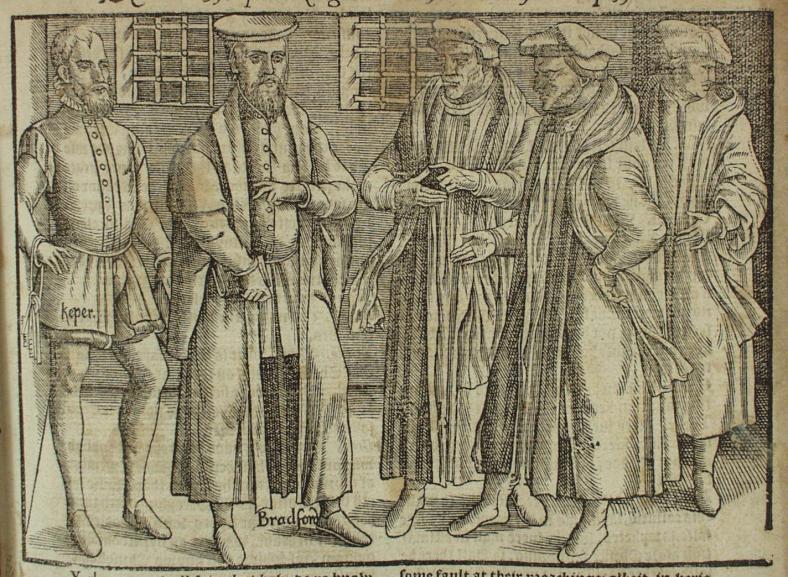
Bradford and others in the Tower of London, from John Foxe’s Book of Martyrs (1563). Public Domain.
His worldly fortunes changed in 1553 when the Catholic Mary I became Queen, and one of her first priorities was persecution of prominent Protestants. Bradford was arrested within a month, imprisoned in the Tower of London, and sentenced to death. While in the Tower, he wrote a letter to his mother on this date, February 24, in 1554, that included a powerful statement about prayer: God “doth put off our prayers, that he might recompense it with abundance, that is, that he might more plentifully pour upon us the effect of our petitions.” [2] On July 1, Bradford was burned alive at the stake.
In another book on prayer, Donald McKim wrote about Bradford’s letter: “We can imagine that no one would seek an answer to his prayers more ardently than Bradford while awaiting death. Yet he believed that even with no apparent answers to prayers, God plentifully pours abundance on those who pray! At the end of his letter Bradford mentions God’s promise-which believers receive and anticipate, even in the midst of their sufferings and afflictions. Paul recorded the promise: “What no eye has seen, nor ear heard, nor the human heart conceived, what God has prepared for those who love him” (1 Cor. 2:9) Plentiful abundance! Now and forever!”[3]
In John Bradford’s story, there is a terrible irony between two things he is known for – a common phrase and his martyrdom – but in the end, God is faithful, and I hope to meet Bradford someday in Paradise, where the grace of God has bought me a place.
In June – July of 2022, we took a 12-day family trip to the UK and it’s a trip I appreciate more and more as time passes. Our days were packed with activities, and I can’t write about them all, but here are some the best memories, in the order we did them. I’m writing this post in response to a prompt on WordPress: “Describe your most memorable vacation.”
After landing at Heathrow on the morning of June 27th, we drove our rental car to Oxford and did a tour of Christ Church college. Having only a few hours, we chose this one college since some of the Hogwarts campus in the Harry Potter movies was based on it. There’s a distinctive stairwell there that appeared in some of the films, and the Great Hall here inspired the dining hall in Hogwarts (the one with all the floating candles). What I didn’t realize until visiting Christ College was that Lewis Carroll (Charles Lutwidge Dodgson) was a student here and much of his “Alice in Wonderland” world and characters were based on his experience here. Some of the stained glass in the Great Hall features his characters.[1]
On our second day, the family split up and my son and I, who love going to amusement parks together, went to Alton Towers, the premier park in the UK. We love roller coasters, and my son was really grateful that we prioritized this, even choosing the house we rented based on how close it was to the park. The highlight of the day was riding The Smiler, the coaster with the most inversions (14) in the world, 3 times. Our son wore a T shirt that day listing some coaster manufacturers, and The Smiler checked off the last one listed on the shirt, Gerstlauer.
A view from our day on Mount Snowdon.
Day 3 was our only day spent outside of England. We did a road trip to Wales, and this ended up being my daughter’s favorite day of the trip. On a friend’s recommendation, we took a train up Mount Snowdon, the tallest mountain in Wales, but unfortunately due to construction we were only able to go ¾ of the way up the mountain. The train stopped there, and we spent ½ hour walking around before heading back down. The views were amazing! I’ve written another blog post about how beautiful and green this mountain was, which you can read here.
On the fifth day, on our way from our rental house in the country to our rental in a London suburb, we spent the afternoon in Bath, England, one of my favorite cities. My wife and I visited there once before, and we were glad to come back and share it with the kids. We toured the old Roman baths, which I wrote about in this blog post, and also had afternoon tea in the “Pump Room.” It’s called that because they pump up water from the hot springs below and you can have a taste. In Victorian times, they thought this water had medicinal properties, but now it just tastes like bad mineral water. The tea was rather formal, and our kids tried some new foods, some good, some bad.
On day 8 we finally made it to London (on July 4th!) and the first big memory was our visit to the National Gallery, an art museum. It’s an amazing museum that has one of my favorite works, The Supper at Emmaus by Caravaggio. But this wasn’t the most memorable part. You may have seen news of protests targeting works of art across Europe, where the protestors glue themselves to art frames or otherwise vandalize it. Turns out that while we were in the National Gallery, some of these protestors posted a dark, dystopian version of The Hay Wain by John Constable over the original. Because of this, they closed off the part of the gallery we were heading to. Remarkably, on our flight home we were playing a trivia game on the plane and The Hay Wain was the answer to one of the questions!
Day 9 may have been the best day of the trip, which started with a Beefeater-guided tour[2] of the Tower of London, and ended with seeing Les Misérables at the Sondheim Theater. Seeing a show on the West End was a bucket list item for my wife, and my son worked in theater production in high school, so it was a big deal for both of them, but we all really enjoyed the show. If I ever see a better show, I’ll be shocked. It was amazing and will be hard to top.
Those are the highlights for me, and of course we did many other things like visiting many “castles and churches,” as my kids say. We did some touristy things like going to Harrod’s, seeing the changing of the guard at Buckingham Palace[3], riding the London Eye, and visiting the British Museum. It was a packed vacation and my most memorable ever.
Have you been to the UK (or live there)? What are some of your best memories?
[1] Later in the trip, we saw his burial place in Westminster Abbey. [2] Our guide, Emma Rousell, was great and was just the third woman ever to be appointed as a Yeoman Warder (“Beefeater”) at the Tower. [3] Among other things, the bands played songs by Bon Jovi and Queen. The crowd sang along.
Born in 1510, John Bradford was a rising Protestant minister during the reign of King Edward VI in England and was well known for his pious dedication and unselfish nature. After studying at Cambridge and preaching regularly around London, he was appointed as Chaplain to the King in 1551. The common expression “There but for the grace of God go I” is often attributed to him and was a reminder to himself that grace alone has saved him. An 1822 book on prayer says that:
“The pious Martyr Bradford, when he saw a poor criminal led to execution, exclaimed, ‘there, but for the grace of God, goes John Bradford’. He knew that the same evil principles were in his own heart which had brought the criminal to that shameful end.”[1]
Bradford and others in the Tower of London, from John Foxe’s Book of Martyrs (1563). Public Domain.
His worldly fortunes changed in 1553 when the Catholic Mary I became Queen, and one of her first priorities was persecution of prominent Protestants. Bradford was arrested within a month, imprisoned in the Tower of London, and sentenced to death. While in the Tower, he wrote a letter to his mother on this date, February 24, in 1554, that included a powerful statement about prayer: God “doth put off our prayers, that he might recompense it with abundance, that is, that he might more plentifully pour upon us the effect of our petitions.” [2] On July 1, Bradford was burned alive at the stake.
In another book on prayer, Donald McKim wrote about Bradford’s letter: “We can imagine that no one would seek an answer to his prayers more ardently than Bradford while awaiting death. Yet he believed that even with no apparent answers to prayers, God plentifully pours abundance on those who pray! At the end of his letter Bradford mentions God’s promise-which believers receive and anticipate, even in the midst of their sufferings and afflictions. Paul recorded the promise: “What no eye has seen, nor ear heard, nor the human heart conceived, what God has prepared for those who love him” (1 Cor. 2:9) Plentiful abundance! Now and forever!”[3]
In John Bradford’s story, there is a terrible irony between two things he is known for – a common phrase and his martyrdom – but in the end, God is faithful, and I hope to meet Bradford someday in Paradise, where the grace of God has bought me a place.


 Driving Toward the Morning Sun