God, Our Eternal River

When comparing Genesis and Revelation, we find similarities between the Paradise man lost and the Paradise to come.  Consider these verses about each:

Genesis 2:8-9: “And the LORD God planted a garden in Eden, in the east, and there he put the man whom he had formed.  And out of the ground the LORD God made to spring up every tree that is pleasant to the sight and good for food. The tree of life was in the midst of the garden, and the tree of the knowledge of good and evil.  A river flowed out of Eden to water the garden, and there it divided and became four rivers.
Revelation 22:1-2: “Then the angel showed me the river of the water of life, bright as crystal, flowing from the throne of God and of the Lamb through the middle of the street of the city; also, on either side of the river, the tree of life with its twelve kinds of fruit, yielding its fruit each month. The leaves of the tree were for the healing of the nations.

A stream in Llanberis, Wales.

In each description is the tree of life, and also a river. Rivers are greatly beneficial to the growth of cities and civilizations, providing benefits for agriculture, trade, travel, etc.  Even today, most large cities that don’t border a large body of water have a navigable river nearby or flowing through it.  A big city without one is rare: in the United States, Dallas, Texas, and Charlotte, North Carolina, may be the only major cities not located near a significant river.

Rivers are mentioned a lot in the Bible, including in this Psalm about God being our refuge and fortress.  An unnamed river in the “city of God” is mentioned:

There is a river whose streams make glad the city of God,
            the holy habitation of the Most High.” (Psalm 46:4)

However, Jerusalem, the place Jews in the Old Testament period would have considered the “city of God” does not have a river.  The Psalmist certainly knew this, so their point is about something else, that the “city of God” has, well, it has God, as described in the next verses:

“God is in the midst of her; she shall not be moved;
            God will help her when morning dawns.
The nations rage, the kingdoms totter;
            he utters his voice, the earth melts.
The LORD of hosts is with us;
            the God of Jacob is our fortress.  Selah” (Psalm 46:5-7)

Jerusalem may not have a river, but it has God who provides all it needs and more.  No river required.  Even though the literal, ancient Jerusalem was eventually destroyed by the Babylonians, and later by the Romans, the eternal City of God will never be moved.  All other nations “rage” and “totter,” but God’s kingdom is forever secured by the One whose voice melts the earth.  Hebrews 1:10-12 (quoting from Psalm 102:25-27):

You, Lord, laid the foundation of the earth in the beginning,
            and the heavens are the work of your hands;
they will perish, but you remain;
            they will all wear out like a garment,
like a robe you will roll them up,
            like a garment they will be changed.
But you are the same,
            and your years will have no end.”

Do you worry that you lack things others have?  Things that would provide benefits for your business, spare time, or other pursuits?  With God as our fortress and refuge, we don’t need a river, but in Paradise He will provide one anyway.

Fret not, for you have God, our eternal river.

Grandpa Solomon’s Retirement Advice

Have you ever asked yourself what Solomon, son of David, king of Israel, and author of much Biblical wisdom, would have to say about modern retirement?  Probably not, but I’m going to write about it anyway, because Solomon actually had some relevant advice.

Since this blog is not a source of income, I have a day job which happens to involve helping companies help their employees save and invest for retirement.  In American culture, retirement has in some ways replaced heaven as the future we hope for.  Advertisements promise retirees can do all the things they dreamed of doing during their working years.  Travel.  Relax.  Read those books you’ve been putting off reading.  If you can, buy a yacht.  After all, if you’ve worked so hard for it, you deserve it, they say.  Like many marketing schemes, something good and prudent (saving for retirement) is wrapped in a lot of gloss to get you to do something you might not do otherwise.  Sacrifices made now are worthwhile because of a later reward.

A photo I took from a Florida beach over the Atlantic near sunrise. I’d like to retire here, but heaven is better.

Thinking about this, I made the connection that Solomon[1] when writing Ecclesiastes was acting in the role of a wise, Godly grandfather in a way that offers a sharp contrast to the story of retirement that goes unchallenged in our culture.

In Ecclesiastes, Solomon lays out an argument that he lived almost the exact life pictured in our retirement ads but learned to regret it.  While still a very young man, he had the power and wealth to try anything he wanted.  He planted vineyards and drank a lot of wine.  He built gardens and pools and acquired many servants and property.  He also had 700 wives and 300 concubines.[2]  He could have everything he desired – everything the retirement ads would show you if they could be R-rated – but he ended up disappointed.  Ecclesiastes is his advice to those who come after to not repeat his mistakes.

While a blog post can’t cover all of Ecclesiastes, I must add that Solomon did encourage us to invest for the future, but also not to place all our bets on one specific vision of the future: “Cast your bread upon the waters, for you will find it after many days.  Give a portion to seven, or even to eight, for you know not what disaster may happen on earth.”  (Ecclesiastes 11:1-2).  A long, healthy and prosperous retirement is one possible future among many, but eternity with God is a future certainty.  Earlier in the book, Solomon writes: “He has made everything beautiful in its time. Also, he has put eternity into man’s heart, yet so that he cannot find out what God has done from the beginning to the end.” (Ecclesiastes 3:11)  God gives us a sense of what He has planned for us, but not many of the details.  We should not foolishly ignore the future, but we should not cling to one future we desire at the cost of the present God has given us and the future He already knows everything about.

Solomon encourages everyone – young and old – to live more in their own moment, enjoying the gifts God has given them and sharing those gifts with the people around them.  While Solomon is encouraging the young to not repeat his own mistakes, he is also encouraging the old to share their perspective.  In both cases, Solomon is telling us not to stress too much about what may or may not happen, but to invest what we have in light of what will be meaningful in eternity.  Joy comes from enjoying the relationships and things God has blessed us with now, not from sacrificing the now in light of a false vision of retirement.

Solomon recommends joy in God’s provision, and so I close with this quote, and pray that we all experience joy and thankfulness in the gifts God has given us today.  Don’t keep them to yourself.

Go, eat your bread with joy, and drink your wine with a merry heart, for God has already approved what you do.  Let your garments be always white. Let not oil be lacking on your head.  Enjoy life with the wife whom you love, all the days of your vain life that he has given you under the sun, because that is your portion in life and in your toil at which you toil under the sun. Whatever your hand finds to do, do it with your might, for there is no work or thought or knowledge or wisdom in Sheol, to which you are going.” – Ecclesiastes 9:7-10


[1] I’m going to proceed for the sake of argument that Solomon is the author of Ecclesiastes, although I know some debate that and it’s not explicitly stated.
[2] 1 Kings 11:3

The Part of Us That Matters

The Apostle Paul wrote an amazing contrast in 2 Corinthians 4:16-18, which says:

So we do not lose heart. Though our outer self is wasting away, our inner self is being renewed day by day. For this light momentary affliction is preparing for us an eternal weight of glory beyond all comparison, as we look not to the things that are seen but to the things that are unseen. For the things that are seen are transient, but the things that are unseen are eternal.

Photo by Aaron Burden on Unsplash

On the one hand, there are things that are transient, described as: outer, wasting away, light, momentary, affliction, and seen.

On the other hand, what is eternal is: inner, being renewed, weighty, glorious, beyond all comparison, and unseen.

These things are part of each of us, but what is eternal matters infinitely more than the other. Don’t confuse the two, or you may lose heart because Paul earlier assured us in verse 14 that “he who raised the Lord Jesus will raise us also with Jesus and bring us with you into his presence.”  At that time, only what is eternal will remain.

Amen.

We Will Not Live in Tents Forever

The apostle Paul was likely one of the finest Old Testament scholars of his day, and sometimes draws on existing imagery to make a point.  One example might be Proverbs 14:11-12, where the second verse is more widely known than the first, but not unrelated:

The house of the wicked will be destroyed,
            but the tent of the upright will flourish.
There is a way that seems right to a man,
            but its end is the way to death.

Physically, it seems obvious that a house is far more durable than a tent, but both of these Proverbs tell us not to judge by appearances.  Looks and reputation may suggest otherwise, but it is righteousness that determines eternal destiny, specifically acceptance of Jesus’ righteousness.

In 2 Corinthians 5:1-3, Paul gives an example of why we should focus not on what “seems right”, but instead focus on the unseen things that matter for eternity, drawing on the tent image:

For we know that if the tent that is our earthly home is destroyed, we have a building from God, a house not made with hands, eternal in the heavens.  For in this tent we groan, longing to put on our heavenly dwelling, if indeed by putting it on we may not be found naked.”

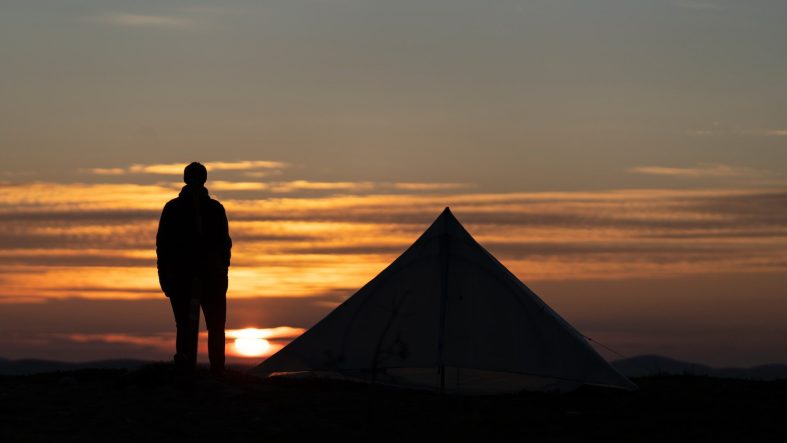
Photo by Hendrik Morkel on Unsplash

Paul, defending his apostleship to the Corinthians amidst his suffering while other false apostles lived in ease, knew that an upright tent was better than a wicked house in God’s eyes, and therefore being less comfortable was entirely worth it, since there was an eternal reward waiting in heaven.

Commenting on 2 Corinthians 5, Warren Wiersbe notes that “Heaven was not simply a destination for Paul: it was a motivation.  Like the heroes of faith in Hebrews 11, he looked for the heavenly city and governed his life by eternal values.”[1]

When frustrated by your earthly limitations, or frustrated by discomfort in this world, know that we will not live in these tents forever.  For His faithful, God is preparing an eternal dwelling for us.  While it “seems right to a man” to think a house is better than a tent, every tent and house in this world is temporary.  Hebrews 1:12 says of all creation, the earth and all the heavens, that:

like a robe you will roll them up,
            like a garment they will be changed.
But you are the same,
            and your years will have no end.

Do we long for our new, eternal heavenly dwelling?  Does this longing motivate us to live for God?  Let us keep Driving Toward Morning today!


[1] Wiersbe, Warren.  Be Encouraged (2 Corinthians) (1994).  P. 69.

The Heavenly Holy of Holies

The temple King Solomon built in Jerusalem was not just as a place of worship and sacrifice, but also an image, or a model, of the cost of sin and of redemption.  The many courts, chambers, and walls were an object lesson in man’s separation from God because of his sin, and the required cost of restoring that relationship.  The most interior part of the temple, and hardest to get to, was the Holy of Holies, a room shaped like a perfect cube: 20 cubits by 20 cubits by 20 cubits.[1]  This cubed space was so sacred, and so holy, that only the high priest could enter it, and only once per year, and only after elaborate sacrifice.

However, by Christ’s sacrifice, we have hope: “We have this as a sure and steadfast anchor of the soul, a hope that enters into the inner place behind the curtain, where Jesus has gone as a forerunner on our behalf.” (Hebrews 6:19-20a).  In Mark’s gospel, we learn that when Christ died on the cross, “the curtain of the temple was torn in two, from top to bottom.”[2]  This curtain was the barrier covering the entrance to the Holy of Holies, and with Jesus’ death, entrance isn’t limited to just the high priest, but open to all who would believe in Him.  He entered “on our behalf” and anchors us to this most holy destination.

The Bible was not finished drawing this picture, though.  In Revelation 21, a new city – a new Jerusalem – is seen by the apostle John in a vision, coming down from heaven, and verse 16 says: “The city lies foursquare, its length the same as its width. And he measured the city with his rod, 12,000 stadia. Its length and width and height are equal.”  This vision was not meant to tell us that in Paradise we will all live inside a big cube.  As pastor Glenn Parkinson wrote: “Certainly all physical beings must exist somewhere, but this is not a vision of where God’s people will live, but how they will live when the former things have passed away.”[3]

Don’t put Earth in a box. Photo by The New York Public Library on Unsplash

Earlier, Revelation 21:1 referred to a whole new heaven and earth, so the new Jerusalem probably represents something about life everywhere in this new creation, and in this image, God would have used things familiar to John, the author of Revelation, otherwise the visions wouldn’t make sense.  The only other architectural cube John would probably recall from Scripture would be the Holy of Holies, but what does that mean?

I believe it means that all of the new heaven and earth will be inhabitable by both God and His people.  All of Paradise will be holier than even the Holy of Holies, but because the church will be fully sanctified, God’s people can enter His presence without the many temple courts and chambers and walls symbolizing man’s separation from God.  Relationship between Creator and created will be fully restored.  Everywhere will be holy, and everyone will be holy.

No, the New Jerusalem isn’t literally a cube, but it symbolizes that in the new world, the temple is not even needed, because all is as it should be between God and man:

And I saw no temple in the city, for its temple is the Lord God the Almighty and the Lamb.” – Revelation 21:22

Praise God Almighty and the Lamb!


[1] 1 Kings 6:20 (a cubit was roughly 18 inches)
[2] Mark 15:38
[3] Parkinson, Glenn.  Tapestry: The Book of Revelation (2015).