From yesterday’s post, you’ll know I am reading King’s X: The Oral History, a book chronicling the history of the rock band King’s X, by Greg Prato. Yesterday, I dove into one of their more bizarre and unknown songs, but today is about the band’s biggest hit. “It’s Love” got to “#6 on Billboard’s Mainstream Rock charts and #1 on the FM Radio Airplay charts. It was our highest-ranking single, ever,”[1] according to Ty Tabor, the band’s guitarist and sometimes lead singer, who wrote the song.
I knew both Christianity and King’s X by reputation before becoming a true fan of either, but both were growing at the same time in me during college. Having heard of King’s X but never actually heard their music, I once saw one of their CDs in a friend’s dorm room. My friend said it was his roommate’s but that he wasn’t much of a fan. Before leaving I picked up the CD and looked at it. The album, called “Faith, Hope, Love” had a cool cover, and included the song “It’s Love.”
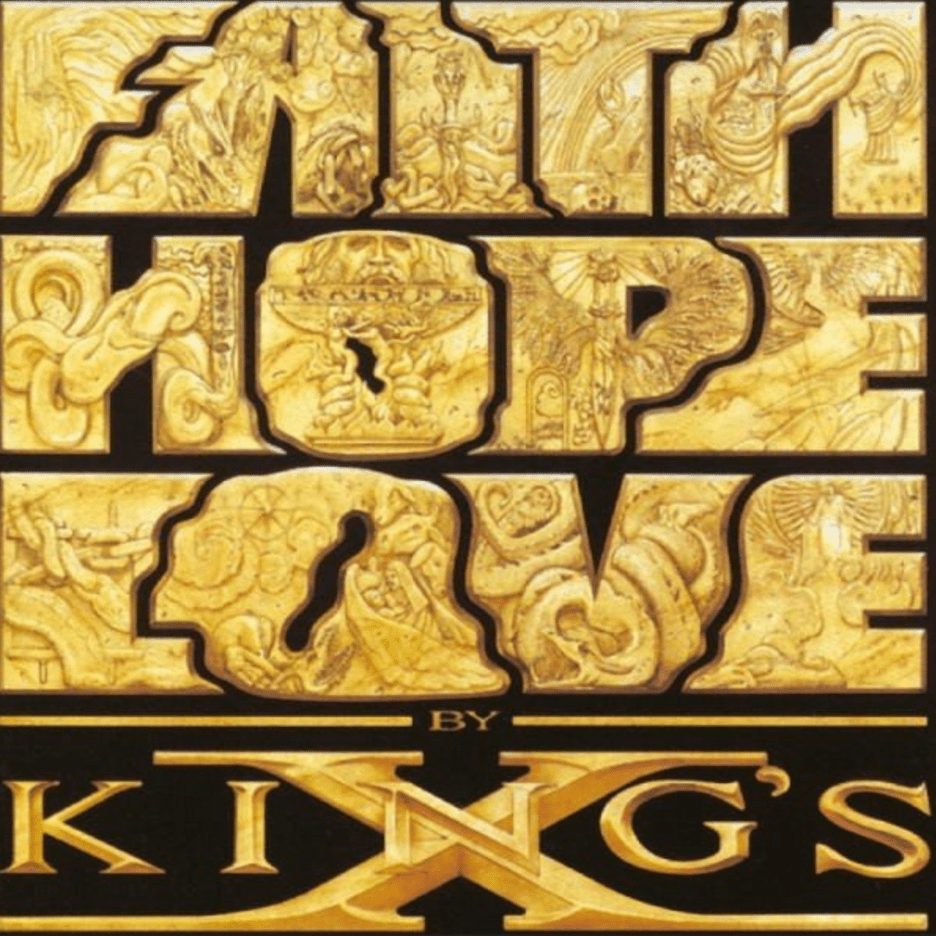
Later, the memory of that album cover made the triad of faith, hope, and love jump out at me whenever I saw it in the Bible, including 1 Corinthians 13:13, which says: “So now faith, hope, and love abide, these three; but the greatest of these is love.” This triad is all over the place and there are many verses explaining the relationships between them. Seeing these references also made me come back to the band and give them a listen. The rest, as they say, is history.
Before getting into “It’s Love”, you can find the lyrics here, or listen to the song here. I promise it’s an easier one to listen to than “Six Broken Soldiers” and also that this post will be shorter than yesterdays.
Overall, the message is fairly simple: Ty says he doesn’t know everything, but the thing he wants to share from his experience is that love is the most important thing in life. Love both keeps the world from falling apart (“holding back the weather”), but also eventually love is what requires a loving God to bring about a plan to fix what’s wrong with the world (“the same will let it go”).
But there’s one line in the song I didn’t really get until reading about it recently: “There’s a ship on the ocean, and I can’t decide if I like it.”
There Ty is, enjoying good company, the beach, and the ocean, but he wasn’t sure about the ship on the ocean. There’s an ambivalence about the ship, and a suggestion that maybe it’s an exception to the overall message of “love,” but I couldn’t figure out more than that. I wasn’t alone in not getting it.
In the book, Ty says his brother didn’t understand the line, so he explained: “my point was, man’s progress is wonderful and everything, but when the ship turns over and poisons all the fish, that’s not so wonderful. So, it was me contemplating all that we do and all that I’m happy with about it, but how much destruction it causes. It’s yet again one of those socially conscious songs. I just had to say it.”[2] It was almost that Ty was struggling with whether love applied when someone does something that “poisons all the fish.” In tricky, real-life situations, does love still rule? Ty doesn’t seem sure.
Contemplating What is Crooked
Yesterday I quoted Romans about Paul’s inner conflict, but later in the same chapter, Paul wrote: “So I find it to be a law that when I want to do right, evil lies close at hand.” (Romans 7:21). This idea that even our best efforts at goodness in this world are tainted is not a new one. Solomon referred to something similar twice in the Old Testament book of Ecclesiastes, in 1:15 – “What is crooked cannot be made straight, and what is lacking cannot be counted.” And also in 7:13 – “Consider the work of God: who can make straight what he has made crooked?”
What Paul and Solomon are getting at is that there are things in this world, including us, that will remain crooked and unfixed until God’s plan is completed in eternity. The Bible tells us that all of creation is cursed by God because of our sin. Some things are wrong because God has made them so. Until a person establishes this in their own heart and mind, they will chase the wind of worldly utopia until they become hopelessly ambivalent, or continue on, highly motivated but frustrated and angry. The phrase “under the sun” comes up 28 times in the book of Ecclesiastes (by my quick count) and refers generally to the actions of mankind done without consideration of God’s wisdom or eternal consequences. Everything done “under the sun” is lacking, and none of it can provide the satisfaction and meaning true wisdom can deliver.
It’s Still Love
Since “under the sun”, even good things come with a cost, what do we do? We can’t be ambivalent to those costs to the point of not caring, but we also can’t be so committed to removing these costs that our efforts become another cost. The world is broken, but also people are broken, and how we treat them matters.
Despite any ambivalence about the ship on the ocean, it’s still “love that holds it all together.” Therefore, the priority is always to focus on obedience and thankfulness to God, who tells us to love, not on utopian alternatives to God that tell us something is more important than loving every one of our fellow humans. The proverbial ship on the ocean and its problems are seen by God and are part of His plan. He cares about our conflicts and paradoxes, but still tells us to have faith, hope, and love.
However, rejection of love means prioritizing our own, temporary, interests and decide who we should love and who we should hate based on that. One side will defend the necessity of the ship – and more ships – at all costs, because it’s good for the economy. They can make money and enjoy what little time on earth they have. The other side will condemn those who poison the fish, or might possibly poison fish in the future, because this earth is all they have, and they want to protect it. “Under the sun” there is no nuance or ambivalence about the ship, but our opinion of the ship determines everything, including whether we can enjoy the beach and the ocean that we do have.
The answer lies not in some abstract move to the center politically, but in knowing that there is more than what exists “under the sun.” Regardless of the conflicts inherent in living with broken people in a broken world, faith in God to save us, hope in His provision of a perfect future, and the priority of love for God and others, is always the right answer. We can be a little ambivalent about the ship on the ocean, but we should have no ambivalence about love, nor about its partners, faith and hope. We should pursue them with everything God has gifted us with and give Him the glory. We can’t fix all the world’s problems, but we can show the world the character of its Creator and show it the way to a better world.
“So now faith, hope, and love abide, these three; but the greatest of these is love.” Always.
[1] Prato, Greg. King’s X: The Oral History (2019). P. 105.
[2] Prato, Greg. King’s X: The Oral History (2019). P. 95.
 Driving Toward the Morning Sun