The Spirit of Craftmanship

After God redeemed His people Israel from slavery in Egypt, He wanted to impart a further lesson to them: that He was always with them.  At first, His presence was signified “by day in a pillar of cloud to lead them along the way, and by night in a pillar of fire to give them light, that they might travel by day and by night.”[1]  Later, including after Israel entered the Promised Land, the Lord’s presence was especially known as dwelling in the tabernacle, and even later in the temple.

The pillars of cloud and fire simply manifested themselves by God’s will, but in the case of the tabernacle and temple, someone had to build them.  After revealing to Moses the intricate design of the tabernacle and all its component parts, Moses may have been concerned about how this was all to get done.  Therefore, God said to Moses in Exodus 31:2-4 how He would provide for that:

See, I have called by name Bezalel the son of Uri, son of Hur, of the tribe of Judah, and I have filled him with the Spirit of God, with ability and intelligence, with knowledge and all craftsmanship, to devise artistic designs, to work in gold, silver, and bronze, in cutting stones for setting, and in carving wood, to work in every craft.”

Since the construction of the tabernacle would require many skills and techniques, including working with wood, metal and cloth, someone with all of these skills would be needed.  But note where the “ability and intelligence,” “knowledge and all craftmanship” come from – the Spirit of God!  They didn’t just appear out of nowhere.  God’s Spirit personally enabled Bezalel to do the needed work.

Also note that God said, “I have called by name Bezalel.”  He didn’t say to Moses “go find someone, anyone, who you think can do the work, and I will enable them to do it.”  No, He called Bezalel “by name.”  This calling was to belong to Him, and no other, by God’s Spirit and grace.

Now Moses might have asked, “how can one man do all this, even with God’s Spirit?”  In verse 6 the answer is provided:

And behold, I have appointed with him Oholiab, the son of Ahisamach, of the tribe of Dan. And I have given to all able men ability, that they may make all that I have commanded you

Oholiab was also called by name, but God also provided many others with the ability to build the tabernacle.  Each person had their part to play, and God knew every one of them personally, even if Exodus doesn’t name them.

Which brings us to the topic of Spiritual gifts, those abilities described by Paul and others in the New Testament as being given to each believer for the building up of the church.  Were all the skills needed to construct the tabernacle “Spiritual gifts” given to Bezalel, Oholiab and others?  I think so, since God clearly says these men were filled with God’s Spirit to do these things.[2]  The lesson here is that every Christian has Spiritual gifts, but that many of those gifts may not seem “spiritual” as we often think of that word.  Not everyone is a pastor, elder, deacon, Sunday school leader, or other church roles you can think of.  In fact, some people will be more like Bezalel and Oholiab, filled with the ability to make beautiful and/or useful things that glorify God.

If you’ve found your place in the church and in the world to use your gifts, praise God!  If not, it doesn’t mean you don’t have gifts to use in God’s service.  Paul wrote in Ephesians 2:10, “For we are his workmanship, created in Christ Jesus for good works, which God prepared beforehand, that we should walk in them,” and when he says “we” he means every Christian.  We all have our own tabernacles to build, and God will give us the means and ability to do them, including the help of other “able men” if needed to get the job done.

What skills and interests do you have?  Can they be used to help build up the church?  Can they be used as a witness to the world?  Ask for God’s guidance and keep an open mind about what He might say.  In Bezalel’s case, it included building a massive curtain!  God calls each of us “by name” to do specific things – are we listening to whatever He might say?  He is always with us, ready to lead.


[1] Exodus 13:21
[2] There are differences between the OT and NT concepts of being filled with the Spirit, but for space I’m leaving that out here.

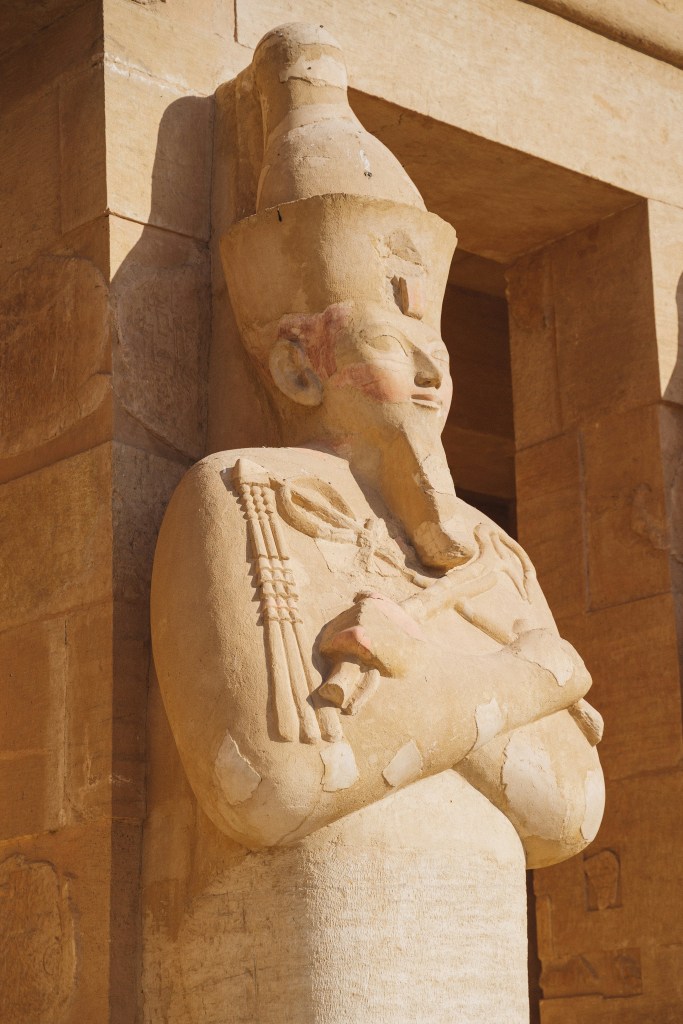
We’re All Little Pharaohs

Anyone who knows the story of the Exodus knows who the bad guy is: Pharaoh.  As the leader of Egypt, he is primarily to blame for the enslavement of Israel.  Eventually, through Moses and Aaron, God tells Pharaoh to free the Israelites from slavery, and time and again Pharaoh refuses.  Clearly, Pharaoh is God’s enemy.  However, in his resistance to God, I think Pharaoh fell into some habits any of us could fall into.

First, Pharaoh admitted his need for God only when things were going wrong but shut God out when things were going well.  In Exodus 8:8, Pharaoh asked Moses to “Plead with the LORD to take away the frogs from me and from my people” but once the frogs were gone, Exodus 8:15 tells us that “when Pharaoh saw that there was a respite, he hardened his heart” and refused to do God’s will.  The same thing happens in chapter 9, during the plague of the hail.  Seeing the destruction caused by the hail, Pharaoh says “Plead with the LORD, for there has been enough of God’s thunder and hail” in verse 28, but in verse 34, “when Pharaoh saw that the rain and the hail and the thunder had ceased, he sinned yet again and hardened his heart.

Photo by Alex Azabache on Unsplash

Next, Pharaoh repeatedly negotiated with God to define the scope of His influence.  Faced with the plague of flies, Pharoah said to Moses and Aaron “Go, sacrifice to your God within the land.”[1]  But staying “in the land” was not what God wanted His people to do.  In response to the plague of locusts, Pharoah said “the men among you” could leave and worship God, but he wouldn’t let the “little ones[2] go.  Also, after the plague of darkness, Pharoah said “Go, serve the LORD; your little ones also may go with you; only let your flocks and your herds remain behind.”[3]  In these 3 responses, Pharaoh insisted on limits to where the people should worship, which people should worship, and what they could (and couldn’t) use in worship.

Third, Pharaoh also tried to limit the scope of his own sin, and which sins he would be accountable to God for.  In Exodus 9:27, Pharaoh said, “this time I have sinned” and in 10:17 said “forgive my sin, please, only this once.”  In reality Pharaoh was sinning every time he refused to listen to God, but he wasn’t willing to admit that.  He only admitted a minority of the times he disobeyed.

If you’re like me, this all might sound familiar.  Often our prayers are more fervent and sincere when we need help than they are when we have something to praise God for, or when times are good.  Often, we allow God to govern some parts of our life, but we keep other parts for ourselves, to do what we want with.  Also, we often only admit some of our sins and choose which ones to care about.  We’re all a bit like Pharaoh, the bad guy in the Exodus story.

Fortunately for us, we have something else in common with Pharaoh: the true, Almighty God will defeat all of the “gods” we follow.  Every single one.  Behind the battle between Moses and Pharaoh was a contest between our God and Pharaoh’s gods.  As the Life Application Study Bible notes: “As each gloomy plague descended upon the land, the Egyptian people realized how powerless their own gods were to stop it. Hapi, the god of the Nile River, could not prevent the waters from turning to blood. Hathor, the crafty cow-goddess, was helpless as Egyptian livestock died in droves. Amon-Re, the sun-god and chief of the Egyptian gods, could not stop an eerie darkness from covering the land for three full days.”

When we choose not to obey God, we harden our hearts against Him and follow the “gods” we choose for ourselves, but God will ultimately defeat them all.  God’s purpose in saving us is to deliver us from all other gods, as He delivered Israel from Egypt.  He will deliver us from our slavery to every sin that binds us and make us not follow Him wholeheartedly.

We may be more like Pharaoh than we’d like to admit, but the Pharaoh in us has been killed, nailed to the cross with Jesus. When we reach heaven, all of our other “gods” will be gone and we will be perfected in our obedience to the one, true God, for our good and for His glory!

That’s a deliverance worth looking forward to and praising God for!

Amen.


[1] Exodus 8:25
[2] Exodus 10:10-11
[3] Exodus 10:24

The Exodus of Jesus

Bible translators have a tough job, otherwise one English translation would be all we have or need.  Translation isn’t a straight-forward process. There are many trade-offs, including between ease of reading in contemporary settings, and depth of meaning in the original context, but sometimes I wish different choices were made.

One example is Luke 9:30-31, which says: “And behold, two men were talking with him, Moses and Elijah, who appeared in glory and spoke of his departure, which he was about to accomplish at Jerusalem” (from ESV, emphasis mine). This happened during an event known as the Transfiguration, when Jesus took His disciples Peter, James, and John up a mountain for a vision of His future glory.  Matthew records in his gospel that Jesus “was transfigured before them, and his face shone like the sun, and his clothes became white as light.”[1]

While on that mountain, the 3 lucky disciples also witnessed a conversation about something: Jesus’ “departure.”  In a recent sermon I learned that the word translated “departure” is “exodos” in the original Greek.  For ease of reading purposes, “departure” is a more familiar word and makes a lot of sense to a modern reader, because Jesus was soon to depart the world temporarily through death, then more permanently after His resurrection.  On the other hand, “exodos” literally means an exit, or figuratively a death, but to the original audience and those familiar with Old Testament history, the word “exodos” carries other meanings as well.

So, why would Moses and Elijah be talking to Jesus about His “exodos”?  Because they both had history with such “departures.”

As told in the Old Testament book of Exodus, Moses was called by God while the descendants of Israel (Jacob) were slaves in Egypt.  After performing many miracles in God’s power, Moses led the new nation of Israel on an exodus out of literal slavery in Egypt.

Elijah performed many miracles, and prophesied that the nation of Israel, unless they repent of their disobedience, would be taken back into exile, but later be freed from Assyrian rule in that generation’s exodus.

Again, why would Moses and Elijah be talking to Jesus about His “exodos”?  Because Jesus was going to lead spiritual Israel out of slavery to sin around the entire world, from each nation, in every generation’s Exodus.  Moses, Elijah, and Jesus would have had a lot to talk about.

And behold, two men were talking with him, Moses and Elijah, who appeared in glory and spoke of his exodos, which he was about to accomplish at Jerusalem.


[1] Matthew 17:2

An ACTS Prayer

Dear fellow travelers,

There are many ways to pray, and my personal prayers are generally highly improvised, but recently something different happened.  I very rarely write (or type) out prayers, but when I was organizing a file of verses I have, I realized a sequence of them made a good prayer outline, even following the ACTS outline I learned many years ago: Adoration, Confession, Thanksgiving, and Supplication.

The prayer is below.  The parts in quotes are adapted from the Scriptures in the footnotes, and the parts between are where we can “improvise”, but I found that the quoted parts help create a good frame of mind for the parts in between.

The Psalm 16 reference might need some explanation.  The Psalm, written by David, references the assignment of land in Canaan among the 12 tribes of Israel.  Numbers 26:56 says, “Their inheritance shall be divided according to lot between the larger and the smaller,” while the “lot” was probably something like a modern “roll of the dice.”  The verses quoted in this prayer recognize that although our circumstances, our “lot in life” are not random outcomes but chosen by our Creator.  Therefore, whatever our “lot” is, we can be thankful for it, and we can also know that our future “lot,” the things we ask for, are in His hands.

Feel free to use this yourselves and I hope it blesses you as it has me!

Photo by Gift Habeshaw on Unsplash

Adoration
“You are the LORD, you alone. You have made heaven, the heaven of heavens, with all their host, the earth and all that is on it, the seas and all that is in them; and you preserve all of them; and the host of heaven worships you.”[1]

Add your own prayers of praise!

Confession
“You are the LORD, a God merciful and gracious, slow to anger, and abounding in steadfast love and faithfulness[2]
Your steadfast love never ceases; your mercies never come to an end;
they are new every morning; great is your faithfulness.”[3]

Confess to the Lord, knowing that He is merciful and faithful!

Thanksgiving & Supplication
“You are my chosen portion and my cup; you hold my lot.
The lines have fallen for me in pleasant places; indeed, I have a beautiful inheritance.”[4]

Thank the Lord for what He has provided for you,
then put your petitions before Him!

Closing
“I bless the LORD who gives me counsel;
            in the night also my heart instructs me.
I have set the LORD always before me;
            because you are at my right hand, I shall not be shaken.

Amen”[5]


[1] Nehemiah 9:6
[2] Exodus 34:6
[3] Lamentations 3:22-23
[4] Psalms 16:5-6
[5] Psalms 16:7-8

When Rights Collide

For a time, Moses was the sole judge over Israel, deciding right and wrong in countless cases brought by the people.  This was a massive burden and brought him to exhaustion, until his father-in-law Jethro urged Moses to delegate some of the responsibility.  Jethro tells Moses to find some able, trustworthy men, and in Exodus 18:22, he says “And let them judge the people at all times. Every great matter they shall bring to you, but any small matter they shall decide themselves. So it will be easier for you, and they will bear the burden with you.”  Moses was to act essentially as a court of appeal for hard cases.  What kind of “great matter” might Moses get?

Deuteronomy 17:8 might be one example: “if any case arises requiring decision between one kind of homicide and another, one kind of legal right and another, or one kind of assault and another, any case within your towns that is too difficult for you, then you shall arise and go up to the place that the LORD your God will choose.”

What the Bible recognizes here is that the right solution isn’t always obvious.  The Bible recognizes that things can get messy.  Life isn’t always as black-and-white, right-versus-wrong as we might think.  There are complex situations where rights conflict with rights, rather than a simple right versus wrong.  Each side of the case – the plaintiff and the defendant – might be at fault.

For example, suppose one person assaulted another without provocation, but in return the other retaliated in an unjustified way.  Should both complaints cancel each other out, and no judgement declared either way?  Or should the judge enforce the penalty for both crimes independent of each other?  If one penalty is greater than the other, should a judge subtract one penalty from the other and enforce the difference on the person with the greater crime?  Would that be justice for either person?

Sometimes there aren’t easy answers, even based on God’s perfect, revealed law.  All of us are sinful and justice requires we be punished for the times we have violated some kind of legal right, committed come kind of assault, or harmed someone in another way.  What solution can untangle all of these competing claims for justice?

The only viable answer is forgiveness, but forgiveness doesn’t come free, or cheap.  For our violations against God, the cost of forgiveness was Jesus’ suffering and dying on the cross.  For our sins against each other, God demands that we forgive others as we have been forgiven by Him.  We are to bear the cross of not only our sins, but the sins of others.  Forgiveness is hard because it sometimes means not demanding that our rights be respected.  Sometimes it means our sense of justice might be violated.  Yet forgiveness is what our Lord demands.

As Jesus said in Matthew 6:14-15, “For if you forgive others their trespasses, your heavenly Father will also forgive you, but if you do not forgive others their trespasses, neither will your Father forgive your trespasses.

Moses may have been able to be the court of appeal for Israel, to bear the burden of every “great matter” of the time, but only Jesus could bear the burden of every matter for all time.  He asks us to follow His example, even when we think we have the right to do otherwise.