Barbs in Our Eyes

As Israel was preparing to enter the Promised Land of Canaan after wandering in the wilderness, God gave them many instructions through Moses about how they were to live when they got there.  One of the instructions was to eliminate all of Canaan’s inhabitants.  Part of the warning not to ignore this comes in Numbers 33:55, which says:

“But if you do not drive out the inhabitants of the land from before you, then those of them whom you let remain shall be as barbs in your eyes and thorns in your sides, and they shall trouble you in the land where you dwell.”

What this is communicating is the urgency of getting rid of anything that could influence us to sin, and this applies as much to us as to ancient Israel.  In Israel’s case, the nations they were to remove from Canaan were under God’s judgement for centuries of worship of false gods, which included practices like ritual prostitution and child sacrifice.  God knew that His people would be tempted by these foreign gods and practices unless all trace of them was eliminated.

For us, God also wants to protect us from false gods and harmful practices and habits, and the phrase “barbs in your eyes” is a picture of the urgency for us to get rid of anything that would tempt us.  Think about it: If I had a thorn in my eye, I would drop everything and not be able to do anything else until I got it out.  Until the thorn was gone, it would be my one and only priority.  In modern times, God doesn’t tell His people to attack other nations in judgement, but He does want His people to attack sin with the same zeal.

So when I read “But if you do not drive out the inhabitants of the land from before you, then those of them whom you let remain shall be as barbs in your eyes and thorns in your sides, and they shall trouble you in the land where you dwell” it leads me to ask the question:

Do we remove sources of sin from our lives as urgently as we would a barb in our eye?

Don’t Ignore Ebenezer Today

Reminders of God’s word can guide our daily lives, but only if we follow those reminders.  Earlier, I introduced the blog’s mascot, “Ebenezer, the ‘But God…’ Squirrel.”  Ebenezer is a reminder that however difficult or frustrating our situation, if we actively and intentionally inject God into the situation, He can and will show us the best way forward.  However, what if we try to say “But God” but take the wrong path anyway?  If we do, we are not alone.

Ebenezer, trying to get your attention.

A search of the exact words “but God” in the ESV Bible gives 43 results, and the first one is found in Genesis 3:3, which says “but God said, ‘You shall not eat of the fruit of the tree that is in the midst of the garden, neither shall you touch it, lest you die.’”  This verse occurs when the serpent in the garden questions God’s word that Adam and Eve were limited by God in what they should and shouldn’t do.  Eve, the speaker in the quote above, responds rightly that God had been specific about what not to do.  As most of my readers will know, even though Eve knew God’s word, the serpent was able to convince her to ignore it.

As they say in the financial industry, “past performance is no guarantee of future results,” but I will guarantee anyway that today and every day every one of us face temptation to do something God wants to protect us from.  I also am confident of the words “but God…” that “If you recall them daily and live by them, they will transform your life completely,” as I quoted earlier from James Montgomery Boice.  But we must live by them to be transformed by God, not just quote them.

Today, pray that we all would be distracted by God’s word as easily as we are sometimes distracted by a passing squirrel when we are tempted to ignore His voice in our souls.  And if God delivers you from temptation today, make a note, a perpetual “stone of help” that God’s word is good!


Keep an eye out for Ebenezer as an ongoing series here, covering the 43 direct “but God” references, but also others.

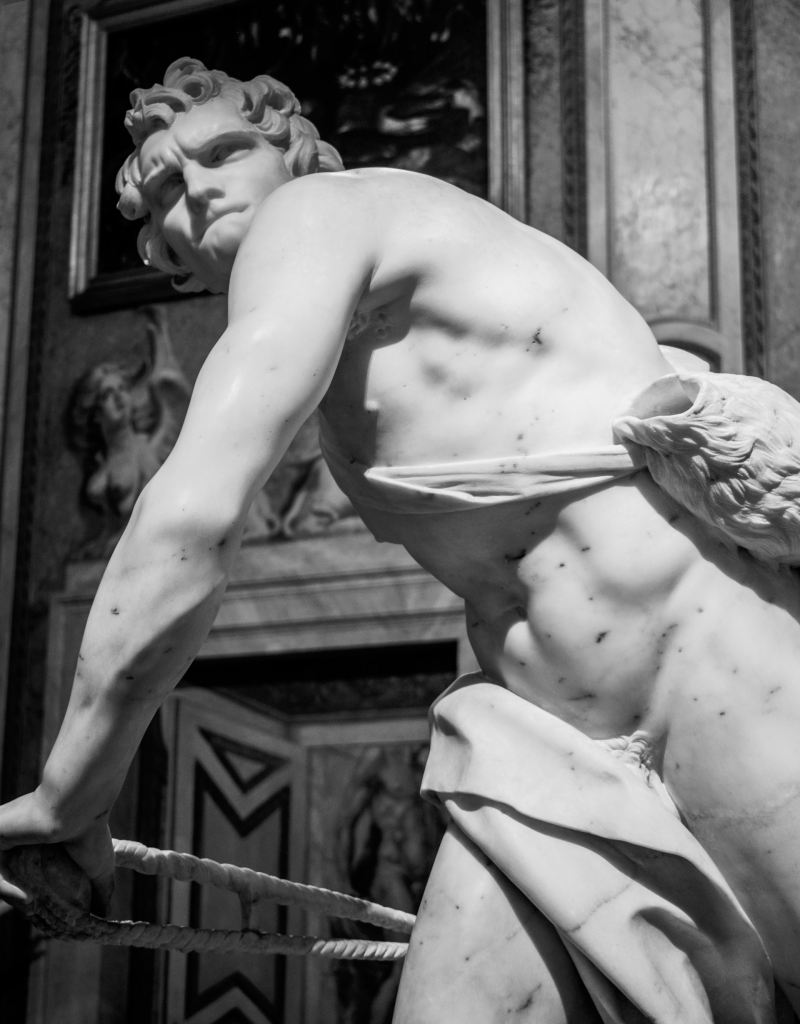
David’s Spiritual Battle with Goliath

David’s defeat of Goliath is such a popular story that it has become a cliché.  For example, unbalanced games in sports where one team is much better than the other are referred to as “David vs. Goliath.”  In these cases, the storyline is about whether a seemingly physically inferior opponent can beat a physically superior one.  However, this misses the point of the story – that it was a spiritual battle.

On one side of the battle, we have false gods.  After David decided to fight and was approaching Goliath, 1 Samuel 17:43 says: “And the Philistine [Goliath] said to David, ‘Am I a dog, that you come to me with sticks?’ And the Philistine cursed David by his gods.”  But even though Goliath invoked his gods in curses, he was counting on his size and strength advantage to win the battle.  He was not actually relying on “gods,” and did not expect to win “by his gods”, but by the god of worldly strength and dominance.

On the other hand, David was clear that this was a battle between true and false gods.  In 1 Samuel 17:26, David says “What shall be done for the man who kills this Philistine and takes away the reproach from Israel? For who is this uncircumcised Philistine, that he should defy the armies of the living God?” and also in verse 37 David says “The LORD who delivered me from the paw of the lion and from the paw of the bear will deliver me from the hand of this Philistine.”  David was actually trusting in and relying on his God for victory, unlike Goliath who just used his gods’ names in vain.  David knew his relative physical weakness against Goliath was not relevant.

So, to Goliath the battle was David vs. Goliath, but to David it was the true God vs. false gods.  And that’s why David won. David wanted to beat Goliath so “that all this assembly may know that the LORD saves not with sword and spear. For the battle is the LORD’S, and he will give you into our hand.” (verse 47)

People also curse us by their gods when we refuse to live by those gods’ standards.  These may be gods of wealth or convenience or rebellion, and many of our spiritual battles are against this world’s gods.

Does it sometimes seem foolish not to make choices based only on what’s best financially?  Is it sometimes inconvenient to worship?  Is it sometimes inconvenient to love our families, congregations, and neighbors?  Is it tempting sometimes to sin “only once” or if we think nobody will find out?

These are battles we all face, but we’re not going to win by doing better by the world’s gods’ standards, but by relying on the true God.  So, a question for us is: do we see these challenges as spiritual battles between true and false gods?  Or do we invoke God in name only like Goliath did, and then rely on our own strength?

The key to the battle between David and Goliath is that David won because 1) he knew his God is real, and 2) because he actually relied on Him.  We can win the same way and overcome the giants that seek to overthrow us.

“For we do not wrestle against flesh and blood, but against the rulers, against the authorities, against the cosmic powers over this present darkness, against the spiritual forces of evil in the heavenly places.” – Ephesians 6:12

The Law of the Medes and Persians Has Been Revoked

During the Old Testament book of Daniel, God’s people were in exile in Babylon, and a group of Babylonian officials really wanted to make a point.  They wanted to do this so badly, that it’s recorded several times in just a few verses of the book of Daniel, chapter 6:

Verse 8: “Now, O king, establish the injunction and sign the document, so that it cannot be changed, according to the law of the Medes and the Persians, which cannot be revoked.”
Verse 12: “Then they came near and said before the king, concerning the injunction, “O king! Did you not sign an injunction, that anyone who makes petition to any god or man within thirty days except to you, O king, shall be cast into the den of lions?” The king answered and said, “The thing stands fast, according to the law of the Medes and Persians, which cannot be revoked.”
Verse 15: “Then these men came by agreement to the king and said to the king, “Know, O king, that it is a law of the Medes and Persians that no injunction or ordinance that the king establishes can be changed.”
Verse 17: “And a stone was brought and laid on the mouth of the den, and the king sealed it with his own signet and with the signet of his lords, that nothing might be changed concerning Daniel.” [bold emphasis mine]

What provoked them to insist on this law that “cannot be revoked”?

They decided Daniel (of the book’s name) needed to be persecuted for successfully contributing to the welfare of Babylon, while humbly giving God the glory for all his gifts, abilities, and success.  He was making them, and their gods, look bad.  It is remarkably similar to the reasons Jesus saw opposition.  Daniel, a Jewish exile, was about to get a big promotion and they wanted to sabotage it.  Knowing Daniel openly prayed three times a day, the officials conspired and convinced the king to sign a law “that whoever makes petition to any god or man for thirty days, except to you, O king, shall be cast into the den of lions.” (Verse 7).  Either Daniel gives glory to Babylon, or he dies.  Forcing Daniel to change his worship would prove that an unjust law was more important to him than his God.

What did Daniel do in response?  Nothing new.  He continued his standard practice of worship, praying in front of his open windows, probably including prayers for the welfare of Babylon[1].  Verse 10 says Daniel acted “as he had done previously,” which indicates he wasn’t snubbing his nose at his government or its new rule.  His faithfulness was more important to him than an unjust law, even when he didn’t know God would deliver him from the lions.  Daniel didn’t just come to God when he thought he needed God; he knew he needed God at all times.

Therefore, when the officials were provoked, it was an outcome of Daniel’s success and prayer, not Daniel’s intent.  Basic, consistent faithfulness to a higher power can sometimes irritate people, especially lower powers who think their rule “cannot be revoked,” even when it’s not very effective.

Following the law, the king had Daniel thrown into the den of lions, but “God sent his angel and shut the lions’ mouths.”  Daniel said he was saved because he had faithfully served his God and the king (verse 22), not because he was a provocative protester.

Seeing Daniel delivered by God, King Darius tore up the law that “cannot be revoked,” but even if Daniel had not been rescued from the lions, the laws would still have been revoked.  The kingdom of the Medes and Persians no longer exists.  Likewise at the end of time every law of every Babylon will be no more.  However, God’s promise of blessing for all who will worship Him and seek His will still stands.  On this promise Daniel stood, or rather, kneeled, and served his God and his countrymen, even in exile.

The law of loving service to neighbor will never be revoked, wherever and whenever you live, and even in heaven!  In the words of G.K. Chesterton, “Men did not love Rome because she was great. She was great because they had loved her.”[2]


[1] Jeremiah 29:7 says: “But seek the welfare of the city where I have sent you into exile, and pray to the LORD on its behalf, for in its welfare you will find your welfare,” referring to Babylon.
[2] Chesterton, G.K. Orthodoxy (1908).  P. 103.

Remembering God in Our Affliction

Dear fellow travelers,

Psalm 119 is memorable in many ways, including that it is the longest chapter in the Bible, with 176 verses.  But the Psalm was also designed to be memorized in Hebrew, with 22 stanzas, one for each letter of the Hebrew alphabet.  In Hebrew, each stanza has 8 lines that each begin with the same letter.

It is also memorable for its topic: a lengthy meditation on God’s law and its positive, multi-faceted qualities.  The Psalm uses 8 words to describe God’s law, and all 8 appear in 5 of the stanzas while every stanza has at least 6 of them. [1]

However, in addition to meditating on God’s law, at least 7 verses also refer to affliction and/or its benefits in one way or another:

“This is my comfort in my affliction,
            that your promise gives me life.” (verse 50)

“Before I was afflicted I went astray,
            but now I keep your word.”  (verse 67)

“It is good for me that I was afflicted,
            that I might learn your statutes.”  (verse 71)

“I know, O LORD, that your rules are righteous,
            and that in faithfulness you have afflicted me.”  (verse 75)

“If your law had not been my delight,
            I would have perished in my affliction.”  (verse 92)

“I am severely afflicted;
            give me life, O LORD, according to your word!”  (verse 107)

“Look on my affliction and deliver me,
            for I do not forget your law.”  (verse 153)

Why the repetition?  By repeating the idea of affliction in this Psalm, the writer wants to make one more thing memorable: in our affliction, God is faithfully present, giving us life, teaching us, and reminding us of His goodness.  His steadfast love remains, even when this broken world and our own sinful condition present endless difficulty.

The law cannot save us, and affliction in this world is difficult, but “we know that for those who love God all things work together for good, for those who are called according to his purpose.  For those whom he foreknew he also predestined to be conformed to the image of his Son, in order that he might be the firstborn among many brothers.”  (Romans 8:28-29)

What God uses all things for, and what He has predestined, is that His people will be conformed to His holiness: “And I am sure of this, that he who began a good work in you will bring it to completion at the day of Jesus Christ.” (Philippians 1:6). Even affliction, in God’s hands, contributes to our development in holiness.

As J.I. Packer sums up these verses from Psalm 119 in his book, Rediscovering Holiness, “God’s faithfulness consists in his unwillingness that his children should lose any of the depths of fellowship with himself that he has in store for them. So he afflicts us to make us lean harder on him, in order that his purpose of drawing us into closest fellowship with himself may be fulfilled.”[2]

Whatever our affliction, God will deliver us and bring us to glory. Amen.


[1] According to the Reformation Study Bible
[2] Packer, J.I.  Rediscovering Holiness (1992), P. 268.  I “miraculously” discovered this quote within ½ hour of posting this blog, then had to add it, and repost.