The Likeness of Christ

As told in Genesis, Joseph served Pharaoh faithfully.  Even after being wrongly accused and imprisoned, he served while in prison and eventually rose again to prominence in Pharaoh’s kingdom.  When Pharaoh dreamed of famine, Joseph interpreted the dream, and under God’s direction, came up with a plan to survive it.  “And Pharaoh said to his servants, “Can we find a man like this, in whom is the Spirit of God?” – Genesis 41:38

In the gospels, Peter and John began as uneducated fishermen, yet they were personally discipled by Jesus for 3 years.  In Acts chapter 4, these former fishermen forcefully proclaim the gospel, and about five thousand people came to faith in Christ.  “Now when they saw the boldness of Peter and John, and perceived that they were uneducated, common men, they were astonished. And they recognized that they had been with Jesus.” – Acts 4:13

Pharoah recognized the Spirit in Joseph and people noticed Peter and John were different – do people notice the Spirit in you?  Can they tell you’ve been with Jesus?

“A Christian should be a striking likeness of Jesus Christ.” – Charles Spurgeon

The Rebellion at Babel

The story of the Tower of Babel, recorded in just 9 verses in Genesis 11, has a lot more to say than its length might suggest.  It’s not just the story of a tower being built, or a story about the origin of different languages.  It is also a story of why the tower was built and what it meant about the builders’ relationship with God.

The Tower of Babel was mankind’s best effort at achieving salvation, a path to heaven, based on their own works.  In the tower we see man declaring his independence from God, his lack of need for the God, or any god.  This act of rebellion was similar to Adam and Eve’s sinful desire to know good and evil for themselves in the garden of Eden, because the builders of the tower were saying that they know better than God.  “We’ll get to perfection on our own,” they thought.  They were the progressives of their day, believing in the infinite potential of mankind.

Also, verse 4 tells us that part of the motivation for building the tower was to prevent man from being “dispersed over the face of the whole earth,” but God had told His people to “fill the earth,”[1] not to settle down in one spot.  In the next chapter God would tell Abraham that he would become a nation, and that through that nation, “all the families of the earth shall be blessed.[2]  God’s people are not meant to hide in their own dwellings, but to bless the world by telling it of God’s love and by living out that love to “all the families of the earth.”  Babel’s builders had the wrong priorities.

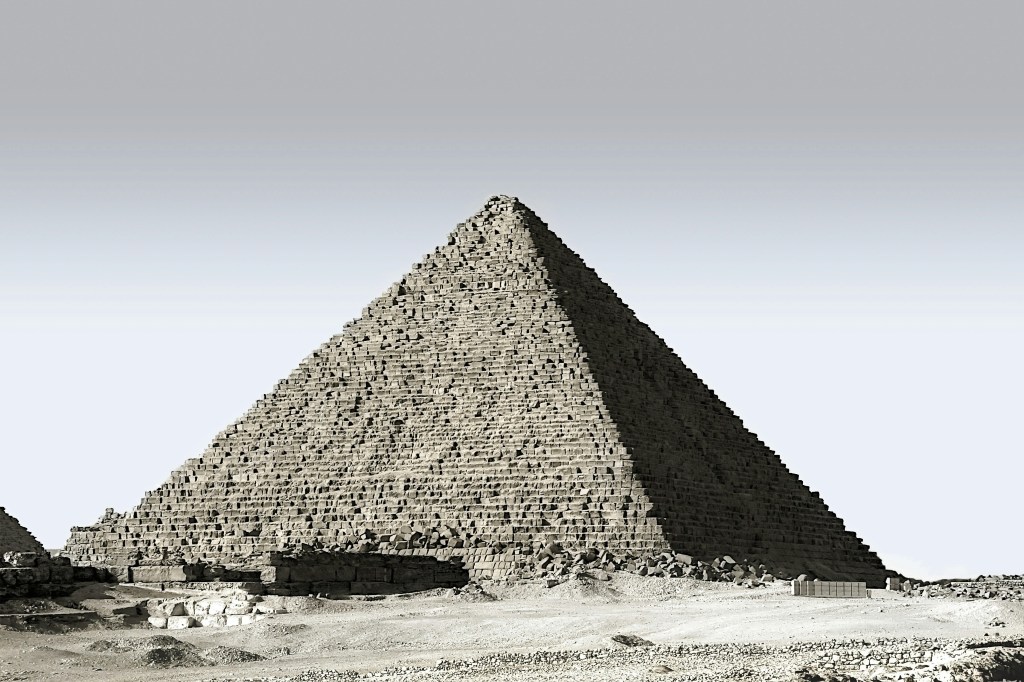
Photo by Simon Berger on Unsplash. The Tower of Babel may have been a ziggurat or a pyramid.

The story of the Tower also tells us that our best efforts will always fall short.  In the story, note that “the LORD came down to see the city and the tower.”  Mankind intended for this tower to reach heaven, but God had to “come down” to see it.  Our best efforts fall way below God’s standards and intention for us.  While we might achieve a lot and take pride in it, but it’s never as good as what God can do for us, and we know that “God opposes the proud but gives grace to the humble.”[3]  Later in history, He would show us that only He, in Christ Jesus, could be the path that gets us to heaven.  There is no other way no matter how hard we try.

Another subtle point from the story is that the materials we decide to work with are never better than what God has already given us.  Babel’s builders “had brick for stone,” meaning the tower was built with manmade bricks, not stones.  We might think of stones as “natural” but really, they’re what God created in the form He created it, and they’re much stronger than bricks.  In the same way, if we follow God’s intention for our lives rather than inventing our own ways, we will find that His ways are better and stronger than anything else available.

Lastly, the tower’s very name, Babel, is a form of “Babylon,” which is a literal city, but also in Revelation 17-18 Babylon represents any society where man attempts to live independently of God.  To seek perfection without Him and by His righteousness.  Revelation also tells us that Babylon will be destroyed, and everything that Babylon represents.

God has given us everything we need to live and to glorify Him today.  Will we use it, or try to go our own way?


[1] Genesis 1:28, Genesis 9:1
[2] Genesis 12:3
[3] James 4:6, 1 Peter 5:5

Edom’s Grudge Match

Does life seem unfair?  Have you ever lost a game to a cheater?  Or were passed over for a promotion by someone you consider unethical?  Or did someone you just don’t like get something you wanted?  There are many reasons we might hold a grudge.

Esau, son of Isaac and Rebekah, surely felt that way about his twin brother Jacob.  The rivalry of these boys began as early as their birth.  Esau was born first, but Jacob came right after, holding on to Esau’s heel.[1]  The name Jacob can mean “he takes by the heel,” but also it can mean “he cheats.”  The twins even had a rivalry over the favor of their parents: “Isaac loved Esau because he ate of his game, but Rebekah loved Jacob.[2]

Esau, as the firstborn (barely), was entitled to a double portion of inheritance, but he found that Jacob was still grasping at his heel, as told in Genesis 25:29-34 – 

Once when Jacob was cooking stew, Esau came in from the field, and he was exhausted.  And Esau said to Jacob, “Let me eat some of that red stew, for I am exhausted!” (Therefore his name was called Edom[3].)  Jacob said, “Sell me your birthright now.”  Esau said, “I am about to die; of what use is a birthright to me?”  Jacob said, “Swear to me now.” So he swore to him and sold his birthright to Jacob.  Then Jacob gave Esau bread and lentil stew, and he ate and drank and rose and went his way. Thus Esau despised his birthright.

Instead of a double inheritance, desperate Esau got only a meal of stew.  There’s more to this story, but the rivalry continued through centuries in a grudge held by Esau’s descendants (the nation of Edom) against Jacob’s descendants (the nation of Israel).  The one-chapter Old Testament book of Obadiah is a response to Edom’s schadenfreude[4] over Judah and Israel’s problems.

This short book is worth a read, but it is essentially a condemnation of Edom for their hate of Jacob’s descendants, summarized well in verse 10:

Because of the violence done to your brother Jacob,
            shame shall cover you,
            and you shall be cut off forever.

Photo by Hugo Fergusson on Unsplash

Under God’s judgement for a long-held grudge, the nation of Edom no longer existed by Jesus’ time.  Therefore, the message of Obadiah is that, even with all the reasons Esau may have had to justify it, his grudge was unjustified.  God’s favor is not a function of whether we deserve it, but a function of His mercy given to those who do not deserve it, and He expects us to treat others with the same love and mercy.  While God’s love for us is unconditional and purchased for us by Jesus on the cross, Jesus did say in Matthew 6:14 –

For if you forgive others their trespasses, your heavenly Father will also forgive you, but if you do not forgive others their trespasses, neither will your Father forgive your trespasses.”

Mercy is better than any grudge.


[1] Genesis 25:24-26
[2] Genesis 25:28
[3] The words for Edom and red are similar in Hebrew
[4] Enjoyment of someone else’s misfortune.

Only God Gets the Glory for Gomer’s Goods

Photo by David Köhler on Unsplash

In the story of the Old Testament prophet Hosea, God told him to marry a prostitute named Gomer to teach a lesson about idolatry, but also God’s steadfast love and mercy.  Gomer was not only a prostitute physically, but also spiritually, worshipping other gods, which isn’t limited to literal, physical idols.  Hosea 2:8-9 explains that idolatry includes giving credit to other gods (or no gods) for things that the LORD had actually provided.  God said through Hosea:

And [Gomer] did not know
            that it was I who gave her
            the grain, the wine, and the oil,
and who lavished on her silver and gold,
            which they used for Baal.
Therefore I will take back
            my grain in its time,
            and my wine in its season,
and I will take away my wool and my flax,
            which were to cover her nakedness.”

In other words, if Gomer (who represents all of Israel) doesn’t recognize the true source of her blessings, God is fully justified in taking them away.  Fortunately, He is a God of love and mercy, who provides for our nakedness – both physical and spiritual, beginning all the way back in Genesis 3:21, which says: “And the LORD God made for Adam and for his wife garments of skins and clothed them.”  Adam and Eve had fallen and became ashamed of their condition, expecting God to judge them, but instead He covered them physically, but also set in place a plan to redeem His people by the blood of Jesus.

In Gomers case, “And the LORD said to me, ‘Go again, love a woman who is loved by another man and is an adulteress, even as the LORD loves the children of Israel, though they turn to other gods and love cakes of raisins.’  So I bought her for fifteen shekels of silver and a homer and a lethech of barley.”  (Hosea 3:1-2)

Fifteen shekels was not a lot of money, meaning other people didn’t value Gomer much, but God and Hosea were faithful and loved her.  The real price of God’s people – His own Son – was much steeper, but He decided we’re worth it even though we are unfaithful.  It is His faithfulness that really matters.

Therefore, today be thankful!  For the One who gives us “the grain, the wine, and the oil” and the “silver and gold” is the same One who died for us to make us His own people.

Soli Deo Gloria

The Way of Escape

Reliable knowledge of good and evil is hard to come by, and the wisdom to follow it even harder.  A well-known and oft-quoted Proverb is 1:7, which says:

The fear of the LORD is the beginning of knowledge;
            fools despise wisdom and instruction.

This Proverb tells us that we only gain useful knowledge, wisdom and instruction when we have an attitude of reverent respect for God, and that we are fools if we do otherwise.  Fear of the Lord should be the rudder that guides us through the waves and storms that buffet us in this world.  Every decision we make should have as its foundation: does this honor God?  No other foundation is good enough for our lives to rest upon.

What’s left unsaid here in Proverbs is that we can’t expect this to come easy.  We are constantly tempted to not fear the Lord in our minute-by-minute, hour-by-hour, and day-by-day decisions.  It’s hard, and not just because we aren’t perfect.

Photo by Nathan Dumlao on Unsplash

In the account of the serpent’s confrontation with Eve in the garden in Genesis 3, the serpent’s whole objective was to get Eve to make one decision that wasn’t based on fear of the Lord.  “He said to the woman, “Did God actually say, ‘You shall not eat of any tree in the garden’?”[1]  “The serpent said to the woman, ‘You will not surely die.’[2]  Eventually he wore her down and she ate from the tree God told her not to eat from, all because her reverence for God had been worn down by constant criticism of God by the serpent.  He wanted her to decide for any reason other than the fear of the Lord, to become a fool, and thus bring down humanity.

When we make decisions, are we always being guided by the fear of the Lord, or do we sometimes think “He didn’t really mean that”?  If you’re like me, you find yourself constantly confronted by influences that oppose God.  Are we foolish when we follow these influences?  Yes.  Do we do it anyway?  Yes.  Could there be a hostile spiritual influence pulling us in that direction?  Sure, but it could also just be our own broken wills, prone to go our own way.

However, in 1 Corinthians 10:13, Paul assures us that “No temptation has overtaken you that is not common to man. God is faithful, and he will not let you be tempted beyond your ability, but with the temptation he will also provide the way of escape, that you may be able to endure it.”  And if we fear the Lord, we will believe it.

If we fear the Lord, when we’re tempted, we will know that “he will also provide the way of escape.”  We need to look for it and pray for it until we find it.  When we do, God will remain in the driving seat of our decisions and knowledge and wisdom will be ours.  He can overcome any of our temptations if we let Him and we fear Him.

Let the fear of the Lord be your guide.  There is always a “way of escape.


[1] Genesis 3:1b
[2] Genesis 3:4