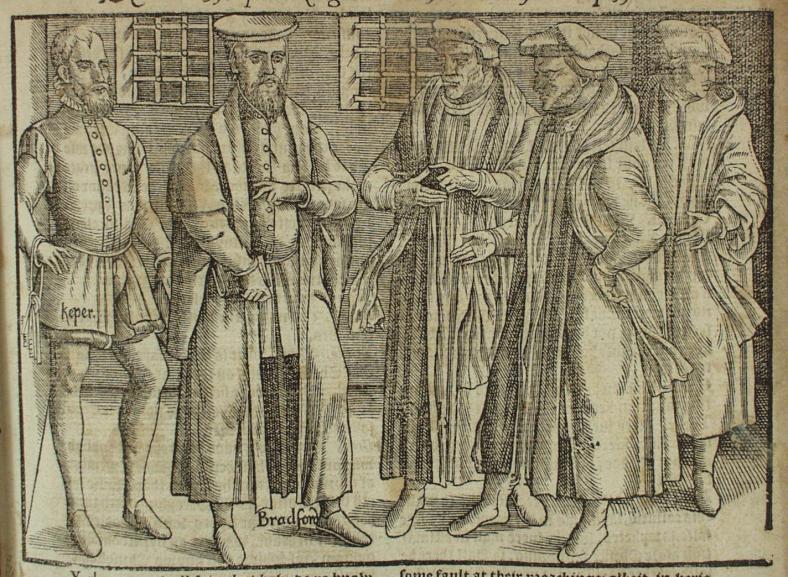
The following is quoted from Warren Wiersbe’s Be Alive commentary on John 3:14.
“On January 6, 1850, a snowstorm almost crippled the city of Colchester, England, and a teenage boy was unable to get to the church he usually attended. So he made his way to a nearby Primitive Methodist chapel, where an ill-prepared layman was substituting for the absent preacher. His text was Isaiah 45:22 – “Look unto me, and be ye saved, all the ends of the earth.” For many months this young teenager had been miserable and under deep conviction, but though he had been reared in church (both his father and grandfather were preachers), he did not have the assurance of salvation.
The unprepared substitute minister did not have much to say, so he kept repeating the text. “A man need not go to college to learn to look,” he shouted. “Anyone can look—a child can look!” About that time, he saw the visitor sitting to one side, and he pointed at him and said, “Young man, you look very miserable. Young man, look to Jesus Christ!” The young man did look by faith, and that was how the great preacher Charles Haddon Spurgeon was converted.”[1]
[1] Wiersbe, Warren. Be Alive (John 1-12) (1986). P. 55.
General George Washington leading the Continental Army on small boats across the Delaware River in the middle of the freezing night, surrounded by chunks of ice, is a popular story and image from early American history. Depicted famously by German-American artist Emanuel Leutze in the painting nearby, this desperate effort was a significant turning point in the war. The daring crossing was an act of desperation and made necessary (and possible) by a long string of events in 1776.
It had not been a good year for Washington’s army, suffering a string of defeats at Brooklyn, Kips Bay, and White Plains. With little hope or troops left, Washington retreated with much of his army across the Delaware around November 7th, expecting the British to soon cross and strike Philadelphia, taking full advantage of their momentum and Washington’s weakness. On November 16, 2,837 Americans surrendered at Fort Washington, after General Washington trusted Nathaniel Greene’s report that the fort could be defended.[1] Another defeat at Fort Lee left Washington with perhaps 3,500 troops after losses and desertions.[2] On top of this, many troops’ commitments were due to expire in early December, reminiscent of when the army had massive turnover during the siege of Boston in 1775.
Washington Crossing the Delaware by Emanuel Leutze. Public Domain.
Desperate to defend Philadelphia (where Congress had been held since the First Continental Congress in 1774), Washington expected General Lee to reinforce him soon with more troops. However, Lee – effectively Washington’s second-in-command – had inexplicably spent the night of December 12th apart from his troops at a tavern. Lee was ratted out and captured in a raid that took less than 15 minutes on the 13th. Things looked bleak, but on the same day, Washington learned that Congress had relocated from Philadelphia to Baltimore for safety.
More importantly, continuing a string of possibly Providential, but certainly weather-assisted, events like a storm that allowed Washington to end the British siege of Boston with minimal bloodshed (see this post), and surprise fog that covered Washington’s overnight escape from Brooklyn (see this one), on December 13th, British General William Howe decided to cease military operations for the winter.[3] Absent this decision, the war may have been over soon, with a British victory, but with this decision, we have the backdrop for the famous crossing of the Delaware.
Seeking opportunity for a decisive move, Washington kept his army as intact as he could manage until the time arrived. With Christmas approaching and the British ceding the initiative, Washington now had about 6,000 troops and intelligence that about 2,000 Hessian mercenaries (the actual number was probably lower, around 1,500) were defending Trenton. After the “Long Retreat,” as the string of defeats above came to be known, the Continental Army needed a victory, and got one. Three separate groups were planned to cross the Delaware, but only Washington’s main force made it. Regardless, Washington caught Hessian commander Johann Rall unprepared, in spite of warnings Rall received and disregarded. After all, the sturdy British had closed down for the winter – why wouldn’t everyone do the same?
Just after 8am on December 26th, Washington’s force attacked, killing 21 Hessians, wounding 90, and capturing 900. 500 escaped over a bridge that was supposed to be defended by one of the two forces unable to make the crossing.[4] Washington went on to another victory at Princeton on January 3, as the British were again caught by surprise, thinking the army was still in Trenton.[5] The momentum had turned, with the central event being the daring crossing of the Delaware on Christmas night, in freezing weather surrounded by ice.
[1] McCullough, David. 1776 (2005). P. 234. [2] McCullough, David. 1776 (2005). P. 249. [3] McCullough, David. 1776 (2005). P. 264-267. [4] McCullough, David. 1776 (2005). P. 270-281. [5] McCullough, David. 1776 (2005). P. 288.
Fans of the dystopian Hunger Games novels and movies know that the story takes place in a country called Panem. There, the extravagantly wealthy Capitol district holds an annual, televised battle royale, The Hunger Games, where children from each of the 12 desperately poor districts fight to the death until there is only one remaining. The purpose of these demented Games is to remind the people of the power of the Capitol, but also to provide entertainment. But why is the country called Panem?
Panem is likely a reference to the Latin phrase “panem et circenses,” or “bread and circuses,” which “means to generate public approval, not by excellence in public service or public policy, but by diversion, distraction, or by satisfying the most immediate or base requirements of a populace, by offering a palliative: for example food (bread) or entertainment (circuses).”[1] Under this way of thinking, for a government to remain in power it needs to provide the basic needs of its people. For an especially cynical government, it would mean they need only provide just enough bread and just enough circuses to keep the population from overthrowing them.
In the case of The Hunger Games, the Capitol reminded the other districts that they could have no bread (panem) without the Capitol’s “benevolence,” and that the only entertainment (circuses) they get is to watch their children kill each other. Talk about a government providing the very bare minimum!
The Hunger Games is obviously an extreme example, but fortunately, Christianity offers a better answer than just the bare minimum of “panem et circenses.” What benefits does it offer? Psalm 103 in the Bible begins in the first 2 verses with a call to:
“Bless the LORD, O my soul, and all that is within me, bless his holy name! Bless the LORD, O my soul, and forget not all his benefits”
And what are these benefits? Is it more than “bread and circuses”? It is, as verses 3-5 tell us that the Lord is the one:
“who forgives all your iniquity, who heals all your diseases, who redeems your life from the pit, who crowns you with steadfast love and mercy, who satisfies you with good so that your youth is renewed like the eagle’s.”
This Psalm says He can take care of both our spiritual and physical maladies. Jesus performed many miracles, so we “may know that the Son of Man has authority on earth to forgive sins,”[2] solving our spiritual alienation from God and each other. Likewise, the body’s diseases do not heal magically or by chance; they heal because God created us with that ability. He is the Great Physician.[3]
Also, He is the One who can save us “from the pit” – from ourselves and the punishment that our sin deserves, replacing our banishment from God’s presence with “love and mercy.” He is the One who has the perspective needed to define what is good, and as our Maker, knows what we need to thrive and be renewed. He offers many benefits we cannot find anywhere else.
Not just the fictional Panem, but all the nations of the real world, have nothing to offer but varying degrees of bread and circuses, various diversions and distractions and palliatives. No government in the world can provide the benefits God provides – those listed in Psalm 103 – and therefore only God offers what can truly satisfy. Therefore,
“Bless the LORD, O my soul, and forget not all his benefits”
At the beginning of Jesus’ public ministry, He spent 40 days alone in the wilderness and at the end of this time was confronted directly by the devil with three temptations. In the first, the temptation was to fulfill His physical need for food. In the second, to display His power presumptuously. This post will focus on the third temptation, as recorded in Matthew 4:8-10:
“Again, the devil took him to a very high mountain and showed him all the kingdoms of the world and their glory. And he said to him, “All these I will give you, if you will fall down and worship me.” Then Jesus said to him, “Be gone, Satan! For it is written, “‘You shall worship the Lord your God and him only shall you serve.’””
As with the first and second temptations, Jesus uses God’s Word to combat the temptations, in this case quoting Deuteronomy 6:13. Jesus knew that to live a life of perfect obedience, He needed to worship God only in every action He took. Even one action that gave in to Satan’s ideas for Him would have made Him an imperfect sacrifice and we would all still be dead in our sins. There would be no Christianity and no salvation for anyone.
But I also think Jesus knew that the kingdoms of the world just weren’t worth ruling. Sinful people need a Savior who can heal them, before anyone will be able to rule them. Therefore, Jesus was not interested in the unredeemed kingdoms of the world, but in redeeming His people and building His perfect kingdom person by person. The world as it is just isn’t good enough.
After all, what good is a kingdom full of people who only worship the wrong things? What good is a world without hope of redemption in Christ? In his book A History of Christianity, British historian Paul Johnson doesn’t shy away from the evils of the world and the failings of the church, which some say disprove that there’s a loving God. However, in the epilogue Johnson asks what if there was no Christianity at all?
“Certainly, mankind without Christianity conjures up a dismal prospect. The record of mankind with Christianity is daunting enough… for there is a cruel and pitiless nature in man which is sometimes impervious to Christian restraints and encouragements. But without these restraints, bereft of these encouragements, how much more horrific the history of these last 2,000 years must have been!”[1]
On the other hand, what if Christianity is true? In a world redeemed by Christ, man does not have “a cruel and pitiless nature,” but the perfect sinless nature of Jesus. There will be nothing but encouragements to live a life of love for God and others. Restraints won’t even be needed.
This is the kingdom that Jesus finds worth ruling, and will rule, eternally, thanks to His overcoming of Satan’s temptations and perfect life of obedient love, so we someday may have a perfect life. In this kingdom,
“‘You shall worship the Lord your God and him only shall you serve.’””
Eternally. Amen.
[1] Johnson, Paul. A History of Christianity. (1976). P. 517.
On this date in 1976, Mao Zedong, or Chairman Mao, founder of the communist People’s Republic of China, died at the age of 82. Some look at Mao’s death as a positive turning point for Christianity in China, since under Mao China had expelled all Western Christian missionaries between 1949 and 1953. However, while it is impossible to come up with precise numbers across a 3.7 million square mile country, Christians probably were about 1 percent of China’s population when Western missionaries were kicked out, but by the 1980s about 5 percent of the population went by Christ’s name. The Christian population grew by ten times, while the overall population doubled. How did this happen?
Mark Noll and Carolyn Nystrom, authors of the book “Clouds of Witnesses” say the key to this growth was “the resilience of the Chinese believers themselves…securely rooted in Chinese life before Mao.” [1] In expelling missionaries, Mao was in part responding to “treaty ports” created at the end of the 1839-42 Opium War. Through these ports foreign powers had extra territorial rights, allowing influences including missionaries to come in, but these ports also allowed opium to flow freely into China from Western countries. Therefore, in the mind of many Chinese, Christianity became linked with both Western imperialism and opium addiction. When Karl Marx said “religion is the opiate of the masses” he may have been thinking of this connection. But native Chinese believers, sometimes planted by Europe-based evangelizing organizations like China Inland Mission, remained behind and spread resilient forms of Christianity that were attractive to the Chinese population.
John Sung Several of these Chinese Christians are profiled by Noll and Nystrom, including John Sung who lived from 1901 to 1944, before Mao’s communist revolution. Around Christmas 1926, Sung heard child evangelist Uldine Utley preach a sermon at Calvary Baptist Church in New York, near where he was attending Union Theological Seminary. This sermon, along with other influences, countered the liberal Christianity he was being taught where the Bible was just “a collection of myths.” He returned to China, determined to spread the gospel in the land of his birth with frenetic energy. In a one-year period in 1931-2, Sung and a small group of missionaries “traveled over 50,000 miles, held 1,200 meetings, preached to more than 400,000 people in thirteen provinces, registered more than 18,000 ‘decisions’” for Christ. Many of these new Christians formed traveling bands themselves. Sung is considered the last great evangelist in China and Southeast Asia before Mao’s reign.
Dora Yu Even earlier, another driver of this resilient, Chinese Christianity was Dora Yu (1873-1931). Dora’s ministry benefitted tremendously from a 1905 decision by Dowager Empress Cixi to replace China’s traditional Confucian civil service examinations with general public schools. Under this system, mission-run schools became a valued option, and one of Dora’s early ministries was to train “Bible women” to not only educate women generally, but also to teach them the Bible, pray with them, and teach them to live by faith. Mostly traveling by foot, in “1903, Dora Yu visited with 925 women and 211 children.” Later, her ministry grew and she became famous for itinerant preaching, reaching many others who would carry on the Lord’s work.
Because of our proneness to look at the bucket and forget the fountain, God has frequently to change His means of supply to keep our eyes fixed on the source
Watchman Nee
Watchman Nee In 1920, Nee Shu-Tsu would hear Dora Yu preach. Later known as Watchman Nee, he “planted at least four hundred Christian churches over a thirty-year period of active ministry.” He died in 1972 in a Communist prison after spending 20 years there. Watchman Nee wrote that “Because of our proneness to look at the bucket and forget the fountain, God has frequently to change His means of supply to keep our eyes fixed on the source.”
Whether it is a European missionary, a child preacher in New York City, a Chinese man temporarily studying in New York City, or a Chinese woman walking miles through the countryside:
“How beautiful upon the mountains are the feet of him who brings good news, who publishes peace, who brings good news of happiness, who publishes salvation, who says to Zion, ‘Your God reigns.’” – Isaiah 52:7
As Jesus said in Matthew 16:18 – “And I tell you, you are Peter, and on this rock I will build my church, and the gates of hell shall not prevail against it.” This rock is the gospel of the kingdom of God, and not even a brutal regime like that of Chairman Mao could prevail against it.
Soli Deo Gloria
[1] Noll, Mark A.; Nystrom, Carolyn. Clouds of Witnesses: Christian Voices from Africa and Asia (2011). This post is drawn from chapters 12 and 14.