Today is Mo Gaba Day

Today my local public school system is celebrating Mo Gaba Day, in honor of Mosilla “Mo” Kingsley Gaba, born on January 26, 2006.  Who is Mo Gaba?  If you aren’t a Maryland local, you likely don’t know Mo’s amazing story, but it’s worth telling!

At 9 months old, Mo had his first cancer diagnosis and soon lost his sight completely and permanently.  Over his life he fought cancer in his brain, bones, legs and elsewhere, but even with these challenges, Mo became a local celebrity because of his unquenchable enthusiasm for the Baltimore Ravens and Orioles, and for life in general.  At 9 years old, he began calling local sports radio shows in secret while his mother was at work, sharing thoughts about his teams, and about life, that seemed way beyond his years.  To listeners, he was known as “Mo from Glen Burnie.”  Over time, people also learned of his health issues and his attitude became an inspiration to, and friend of, many, including then-Orioles player Trey Mancini, who had been diagnosed with colon cancer in early 2020.  Tragically, 14-year-old Mo Gaba died on July 28, 2020, after spending 75% of his life in hospitals, but he remains inspirational to many.

Mo Gaba and Trey Mancini

Two years later to the day, the Orioles held their first Mo Gaba Day, and something amazing happened: “Mancini hit an inside-the-park home run with a runner on base that started as what appeared to be a routine sacrifice fly. However, the ball deflected off the glove of Tampa Bay right fielder Josh Lowe after he lost it in the afternoon sun and hit him in the face, allowing Mancini to score…Trey commented about Mo playing around in the clouds so that he could score.”[1]  As Mancini rounded the bases, there was hardly a dry eye in attendance at the game, or watching on TV.  The Orioles won 3-0.

I don’t know much about Mo’s private life, the source of his hope and personality, or his religion, but share his story in the spirit of Philippians 4:8 – “Finally, brothers, whatever is true, whatever is honorable, whatever is just, whatever is pure, whatever is lovely, whatever is commendable, if there is any excellence, if there is anything worthy of praise, think about these things.”  Can followers of Christ provide hope as Mo did?

Lastly, below is what I posted to Facebook the day after hearing of his passing.

“RIP Mo Gaba, age 14.

Who is Mo Gaba?  A few years ago I started hearing him on the radio, calling in to the sports talk show I listened to in the car on my drive home.  He would have been about 10 when I first heard him.  Kids don’t call in much and the hosts usually aren’t patient with them so I wondered what was the deal with this very informed, very enthusiastic kid.  He loved his Orioles and Ravens!!!  Later I found out he was blind and had been fighting cancer his whole life. He was confined to a wheelchair. But he was so endearingly positive at all times.  The talk show host (Jeremy Conn) became a big advocate for him and his family, raising money to support him.  Other local sports figures and celebrities also began to support this kid who had an amazing personality in spite of his health problems that would crush many peoples spirits.  for example, “In 2019, Gaba became the first person to announce an NFL draft pick in Braille when he announced the Ravens’ fourth-round pick.”  Yesterday he was in the news (below) for getting into the Orioles Hall of Fame and today he’s gone.

We can all learn a lesson from his attitude in the face of adversity.  His joy was infectious. 

May we all experience joy as the world has become so negative and in turmoil!  A world that in some ways is teaching us to feel nothing but guilt and helplessness.  We are not victims in God’s eyes.

“In the day of prosperity be joyful, and in the day of adversity consider: God has made the one as well as the other, so that man may not find out anything that will be after him” – Ecclesiastes 7:14”

https://www.baltimoresun.com/sports/orioles/bs-sp-orioles-mo-gaba-hall-of-fame-20200728-5kcctc4q6zeefbzkw6ahq2xg7q-story.html


[1] https://en.wikipedia.org/wiki/Trey_Mancini

We Will Not Live in Tents Forever

The apostle Paul was likely one of the finest Old Testament scholars of his day, and sometimes draws on existing imagery to make a point.  One example might be Proverbs 14:11-12, where the second verse is more widely known than the first, but not unrelated:

“The house of the wicked will be destroyed,
            but the tent of the upright will flourish.
There is a way that seems right to a man,
            but its end is the way to death.”

Physically, it seems obvious that a house is far more durable than a tent, but these Proverbs tell us not to judge by appearances.  Looks and reputation may suggest otherwise, but it is righteousness that determines eternal destiny, specifically acceptance of Jesus’ righteousness.

In 2 Corinthians 5:1-3, Paul gives an example of why we should focus not on what “seems right”, but instead focus on the unseen things that matter for eternity, drawing on the tent image:

“For we know that if the tent that is our earthly home is destroyed, we have a building from God, a house not made with hands, eternal in the heavens.  For in this tent we groan, longing to put on our heavenly dwelling, if indeed by putting it on we may not be found naked.”

Photo by Hendrik Morkel on Unsplash

Paul, defending his apostleship to the Corinthians amidst his suffering while other false apostles lived in ease, knew that an upright tent was better than a wicked house in God’s eyes, and therefore being less comfortable was entirely worth it, since there was an eternal reward waiting in heaven.

Commenting on 2 Corinthians 5, Warren Wiersbe notes that “Heaven was not simply a destination for Paul: it was a motivation.  Like the heroes of faith in Hebrews 11, he looked for the heavenly city and governed his life by eternal values.”[1]

When frustrated by your earthly limitations, or frustrated by discomfort in this world, know that we will not live in these tents forever.  For His faithful, God is preparing an eternal dwelling for us.  While it “seems right to a man” to think a house is better than a tent, every tent and house in this world is temporary.  Hebrews 1:12 says of all creation, the earth and all the heavens, that:

“like a robe you will roll them up,
            like a garment they will be changed.
But you are the same,
            and your years will have no end.”

Do we long for our new, eternal heavenly dwelling?  Does this longing motivate us to live for God?  Let us keep Driving Toward Morning today!


[1] Wiersbe, Warren.  Be Encouraged (2 Corinthians) (1994).  P. 69.

Christianity is Not in Decline. Ever.

The tomb is empty. Photo by Pisit Heng on Unsplash

Too often I start reading something thinking it will be encouraging, but find it filled with phrases like “post-Christian world,” or “Christianity’s decline.”  I just read that apparently, I’m “living in the ruins of Christendom.”  However, because Hebrews 11:1 says, “Now faith is the assurance of things hoped for, the conviction of things not seen,” our faith and hope are not based on any ruin or decline we see in the communities and world around us.  Other things may end up in ruins or in decline, but Christianity does not.  It was not in decline on Good Friday and it is not in decline now.

In a recent post about the massive expansion of Christianity under Communist China, I wrote: “As Jesus said in Matthew 16:18 – ‘And I tell you, you are Peter, and on this rock I will build my church, and the gates of hell shall not prevail against it.’  This rock is the gospel of the kingdom of God, and not even a brutal regime like that of Chairman Mao could prevail against it.”

The best of the kingdom of God is always in the future, never in the past, which brings me to the Rewind Wednesday part of today’s post, from last November:

“Today, many will hear the good news of the kingdom of Jesus, and some may hear and be saved!  Also today, none will be snatched out of His hand! (John 10:28)

True progress will be made today and every day.”

Will Green Be Greener in Paradise?

Psalm 98:7 declares: “Let the sea roar, and all that fills it; the world and those who dwell in it!” In Romans 8:19 Paul adds that “the creation waits with eager longing for the revealing of the sons of God.”

Pastor James Montgomery Boice connects these ideas and says, “The world will one day be renewed.”  Nature already shows God’s glory, but it also, like mankind, is not yet as it shall be.  Boice adds: “I think of the way C.S. Lewis developed this idea in The Lion, the Witch, and the Wardrobe. In the first section of that book, when Narnia was under the power of the wicked Witch of the North, the land was in a state of perpetual winter. Spring never came. But when Aslan rose from the dead, the ice began to melt, flowers bloomed, and the trees turned green.”[1] Creation shares the hope of mankind – regeneration in a future paradise at the coming of its Lord!

Even now, we get an occasional glimpse of nature that’s somehow better than what we’re used to, and perhaps it is a glimpse of the paradise beyond the renewal of all things.  We were recently in Wales, on Mount Snowdon and a nearby trail in Llanberis, and below are some pictures from that day.  Some of these show the many brilliant shades of green, which seemed more glorious than the greens near our home in the U.S. We don’t often see rocks interact with the greenery like this here.

So, will paradise be even greener than this?  Will it seem like a perpetual winter has finally lifted?  I’m eagerly waiting to find out someday. In the meantime, enjoy these:


[1] From “April 19.” James Montgomery Boice and Marion Clark. Come to the Waters: Daily Bible Devotions for Spiritual Refreshment.  (2017).

Finding Port for the Good Ship Ambivalent

From yesterday’s post, you’ll know I am reading King’s X: The Oral History, a book chronicling the history of the rock band King’s X, by Greg Prato.  Yesterday, I dove into one of their more bizarre and unknown songs, but today is about the band’s biggest hit.  “It’s Love” got to “#6 on Billboard’s Mainstream Rock charts and #1 on the FM Radio Airplay charts. It was our highest-ranking single, ever,”[1] according to Ty Tabor, the band’s guitarist and sometimes lead singer, who wrote the song.

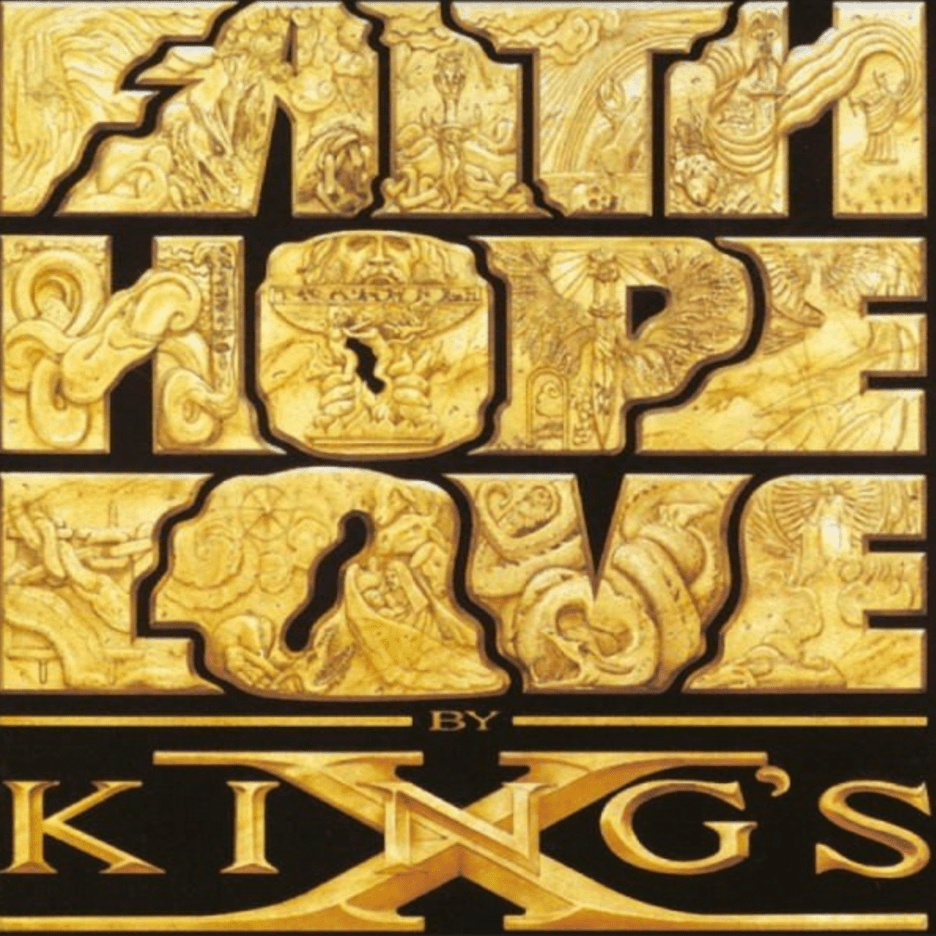
I knew both Christianity and King’s X by reputation before becoming a true fan of either, but both were growing at the same time in me during college.  Having heard of King’s X but never actually heard their music, I once saw one of their CDs in a friend’s dorm room.  My friend said it was his roommate’s but that he wasn’t much of a fan.  Before leaving I picked up the CD and looked at it.  The album, called “Faith, Hope, Love” had a cool cover, and included the song “It’s Love.”

Album cover of “Faith Hope Love” by King’s X

Later, the memory of that album cover made the triad of faith, hope, and love jump out at me whenever I saw it in the Bible, including 1 Corinthians 13:13, which says: “So now faith, hope, and love abide, these three; but the greatest of these is love.”  This triad is all over the place and there are many verses explaining the relationships between them.  Seeing these references also made me come back to the band and give them a listen. The rest, as they say, is history.

Before getting into “It’s Love”, you can find the lyrics here, or listen to the song here.  I promise it’s an easier one to listen to than “Six Broken Soldiers” and also that this post will be shorter than yesterdays.

Overall, the message is fairly simple: Ty says he doesn’t know everything, but the thing he wants to share from his experience is that love is the most important thing in life.  Love both keeps the world from falling apart (“holding back the weather”), but also eventually love is what requires a loving God to bring about a plan to fix what’s wrong with the world (“the same will let it go”).

But there’s one line in the song I didn’t really get until reading about it recently: “There’s a ship on the ocean, and I can’t decide if I like it.”

There Ty is, enjoying good company, the beach, and the ocean, but he wasn’t sure about the ship on the ocean.  There’s an ambivalence about the ship, and a suggestion that maybe it’s an exception to the overall message of “love,” but I couldn’t figure out more than that.  I wasn’t alone in not getting it.

In the book, Ty says his brother didn’t understand the line, so he explained: “my point was, man’s progress is wonderful and everything, but when the ship turns over and poisons all the fish, that’s not so wonderful. So, it was me contemplating all that we do and all that I’m happy with about it, but how much destruction it causes. It’s yet again one of those socially conscious songs. I just had to say it.”[2]  It was almost that Ty was struggling with whether love applied when someone does something that “poisons all the fish.”  In tricky, real-life situations, does love still rule?  Ty doesn’t seem sure.

Contemplating What is Crooked
Yesterday I quoted Romans about Paul’s inner conflict, but later in the same chapter, Paul wrote: “So I find it to be a law that when I want to do right, evil lies close at hand.” (Romans 7:21). This idea that even our best efforts at goodness in this world are tainted is not a new one.  Solomon referred to something similar twice in the Old Testament book of Ecclesiastes, in 1:15 – “What is crooked cannot be made straight, and what is lacking cannot be counted.”  And also in 7:13 – “Consider the work of God: who can make straight what he has made crooked?”

What Paul and Solomon are getting at is that there are things in this world, including us, that will remain crooked and unfixed until God’s plan is completed in eternity.  The Bible tells us that all of creation is cursed by God because of our sin.  Some things are wrong because God has made them so.  Until a person establishes this in their own heart and mind, they will chase the wind of worldly utopia until they become hopelessly ambivalent, or continue on, highly motivated but frustrated and angry.  The phrase “under the sun” comes up 28 times in the book of Ecclesiastes (by my quick count) and refers generally to the actions of mankind done without consideration of God’s wisdom or eternal consequences.  Everything done “under the sun” is lacking, and none of it can provide the satisfaction and meaning true wisdom can deliver.

It’s Still Love
Since “under the sun”, even good things come with a cost, what do we do?  We can’t be ambivalent to those costs to the point of not caring, but we also can’t be so committed to removing these costs that our efforts become another cost.  The world is broken, but also people are broken, and how we treat them matters.

Despite any ambivalence about the ship on the ocean, it’s still “love that holds it all together.”  Therefore, the priority is always to focus on obedience and thankfulness to God, who tells us to love, not on utopian alternatives to God that tell us something is more important than loving every one of our fellow humans.  The proverbial ship on the ocean and its problems are seen by God and are part of His plan.  He cares about our conflicts and paradoxes, but still tells us to have faith, hope, and love.

However, rejection of love means prioritizing our own, temporary, interests and decide who we should love and who we should hate based on that.  One side will defend the necessity of the ship – and more ships – at all costs, because it’s good for the economy.  They can make money and enjoy what little time on earth they have.  The other side will condemn those who poison the fish, or might possibly poison fish in the future, because this earth is all they have, and they want to protect it.  “Under the sun” there is no nuance or ambivalence about the ship, but our opinion of the ship determines everything, including whether we can enjoy the beach and the ocean that we do have.

The answer lies not in some abstract move to the center politically, but in knowing that there is more than what exists “under the sun.”  Regardless of the conflicts inherent in living with broken people in a broken world, faith in God to save us, hope in His provision of a perfect future, and the priority of love for God and others, is always the right answer.  We can be a little ambivalent about the ship on the ocean, but we should have no ambivalence about love, nor about its partners, faith and hope.  We should pursue them with everything God has gifted us with and give Him the glory.  We can’t fix all the world’s problems, but we can show the world the character of its Creator and show it the way to a better world.

“So now faith, hope, and love abide, these three; but the greatest of these is love.”  Always.


[1] Prato, Greg. King’s X: The Oral History (2019).  P. 105.
[2] Prato, Greg. King’s X: The Oral History (2019).  P. 95.