Notes From the Tilt-a-Whirl: Book Thoughts

What do you get when you combine equal parts whimsy, theology and apologetics?  A book called Notes from the Tilt-a-Whirl by N.D. Wilson.  Subtitled “Wide-Eyed Wonder in God’s Spoken World,” I would have never come across this book, and wouldn’t have considered reading it if I had, except that a relative (and blog reader) strongly recommended it.  However, the fact that the book begins with “I am a traveler” was a good starting point considering my blog’s typical greeting.

How to describe this book?  I think it was written as an antidote to this quote from the early pages of the book itself: “Marx called religion an opiate, and all too often it is.  But philosophy is an anesthetic, a shot to keep the wonder away.”  The book makes Christianity exciting and wonderful.  It dwells on how interesting, and often bizarre, this world and universe are, and how it can only be explained by an infinitely creative Creator God.  As a bonus, I learned a lot about nature from this book!
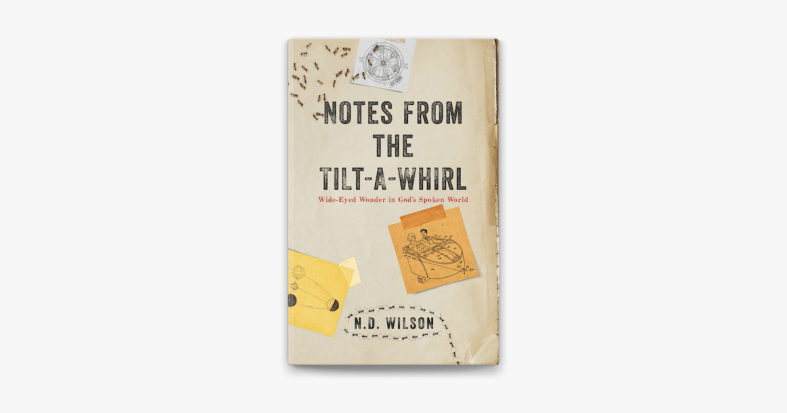
The book’s main point of view is that God is an artist, constantly creating in ways that we can’t reproduce or even fully understand.  God is always speaking things into existence and sustaining those things, including us.  “The world cannot exist apart from the voice of God,” and we are “a glop of paint, a character on a stage, an extra in a musical” in God’s creation.  Everything we create is an imitation of His infinite creativity.  Even the painter Jackson Pollock, when trying to create art that looks random and without design, can’t avoid the fact that he is its creator and that he created it on purpose.  It wouldn’t exist otherwise.

There’s also a good deal of philosophy in this book, but in a philosophy-for-poets kind of way that goes just deep enough so you can follow where he’s going, which is usually to show how the philosophy falls short of what the gospel offers.  He covers a lot of different viewpoints and always with a touch of whimsy (and at times a little condescension).  There’s a bit of Hume, a bit of Nietzsche, and a few others.

My favorite part of the book was his answer to an unbeliever who asked him whether he thought she was going to hell.  I won’t spoil it here (you’ll have to read it to find out), but I’m not sure C.S. Lewis could have come up with a better response.  If or when I’m asked that question, I hope I remember it.

For some the book’s whimsicality may seem irreverent as it explores our strange universe in all its forms over time.  For instance, Wilson at one point wonders: “As for God, His Son turned water into wine.  And so we end the story before He turned that wine into urine.  (Should we deny that He did?)”.  Sometimes Wilson goes for shock value to make us think, and here he asks us whether we really consider how complex and yet orderly this world really is, and how we think about the miracles Jesus performed.  And speaking of shock value, now is also probably a good time to warn you that there is a little bit of bad language in the book, if that bothers you.

So, if you’re looking for something to read that is likely very different from other things you read (at least for me), pick up Notes from the Tilt-a-Whirl by N.D. Wilson.  It was very funny, thought-provoking and edifying all at the same time.  I look forward to reading it again, and soon!

Check it out.

A Detour into the Total Perspective Vortex

In the previous post in this series on our Master’s voice, I wrote that: “We can’t see the reasons God wants us to trust Him because there is far more at work than we could ever imagine.”  Sometimes truth is stranger than fiction, but sometimes great illustrations come from strange fictional places, like Jim Carrey movies and Douglas Adams books for example.

In The Restaurant at the End of the Universe,[1] the sequel to the sci-fi comedy classic The Hitchhiker’s Guide to the Galaxy, author Douglas Adams imagines a technology that harnesses full awareness of the universe as a profoundly cruel torture device.  When Trin Tragula invented the “Total Perspective Vortex” to annoy his wife who kept accusing him of blowing things out of proportion, he found that when he tested it on her, “the shock completely annihilated her brain.”  A victim is placed in the TPV and presented with a realistic model of the entire universe, with a tiny dot on top of a tiny dot that says, “you are here.”  He concluded that “a sense of proportion” in such a massive universe would only make someone feel completely insignificant, hopeless, and insane beyond all hope of recovery.  It’s a sci-fi comedy, but still, be careful what you wish for.

Another example from a different angle is the Jim Carrey movie, Bruce Almighty.  This hilarious (but irreverent) comedy is based on Carrey’s character Bruce Nolan raging against God about his frustrating life.  God, played by Morgan Freeman, appears and challenges Bruce to do any better, giving him “the job” for a temporary period to teach him a lesson.  The 3-ish-minute video embedded here is my favorite part of the movie, where Bruce tries to figure out how to deal with his new awareness of all the prayers of the world.

If God thought it was possible, or a good idea, for us to know it all, we would.  After all, even Nipper the dog from the “His Master’s Voice” painting would be distracted and unable to get anything done if he saw this picture, even though it contains only good news:

Our Master speaks to us as our creator, knowing both our limitations, but also what we are capable of as His marvelous creatures if we trust Him!

This post is fourth in a series that started with this post on His Master’s Voice. More to come…


[1] Adams, Douglas. The Restaurant at the End of the Universe.  (1980).  P. 79

In Search of a Winning Philosophy

In 1 Timothy 1:3-4 Paul writes to Timothy: “As I urged you when I was going to Macedonia, remain at Ephesus so that you may charge certain persons not to teach any different doctrine, nor to devote themselves to myths and endless genealogies, which promote speculations rather than the stewardship from God that is by faith.”

In his commentary on the verse, John Calvin adds: “He judges of doctrine by the fruit; for every tiling that does not edify ought to be rejected, although it has no other fault; and everything that is of no avail but for raising contentions, ought to be doubly condemned.”

When I came across Calvin’s note last week, it reminded me of the linked Monty Python video of philosophers philosophizing about soccer while simultaneously “playing” soccer.

Every doctrine and institution of the church should empower His people to live for Him. Are we playing the right game, and are we playing to win?