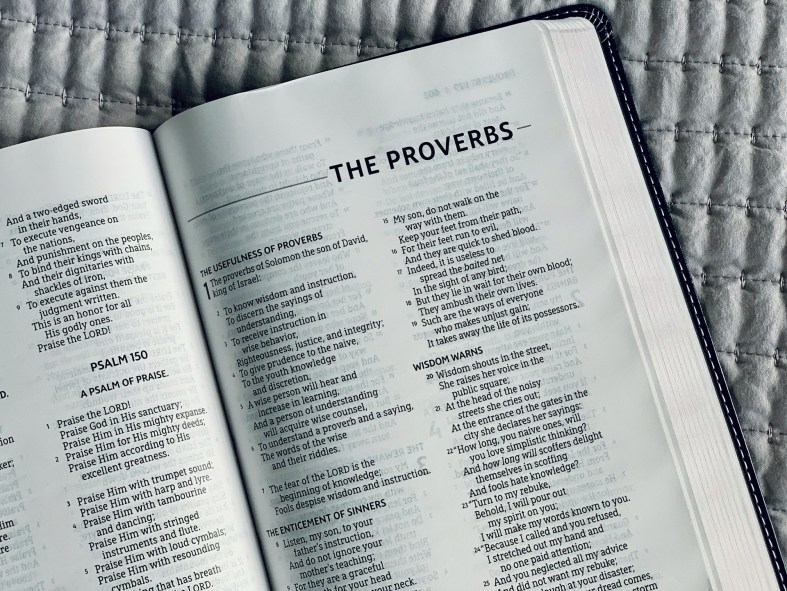
Instead of my usual “quint of quotes” here are 5 Bible verses (a quint of verses doesn’t sound as good), one from James and the others from Proverbs that expand on the idea from James. Thanks to the ESV Study Bible notes for the idea.
“Know this, my beloved brothers: let every person be quick to hear, slow to speak, slow to anger; for the anger of man does not produce the righteousness of God.” – James 1:19-20
“When words are many, transgression is not lacking, but whoever restrains his lips is prudent.” – Proverbs 10:19
“Whoever belittles his neighbor lacks sense, but a man of understanding remains silent.” – Proverbs 11:12
“A soft answer turns away wrath, but a harsh word stirs up anger.” – Proverbs 15:1
“Even a fool who keeps silent is considered wise; when he closes his lips, he is deemed intelligent.” – Proverbs 17:28
I am on vacation this week, so I’ve collected some old posts about James 1:27 for the week. I’m reposting them as is, but they definitely need some editing!
The gospel is more than just the good news that Jesus took the punishment for our sin, dying for sinners like us so that we may be saved. The gospel is also the good news of what the punishment has been replaced with – the kingdom of heaven. If the gospel is about a kingdom, our lives should reflect the values of our King and we should seek for others what our King would offer.
This post, another in the series on James 1:27 (“Religion that is pure and undefiled before God the Father is this: to visit orphans and widows in their affliction, and to keep oneself unstained from the world,”) is about that verse as an ethic that prioritizes the gospel over all other issues by looking briefly at the issue of slavery.
The period of the American Civil War was similar to modern times in its obsession over issues. While its naïve and vastly simplified to say the North was anti-slavery and the South was pro-slavery, it is not entirely false either. Those views were typical of many in each area. Both sides had a high conviction in their cause, using the Bible to justify why their side needed to win, and at what costs.
Paul’s Concern Was for Individuals Part of the reason for this confusion comes from the apostle Paul’s comments on slavery, which seem ambivalent to many on the actual issue of slavery. One relevant passage is Ephesians 6:5-9, in which Paul writes:
“Bondservants, obey your earthly masters with fear and trembling, with a sincere heart, as you would Christ, not by the way of eye-service, as people-pleasers, but as bondservants of Christ, doing the will of God from the heart, rendering service with a good will as to the Lord and not to man, knowing that whatever good anyone does, this he will receive back from the Lord, whether he is a bondservant or is free. Masters, do the same to them, and stop your threatening, knowing that he who is both their Master and yours is in heaven, and that there is no partiality with him.”
Verses like these were used to justify slavery during the American Civil War and at other times, by people claiming that Paul did not condemn it. Since the War, others have said that Paul was cruel not to condemn slavery and a few even refuse to read Paul’s words in the Bible, claiming they have no authority because of this cruelty. This topic goes way beyond what can be covered here, but the reason for Paul’s seeming ambivalence on the issue is that his focus was somewhere else: on the specific individuals involved in all aspects of slavery, including both masters and slaves. He even addresses them directly and separately: “Bondservants” and “Masters.” One group was to follow what was addressed to them, and the other group was to follow what was addressed to them. Why did he take this approach? Because people matter more than issues.
Having no power to end slavery, which still exists today, Paul did have influence and authority as an apostle to improve the lives of specific masters (who would have to justify their actions to God), and of specific slaves (who would have to do the same). Paul knew the real question before him was: If slavery currently exists and I have no power to end it, should I do nothing to improve the condition of slaves until slavery is 100% abolished? Should Paul have focused on ending slavery, or on improving the lives of people affected by it, and offering them a way to eternal life without slavery? Paul knew God’s heart goes out to individual souls, and the issue of slavery would be eliminated in eternity. However, many would condemn Paul for not going straight to an all-or-nothing, hyperbolic position we expect when talking about issues. Also, it’s not necessarily an either/or, but a matter of priority and emphasis.
Some approach contentious issues like the Pharisees of Jesus’ day, “They tie up heavy burdens, hard to bear, and lay them on people’s shoulders, but they themselves are not willing to move them with their finger.”[1] These burdens take the form of ostracism, public humiliation, insistence on use of #hashtags and slogans, rude comments, and other means of hating others simply because those others don’t think the weight of all the issues in the entire world need to be on everyone’s shoulders. But Paul presents a contrast to this. He knew God called him to proclaim grace and peace to all people, in Jesus’ name. Paul’s ministry saved many souls for an eternity where slavery is no longer an issue, and in the meantime, slavery still exists as an issue people mistreat each other over. Yes, we should fight for peace and justice, but not at the expense of individuals, on either side.
D. A. Carson, a professor at Trinity Evangelical Divinity School, said, “The overthrowing of slavery, then, is through the transformation of men and women by the gospel rather than through merely changing an economic system…In the final analysis, if you want lasting change, you’ve got to transform the hearts of human beings. And that was Jesus’ mission.”[2]
During the Civil War, Abraham Lincoln said “My concern is not whether God is on our side; my greatest concern is to be on God’s side, for God is always right.” This should be our main concern as well.
“Religion that is pure and undefiled before God the Father is this: to visit orphans and widows in their affliction, and to keep oneself unstained from the world.”
[1] Matthew 23:4 [2] Strobel, Lee. The Case for Christ (1998). P. 168
I am on vacation this week, so I’ve collected some old posts about James 1:27 for the week. I’m reposting them as is, but they definitely need some editing!
It’s become cliché to say social media brings out the worst of people, since they can hide from consequences behind internet anonymity and distance. Mike Tyson, one of the greatest heavyweight boxers of all time, said “Social media made y’all way too comfortable with disrespecting people and not getting punched in the face for it.” But disrespect and wanting to punch people in the face who disagree with us is nothing new. Just one generation after Adam and Eve were made in the image of God and living in perfect love, their son Cain killed his brother Abel for uncertain reasons. Genesis also doesn’t tell us exactly how Cain killed Abel, but we can be sure social media wasn’t involved. Hate doesn’t require an internet connection or working Wi-Fi, only one person deciding that another person is a thing to be defeated, not as a person made in God’s image. Sometimes by focusing on what we are disagreeing about, we can lose sight of the fact that the person disagreeing with us is inherently valuable.
Today, after months away, we return to a series on James 1:27, which says: “Religion that is pure and undefiled before God the Father is this: to visit orphans and widows in their affliction, and to keep oneself unstained from the world.” James gave careful thought to this phrase, not as hyperbole, but as an example of what perfect religion – worship of God the Father – looks like. Eternal life is for people who love when there’s nothing more at stake than the person being loved, but putting issues above people is one way we get stained by the world and fail to represent Christ. Note that I didn’t say ignore the issues – it’s a question of priority.
The Singular Person Psalm 113 is a Psalm about praising God and making Him known throughout the world, and ends with a very specific praise:
“He gives the barren woman a home, making her the joyous mother of children. Praise the LORD!”
To me, what’s most striking here is that this is a singular barren woman, not barren women as a group. It doesn’t say that God ends all barrenness (although He might). The Psalmist chose as a climactic ending to this poem about the heart of God and how He wants to be known a praise to God for giving a home and family to one barren woman. This means that the sovereign God of all the universe is concerned about individuals, their specific circumstances, and their specific need for salvation. He does not respond to an “issue” of the barrenness of women but responds in a way that satisfies the needs of individual people. People are not statistics to Him, to be counted and divided into opposing sides until one prevails over the other. Each person’s needs and path to redemption are unique in God’s eyes, and only He can provide for all. He is the only way to a perfect world.
Similar to the “barren woman”, James 1:27 is about visiting specific “orphans and widows,” not fighting for the end of all afflictions for all widows and orphans. He is fighting for people, not total victory in an argument. While this might seem obvious to some, it’s so easy to exalt issues over people that we don’t always notice when we do it.
The Issue of Family A common issue today is “family,” which I put in quotes because as an issue it doesn’t mean the same thing to everyone. A lot of time and energy is put into fighting for “family values,” defined many different ways, and James 1:27, “Religion that is pure and undefiled before God the Father is this: to visit orphans and widows in their affliction, and to keep oneself unstained from the world,” is relevant in multiple ways.
First, an earlier post of this series, said “whatever its source, civil law is a provision for a fallen world, not a pathway to a perfect world.” In both the Old and New Testaments, God tells us there will always be poor in the land and that every civil law is inherently limited in a broken world. Christians should “defend the family,” but in what way? James 1:27 says to stand for individuals for whom the institution of family has already failed – widows and orphans. “Pure and undefiled religion” succeeds where law fails, filling the gap with the heart of God, who cares for the specific “barren woman” of Psalm 113:9. There is no perfect law that solves the issue of “family values,” therefore “visit orphans and widows in their affliction.” Affliction comes in many forms and is too complex and diverse for any government to deal with entirely.
Second, when we fight for perfection in our laws, taking absolute stands on either side of an “issue,” we risk elevating law to a level it’s not possible of achieving, and we also may justify hurting people in the process, thinking the end result will be worth it somehow. Once we see the world in fully black/white, either/or terms, it becomes easy to think that if only the right side came out ahead, the issue would be resolved, any collateral damage can be explained, and everyone would be happy. However, consider the extreme example of violence around both abortion clinics and crisis pregnancy centers. In that case and many smaller ones, when we cause harm to opponents, we prove that there are cracks in our own system, creating new victims on top of the existing ones. Those left behind haven’t been helped, but new affliction has been added by those hoping it will be somehow worth it to win the “issue” battle.
Third, ministering to widows and orphans keeps us from the pollution of the world which insists that our salvation is political and based on power. James 1:27 encourages us to reject a world that wants to put laws, culture, even hashtags above actual people. The world too often believes the ends justify the means because belief in worldly utopia depends on a 100% solution, but also believes it’s ok to ignore concrete problems while fighting for a solution that will never arrive. Salvation comes from only one source: the cross.
In the start of this post, I wrote that it’s become cliché to say social media brings out the worst of people, and its cliché because massive amounts of time and energy go into fighting over abstract issues and dividing into groups of “us” and “them”. James 1:27 says that we are not defined by which side of an issue we support, and what we’re willing to do to achieve victory for our side, but by how we love those individuals for whom this world has failed.
It is better to minister to the ones who have been punched by this world than to add another punch to the damage.
Therefore, “Let us hold fast the confession of our hope without wavering, for he who promised is faithful. And let us consider how to stir up one another to love and good works, not neglecting to meet together, as is the habit of some, but encouraging one another, and all the more as you see the Day drawing near.” – Hebrews 10:23-25
And what are “good works”? “Religion that is pure and undefiled before God the Father is this: to visit orphans and widows in their affliction, and to keep oneself unstained from the world.”
What does a Godly person act like? In Psalm 15, David asks this same question:
“O LORD, who shall sojourn in your tent? Who shall dwell on your holy hill?”
Then David lists a set of qualities that God requires for one to be righteous, and it includes how we swear. At the end of verse 4, David writes that a Godly person is someone “who swears to his own hurt and does not change.”
Some of the qualities in the list are easy to understand, but what does it mean when someone “swears to his own hurt”? David is not writing about swear or curse words. He’s writing about vows or promises made, but not just any vows.
There are vows that are hurtful, but are not qualities of a Godly person, such as when Saul vowed in 1 Samuel 14:24 – “Cursed be the man who eats food until it is evening and I am avenged on my enemies.” This vow resulted in a death sentence for Saul’s son Jonathan, which was overruled by the people. Another example is Jephthah, who vowed in Judges 11:30-31 – “If you will give the Ammonites into my hand, then whatever comes out from the doors of my house to meet me when I return in peace from the Ammonites shall be the LORD’S, and I will offer it up for a burnt offering.” This resulted in a death sentence for his own daughter, who was the first to come out of the house when he returned in peace. Saul and Jephthah swore to their own hurt, but this type of swearing is not a quality of a Godly person.
There are also vows that help us get ahead in this world. An honest reputation is good for a career or in getting along with people and feeling successful. But it’s easier to keep your word when there is a tangible benefit in this world. Honesty in these situations is not necessarily bad, but it just doesn’t rise to the level of righteousness. These vows are not what David is writing about either.
What David means by someone “who swears to his own hurt and does not change” is a person who is honest because it’s what God is and what God wants from us, no matter what it costs them. Even if honesty brings no benefit to the honest person, they remain honest anyway.
Maybe you’ve promised a spouse or friend that you will help with a project this weekend, but then you get a call from another friend who has tickets to a big game. Maybe you’ve promised to play with your children or help with their homework, but then remember you have a work project that requires after-hours time to get done. Maybe vowing to be honest at work means you have to reveal something that could hurt your businesses’ reputation? A person who “who swears to his own hurt and does not change” is not affected by changes in circumstances, whether they might miss out on something, or whether there is a personal cost.
Is this difficult? Yes. It’s so difficult that James wrote: “my brothers, do not swear, either by heaven or by earth or by any other oath, but let your ‘yes’ be yes and your ‘no’ be no, so that you may not fall under condemnation.”[1] To James, keeping vows was so hard that it was something to be avoided. So…
“O LORD, who shall sojourn in your tent? Who shall dwell on your holy hill?”
Who? Jesus, the only one who ever kept all of their vows and promises, and offers His righteousness to us, both as a means for our salvation, but also as a model for us to follow. He alone has fully done what is necessary for anyone to dwell in God’s presence.
What are the most challenging parts of your life? Maybe your job has been difficult recently. Maybe you have a ministry that has been exhausting or frustrating. There may be difficult people or relationships in your life. It could be anything, but we all have difficult tasks at times.
King Solomon was given a very difficult task by God, to govern His people Israel as their king. Solomon knew this job was too big for him, saying in 1 Kings 3:7-8, “O LORD my God, you have made your servant king in place of David my father, although I am but a little child. I do not know how to go out or come in. And your servant is in the midst of your people whom you have chosen, a great people, too many to be numbered or counted for multitude.”
Solomon’s response was not to despair or give up, but to rely on God, in verse 9 asking him to “Give your servant therefore an understanding mind to govern your people, that I may discern between good and evil, for who is able to govern this your great people?” God answered Solomon’s prayer and gave him wisdom that made him world-famous. The wisdom that only comes from God.
But this wisdom isn’t just for kingly or other grand duties. Just as Solomon did, we can all pray for God to give us wisdom to manage our lives better – those hard jobs, difficult relationships, challenging ministries, and other things. God doesn’t always solve our problems or remove our difficulties, but He does want to help us live wisely in the midst of them. If He has given us things to manage, He will also give us the resources to manage them, including wisdom.
Therefore, “If any of you lacks wisdom, let him ask God, who gives generously to all without reproach, and it will be given him.” (James 1:5)



 Driving Toward the Morning Sun