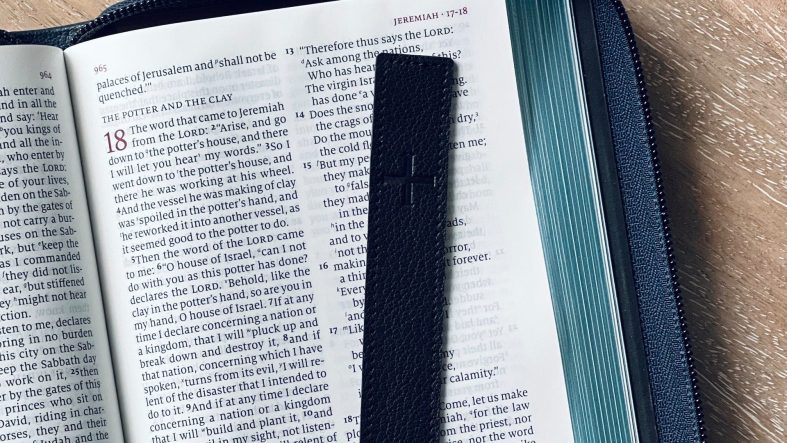
God Equips Those He Calls

When Jeremiah was called to serve as a prophet in the Old Testament, God told him he was literally made for it in Jeremiah 1:5 –

“‘Before I formed you in the womb I knew you,
            and before you were born I consecrated you;
            I appointed you a prophet to the nations.’”

However, Jeremiah’s response was not an enthusiastic one.  Jeremiah 1:6-8 records this exchange:

“Then I said, ‘Ah, Lord GOD! Behold, I do not know how to speak, for I am only a youth.’  But the LORD said to me,
            ‘Do not say, ‘I am only a youth’;
            for to all to whom I send you, you shall go,
            and whatever I command you, you shall speak.’”
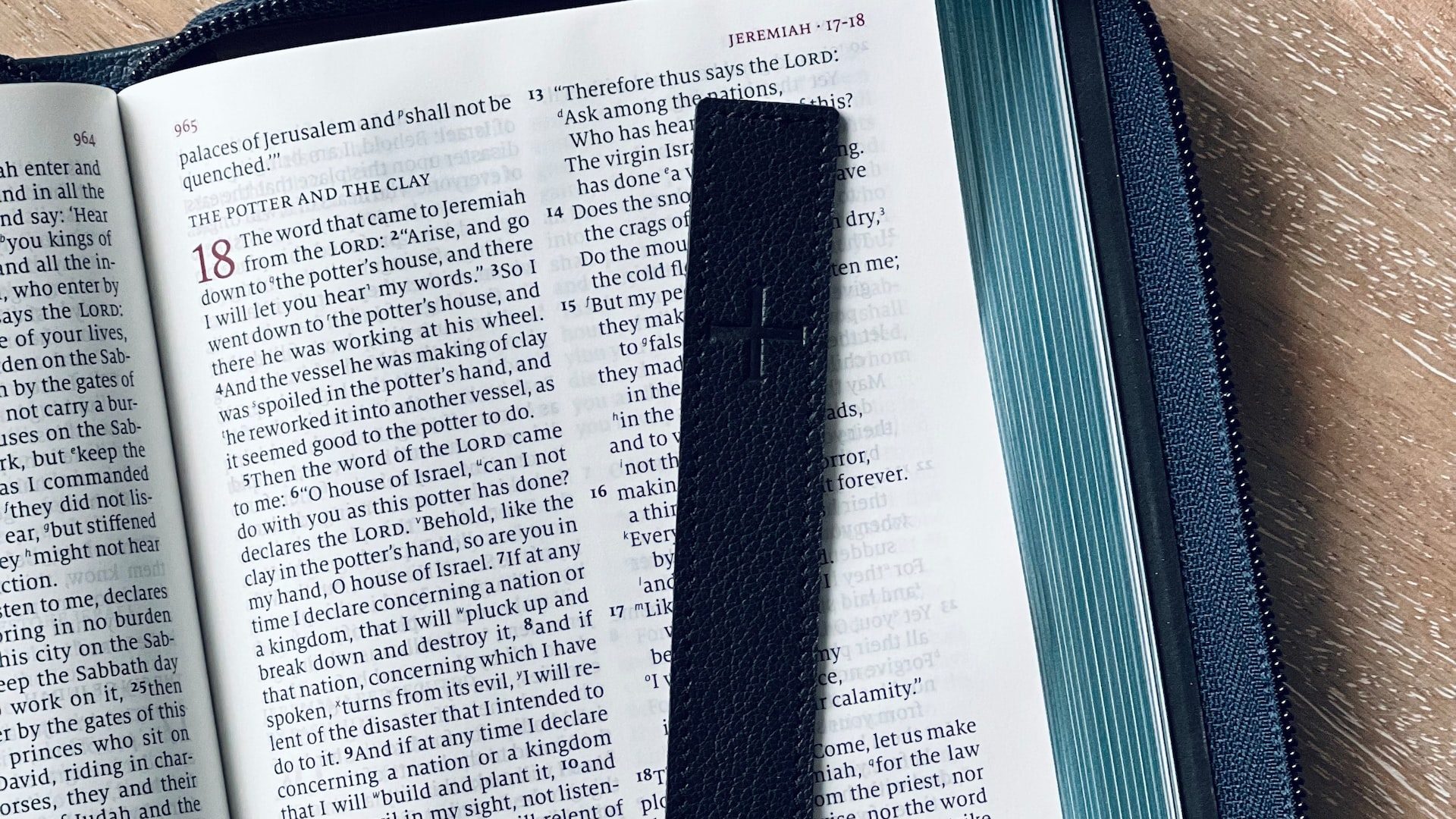
Photo by Tim Wildsmith on Unsplash

Even though God had just said “Before I formed you in the womb I knew you,” Jeremiah objects that he was too young and did not have the natural ability required for the job.  Maybe he doubted anyone would listen to him, so God must have the wrong guy.  God doesn’t disagree that Jeremiah was young (he already knew that), but knows that God’s ability is what matters, not Jeremiah’s.  God knew that someday you and I would be reading Jeremiah’s words regardless of his own youth or ability.  God never picks the wrong person for the job.

But if “All Scripture is breathed out by God and profitable for teaching, for reproof, for correction, and for training in righteousness,”[1] why does the Scripture tell us that one of its own authors doubted and questioned God Himself?

The answer of course, is “for teaching, for reproof, for correction, and for training in righteousness.”  We should learn not only from Jeremiah’s prophecies to the people of his time, but also from His experience with God.  In hindsight, we think that because Jeremiah is a book of the Bible, of course he was able to do the work God gave him, but in the moment of his call, Jeremiah had no idea.  So, when we think our ability is not enough for the job at hand, we should remember Jeremiah’s youth and remember that “God does not call the equipped; He equips the called,” as the saying goes.  Jeremiah learned this from his own experience, and we may learn from it as well because the Bible records it.

Also, God shows us Jeremiah’s flaws to comfort us when we feel inadequate, not only in ability but also in faith.  Even if we know that “God does not call the equipped; He equips the called,” we don’t always act on that knowledge.  Jeremiah doubts not only his call, but there are other examples, including when he questions why he should buy a field the Babylonians were about to seize.[2]  Doubt is not something that only some Christians feel – we are not alone in our weakness.  Even the Bible’s own authors had doubt because they could not see as God sees.

God is patient when we are honest with Him about our doubts, but He is also honest with us when He says we were literally made to serve Him.  No Christian is inadequate for the work God gives them, for in His power He accomplishes what He wants. He has no doubts and is faithful in providing everything we need.

Sometimes God sends us before we think we are ready, so we can learn to put our confidence in the right place like Paul, who wrote: “I can do all things through Him who strengthens me.” – Philippians 4:13


[1] 2 Timothy 3:16
[2] The story is in Jeremiah 32, which I covered in an earlier post, here.

Called to Be Our Consecrated Selves

Photo by Greg Rakozy on Unsplash

People have moments where they wish they had a greater role in the world around them.  We see other people around us, or in stories from the Bible or in the news, and think we’d like to be more like them.  More influential, more effective, more powerful.  For example, what if I could be a prophet or an apostle?  Or in our modern world, maybe a “social media influencer”?  “Be yourself” is often the advice for finding contentment when we feel like this, but the Bible says we are “to be conformed to the image of his Son.”[1]  So, should we be ourselves, or should we be like Jesus?  What will give us contentment?  While not a full answer, the call of Jeremiah the prophet offers some help.

Jeremiah was not a prophet by accident, because Jeremiah 1:4-5 says:

“Now the word of the LORD came to me, saying,
‘Before I formed you in the womb I knew you,
            and before you were born I consecrated you;
            I appointed you a prophet to the nations.’”

Here, God calls Jeremiah both to conform his ways to God’s, and also to his own specific task.  Like Jeremiah, every Christian is known by God and called to do His will.  Only God knows why we were each made the way we were made, and in a way God calling us to serve Him is like Him saying “stop living like you’re an accident of a random, purposeless world.”  It is because we were made, not just evolved, that we have purpose, and God has “consecrated” us to that purpose.

Stop living like you’re an
accident of a random,
purposeless world.

But each of us was made differently, also on purpose.  Unlike Jeremiah, my fellow travelers on this blog probably aren’t prophets, and that is part of why Jeremiah needed to be a prophet.  His job wasn’t to call everyone else to be a prophet, but to serve everyone else by calling them to find their own purpose in God.  Jeremiah wanted all of God’s people to take whatever He has endowed them with and dedicate it to Him.  Likewise, being “conformed to the image of” Jesus does not mean we should all be carpenters, but that we should apply His righteousness to every task He puts before us.

Therefore, God’s people should never live like they are an accident.  We are all a valuable work of creation, made to find our good and His glory in His amazing design.  We will find our true selves in the One who made us, and God’s people will have unity in Christ’s character, combined with diversity in the infinite creativity of the people He created.

Be yourself, and also be like Jesus.

“For we are his workmanship, created in Christ Jesus for good works, which God prepared beforehand, that we should walk in them.” – Ephesians 2:10


[1] Romans 8:29

God Has a Plan for Your Life

In a commonly quoted Bible verse, the prophet Jeremiah says in Jeremiah 29:11 – “For I know the plans I have for you, declares the LORD, plans for welfare and not for evil, to give you a future and a hope.”  But who was Jeremiah talking to and what were God’s plans at that time?  God was about to exile Israel from the Promised Land and take away all of their cherished (and God-given) political and religious institutions.  Jerusalem and the temple would be torn down and burned by the Babylonians, while God would tell the Jews to love their brutal enemy, and to be a blessing to them[1], contributing to the prosperity of the Babylonian kingdom.  After 70 years of exile, Jerusalem and the temple would be rebuilt, but disappointing: “many of the priests and Levites and heads of fathers’ houses, old men who had seen the first house, wept with a loud voice when they saw the foundation of this house being laid”.[2]

This is not the plan I would wish on any of us, but it was God’s will at the time, to discipline His people.  Clearly, God has different plans for each one of us – specific to us and not a photocopy of specific Biblical people or situations.

The prophet Isaiah provides an excellent picture of how God has plans for each of us individually.  Right after declaring that God would lay a new cornerstone, a new foundation, in Zion[3] (later revealed to be Jesus), he declares in Isaiah 28:23-26:

“Give ear, and hear my voice;
         give attention, and hear my speech.
Does he who plows for sowing plow continually?
         Does he continually open and harrow his ground?
When he has leveled its surface,
         does he not scatter dill, sow cumin,
and put in wheat in rows
         and barley in its proper place,
         and emmer as the border?
For he is rightly instructed;
         his God teaches him.”

Isaiah describes how a farmer works diligently with God-given wisdom to plant his crops.  The farmer does things step by step, plowing, then sowing each plant according to its kind.  Some crops grow best in rows, and some are suitable as borders.  Everything is in its time and place.  Isaiah then continues with verses 27-29:

“Dill is not threshed with a threshing sledge,
         nor is a cart wheel rolled over cumin,
but dill is beaten out with a stick,
         and cumin with a rod.
Does one crush grain for bread?
         No, he does not thresh it forever;
when he drives his cart wheel over it
         with his horses, he does not crush it.
This also comes from the LORD of hosts;
         he is wonderful in counsel
         and excellent in wisdom.”

Here, some crops need to be threshed or even crushed, but other crops do not.  All of the farmer’s work is done with God’s wisdom.  Yet is Isaiah only concerned with crops?  No, because the context in Isaiah is a story of Judah’s discipline, followed by a restoration. Just as a farmer’s wisdom in dealing with crops is from God, in the same way God knows how to deal with His people skillfully, to each as needed.

The Reformation Study Bible notes on verse 29: “Yet the Lord is wiser than any good farmer…and knows exactly the methods to use to cultivate His harvest—when to judge and when to restore His people.”  As different grains need to be planted and treated differently, so God treats each person according to His own intentions for them and to their own needs.  After laying the cornerstone of Jesus Christ, God, like a farmer, knows how to deal with each of His people individually, giving each exactly what they need when they need it, building His family diligently, step by step, and with infinite wisdom.

Therefore, when Jeremiah says: “For I know the plans I have for you, declares the LORD, plans for welfare and not for evil, to give you a future and a hope,” he declares the general principle that for each of us, God has a plan, a future, and a hope.  The Lord delivers us from evil and provides for our welfare in eternity for all time, after our sojourn in this world is complete.

For every meal, thank a farmer, but for every opportunity to grow in Christ, in good times and in bad, thank the Lord for His wisdom in dealing with you as an individual.  Only He, as Creator, knows best how we are broken and how we are intended to be.

“And I am sure of this, that he who began a good work in you will bring it to completion at the day of Jesus Christ.” – Philippians 1:6


[1] Jeremiah 29:7
[2] Ezra 3:12
[3] Isaiah 28:16

“Let Not the Flood Sweep Over Me”

A recent post was about Jeremiah’s comparison of false religion to a broken cistern, with God alternatively being “the fountain of living waters.”[1]  Jeremiah lived when most of God’s people – including most of the priests and prophets – had turned from Him to follow other gods.  As Jeremiah remained faithful, correctly predicting that Jerusalem would fall to Babylon, he was persecuted, including this instance in Jeremiah 38:6, where King Zedekiah’s officials “took Jeremiah and cast him into the cistern of Malchiah, the king’s son, which was in the court of the guard, letting Jeremiah down by ropes. And there was no water in the cistern, but only mud, and Jeremiah sank in the mud.”

Since God is “the fountain of living waters,” the only path to eternal blessing, it’s incredibly ironic that Jeremiah, one of the few remaining faithful prophets and therefore a rare source of God’s “living waters,” should be cast into a cistern with no water.  Perhaps it was broken.  King Zedekiah thought he could silence the “living waters” Jeremiah represented by casting them into a cistern, trading truth for falsehood.

Photo by Mishal Ibrahim on Unsplash

Later, Jeremiah seems to recall the cistern experience in Lamentations 3:52-57, where he said:

“I have been hunted like a bird
            by those who were my enemies without cause;
they flung me alive into the pit
            and cast stones on me;
water closed over my head;
            I said, ‘I am lost.’
‘I called on your name, O LORD,
            from the depths of the pit;
you heard my plea, ‘Do not close
            your ear to my cry for help!’
You came near when I called on you;
            you said, ‘Do not fear!’”

Returning to the book of Jeremiah, we read that Ebed-melech, an Ethiopian eunuch, heard of Jeremiah’s situation and pleaded his case: “My lord the king, these men have done evil in all that they did to Jeremiah the prophet by casting him into the cistern, and he will die there of hunger, for there is no bread left in the city.”[2]  This unlikely source – a foreigner – was Jeremiah’s deliverance from God to rescue Jeremiah from the well.  Ebed-melech gathered 30 men, “Then they drew Jeremiah up with ropes and lifted him out of the cistern. And Jeremiah remained in the court of the guard.”

Jeremiah was not the only Old Testament figure to suffer for his faithfulness.  Many years earlier, King David also referred to “sinking in the mire” in the Messianic Psalm 69, verses 14-15:

“Deliver me
            from sinking in the mire;
let me be delivered from my enemies
            and from the deep waters.
Let not the flood sweep over me,
            or the deep swallow me up,
            or the pit close its mouth over me.”

David knew this feeling of sinking came not because of his sin, but when he was faithfully serving his Lord.  David’s “sinking in the mire” happened under these circumstances from verse 9 of the same Psalm:

“For zeal for your house has consumed me,
            and the reproaches of those who reproach you have fallen on me.”

In Jeremiah’s case, as well as David’s and that of Jesus, whom Psalm 69 foreshadowed[3], we know we that cannot judge our faithfulness based on whether it improves our circumstances.  When we do, we might stop being faithful because it seems we are “sinking in the mire.”  Being reproached by the world and feeling down aren’t the circumstances we prefer, but “Blessed are those who are persecuted for righteousness’ sake, for theirs is the kingdom of heaven.”[4]  Through these and all other circumstances, God develops in us deeper trust in Him.

Therefore, with David may we pray:

“But as for me, my prayer is to you, O LORD.
            At an acceptable time, O God,
            in the abundance of your steadfast love answer me in your saving faithfulness.” – Psalm 69:13

And in His time, He will deliver us, perhaps in ways we don’t expect.

Coda

In 1995, Christian rock group Jars of Clay released their self-titled album, and the track “Flood” has similar themes to this post.  The song was also a mainstream hit, charting as high as No. 12 on the Billboard Modern Rock Tracks chart,[5] amazing for a song that is essentially a prayer like David’s in Psalm 69.

You can check out the song’s lyrics here: https://genius.com/Jars-of-clay-flood-lyrics

Or, if you have 3 ½ minutes, watch the music video here:


[1] Jeremiah 3:13
[2] Jeremiah 38:9
[3] John 2:17, 15:25, Acts 1:20, Romans 11:9-10, 15:3
[4] Matthew 5:10
[5] https://en.wikipedia.org/wiki/Flood_(Jars_of_Clay_song)

Broken Cisterns Can Hold No Water

Sometimes word pictures in the Bible weren’t written for people like me.  In my life I haven’t thought much of cisterns, but the Old Testament prophets Isaiah and Jeremiah refer to them a few times in their prophecies, and Jeremiah ends up thrown into one.  To Jeremiah’s original audience, and others living now, the meaning behind these pictures might be obvious.  But for me, it took a little research.

A cistern-centered comparison in Jeremiah 3:12-13 particularly drew my attention, where broken cisterns are used as a picture of false religion and idolatry:

“Be appalled, O heavens, at this;
            be shocked, be utterly desolate,
            declares the LORD,
for my people have committed two evils:
they have forsaken me,
            the fountain of living waters,
and hewed out cisterns for themselves,
            broken cisterns that can hold no water.”

God is the “fountain of living waters,” but how is false religion like “broken cisterns”?

Looking up “cistern” in the American Heritage Dictionary I find it is: “A receptacle for holding water or other liquid, especially a tank for catching and storing rainwater.”  So, a cistern is not a fountain, a source of water, but instead is dependent on another source (usually rain) for its water.  So, Jeremiah’s accusation is that false religion can’t create its own water, which brings us to the second point…

The false religions of Judah in Jeremiah’s day weren’t even good cisterns – they were broken.  While a cistern is a vessel for storing water in reserve when there is no rain, when broken it’s not even that.  Even with another source of water, putting it into a broken cistern was no better than pouring it out into the sand.  Jeremiah’s second accusation is that false religion can’t even store good things from other sources.  The picture here is that if they took parts of true worship and mixed them with other religions, not only were the other religions wasted, but whatever they would have gained from God is also wasted.

Without God, many things are like broken cisterns.  Things that make us happy in this world are temporary and require our Creator God to provide us with more.  A food you like might satisfy you for a while, but eventually you need to find more food.  Rain may satisfy your garden plants, but eventually they will need more water.  Money may seem alluring for its own sake, but it only buys things that are temporary like everything else.

In Jeremiah 2:18, he tells the people not to look anywhere other than the true God of Israel for the source of living water and eternal satisfaction:

“And now what do you gain by going to Egypt
            to drink the waters of the Nile?
Or what do you gain by going to Assyria
            to drink the waters of the Euphrates?”

Like a cistern, even the Nile and Euphrates only get their water from some other source.  They can’t make their own, and God can even determine if the rivers are empty or full.  Later, in Jeremiah 14:2-3, he says that because Judah had forsaken God, He had caused a drought, and therefore:

“Judah mourns,
            and her gates languish;
her people lament on the ground,
            and the cry of Jerusalem goes up.
Her nobles send their servants for water;
            they come to the cisterns;
they find no water;
            they return with their vessels empty;
they are ashamed and confounded
            and cover their heads.”

The people mourned their earthly problem but did not care about their spiritual problem which is infinitely more important.  No provision – any science, philosophy, or religion – can defend against a drought caused by forsaking God, because false gods – anything we put in His place – cannot deliver rain.  They are but broken cisterns.

Consider that if there is no Creator behind the workings of nature, or if that Creator doesn’t care about us, why should we expect the world to act in ways that predictably bless us, instead of just being completely unpredictable and random?  Why do things seem to work most of the time?  Rain, friction, food, gravity, math, and on and on.  Fortunately, our God “sends rain on the just and on the unjust,”[1] and to His own He gives “a spring of water welling up to eternal life”[2]

He calls all people to know Him as “the fountain of living waters.”  No cistern needed.

Soli Deo Gloria


[1] Matthew 5:45
[2] John 4:14