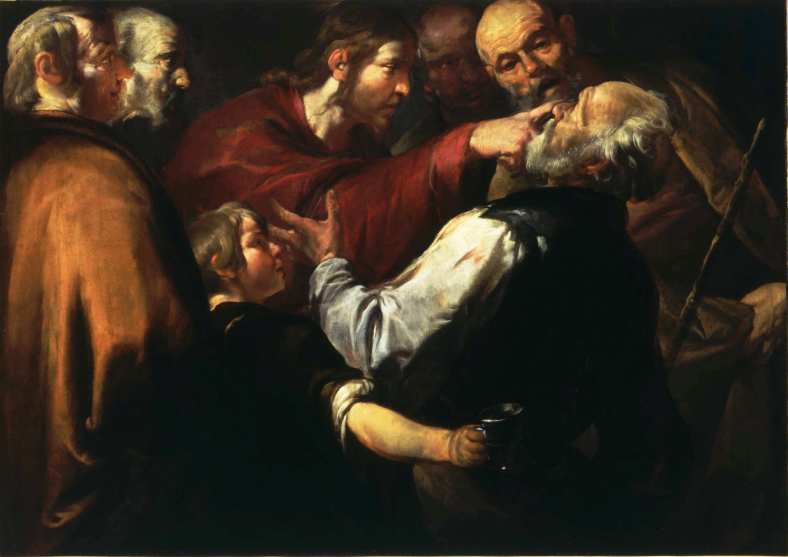
The Gospel is About a Who, not a How

In chapter 9 of John’s gospel he records a story of Jesus healing a man who was born blind.  In John’s story, Jesus made some mud out of saliva and dirt, then put the mud on the man’s eyes.  Then Jesus tells the man to go wash off the mud in a pool.  When the man does this, his blindness is gone!

Because this man was born blind and had begged in the temple area for years, the miracle was hard to deny as a claim that Jesus was the Messiah, but many of the people put their focus on the wrong question: the how of the miracle.  Four times in the chapter someone asks how the man’s eyes were healed, as if the method of the healing was the important part.  Some of “The neighbors and those who had seen him before” asked “how were your eyes opened?[1]  Then some Pharisees asked the man how he was healed.  In both cases, the man formerly blind explained what Jesus had done.

Then, because Jesus had healed the man on the Sabbath and because practicing medicine on the Sabbath was against traditional Jewish regulations, the Pharisees asked, “How can a man who is a sinner do such signs?[2]  The Pharisees kept looking for an explanation.  A scientific or natural explanation.  Perhaps this wasn’t the same man who was born blind.  So they found his parents, “and asked them, ‘Is this your son, who you say was born blind? How then does he now see?’[3]

The better question is who healed the man born blind, but the Pharisees didn’t want to deal with that question.  They had already made up their minds that Jesus wasn’t from God.  So, they focused on the how, on the method.  People still do this today, as Warren Wiersbe wrote: “We want to understand the mechanics of a miracle instead of simply trusting the Savior, who alone can perform the miracle.”[4]

Modern people want scientific explanations because they think nothing exists outside of scientific understanding and when something doesn’t fit that worldview it is denied or explained away.  We want to fit miracles within our pre-existing understanding of the world.  And when we can’t, we resist any way we can.  In the case of the Pharisees and Jesus, “they cast him out.”[5]  Anything to avoid the real question: who is this person who can do things that don’t fit into our narrow view of the universe?  Comparing John’s gospel to modern events, we see this is nothing new.

However, if Jesus is who He said He was – God the Son – no miracle should be unbelievable because God has absolute control over His own creation.  If Jesus is God, He exists outside of our universe and so obviously can’t be explained by using scientific laws that describe this universe.  But we continue to resist.  When people want to avoid dealing with their God, they still stick to the “how” question to avoid the more important question of “who.”

If you’re struggling to understand the miraculous stories of the Bible, make sure you’re asking the right (“who”) questions.  If you’re talking to an unbeliever having the same struggles, make sure they’re asking the right questions, because: If Jesus is who God is, every how is possible, including the greatest miracle: the salvation of anyone who would believe in Him.  And, Jesus can heal anyone who is blind to this reality.


[1] John 9:8-10
[2] John 9:16
[3] John 9:19
[4] Wiersbe, Warren.  Be Alive (John 1-12) (1986).  P. 143
[5] John 9:34

Church is Not a Shopping Mall

I recently had a very strange dream, which occurred (kind of) in the church I went to as a kid.  This church, in Washington, D.C., has been around for over 130 years and meets in a stone building and has an amazing pipe organ in the main sanctuary.  The appearance and structure of the church communicates permanence and tradition.

In this dream, I was roughly a teenager on one end of the church building but had to meet up with my family at the other end of the building.  I started out in a place that seemed like the church I knew, but as I travelled to the other end, things got really bizarre.  First, the size of the building seemed to keep expanding and the number of people in it kept multiplying.  Soon I noticed that there was a gift shop selling all sorts of kitsch that had nothing to do with religion.  I kept going in the same direction, trying to find my family, but the building just kept growing as I went, eventually having many levels, with huge moving walkways and escalators.  The dream ended with me still in the church, but this end of it had become a very upscale, very massive, shopping mall.  I remember wondering “how did the church turn into this?”

What to make of this?  Consider what a shopping mall is.  Yes, it’s a large collection of stores in one place, but not a random collection.  Those stores were chosen to be as diverse as possible.  The more of our desires and wants the mall can meet by having different types of stores, the more economically successful the mall will be, and that’s what matters to the mall operator.  People want fancy clothes, jewelry, entertainment, snacks and candy, toys, and many other things.  So, a mall can represent our “do whatever you want” culture.

I wonder if the seed of the dream was something I saw on Twitter a few days before: “There are infinite ways to be non-binary.”  What they were saying is that not only are there not just two genders, but that we can endlessly create new ones with no limit at all.  It’s like a sexual version of the shopping mall, and also a denial that there’s any real right or wrong or that there’s any such thing as an inappropriate desire.  But can we really make ourselves into anything we want to be without consequences?

Consider this: no competent computer engineer would tell us that we can just arrange a diverse group of components any way we want and end up with a working computer.  The engineer isn’t being intolerant or mean, they just know what it takes to make a computer do what it’s supposed to.

Likewise, when Jesus says “Enter by the narrow gate. For the gate is wide and the way is easy that leads to destruction, and those who enter by it are many. For the gate is narrow and the way is hard that leads to life, and those who find it are few,”[1] He is not being intolerant or mean by saying we can’t do whatever we want to, He just knows that we were designed, what we were designed to do, and also what will ultimately satisfy us.

Christian churches are supposed to teach us how to follow Christ, not tell us to do whatever we want to, but now many churches, just like in my dream, have turned into proverbial shopping malls.  In many cases, we’ve forgotten that people are not accidents of random circumstances in nature, and we’ve forgotten that our Creator knows what’s best for us.  We’ve decided to pursue “the way that is easy” forgetting that it “leads to destruction.”  Too many churches, now including the one I went to in DC, say that Jesus will meet whatever needs we think we have, rather than saying that Jesus knows what we need better than we do; that it’s our idea of need that must be changed.

It’s our idea of need
that must be changed

When Jesus said, “For God so loved the world, that he gave his only Son, that whoever believes in him should not perish but have eternal life,” the “world” He loves is the one where we’ve come up with infinite ways to reject Him.  Where we’ve come up with infinite ways to deny that He made us and knows better than us what’s right and wrong, what “leads to life” and what “leads to destruction.”

When God gave His Son, His sacrifice was sufficient for all sin and can cover all the infinite ways we decide to ignore what’s good for us.  Because God loved this world, it’s also true that His people should communicate His love and grace at all times to all people, by word and action.  Yet it’s also true that church is not a shopping mall regardless of what people can imagine in their dreams that it should be.  The church is called to a higher standard of living, a holy standard informed by our Creator’s knowledge of what works.

So, in these troubling times, pray that people will continue to find Jesus, both within and outside the church and what much of it has become.  That God’s people will love holiness, but also love sinners.  Pray that we find the way that is hard but leads to life and that God’s church is a beacon calling people to it.

Amen.


[1] Matthew 7:13-14

Pictures of Holiness and Grace

A picture can be, as they say, worth a thousand words.  To make an impression, sometimes God uses pictures or images, and one example is how He lets us know just how holy He is.

When calling Isaiah to be a prophet, God gave him an image in Isaiah 6:1 “In the year that King Uzziah died I saw the Lord sitting upon a throne, high and lifted up; and the train of his robe filled the temple.”  In this vision of a throne room, why bother to mention that “the train of his robe filled the temple”?  Because in this image of God’s presence, there is no room for anything that isn’t holy.  If anyone tries to walk into the temple, they will tread on the Lord’s robe with their dirty feet, and any lord would be immensely offended at that.  James Boice commented on the verse, that: “This suggests that there is room for no one else at the highest pinnacle of the universe.  It is not just that Jehovah reigns, therefore, but also that no one else reigns beside Him or in opposition to Him”[1]

Photo by Wonderlane on Unsplash

A similar picture of holiness comes from Revelation 15:8, which says: “and the sanctuary was filled with smoke from the glory of God and from his power, and no one could enter the sanctuary until the seven plagues of the seven angels were finished.”  Until God’s judgment was complete – both on the unrepentant and on the cross for His people – there would continue to be no room in the sanctuary for anyone but the Lord.

A third picture, which was not just a vision, but built in actual, physical form, is the “Holy of Holies.”  During most of the Old Testament period, priests implemented an elaborate sacrificial system to illustrate God’s requirements for meeting with sinners: an innocent creature had to die.  These animals symbolized the later sacrifice of Jesus Christ.  But the “Holy of Holies” was the ultimate statement of how serious approaching God is.

This innermost room of the temple was only entered once per year (on the Day of Atonement, or Yom Kippur), and only by the high priest, who only can enter after hours of preparation.  Once there, the high priest would sprinkle the blood of a sacrificed bull on and in front of God’s “mercy seat”, the cover of the ark of the covenant and a sign of His presence.  Later Jewish tradition (not found in the Bible) indicates that others would stand outside the room holding a rope that was tied to the high priest, who also had bells tied around his waist.  If those outside heard the bells jingling, followed by silence, they would assume the high priest did not atone properly for the sins of the people, died in God’s presence, and needed to be dragged out by the rope.  God’s holy presence was to be taken seriously.

So Isaiah, presented with God’s holiness, cried out “Woe is me! For I am lost; for I am a man of unclean lips, and I dwell in the midst of a people of unclean lips; for my eyes have seen the King, the LORD of hosts!”  Isaiah’s “Woe” comes down to current times in the expression “Oy!”  Isaiah knew instinctually that being in God’s temple was a bad idea.  However, God provides redemption for His people, which He pictured for Isaiah like this: “Then one of the seraphim flew to me, having in his hand a burning coal that he had taken with tongs from the altar.  And he touched my mouth and said: “Behold, this has touched your lips; your guilt is taken away, and your sin atoned for.”[2]

Isaiah was not saved by a burning coal, but by what it represented: the future sacrifice of Jesus Christ.  In God’s steadfast love for His people, He offered Jesus once for all, and the only sacrifice necessary and sufficient for us to know God.  Therefore, there is no longer a barrier to His holy presence for God’s people, so the writer of Hebrews says, “Let us then with confidence draw near to the throne of grace, that we may receive mercy and find grace to help in time of need.”[3]

Yes, God is holy and must be honored as holy, but when we feel insufficient or feel like yelling “oy!” when things go wrong, we can come “with confidence” to Jesus in His temple and ask Him to reassure us of His provision for our sin.  That we may know, like Isaiah, that “your guilt is taken away, and your sin atoned for.”

Amen


[1] From “May 9.” James Montgomery Boice and Marion Clark. Come to the Waters: Daily Bible Devotions for Spiritual Refreshment.  (2017).
[2] Isaiah 6:6-7
[3] Hebrews 4:16

“Let Not the Flood Sweep Over Me”

A recent post was about Jeremiah’s comparison of false religion to a broken cistern, with God alternatively being “the fountain of living waters.”[1]  Jeremiah lived when most of God’s people – including most of the priests and prophets – had turned from Him to follow other gods.  As Jeremiah remained faithful, correctly predicting that Jerusalem would fall to Babylon, he was persecuted, including this instance in Jeremiah 38:6, where King Zedekiah’s officials “took Jeremiah and cast him into the cistern of Malchiah, the king’s son, which was in the court of the guard, letting Jeremiah down by ropes. And there was no water in the cistern, but only mud, and Jeremiah sank in the mud.”

Since God is “the fountain of living waters,” the only path to eternal blessing, it’s incredibly ironic that Jeremiah, one of the few remaining faithful prophets and therefore a rare source of God’s “living waters,” should be cast into a cistern with no water.  Perhaps it was broken.  King Zedekiah thought he could silence the “living waters” Jeremiah represented by casting them into a cistern, trading truth for falsehood.

Photo by Mishal Ibrahim on Unsplash

Later, Jeremiah seems to recall the cistern experience in Lamentations 3:52-57, where he said:

I have been hunted like a bird
            by those who were my enemies without cause;
they flung me alive into the pit
            and cast stones on me;
water closed over my head;
            I said, ‘I am lost.’
‘I called on your name, O LORD,
            from the depths of the pit;
you heard my plea, ‘Do not close
            your ear to my cry for help!’
You came near when I called on you;
            you said, ‘Do not fear!’”

Returning to the book of Jeremiah, we read that Ebed-melech, an Ethiopian eunuch, heard of Jeremiah’s situation and pleaded his case: “My lord the king, these men have done evil in all that they did to Jeremiah the prophet by casting him into the cistern, and he will die there of hunger, for there is no bread left in the city.”[2]  This unlikely source – a foreigner – was Jeremiah’s deliverance from God to rescue Jeremiah from the well.  Ebed-melech gathered 30 men, “Then they drew Jeremiah up with ropes and lifted him out of the cistern. And Jeremiah remained in the court of the guard.”

Jeremiah was not the only Old Testament figure to suffer for his faithfulness.  Many years earlier, King David also referred to “sinking in the mire” in the Messianic Psalm 69, verses 14-15:

“Deliver me
            from sinking in the mire;
let me be delivered from my enemies
            and from the deep waters.
Let not the flood sweep over me,
            or the deep swallow me up,
            or the pit close its mouth over me.”

David knew this feeling of sinking came not because of his sin, but when he was faithfully serving his Lord.  David’s “sinking in the mire” happened under these circumstances from verse 9 of the same Psalm:

For zeal for your house has consumed me,
            and the reproaches of those who reproach you have fallen on me.”

In Jeremiah’s case, as well as David’s and that of Jesus, whom Psalm 69 foreshadowed[3], we know that cannot judge our faithfulness based on whether it improves our circumstances.  When we do, we might stop being faithful because it seems we are “sinking in the mire.”  Being reproached by the world and feeling down aren’t the circumstances we prefer, but “Blessed are those who are persecuted for righteousness’ sake, for theirs is the kingdom of heaven.”[4]  Through these and all other circumstances, God develops in us deeper trust in Him.

Therefore, with David may we pray:

But as for me, my prayer is to you, O LORD.
            At an acceptable time, O God,
            in the abundance of your steadfast love answer me in your saving faithfulness.” – Psalm 69:13

And in His time, He will deliver us, perhaps in ways we don’t expect.

Coda

In 1995, Christian rock group Jars of Clay released their self-titled album, and the track “Flood” has similar themes to this post.  The song was also a mainstream hit, charting as high as No. 12 on the Billboard Modern Rock Tracks chart,[5] amazing for a song that is essentially a prayer like David’s in Psalm 69.

You can check out the song’s lyrics here: https://genius.com/Jars-of-clay-flood-lyrics

Or, if you have 3 ½ minutes, watch the music video here:


[1] Jeremiah 3:13
[2] Jeremiah 38:9
[3] John 2:17, 15:25, Acts 1:20, Romans 11:9-10, 15:3
[4] Matthew 5:10
[5] https://en.wikipedia.org/wiki/Flood_(Jars_of_Clay_song)

The Part of Us That Matters

The Apostle Paul wrote an amazing contrast in 2 Corinthians 4:16-18, which says:

So we do not lose heart. Though our outer self is wasting away, our inner self is being renewed day by day. For this light momentary affliction is preparing for us an eternal weight of glory beyond all comparison, as we look not to the things that are seen but to the things that are unseen. For the things that are seen are transient, but the things that are unseen are eternal.

Photo by Aaron Burden on Unsplash

On the one hand, there are things that are transient, described as: outer, wasting away, light, momentary, affliction, and seen.

On the other hand, what is eternal is: inner, being renewed, weighty, glorious, beyond all comparison, and unseen.

These things are part of each of us, but what is eternal matters infinitely more than the other. Don’t confuse the two, or you may lose heart because Paul earlier assured us in verse 14 that “he who raised the Lord Jesus will raise us also with Jesus and bring us with you into his presence.”  At that time, only what is eternal will remain.

Amen.