Pictures of Holiness and Grace

A picture can be, as they say, worth a thousand words.  To make an impression, sometimes God uses pictures or images, and one example is how He lets us know just how holy He is.

When calling Isaiah to be a prophet, God gave him an image in Isaiah 6:1 “In the year that King Uzziah died I saw the Lord sitting upon a throne, high and lifted up; and the train of his robe filled the temple.”  In this vision of a throne room, why bother to mention that “the train of his robe filled the temple”?  Because in this image of God’s presence, there is no room for anything that isn’t holy.  If anyone tries to walk into the temple, they will tread on the Lord’s robe with their dirty feet, and any lord would be immensely offended at that.  James Boice commented on the verse, that: “This suggests that there is room for no one else at the highest pinnacle of the universe.  It is not just that Jehovah reigns, therefore, but also that no one else reigns beside Him or in opposition to Him”[1]

Photo by Wonderlane on Unsplash

A similar picture of holiness comes from Revelation 15:8, which says: “and the sanctuary was filled with smoke from the glory of God and from his power, and no one could enter the sanctuary until the seven plagues of the seven angels were finished.”  Until God’s judgment was complete – both on the unrepentant and on the cross for His people – there would continue to be no room in the sanctuary for anyone but the Lord.

A third picture, which was not just a vision, but built in actual, physical form, is the “Holy of Holies.”  During most of the Old Testament period, priests implemented an elaborate sacrificial system to illustrate God’s requirements for meeting with sinners: an innocent creature had to die.  These animals symbolized the later sacrifice of Jesus Christ.  But the “Holy of Holies” was the ultimate statement of how serious approaching God is.

This innermost room of the temple was only entered once per year (on the Day of Atonement, or Yom Kippur), and only by the high priest, who only can enter after hours of preparation.  Once there, the high priest would sprinkle the blood of a sacrificed bull on and in front of God’s “mercy seat”, the cover of the ark of the covenant and a sign of His presence.  Later Jewish tradition (not found in the Bible) indicates that others would stand outside the room holding a rope that was tied to the high priest, who also had bells tied around his waist.  If those outside heard the bells jingling, followed by silence, they would assume the high priest did not atone properly for the sins of the people, died in God’s presence, and needed to be dragged out by the rope.  God’s holy presence was to be taken seriously.

So Isaiah, presented with God’s holiness, cried out “Woe is me! For I am lost; for I am a man of unclean lips, and I dwell in the midst of a people of unclean lips; for my eyes have seen the King, the LORD of hosts!”  Isaiah’s “Woe” comes down to current times in the expression “Oy!”  Isaiah knew instinctually that being in God’s temple was a bad idea.  However, God provides redemption for His people, which He pictured for Isaiah like this: “Then one of the seraphim flew to me, having in his hand a burning coal that he had taken with tongs from the altar.  And he touched my mouth and said: “Behold, this has touched your lips; your guilt is taken away, and your sin atoned for.”[2]

Isaiah was not saved by a burning coal, but by what it represented: the future sacrifice of Jesus Christ.  In God’s steadfast love for His people, He offered Jesus once for all, and the only sacrifice necessary and sufficient for us to know God.  Therefore, there is no longer a barrier to His holy presence for God’s people, so the writer of Hebrews says, “Let us then with confidence draw near to the throne of grace, that we may receive mercy and find grace to help in time of need.”[3]

Yes, God is holy and must be honored as holy, but when we feel insufficient or feel like yelling “oy!” when things go wrong, we can come “with confidence” to Jesus in His temple and ask Him to reassure us of His provision for our sin.  That we may know, like Isaiah, that “your guilt is taken away, and your sin atoned for.”

Amen


[1] From “May 9.” James Montgomery Boice and Marion Clark. Come to the Waters: Daily Bible Devotions for Spiritual Refreshment.  (2017).
[2] Isaiah 6:6-7
[3] Hebrews 4:16

All You Need is Love, But What is Love?

A recent survey said that only 9% of American adults have a “biblical worldview.”  I’m generally skeptical of polls unless I know how they were done.  After looking into this one, I wonder if I fall in to the 91% of American adults who don’t have a “biblical worldview.”  Why?  In their definition of “biblical worldview” the word “love” was nowhere to be found.  Maybe they thought “love” was too hard to define to base a survey on.  If so, I can understand because love is a complicated thing.

In this survey, “love” was not in the definition, but “absolute moral truth” is, which bothered me not because truth is a bad thing, but because moral law is what condemns us.  Moral law would still exist if Christ had not died for us.  The Gospel, or Good News, of Christianity is that we can be saved despite failing to follow the law. Truth without love is like describing Easter and leaving out the Resurrection.  If we have not love, we have nothing but condemnation.  Love is essential.

But what is love?  Love means many things to different people and is a word people like to leave undefined or use to mean whatever sounds good.  Often people agree that “we should all love each other” without knowing what exactly they’re agreeing on.

Confusion about what love is has been around for a long, long time.  The Bible itself talks about several different kinds of love, making a “biblical worldview” definition harder.  In English translations of the New Testament, the word “love” shows up over and over again, but the Bible wasn’t written in English.  I’m no Greek scholar, but what follows is how I personally understand “love,” and I hope it clarifies rather than confuses.

In Greek, there are at least 4 words for love, including these three:

  • Eros – sexual or passionate love
  • Phileo – this is a root of “Philadelphia”, literally the city of brotherly love.  Loosely, phileo means an affection for people who are “brothers,” who we like because we admire something about them, or because they are like us.
  • Stergo – This is a love toward kindred or family, typically between parents and children.  This love is like a loyalty to those we are related to by blood.

These words and ideas were part of the culture in which Jesus lived, died and rose again over 2,000 years ago.  However, the writers of the New Testament Bible couldn’t line the meaning of these words up with what they wanted to say about Jesus.  Therefore, they took a little-used word – agape – and poured new meaning into it.

A Better Love
Agape is epitomized by the act of Jesus dying on the cross, but also by His selfless love for others repeatedly demonstrated in the gospel records of His life.  Agape is putting the interests of others above the interests of yourself, even if there is no benefit to yourself, or even if there is a significant cost to yourself.  Even if those others don’t love you.  Agape motivates acts of benevolence or charity.

Why is love so important to a Christian worldview?  Not only because if God didn’t love the world, He wouldn’t have sent His only son, but also because if individual Christians leave love out of their worldview, they use “absolute truth” as a reason to judge.  Love that requires sacrifice may be less popular than love that doesn’t, but without it there is no cross.

As I see a Christian worldview, this kind of love is absolutely essential.  From it comes a framework of the entire history of God’s relations with man in three phases: love rejected, love redeemed, and love restored.

Love Rejected
While vague “love” is popular, true agape love is not.  When I took a college class on Interpersonal Psychology, one of the topics was the multiple meanings of love. The professor explained the multiple Greek words used for “love”, but when he got to “agape” he asked if anyone in the class could explain because he didn’t “understand” it (or so he said).  I raised my hand, answered by describing the self-sacrificial love of Jesus, and was snickered at by much of the class.  The professor smiled at me and moved on to the next topic.  He probably set up the same situation every semester.  So, yes, not only does the world often not know what “love” means in a Christian sense, but they actively ridicule it when it’s explained to them.

From Adam and Eve right to the modern day, agape love is the bonds that mankind seeks to break and find their own way.  In an earlier post, I wrote that the “bonds” and “cords” that the world tries to break free from in Psalm 2 are the laws of love for God and for our fellow man.  Jesus summarized all the commandments of the Bible as: “You shall love the Lord your God with all your heart and with all your soul and with all your mind”, and “You shall love your neighbor as yourself.”[1]

I recently wrote that “the problem with every person individually is that they are unable, no matter how much external pressure is put on them, to treat other individuals the way they should be treated.”  People like to ask or demand that others practice agape love, but usually for the benefit of themselves.  It is not in our nature to demand it of ourselves first whether or not anyone else reciprocates.

Love Redeemed
People also usually like the idea that every person gets what they deserve – but we are less likely to talk about that for ourselves than for others.  The justice of God demands that anyone who refuses – at any time – to love Him and to love their neighbor should get what they deserve.  He does not miss anything but is perfect in His justice.  Jesus had to live the perfect life of agape love, under the loving guidance of Our Father, not so we won’t have to, but because we can’t.  Without Christianity and without love, the world would never be able to overcome the “Love Rejected” stage.

Christianity is not judgement, but the only way of escape from it: “For God so loved the world, that he gave his only Son, that whoever believes in him should not perish but have eternal life.” (John 3:16). If man had not rejected love, Christianity wouldn’t be necessary; but also, if Christianity does not restore mankind to agape love, it’s pointless.  Jesus, by willingly giving the ultimate sacrifice of Himself, satisfied God’s perfect justice and perfect love simultaneously.

By rising from the grave, He is able to share with us the power of agape love, which governs and redeems the other loves:

  • Eros – So many of the personal and societal problems in the world are driven by unconstrained eros.  In agape, God provides boundaries within which eros benefits, rather than harms, humanity.  See an earlier post on Godly Offspring for how God prevails over unconstrained eros even when we fail.
  • Phileo – Unconstrained phileo, which can become what we call tribalism, is behind a lot of the racism, sexism, xenophobia, and other group conflicts in the world.  This also is nothing new – God through His Son will redeem us.  I wrote about agape overcoming tribalism in an old post about Jesus reaching out to Zacchaeus the tax collector.
  • Stergo – Families might be expected to be the easiest places to love each other, but they are often where passions run hottest.  James 4:1 says “What causes quarrels and what causes fights among you? Is it not this, that your passions are at war within you?”  Only agape provides what is needed to bridge the divide, a love to govern stergo.

A Christian in our world has a restored relationship with God but is only able to practice agape love imperfectly while awaiting a new body in a new heaven and a new earth.

Love Restored
The Bible does not contain a lot of specifics about the eternal life that Christians inherit and it is often misunderstood.  For example, those who think of Christianity as a set of rules that make us “perfect” think they are right to ignore the hope of heaven.  C.S. Lewis says sometimes “our notion of Heaven involves perpetual negations: no food, no drink, no sex, no movement, no mirth, no events, no time, no art.”[2]

But thinking of heaven as love restored helps understand it better.  Elsewhere Lewis reframes heaven as: “When human souls have become as perfect in voluntary obedience as the inanimate creation is in its lifeless obedience, then they will put on its glory, or rather that greater glory of which Nature is only the first sketch.”[3]  By obedience he means obedience to loving God and man, and in heaven every person’s ability to love will be as the laws of nature, as reliable and predictable as the rising of the sun every morning or the return of leaves to the trees in the spring.

Also, we will not become something entirely other than what we are now, like an angel, but will be transformed and perfected, while retaining our individuality.  Pastor Tim Keller explains that “Our future, glorified selves will be continuous with who we are now, but the growth into wisdom, goodness, and power will be infinitely greater.”[4]

This is a future worth having.

How to Have This Love
For those who agree that the agape love we lost is the love we need back, Jesus alone is the Way, the Truth and the Life.  He offers a world where every individual person uses their individual talents, gifts and creativity in the best interests of others.  All you have to do is agree to do the same, redeemed by His sacrifice and empowered by His Spirit to do the will of the Father.

How do we accept this offer?
“…if you confess with your mouth that Jesus is Lord and believe in your heart that God raised him from the dead, you will be saved.  For with the heart one believes and is justified, and with the mouth one confesses and is saved.” – Romans 10:9-10

If you haven’t already, ask Him to be your Lord and Savior.

Nobody is more or less Christian than Jesus makes them.  No doctrine or experience can replace a loving, personal relationship with our Maker and Lord, who guides and empowers us to love as He does.  If we have not love, we have nothing (1 Corinthians 13:1-3).  Fortunately, in Christianity we have His agape love if we will accept it above all other, lesser loves.  Christianity is not Christianity, and we are not fully ourselves, without it.


[1] From Matthew 22:37 and 39
[2] Lewis, C.S.  The Weight of Glory (1941).  P. 107
[3] Ibid.  P. 43
[4] Keller, Timothy.  Making Sense of God (2016).  P. 170

Confession: The Blessing Nobody Expects

What comes to mind when you think of confession?  Think about it for a moment.

For some, the thought might be a simple private prayer, or for some a confessional booth.  For others, no specific images might come to mind, but just a feeling of someone “out to get you.”  I expect some of you thought of the Spanish Inquisition, or at least the Monty Python skit making fun of it[1].  Where do these ideas come from?

The blame belongs in many places: secular culture, bad experiences with church, an emphasis on external over internal religion, and even Monty Python comedy skits.  My fantasy baseball league even has a team named “Spanish Inquisition” because the manager of that team thinks no one expects him to win – not even himself.

The mocking of secular culture aside, confession is an uncomfortable topic even for sincere Christians.  In Humphrey Carpenter’s biography of J.R.R. Tolkien, he shares the tension over confession between Tolkien and his then-fiancée Edith.  Tolkien was a practicing Catholic, while Edith was a member of the Church of England.  They had agreed as a couple to be Catholic, but Edith “began to dislike making her confession.  It was therefore all too easy when she was worried about her health (which was often) to postpone going to mass. She reported to Ronald [Tolkien] that getting up to go to church early in the morning and fasting until she had made her communion did not agree with her.”  She insisted “my health won’t stand it.”[2]  In my own Protestant church, we have a weekly prayer of confession, which the pastor regularly defends the importance of.  Few of us probably look forward to confession, whatever form we practice it in.

Photo by Shalone Cason on Unsplash

This discomfort with confession seems to be a shared part of mankind’s fallen nature, but if we look at well-known Bible verses on confession, we find that it is really about restoration, a rebirth of man’s relationship with God and a renewal of man to his ideal nature.  It is as different from God being “out to get you” as it could be.  1 John 1:9 encourages confession, because: “If we confess our sins, he is faithful and just to forgive us our sins and to cleanse us from all unrighteousness.”  God wants to give us forgiveness and cleansing, not condemnation and guilt.  Isaiah 1:18 explains this cleansing more poetically:

Come now, let us reason together, says the LORD:
though your sins are like scarlet,
            they shall be as white as snow;
though they are red like crimson,
            they shall become like wool.

Confession doesn’t need to be a dirty word.  The word “confess” means loosely to say the same thing about something, so confession means we agree with God (say the same thing he does) about sin – that it is bad.  But confession also applies to the rest of 1 John 1:9, that God “is faithful and just to forgive us our sins and to cleanse us from all unrighteousness.”  Full confession includes agreeing about the steadfast and dependable character of God, His faithfulness and justice, as well as His desire to forgive and cleanse.  If we doubt this desire, consider what He voluntarily suffered on the cross to provide for this forgiveness, and to demonstrate His enduring love.

By adding confession about the good things of God to our confession of our sin, our confession does not make us miserable about our own condition but shows us how different we are from what God wants for us, how deeply our sin needs to be corrected, and how wonderfully God has provided for the removal of sin.

But this does not come easily.  Referencing Hebrews 4:16, which says, “Let us then with confidence draw near to the throne of grace, that we may receive mercy and find grace to help in time of need,” Puritan preacher Thomas Watson wrote that “Christ went more willingly to the cross than we do to the throne of grace.”

Why is this?  Could it be that we have trouble whole-heartedly confessing that “he is faithful and just to forgive us our sins and to cleanse us from all unrighteousness”?  Monty Python joke that “nobody expects the Spanish Inquisition,” but do we fully expect God’s throne to be one of grace when we come to confess?


[1] If you’re not familiar with the skit, here’s a 4-minute example: https://youtu.be/Cj8n4MfhjUc
[2] Carpenter, Humphrey. Tolkien: A Biography.  (1977).  P. 68-69.

Jesus was Born to Overthrow King Herod, but How?

The story of Herod and the three wise men is familiar to most who celebrate Christmas.  After the birth of Jesus in Bethlehem, the wise men came looking for Him, having seen a star they believed signaled His coming.  Arriving in Jerusalem, they asked “Where is he who has been born king of the Jews? For we saw his star when it rose and have come to worship him.[1]  Word of this search made it to Herod, the then-current king of that region under Rome’s authority, and his first instinct was to eliminate what he saw as a threat to his own power.  In Herod’s eyes, only he was king of the Jews.

Herod came up with a simple plan: to use the wise men to help him find this threat.  “And he sent them to Bethlehem, saying, ‘Go and search diligently for the child, and when you have found him, bring me word, that I too may come and worship him.’”[2]  However, the wise men were warned in a dream not to return to Herod, so they went home after visiting Jesus.  “Then Herod, when he saw that he had been tricked by the wise men, became furious, and he sent and killed all the male children in Bethlehem and in all that region who were two years old or under, according to the time that he had ascertained from the wise men.”[3]

Herod believed so strongly in the necessity of the power of Rome and of his place in it that he was willing to commit mass murder.  If he couldn’t find the one child he wanted, he’d just kill them all.  He feared Jesus (or His followers) would overthrow him as king, and he was right but in the wrong sense.  Jesus would overthrow Rome.  He was born to overthrow every earthly kingdom – that is inevitable.

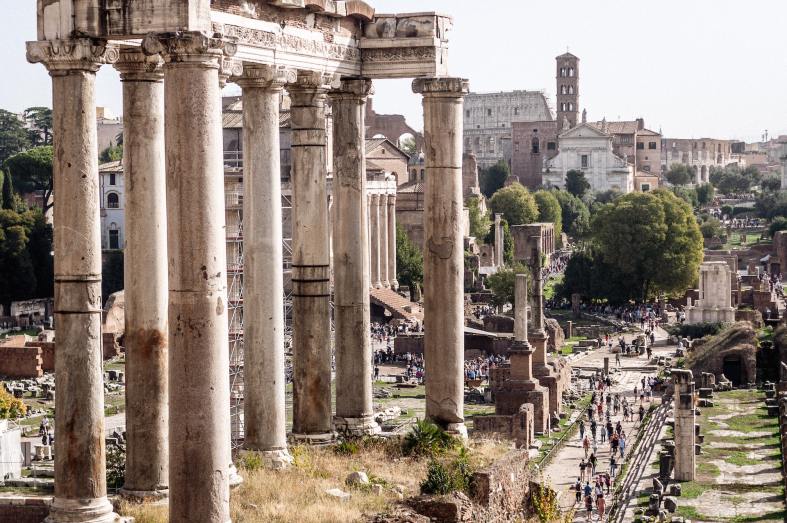
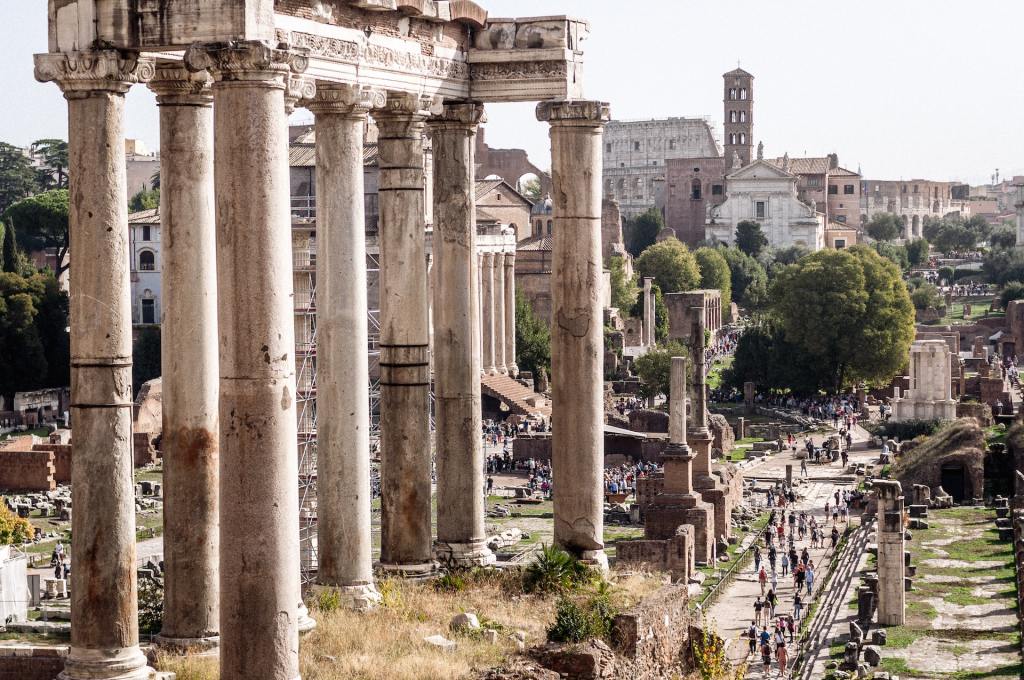
Much of Rome is already in ruins. Photo by Giu Vicente on Unsplash

Isaiah 40:17 proclaims that “All the nations are as nothing before him, they are accounted by him as less than nothing and emptiness.”  The word “emptiness” here is the Hebrew “bohu,” part of the phrase “tohu va’bohu” translated as “without form and void” in Genesis 1:2.  This phrase represents empty things with no eternal value or purpose.  So, while Isaiah doesn’t use the whole phrase from Genesis, he uses “less than” for emphasis instead.  When compared to God’s eternal purposes, all that every nation has ever devised and achieved is less than useless.  God has nothing to learn from our political and economic visions – He transcends them all.  No nation can or will accomplish what God has accomplished and will accomplish.

Therefore, Jesus’ other mission was to overthrow Herod’s dominion over Herod.  But Herod was determined to resist.  His heart was so hard that he preferred to hang on to a government willing to commit mass murder to preserve its own self-centered ways.  He thought he could preserve the façade of “Pax Romana,” the idea that worldly government can solve all of our problems, even while he, as an agent of Rome, was killing innocent children.  Herod saw it as in his own best interest, and in the interest of Rome, but this is one of many examples of “a way that seems right to a man, but its end is the way to death.”[4]

Jesus can overcome death only by overthrowing our views of our own “best interest” and what “seems right.”  He was not born and did not die and rise again just to overthrow Rome, but He came so we would have a way to overthrow ourselves and death itself.  Jesus will establish the only government that will matter in eternity: His Kingdom.  The soul of Herod, and of all of us, will outlive every society that ever existed, and ever will, on this earth.  The nations are all “accounted by him as less than nothing and emptiness.”  While Herod could find hope in Jesus if he wanted to, Rome itself never had any hope.

Therefore, the question Jesus asks all people is: Will we let Jesus overthrow us or will we, like Herod, go to great lengths to resist Jesus and try to preserve a world that is doomed to fail?

Isaiah 9:6, recently the focus of my Christmas series on 4 names describing Jesus, also says “and the government shall be upon his shoulder.”  His Kingdom will be the only government we need, and He alone is uniquely qualified to establish and rule it.

For to us a child is born,
            to us a son is given;
and the government shall be upon his shoulder,
            and his name shall be called
Wonderful Counselor, Mighty God,
            Everlasting Father, Prince of Peace.”


[1] Matthew 2:2
[2] Matthew 2:8
[3] Matthew 2:16
[4] Proverbs 14:12, 16:25

What We Need For Christmas Summary

Merry Christmas everyone!

Thank you for reading my series about what we need for Christmas.

Remember that whatever mess we find ourselves and the world in, Christmas is a reminder that God has not given up on us and on the world.  Isaiah 9:6, a prophecy from around 700 BC describes the Christ we celebrate each Christmas:

“And his name shall be called Wonderful Counselor,
Mighty God, Everlasting Father, Prince of Peace.”

To meet our deepest, most significant needs, this Christ is provided for us.
         As Wonderful Counselor, He is our source of wisdom; (covered in this post)
         As Mighty God, He will empower us to live as He did; (this post)
         As Everlasting Father, He invites us with unconditional love into His family; (this post)
         As Prince of Peace, He buys peace between us and Him, and between us and others. (this post)

“Four gifts for Christmas. They are the greatest gifts that anybody can give or we can have, and they are all in Jesus. They are for us. They are for you, if you will have them.” – James Montgomery Boice

Celebrate these gifts today!

In closing here is a video of the Royal Choral Society performing the Hallelujah Chorus from Handel’s Messiah, for He, the Christ of Christmas, shall reign forever and ever: