Who We Shall Be

The apostle Peter wasn’t always a follower of Jesus.  He also wasn’t always Peter; he was originally named Simon.  He got his new name when his brother Andrew took him to meet Jesus.  Andrew “brought him to Jesus. Jesus looked at him and said, ‘You are Simon the son of John? You shall be called Cephas” (which means Peter).’” (John 1:42).

Photo by Lionel Gustave on Unsplash

Something that stands out in Jesus’ words are the phrases “You are,” and “You shall be.”  It’s as if Jesus saw 2 people: the one Simon was, and Peter that Simon would be.  The Simon of the present and the Peter of the future.  Jesus knew there was work to be done with this Simon who would become His disciple, but He also knew that the work would be completed.  It was inevitable that Simon would become Peter, the rock, which is what the name Peter means.  Cephas also means rock in Aramaic, but Peter is the Greek name we know him by.

But in the meantime, Peter was going to be a work in progress, like all of us.  Jesus sees everyone as they “are” and as they “shall be.”  He sees the raw material and He sees what it will take to finish each competed work of art.  Jesus takes us as we are, begins our transformation there, and will complete it in eternity.

Revelation 2:17 says of believers: “To the one who conquers I will give some of the hidden manna, and I will give him a white stone, with a new name written on the stone that no one knows except the one who receives it.”  This new name represents our future, eternal identity.  The person we will be when God is finished with His work of creation in us, the person Jesus sees in us, but that is beyond our wildest imagination. C.S. Lewis wrote that believers will “one day be a creature which, if you saw it now, you would be strongly tempted to worship.”  This is how completely we will be changed and conformed to the image and likeness of God that He intended for us from the beginning.[1]

So, if you ever feel disappointed in yourself, if you feel unworthy of God’s attention, if you wonder how God could love someone like you, remember: God sees who you “are” and who “you shall be.”  And who “you shall be” is beautiful beyond what we can imagine, but not beyond what He can see.

You are Simon the son of John? You shall be called Cephas” (which means Peter).


[1] Genesis 1:26-27

The Likeness of Christ

As told in Genesis, Joseph served Pharaoh faithfully.  Even after being wrongly accused and imprisoned, he served while in prison and eventually rose again to prominence in Pharaoh’s kingdom.  When Pharaoh dreamed of famine, Joseph interpreted the dream, and under God’s direction, came up with a plan to survive it.  “And Pharaoh said to his servants, “Can we find a man like this, in whom is the Spirit of God?” – Genesis 41:38

In the gospels, Peter and John began as uneducated fishermen, yet they were personally discipled by Jesus for 3 years.  In Acts chapter 4, these former fishermen forcefully proclaim the gospel, and about five thousand people came to faith in Christ.  “Now when they saw the boldness of Peter and John, and perceived that they were uneducated, common men, they were astonished. And they recognized that they had been with Jesus.” – Acts 4:13

Pharoah recognized the Spirit in Joseph and people noticed Peter and John were different – do people notice the Spirit in you?  Can they tell you’ve been with Jesus?

“A Christian should be a striking likeness of Jesus Christ.” – Charles Spurgeon

A Better Country

In Hebrews chapter 11 there is a list of Biblical figures who “by faith” were obedient to God, but it also says that, in this life, their faith was not fully rewarded.  Everyone mentioned in the chapter “died in faith, cnot having received the things promised[1]  But these faithful examples knew that God wouldn’t fail them.  In this world, they would be unfulfilled, “but as it is, they desire a better country, that is, a heavenly one.[2]

Their obedience was motivated not by current, earthly reward, but by future rewards in a new heaven and new earth.  Although Peter tells us “Beloved, do not be surprised at the fiery trial when it comes upon you to test you, as though something strange were happening to you,[3] Paul wrote “For I consider that the sufferings of this present time are not worth comparing with the glory that is to be revealed to us.”[4]  In this world, we will have trials and experience persecution, which means that much of what a Christian has to be thankful for is in the future.

However, our faithful actions can be motivated by a future hope, just as those listed in Hebrews 11 were.  Because of the unchanging character of God, and His faithfulness, we can be so sure of our heavenly future that we can be thankful for it now.  God promises “a better country” and He is trustworthy.

Do we desire this “better country”?  While we wander in this world, do we believe that “a better country” is possible?  Do we believe God when He says He has promised us our place in it?  Jesus said “In my Father’s house are many rooms. If it were not so, would I have told you that I go to prepare a place for you?[5]

If we trust God for our future in eternity, we have much more to live for and to be thankful for than we have right now!  When you count your blessings, don’t forget the ones in the future that you can count on.

Desire a better country.”


[1] Hebrews 11:13a
[2] Hebrews 11:16a
[3] 1 Peter 4:12
[4] Romans 8:18
[5] John 14:2

Jesus is Patient and Kind Even When I am Not

Jesus is patient and kind; Jesus does not envy or boast; Jesus is not arrogant or rude. Jesus does not insist on His own way; He is not irritable or resentful; He does not rejoice at wrongdoing, but rejoices with the truth. Jesus bears all things, believes all things, hopes all things, endures all things.

Knowing the love Jesus has for us is an encouraging thought. This paraphrase of 1 Corinthians 13:4-8 was suggested in a devotional I read in 2021 [1] for John 13:34 – “A new commandment I give to you, that you love one another: just as I have loved you, you also are to love one another.”  James Boice said that we are not to “love” in any way we see fit, but as Jesus loved, which the above describes.

Based on John 13:34, Boice says we should also be able to substitute “I” in place of “Jesus” in 1 Corinthians 13:4-8 and see what He commands us to be.  When I re-read the first paragraph with myself in mind, I see how much I fall short, but His love for me remains an encouragement.  He will be patient and kind with me.

Pray that we may get ever closer to living the love of Jesus.


[1] From “August 30.” James Montgomery Boice and Marion Clark. Come to the Waters: Daily Bible Devotions for Spiritual Refreshment.  (2017).

The Gospel is About a Who, not a How

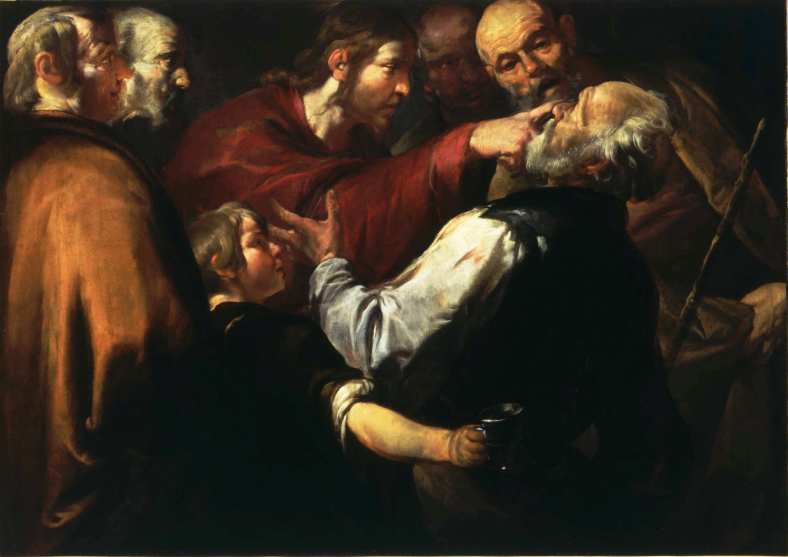
In chapter 9 of John’s gospel he records a story of Jesus healing a man who was born blind.  In John’s story, Jesus made some mud out of saliva and dirt, then put the mud on the man’s eyes.  Then Jesus tells the man to go wash off the mud in a pool.  When the man does this, his blindness is gone!

Because this man was born blind and had begged in the temple area for years, the miracle was hard to deny as a claim that Jesus was the Messiah, but many of the people put their focus on the wrong question: the how of the miracle.  Four times in the chapter someone asks how the man’s eyes were healed, as if the method of the healing was the important part.  Some of “The neighbors and those who had seen him before” asked “how were your eyes opened?[1]  Then some Pharisees asked the man how he was healed.  In both cases, the man formerly blind explained what Jesus had done.

Then, because Jesus had healed the man on the Sabbath and because practicing medicine on the Sabbath was against traditional Jewish regulations, the Pharisees asked, “How can a man who is a sinner do such signs?[2]  The Pharisees kept looking for an explanation.  A scientific or natural explanation.  Perhaps this wasn’t the same man who was born blind.  So they found his parents, “and asked them, ‘Is this your son, who you say was born blind? How then does he now see?’[3]

The better question is who healed the man born blind, but the Pharisees didn’t want to deal with that question.  They had already made up their minds that Jesus wasn’t from God.  So, they focused on the how, on the method.  People still do this today, as Warren Wiersbe wrote: “We want to understand the mechanics of a miracle instead of simply trusting the Savior, who alone can perform the miracle.”[4]

Modern people want scientific explanations because they think nothing exists outside of scientific understanding and when something doesn’t fit that worldview it is denied or explained away.  We want to fit miracles within our pre-existing understanding of the world.  And when we can’t, we resist any way we can.  In the case of the Pharisees and Jesus, “they cast him out.”[5]  Anything to avoid the real question: who is this person who can do things that don’t fit into our narrow view of the universe?  Comparing John’s gospel to modern events, we see this is nothing new.

However, if Jesus is who He said He was – God the Son – no miracle should be unbelievable because God has absolute control over His own creation.  If Jesus is God, He exists outside of our universe and so obviously can’t be explained by using scientific laws that describe this universe.  But we continue to resist.  When people want to avoid dealing with their God, they still stick to the “how” question to avoid the more important question of “who.”

If you’re struggling to understand the miraculous stories of the Bible, make sure you’re asking the right (“who”) questions.  If you’re talking to an unbeliever having the same struggles, make sure they’re asking the right questions, because: If Jesus is who God is, every how is possible, including the greatest miracle: the salvation of anyone who would believe in Him.  And, Jesus can heal anyone who is blind to this reality.


[1] John 9:8-10
[2] John 9:16
[3] John 9:19
[4] Wiersbe, Warren.  Be Alive (John 1-12) (1986).  P. 143
[5] John 9:34