Bible in a Year: Week of July 22 – 28

Fellow travelers:

Below are the chapters to read this week if you’re following along in my Bible in a year schedule, divided into morning and evening readings.  Follow along any way you want: you can just do the evening reading, flip the morning and evening, or read it all.  Whatever works for you and your schedule!  It doesn’t have to be Bible in a Year for everyone.

Monday, July 22
Morning: John 6-7
Evening: Joshua 17

Tuesday, July 23
Morning: John 8-9
Evening: Joshua 18

Wednesday, July 24
Morning: John 10-11
Evening: Joshua 19

Thursday, July 25
Morning: John 12-13
Evening: Joshua 20

Friday, July 26
Morning: John 14-15
Evening: Joshua 21

Saturday, July 27
Morning: John 16-18
Evening: Joshua 22

Sunday, July 28
Morning: John 19-21
Evening: Joshua 23

Bible in a Year: Week of July 15 – 21

Fellow travelers:

Below are the chapters to read this week if you’re following along in my Bible in a year schedule, divided into morning and evening readings.  Follow along any way you want: you can just do the evening reading, flip the morning and evening, or read it all.  Whatever works for you and your schedule!  It doesn’t have to be Bible in a Year for everyone.

This week we finish Song of Solomon and Luke.  There will be 3 morning chapters on Friday instead of on Saturday to keep the end of Luke together.

Monday, July 15
Morning: Song of Solomon 5, Luke 18
Evening: Joshua 10

Tuesday, July 16
Morning: Song of Solomon 6, Luke 19
Evening: Joshua 11

Wednesday, July 17
Morning: Song of Solomon 7, Luke 20
Evening: Joshua 12

Thursday, July 18
Morning: Song of Solomon 8, Luke 21
Evening: Joshua 13

Friday, July 19
Morning: Luke 22-24
Evening: Joshua 14

Saturday, July 20
Morning: John 1-2
Evening: Joshua 15

Sunday, July 21
Morning: John 3-5
Evening: Joshua 16

Being a Master at Washing Feet

English author Samuel Johnson said, “The true measure of a man is how he treats someone who can do him absolutely no good.”  I recently read The Residence, a book of real stories about White House staff over the years.  In a chapter on how staff often go unnoticed comes this humiliating negative example:

President [Lyndon] Johnson often undressed in front of staffers and was famous for rattling off orders while he was sitting on the toilet.  Once, reporter Frank Cormier was shocked to see Air Force One Steward Sergeant and Valet Paul Glynn kneel before the president while they were in midair and wash his feet – all the more so because Johnson never once acknowledged Glynn.

“Talking all the while, Johnson paid no heed except to cross his legs in the opposite direction when it was time for Glynn to attend to the other foot,” Cormier observed.[1]

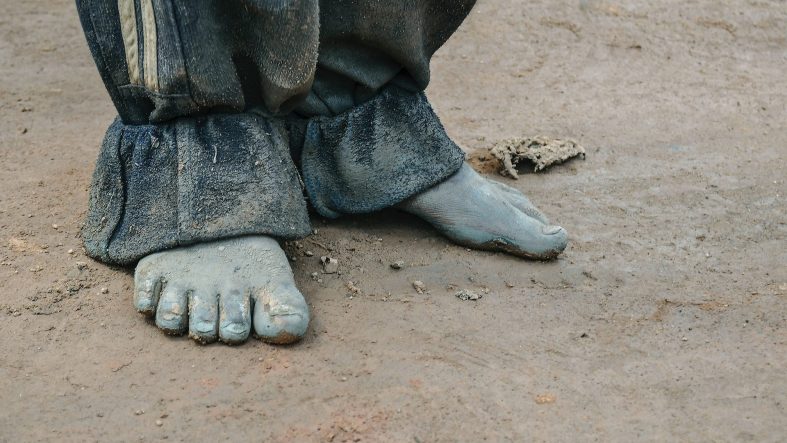
When looking for an example of a servant being humiliated, author Kate Andersen Brower chose the washing of feet.  Worse than having someone undressing in front of you and worse than being bossed around from a toilet.

Photo by Felicia Montenegro on Unsplash

Jesus, looking for an example of how his disciples should serve and love each other, chose the same act, but from a different perspective and with a different attitude:

“Jesus, knowing that the Father had given all things into his hands, and that he had come from God and was going back to God, rose from supper. He laid aside his outer garments, and taking a towel, tied it around his waist. Then he poured water into a basin and began to wash the disciples’ feet and to wipe them with the towel that was wrapped around him.” – John 13:3-5

Jesus does not need anything from us, we cannot provide anything He cannot provide for Himself, but He showed us how much He cares by washing His disciples’ feet.  He was willing to experience humiliation for His people, and He asks us to care in the same way:

“For I have given you an example, that you also should do just as I have done to you. Truly, truly, I say to you, a servant is not greater than his master, nor is a messenger greater than the one who sent him.” – John 13:15-16

“The true measure of a man is how he treats someone who can do him absolutely no good.”

Ask Him to give us compassion for those with dirty feet, and to give us the strength to serve as He did.  Because He has washed our dirty feet again and again.


[1] Brower, Kate Andersen.  The Residence: Inside the Private World of the White House.  (2015).  P. 88.

The Heavenly Holy of Holies

The temple King Solomon built in Jerusalem was not just as a place of worship and sacrifice, but also an image, or a model, of the cost of sin and of redemption.  The many courts, chambers, and walls were an object lesson in man’s separation from God because of his sin, and the required cost of restoring that relationship.  The most interior part of the temple, and hardest to get to, was the Holy of Holies, a room shaped like a perfect cube: 20 cubits by 20 cubits by 20 cubits.[1]  This cubed space was so sacred, and so holy, that only the high priest could enter it, and only once per year, and only after elaborate sacrifice.

However, by Christ’s sacrifice, we have hope: “We have this as a sure and steadfast anchor of the soul, a hope that enters into the inner place behind the curtain, where Jesus has gone as a forerunner on our behalf.” (Hebrews 6:19-20a).  In Mark’s gospel, we learn that when Christ died on the cross, “the curtain of the temple was torn in two, from top to bottom.”[2]  This curtain was the barrier covering the entrance to the Holy of Holies, and with Jesus’ death, entrance isn’t limited to just the high priest, but open to all who would believe in Him.  He entered “on our behalf” and anchors us to this most holy destination.

The Bible was not finished drawing this picture, though.  In Revelation 21, a new city – a new Jerusalem – is seen by the apostle John in a vision, coming down from heaven, and verse 16 says: “The city lies foursquare, its length the same as its width. And he measured the city with his rod, 12,000 stadia. Its length and width and height are equal.”  This vision was not meant to tell us that in Paradise we will all live inside a big cube.  As pastor Glenn Parkinson wrote: “Certainly all physical beings must exist somewhere, but this is not a vision of where God’s people will live, but how they will live when the former things have passed away.”[3]

Don’t put Earth in a box. Photo by The New York Public Library on Unsplash

Earlier, Revelation 21:1 referred to a whole new heaven and earth, so the new Jerusalem probably represents something about life everywhere in this new creation, and in this image, God would have used things familiar to John, the author of Revelation, otherwise the visions wouldn’t make sense.  The only other architectural cube John would probably recall from Scripture would be the Holy of Holies, but what does that mean?

I believe it means that all of the new heaven and earth will be inhabitable by both God and His people.  All of Paradise will be holier than even the Holy of Holies, but because the church will be fully sanctified, God’s people can enter His presence without the many temple courts and chambers and walls symbolizing man’s separation from God.  Relationship between Creator and created will be fully restored.  Everywhere will be holy, and everyone will be holy.

No, the New Jerusalem isn’t literally a cube, but it symbolizes that in the new world, the temple is not even needed, because all is as it should be between God and man:

And I saw no temple in the city, for its temple is the Lord God the Almighty and the Lamb.” – Revelation 21:22

Praise God Almighty and the Lamb!


[1] 1 Kings 6:20 (a cubit was roughly 18 inches)
[2] Mark 15:38
[3] Parkinson, Glenn.  Tapestry: The Book of Revelation (2015).
The Likeness of Christ

As told in Genesis, Joseph served Pharaoh faithfully.  Even after being wrongly accused and imprisoned, he served while in prison and eventually rose again to prominence in Pharaoh’s kingdom.  When Pharaoh dreamed of famine, Joseph interpreted the dream, and under God’s direction, came up with a plan to survive it.  “And Pharaoh said to his servants, “Can we find a man like this, in whom is the Spirit of God?” – Genesis 41:38

In the gospels, Peter and John began as uneducated fishermen, yet they were personally discipled by Jesus for 3 years.  In Acts chapter 4, these former fishermen forcefully proclaim the gospel, and about five thousand people came to faith in Christ.  “Now when they saw the boldness of Peter and John, and perceived that they were uneducated, common men, they were astonished. And they recognized that they had been with Jesus.” – Acts 4:13

Pharoah recognized the Spirit in Joseph and people noticed Peter and John were different – do people notice the Spirit in you?  Can they tell you’ve been with Jesus?

“A Christian should be a striking likeness of Jesus Christ.” – Charles Spurgeon