Below are the chapters to read this week if you’re following along in my Bible in a year schedule, divided into morning and evening readings. Follow along any way you want: you can just do the evening reading, flip the morning and evening, or read it all. Whatever works for you and your schedule! It doesn’t have to be Bible in a Year for everyone.
Monday, August 12 Morning: Romans 4-5 Evening: Judges 14
Tuesday, August 13 Morning: Romans 6-7 Evening: Judges 15
Wednesday, August 14 Morning: Romans 8-9 Evening: Judges 16
Thursday, August 15 Morning: Romans 10-11 Evening: Judges 17
Friday, August 16 Morning: Romans 12-13 Evening: Judges 18
Saturday, August 17 Morning: Romans 14-16 Evening: Judges 19
Sunday, August 18 Morning: 1 Corinthians 1-3 Evening: Judges 20
The TV show Whose Line is it Anyway? is probably the most-widely-known form of improvisational comedy, and one of my favorites. Four performers act out short scenes based on a set of rules for each scene or game, spontaneously adding their own creativity and (if successful) humor. For example, in the “Props” game, pictured, the performers were given two “P” shaped props to make jokes about. The show wouldn’t be any good if they just showed us the props and explained the rules over and over again. The show is pointless without spontaneous creativity. But why am I writing about improv on a Christian blog? But why am I writing about improv on a Christian blog? Because today I’m writing about a Bible study that leaves us to ask: Whose Plan is it Anyway?
Whose Pun is it Anyway?
In Judges 6-7, God delivers Israel from the Midianites using Gideon, who thought God couldn’t use him because “my clan is the weakest in Manasseh, and I am the least in my father’s house.” At times, Gideon doubts God is speaking to him and that He really means what He says, but God patiently answers Gideon’s questions and performs miracles, encouraging Gideon to move forward.
Eventually, Gideon and his 300-man army attacked the enemy army, which was “like locusts in abundance, and their camels were without number, as the sand that is on the seashore in abundance.”[1] After Gideon split his army into three groups, this was the plan of attack:
“So Gideon and the hundred men who were with him came to the outskirts of the camp at the beginning of the middle watch, when they had just set the watch. And they blew the trumpets and smashed the jars that were in their hands. Then the three companies blew the trumpets and broke the jars. They held in their left hands the torches, and in their right hands the trumpets to blow. And they cried out, ‘A sword for the LORD and for Gideon!’”[2]
Whose Plan is it Anyway? This is where improv comes in: the text does not tell us who came up with this wacky attack plan. Was it God’s idea or was it Gideons? Why leave it ambiguous? I think it is because, either way, it is not a decisive factor in the victory. The attack plan works because of God’s involvement, no matter whose idea it was. If it was Gideon’s idea, he was only using the abilities his Maker had given Him for the purpose of glorifying Him. If it was God’s, Gideon was also only using the abilities God gave him and dedicating them to God’s glory.
What’s amazing is that Gideon went from testing God with fleece to carrying out this attack. God had Gideon convinced it would work, and that it would work because God would make it work. Victory didn’t come from any advantage Gideon had or created, and all along God was determined to get the glory. The plan would have failed if God had not put fear into the camp, and had not let Gideon know about that fear by way of a dream a Midianite soldier had.
Like improv comedy, God’s rules only go so far before the performers need to take over. God gives us patterns, which are like the rules of an improv skit, not step-by-step instructions in every aspect of our lives. Adam and Eve were shown a pattern in the Garden of Eden, Moses was given a pattern for the tabernacle on the mountain, and Jesus lived a pattern of how to love the Father and our neighbor. Beyond the patterns and rules there is so much to do and explore. His will is for His people to make the world like Eden, to worship Him as He should be worshiped, and to love the world the way Jesus loved.
The Little Things To hear and obey His voice, we must spend time with Him in prayer and study, diligently learning the patterns He has laid out for us, but He does not expect us to stop there. At some point, we must take the guidance we have and move forward with the wisdom and creativity He has endowed us each with. When we do we will be like the servant who successfully invested his Master’s resources, and in return “His master said to him, ‘Well done, good and faithful servant. You have been faithful over a little; I will set you over much. Enter into the joy of your master.’”[3]
However, if we either do not diligently seek Him, or if we say He has not given us enough instructions, we may find ourselves cast out from the Master’s presence, hearing: “you ought to have invested my money with the bankers, and at my coming I should have received what was my own with interest.”[4]
In Gideon’s story, we see God’s compassionate understanding toward His people who struggle to hear and obey His voice but keep trying. We, like Gideon, are not always faithful over the little things such as prayer, study, and regular worship. But Only He fully knows the depth of our doubts and struggles, and He provides what we need to trust Him and move forward in faith, knowing our doubt is never fully overcome until eternity.
In the story, we also see that we must often act on trust, even when we think we have incomplete information. Like Gideon, we should be imperfectly persistent, wrestling with God who knows our faith is imperfect. He can bridge the gap to us in His unlimited grace.
So, where does God’s guiding voice stop, and our God-given creativity begin? Like a good improv comedy scene, the parts can come together perfectly, glorify God, and encourage His people to come along in faith, as the men of Naphtali, Asher, Manasseh, and Ephraim joined the battle against the Midianites once it was clear God had delivered the victory[5]. When we seek Him and find Him, and in faith move forward to spread His character and creativity in the world, glorifying Him.
God is glorified when His people attempt things that sometimes don’t make sense, then succeed because He provided the way. It’s always His plan anyway.
Soli Deo Gloria
[1] Judges 7:12 [2] Judges 7:19-20 [3] Matthew 25:21 [4] Matthew 25:27 [5] Judges 7:23-25
Below are the chapters to read this week if you’re following along in my Bible in a year schedule, divided into morning and evening readings. Follow along any way you want: you can just do the evening reading, flip the morning and evening, or read it all. Whatever works for you and your schedule! It doesn’t have to be Bible in a Year for everyone.
Monday, August 5 Morning: Acts 17-18 Evening: Judges 7
Tuesday, August 6 Morning: Acts 19-20 Evening: Judges 8
Wednesday, August 7 Morning: Acts 21-22 Evening: Judges 9
Thursday, August 8 Morning: Acts 23-24 Evening: Judges 10
Friday, August 9 Morning: Acts 25-26 Evening: Judges 11
Saturday, August 10 Morning: Acts 27-28 Evening: Judges 12
Sunday, August 11 Morning: Romans 1-3 Evening: Judges 13
Below are the chapters to read this week if you’re following along in my Bible in a year schedule, divided into morning and evening readings. Follow along any way you want: you can just do the evening reading, flip the morning and evening, or read it all. Whatever works for you and your schedule! It doesn’t have to be Bible in a Year for everyone.
Monday, July 29 Morning: Acts 1-2 Evening: Joshua 24
Tuesday, July 30 Morning: Acts 3-4 Evening: Judges 1
Wednesday, July 31 Morning: Acts 5-6 Evening: Judges 2
Thursday, August 1 Morning: Acts 7-8 Evening: Judges 3
Friday, August 2 Morning: Acts 9-10 Evening: Judges 4
Saturday, August 3 Morning: Acts 11-13 Evening: Judges 5
Sunday, August 4 Morning: Acts 14-16 Evening: Judges 6
Picking your battles, rather than trying to fight and win every fight that comes your way, is a good piece of advice. However, who should pick which battles to fight? The Old Testament book of Judges is a record of the consequences of Israel’s failure to completely conquer the promised land, a battle God gave them to fight and win. Judges also shows more generally what happens when anyone picks the wrong battles to fight: they end up with less than what God intended for them.
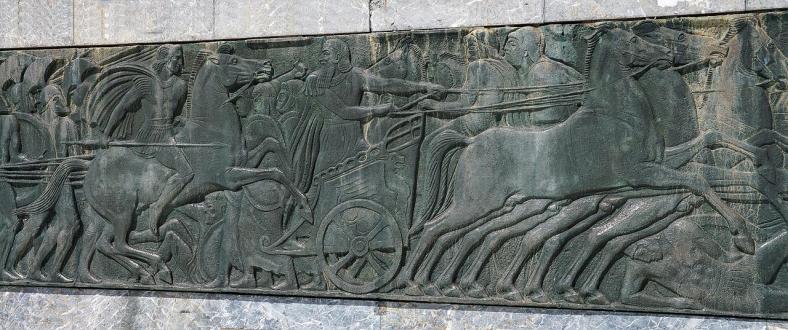
For example, Judges 1:19 tells us: “And the LORD was with Judah, and he took possession of the hill country, but he could not drive out the inhabitants of the plain because they had chariots of iron.”
This verse, especially the second part, is written from a human perspective. God did not tell Israel to conquer all of the promised land, except for the plains. God is not afraid of chariots. He told them to conquer all of it, but Israel thought that chariots couldn’t be defeated, so they decided not to fight in the plain. By using their own judgement and preferring to fight in hills or forests where chariots were less effective, they failed to fully receive what God had promised them.
An application to us is that our inheritance is Christ’s righteousness, and Jesus tells us “Blessed are those who hunger and thirst for righteousness, for they shall be satisfied.”[1] Jesus is telling us that righteousness is like food and drink. We can never have enough because no matter how much we eat and drink, our hunger and thirst soon return. We are all in different places, at different levels of knowledge and maturity, but in Christ we are all on the same path and have an appetite only He can satisfy.
To be satisfied, we cannot settle for what we have already accomplished, the hill country we have already taken. To be satisfied, we must fight the chariots in the plains if that is what God wants us to do, so that we learn to rely on His strength. To be satisfied, we move from only fighting battles we choose based on our own wisdom and ability to choosing the battles we will win in His strength.
Sometimes life is hard on purpose, so that God alone may be glorified in victory, and also so that we may grow in our faith in His strength. When we let Him pick our battles, we learn that His righteousness is the only thing that will satisfy us. Nothing less will do.


 Driving Toward the Morning Sun