Finding Port for the Good Ship Ambivalent

From yesterday’s post, you’ll know I am reading King’s X: The Oral History, a book chronicling the history of the rock band King’s X, by Greg Prato.  Yesterday, I dove into one of their more bizarre and unknown songs, but today is about the band’s biggest hit.  “It’s Love” got to “#6 on Billboard’s Mainstream Rock charts and #1 on the FM Radio Airplay charts. It was our highest-ranking single, ever,”[1] according to Ty Tabor, the band’s guitarist and sometimes lead singer, who wrote the song.

I knew both Christianity and King’s X by reputation before becoming a true fan of either, but both were growing at the same time in me during college.  Having heard of King’s X but never actually heard their music, I once saw one of their CDs in a friend’s dorm room.  My friend said it was his roommate’s but that he wasn’t much of a fan.  Before leaving I picked up the CD and looked at it.  The album, called “Faith, Hope, Love” had a cool cover, and included the song “It’s Love.”
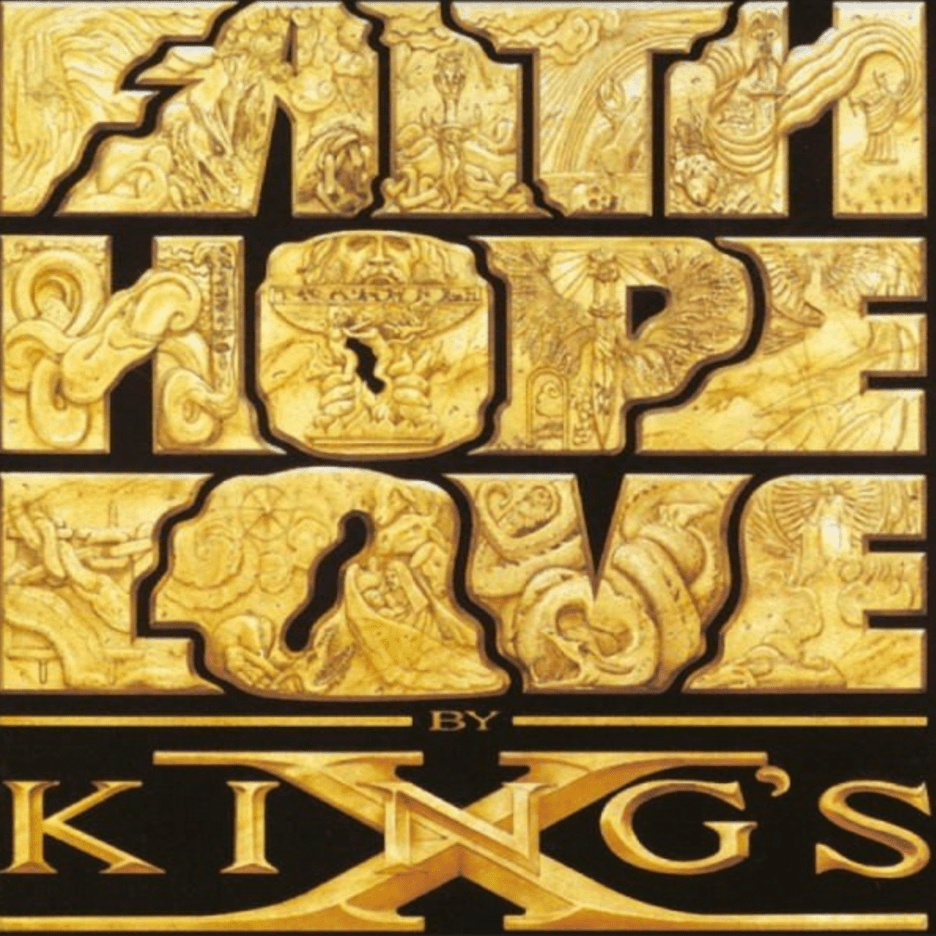
Album cover of “Faith Hope Love” by King’s X

Later, the memory of that album cover made the triad of faith, hope, and love jump out at me whenever I saw it in the Bible, including 1 Corinthians 13:13, which says: “So now faith, hope, and love abide, these three; but the greatest of these is love.”  This triad is all over the place and there are many verses explaining the relationships between them.  Seeing these references also made me come back to the band and give them a listen. The rest, as they say, is history.

Before getting into “It’s Love”, you can find the lyrics here, or listen to the song here.  I promise it’s an easier one to listen to than “Six Broken Soldiers” and also that this post will be shorter than yesterdays.

Overall, the message is fairly simple: Ty says he doesn’t know everything, but the thing he wants to share from his experience is that love is the most important thing in life.  Love both keeps the world from falling apart (“holding back the weather”), but also eventually love is what requires a loving God to bring about a plan to fix what’s wrong with the world (“the same will let it go”).

But there’s one line in the song I didn’t really get until reading about it recently: “There’s a ship on the ocean, and I can’t decide if I like it.”

There Ty is, enjoying good company, the beach, and the ocean, but he wasn’t sure about the ship on the ocean.  There’s an ambivalence about the ship, and a suggestion that maybe it’s an exception to the overall message of “love,” but I couldn’t figure out more than that.  I wasn’t alone in not getting it.

In the book, Ty says his brother didn’t understand the line, so he explained: “my point was, man’s progress is wonderful and everything, but when the ship turns over and poisons all the fish, that’s not so wonderful. So, it was me contemplating all that we do and all that I’m happy with about it, but how much destruction it causes. It’s yet again one of those socially conscious songs. I just had to say it.”[2]  It was almost that Ty was struggling with whether love applied when someone does something that “poisons all the fish.”  In tricky, real-life situations, does love still rule?  Ty doesn’t seem sure.

Contemplating What is Crooked
Yesterday I quoted Romans about Paul’s inner conflict, but later in the same chapter, Paul wrote: “So I find it to be a law that when I want to do right, evil lies close at hand.” (Romans 7:21). This idea that even our best efforts at goodness in this world are tainted is not a new one.  Solomon referred to something similar twice in the Old Testament book of Ecclesiastes, in 1:15 – “What is crooked cannot be made straight, and what is lacking cannot be counted.”  And also in 7:13 – “Consider the work of God: who can make straight what he has made crooked?”

What Paul and Solomon are getting at is that there are things in this world, including us, that will remain crooked and unfixed until God’s plan is completed in eternity.  The Bible tells us that all of creation is cursed by God because of our sin.  Some things are wrong because God has made them so.  Until a person establishes this in their own heart and mind, they will chase the wind of worldly utopia until they become hopelessly ambivalent, or continue on, highly motivated but frustrated and angry.  The phrase “under the sun” comes up 28 times in the book of Ecclesiastes (by my quick count) and refers generally to the actions of mankind done without consideration of God’s wisdom or eternal consequences.  Everything done “under the sun” is lacking, and none of it can provide the satisfaction and meaning true wisdom can deliver.

It’s Still Love
Since “under the sun”, even good things come with a cost, what do we do?  We can’t be ambivalent to those costs to the point of not caring, but we also can’t be so committed to removing these costs that our efforts become another cost.  The world is broken, but also people are broken, and how we treat them matters.

Despite any ambivalence about the ship on the ocean, it’s still “love that holds it all together.”  Therefore, the priority is always to focus on obedience and thankfulness to God, who tells us to love, not on utopian alternatives to God that tell us something is more important than loving every one of our fellow humans.  The proverbial ship on the ocean and its problems are seen by God and are part of His plan.  He cares about our conflicts and paradoxes, but still tells us to have faith, hope, and love.

However, rejection of love means prioritizing our own, temporary, interests and decide who we should love and who we should hate based on that.  One side will defend the necessity of the ship – and more ships – at all costs, because it’s good for the economy.  They can make money and enjoy what little time on earth they have.  The other side will condemn those who poison the fish, or might possibly poison fish in the future, because this earth is all they have, and they want to protect it.  “Under the sun” there is no nuance or ambivalence about the ship, but our opinion of the ship determines everything, including whether we can enjoy the beach and the ocean that we do have.

The answer lies not in some abstract move to the center politically, but in knowing that there is more than what exists “under the sun.”  Regardless of the conflicts inherent in living with broken people in a broken world, faith in God to save us, hope in His provision of a perfect future, and the priority of love for God and others, is always the right answer.  We can be a little ambivalent about the ship on the ocean, but we should have no ambivalence about love, nor about its partners, faith and hope.  We should pursue them with everything God has gifted us with and give Him the glory.  We can’t fix all the world’s problems, but we can show the world the character of its Creator and show it the way to a better world.

“So now faith, hope, and love abide, these three; but the greatest of these is love.”  Always.


[1] Prato, Greg. King’s X: The Oral History (2019).  P. 105.
[2] Prato, Greg. King’s X: The Oral History (2019).  P. 95.

Your Family is More Important Than Your Furniture – Psalms of Ascent #4

A prominent feature of the culture I live in is the demand that everyone must respect the “individualism” of everyone else.  Pressure to affirm whatever anyone else wants affirmed about them has ballooned all over the news, social media, corporate policy, and even in churches.  There’s an assumption built into this, which is that the sincere ability to love someone can be the result of someone else threatening us to do it.  Exert enough legal, social, cultural, or even physical pressure and someone’s fundamental nature can be changed by coercion.  The coal turns into a diamond.

Tomorrow is Sunday, so today we return to the Psalms of Ascent, a liturgy used in ancient Israel to prepare for worship at the annual festivals in Jerusalem.  What does this have to do with the last paragraph?  In Psalm 120, the first Psalm of Ascent, we read (post here) that no matter where we live, or where we come from, no matter our genealogy, we live among people with “lying lips” who can’t get along with each other.  In Psalm 121, we are encouraged to find the answer outside of our current place:

“A Song of Ascents.

I lift up my eyes to the hills.
            From where does my help come?
My help comes from the LORD,
            who made heaven and earth.

He will not let your foot be moved;
            he who keeps you will not slumber.
Behold, he who keeps Israel
            will neither slumber nor sleep.

The LORD is your keeper;
            the LORD is your shade on your right hand.
The sun shall not strike you by day,
            nor the moon by night.

The LORD will keep you from all evil;
            he will keep your life.
The LORD will keep
            your going out and your coming in
            from this time forth and forevermore.”

The Psalm asks us to take our eyes off of the world around us and look upward for our hope.  Not just talk about the idea of it, but to actually do it.  To turn off the outside world and its circumstances and seek God’s help.  It takes effort because the idea that we can solve our own problems is so powerful.  The fall of Adam and Eve was driven by a curiosity that there may be a better system than the one they already had.  In a literally perfect society, they wanted something else.  If we aren’t intentional about avoiding this trap, it’s easy to not realize we are in it.

We’re All Messed Up
I’ve written much about Tyler Joseph, the songwriter of the band twenty øne piløts, and his campaign to create music and stories that help people deal with mental illness.  In an interview years ago, the interviewer criticized Tyler for calling himself “messed up.”  Was Tyler being too hard on himself?  This was Tyler’s response:

“I know I’m messed up. I think to myself I should be able to control myself.  I look at a lamp and I decide that I’m going to stand up and not hit that lamp. Why can’t I make decisions like that about everything in life. I’m not going to get angry at my brother. I want to be the best brother. Why can’t I do what I want to do? That’s messed up. Something is broken in the way we live. It’s proof that something is not right.”

Tyler is explaining Romans 7:13-21, especially verses 15 and 21, but in a way that’s as plain as day to anyone being honest with themselves.  Romans 7:15 and 21 say: “For I do not understand my own actions. For I do not do what I want, but I do the very thing I hate.”  And “So I find it to be a law that when I want to do right, evil lies close at hand.”

What if the problem with every person individually is that they are unable, no matter how much external pressure is put on them, to treat other individuals the way they should be treated? If true, it puts the first paragraph into an entirely different light.

In this exact moment as I write this, I’m being very careful not to spill my drink on my laptop.  I have no desire to do anything violent to the couch I’m sitting on but just to enjoy having a place to sit.  If I stop writing to check something on my phone, I make sure I put it down gently in a spot where it won’t fall off and hit the floor.  But at the same time, I know I don’t always treat people with the same respect.  I know if I’m interrupted in the middle of what I think is a great thought or phrase I could get irritated and rude.  Not always, but I could.  I know I could be a better son, husband, father, employee, and friend.  So why don’t I?

Why do we treat our furniture better than our family, even in a culture that increasingly demands with all its strength that we prioritize every individual?  Because we are broken in a way that no political or economic system, no culture or tradition, can fix.  One may be better or worse than another, but none of them has the power to solve the real problem that we can’t consistently love people more than we love our furniture.  We have to go somewhere else to find the answer.

Therefore,
“I lift up my eyes to the hills.
            From where does my help come?
My help comes from the LORD,
            who made heaven and earth.”

As pilgrims traveling to Jerusalem, the Israelites were telling a story by making the effort to move.  A story that the towns they leave behind – no matter where they are coming from – don’t have the answer to their most important problems.  On the long journey, they travelled in large groups and slowly, sometimes by foot.  They probably had constant reminders of their own inability to treat the family they traveled with better than whatever furniture or baggage they brought along for the trip. While togetherness is sometimes uncomfortable, together we must lift up our eyes and look for the answer outside of everything we know.

We’re broken and can’t fix ourselves, but “The LORD will keep you from all evil; He will keep your life.”  Take some time out of your week and each day to look up to the hills and seek Him.  To set aside everything else.  To focus on the LORD, because He alone loves us in the way we need to be loved and can help us love others the way they need to be loved.  He won’t seek to break you to make you do it, but He Himself was broken to provide us a way.


This post continues a series on the Psalms of Ascent. To start at the beginning, click here, and for the next post click here

#widowsandorphans

“Religion that is pure and undefiled before God the Father is this: to visit orphans and widows in their affliction, and to keep oneself unstained from the world” – James 1:27

The article below is a must-read not because I know everything in it is accurate (I couldn’t possibly verify it all), but because it demonstrates how the distance between real people created by screens and the internet feeds unproductive divisiveness over things that may not even be real. Malevolent actors intentionally use the internet to pull the church apart.

God has given us all limited resources, including our time, and wants us to use all for His glory. Love for God and neighbor involves tackling real problems which is what “widows and orphans” represent in the above verse from James.

Perhaps #widowsandorphans should be the #1 trending hashtag in the church every day. Why not? There are enough real problems to go around.

In Search of a Winning Philosophy

In 1 Timothy 1:3-4 Paul writes to Timothy: “As I urged you when I was going to Macedonia, remain at Ephesus so that you may charge certain persons not to teach any different doctrine, nor to devote themselves to myths and endless genealogies, which promote speculations rather than the stewardship from God that is by faith.”

In his commentary on the verse, John Calvin adds: “He judges of doctrine by the fruit; for every tiling that does not edify ought to be rejected, although it has no other fault; and everything that is of no avail but for raising contentions, ought to be doubly condemned.”

When I came across Calvin’s note last week, it reminded me of the linked Monty Python video of philosophers philosophizing about soccer while simultaneously “playing” soccer.

Every doctrine and institution of the church should empower His people to live for Him. Are we playing the right game, and are we playing to win?

Somehow He Really Loves Who You Really Are

I love this song. I first heard it at a year-end event for my son’s Christian Service Brigade and thought this is what not only teenagers, but everyone, should hear!

“While I’m on this road you take my hand
Somehow you really love who I really am
I push you away, still you won’t let go
You grow your roses on my barren soul”

Thank God we do not get what we deserve!