There Goes John Bradford (to Paradise): History for February 24

Born in 1510, John Bradford was a rising Protestant minister during the reign of King Edward VI in England and was well known for his pious dedication and unselfish nature.  After studying at Cambridge and preaching regularly around London, he was appointed as Chaplain to the King in 1551.  The common expression “There but for the grace of God go I” is often attributed to him and was a reminder to himself that grace alone has saved him.  An 1822 book on prayer says that:

“The pious Martyr Bradford, when he saw a poor criminal led to execution, exclaimed, ‘there, but for the grace of God, goes John Bradford’. He knew that the same evil principles were in his own heart which had brought the criminal to that shameful end.”[1]

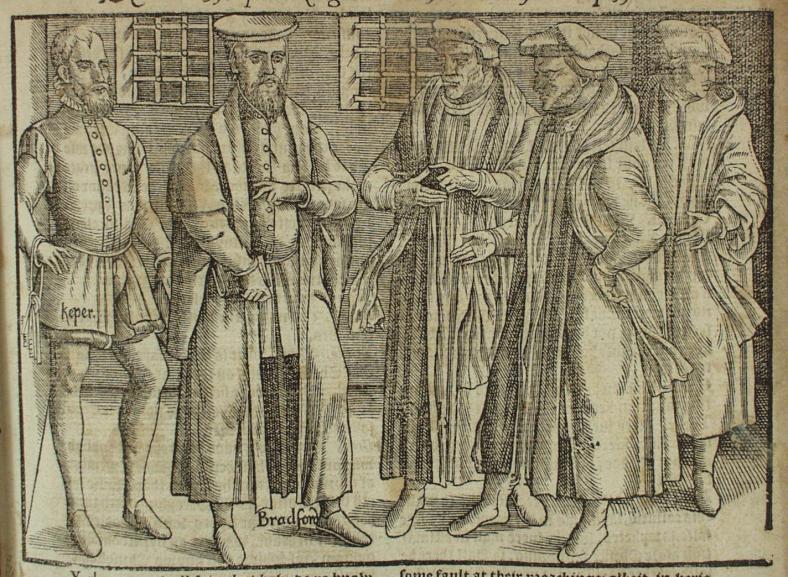
Bradford and others in the Tower of London, from John Foxe’s Book of Martyrs (1563). Public Domain.

His worldly fortunes changed in 1553 when the Catholic Mary I became Queen, and one of her first priorities was persecution of prominent Protestants.  Bradford was arrested within a month, imprisoned in the Tower of London, and sentenced to death.  While in the Tower, he wrote a letter to his mother on this date, February 24, in 1554, that included a powerful statement about prayer: God “doth put off our prayers, that he might recompense it with abundance, that is, that he might more plentifully pour upon us the effect of our petitions.” [2]  On July 1, Bradford was burned alive at the stake.

In another book on prayer, Donald McKim wrote about Bradford’s letter:
“We can imagine that no one would seek an answer to his prayers more ardently than Bradford while awaiting death. Yet he believed that even with no apparent answers to prayers, God plentifully pours abundance on those who pray!
At the end of his letter Bradford mentions God’s promise-which believers receive and anticipate, even in the midst of their sufferings and afflictions. Paul recorded the promise: “What no eye has seen, nor ear heard, nor the human heart conceived, what God has prepared for those who love him” (1 Cor. 2:9) Plentiful abundance! Now and forever!”[3]

In John Bradford’s story, there is a terrible irony between two things he is known for – a common phrase and his martyrdom – but in the end, God is faithful, and I hope to meet Bradford someday in Paradise, where the grace of God has bought me a place.


[1] Bickersteth, Edward.  A Treatise on Prayer.  (1822).  Sourced from https://en.wikipedia.org/wiki/John_Bradford
[2] McKim, Donald K.  Everyday Prayer with the Reformers (2020).  P. 92.
[3] Ibid.

To Gain What We Cannot Lose: History for January 8

On January 6, 1956, a group of American missionaries made first contact with a local tribe in Ecuador, trying to reach them with the gospel.  Two days later, on this date, January 8, 1956, five of those missionaries – Jim Elliot, Pete Fleming, Ed McCully, Nate Saint and Roger Youderian – were speared to death by the very Auca tribe they spent years preparing to minister to. But their story was not over.

Jim Elliot and others had been ministering to the Quichua people in Ecuador since 1952, with many coming to faith in Jesus.  However, the nearby Aucas (now called Waodoni) were known to kill any outsiders that entered their area, including Quichua and also oil workers at a site nearby.  Jim “knew the only way to stop the Aucas from killing was to tell them about Jesus”[1] and came up with a plan to reach them.  Working with Nate Saint, a missionary supply pilot, they spent months trying to safely build goodwill with the Waodoni by lowering supplies to them from a plane and speaking friendly Waodoni phrases from a loudspeaker.

On January 6th, they talked to a Waodoni called George, thinking they had gained some trust and they set up a later meeting.  George, however, lied to them about his intentions, and ten members of the tribe were ready in ambush with spears on January 8th.  The unarmed missionaries had no chance.

Jim Elliot

Seeking vengeance or giving up might have been a reasonable response for the other missionaries, but in a miraculous example of forgiveness, persistent faith, and a heart for the lost, Elisabeth and Valerie Elliot (Jim’s wife and young daughter), and Rachel Saint (Nate’s sister) learned the local language and moved into the jungle to live with the Waodoni in 1958.  Elisabeth wrote about serving those who killed her husband: “The deepest things that I have learned in my own life have come from the deepest suffering. And out of the deepest waters and the hottest fires have come the deepest things I know about God.”  Today, the Waodoni are a friendly tribe and many are professing Christians.  Missionaries, including members of the Saint family, still live among them today.  Elisabeth died in 2015 at the age of 88, after a long career as missionary, author, speaker, and radio host.

Jim’s Apparent Failure is God’s Victory
In life, Jim Elliot was sometimes frustrated by his effort, once writing: “No fruit yet. Why is it that I’m so unproductive? I cannot recall leading more than one or two into the kingdom. Surely this is not the manifestation of the power of the Resurrection. I feel as Rachel, ‘Give me children, or else I die.’”[2]  While attending Wheaton College in Illinois in the 1940’s, Jim developed a desire to preach the gospel, including taking the train to Chicago and talking about Jesus with people at the train station, but with little response.

“He is no fool who gives what
he cannot keep to gain
that which he cannot lose.”

– Jim Elliot

But in death, Jim was used by God to inspire many other missionaries, including his own family, through whom God’s love for the lost went out and bore more eternal fruit than Jim may have ever imagined.  His story is a reminder that faithfulness is the Christian’s objective, and God provides the fruit.

Jim wrote what has become a familiar quote to many: “He is no fool who gives what he cannot keep to gain that which he cannot lose.”  In Paradise, Jim, those affected by his ministry, and all other believers, will forever praise God for His steadfast love through the centuries.  Nothing we do for God now can look foolish from that perspective.  We have so much to gain that we cannot lose.

Soli Deo Gloria

Learn More:
This story was dramatized in the 2005 film End of the Spear and in the 2002 documentary Beyond the Gates of Splendor.  A website dedicated to Elisabeth Elliot’s life (https://elisabethelliot.org/) has more on this amazing history of God’s work.


[1] https://www.christianity.com/church/church-history/timeline/1901-2000/jim-elliot-no-fool-11634862.html
[2] https://www.inspirationalchristians.org/evangelists/jim-elliot-biography/

To Gain What We Cannot Lose: History for January 8

On January 6, 1956, a group of American missionaries made first contact with a local tribe in Ecuador, trying to reach them with the gospel.  Two days later, on this date, January 8, 1956, five of those missionaries – Jim Elliot, Pete Fleming, Ed McCully, Nate Saint and Roger Youderian – were speared to death by the very Auca tribe they spent years preparing to minister to. But their story was not over.

Jim Elliot and others had been ministering to the Quichua people in Ecuador since 1952, with many coming to faith in Jesus.  However, the nearby Aucas (now called Waodoni) were known to kill any outsiders that entered their area, including Quichua and also oil workers at a site nearby.  Jim “knew the only way to stop the Aucas from killing was to tell them about Jesus”[1] and came up with a plan to reach them.  Working with Nate Saint, a missionary supply pilot, they spent months trying to safely build goodwill with the Waodoni by lowering supplies to them from a plane and speaking friendly Waodoni phrases from a loudspeaker.

On January 6th, they talked to a Waodoni called George, thinking they had gained some trust and they set up a later meeting.  George, however, lied to them about his intentions, and ten members of the tribe were ready in ambush with spears on January 8th.  The unarmed missionaries had no chance.

Jim Elliot

Seeking vengeance or giving up might have been a reasonable response for the other missionaries, but in a miraculous example of forgiveness, persistent faith, and a heart for the lost, Elisabeth and Valerie Elliot (Jim’s wife and young daughter), and Rachel Saint (Nate’s sister) learned the local language and moved into the jungle to live with the Waodoni in 1958.  Elisabeth wrote about serving those who killed her husband: “The deepest things that I have learned in my own life have come from the deepest suffering. And out of the deepest waters and the hottest fires have come the deepest things I know about God.”  Today, the Waodoni are a friendly tribe and many are professing Christians.  Missionaries, including members of the Saint family, still live among them today.  Elisabeth died in 2015 at the age of 88, after a long career as missionary, author, speaker, and radio host.

Jim’s Apparent Failure is God’s Victory
In life, Jim Elliot was sometimes frustrated by his effort, once writing: “No fruit yet. Why is it that I’m so unproductive? I cannot recall leading more than one or two into the kingdom. Surely this is not the manifestation of the power of the Resurrection. I feel as Rachel, ‘Give me children, or else I die.’”[2]  While attending Wheaton College in Illinois in the 1940’s, Jim developed a desire to preach the gospel, including taking the train to Chicago and talking about Jesus with people at the train station, but with little response.

“He is no fool who gives what
he cannot keep to gain
that which he cannot lose.”

– Jim Elliot

But in death, Jim was used by God to inspire many other missionaries, including his own family, through whom God’s love for the lost went out and bore more eternal fruit than Jim may have ever imagined.  His story is a reminder that faithfulness is the Christian’s objective, and God provides the fruit.

Jim wrote what has become a familiar quote to many: “He is no fool who gives what he cannot keep to gain that which he cannot lose.”  In Paradise, Jim, those affected by his ministry, and all other believers, will forever praise God for His steadfast love through the centuries.  Nothing we do for God now can look foolish from that perspective.  We have so much to gain that we cannot lose.

Soli Deo Gloria

Learn More:
This story was dramatized in the 2005 film End of the Spear and in the 2002 documentary Beyond the Gates of Splendor.  A website dedicated to Elisabeth Elliot’s life (https://elisabethelliot.org/) has more on this amazing history of God’s work.


[1] https://www.christianity.com/church/church-history/timeline/1901-2000/jim-elliot-no-fool-11634862.html
[2] https://www.inspirationalchristians.org/evangelists/jim-elliot-biography/