Sometimes Life is Hard on Purpose

Photo by ål nik on Unsplash

Joshua, Moses’ hand-picked successor, was very aware of the consequences of failing to trust God.  After being delivered from Egypt, Israel was led to Canaan – their promised land – and God had Moses “Send men to spy out the land of Canaan, which I am giving to the people of Israel.[1]  The purpose of the spy mission was not to decide whether or not to move into the land.  God promised to give it to them.  However, when the 12 spies returned, 10 of them said “We are not able to go up against the people, for they are stronger than we are.[2]  Only Joshua and Caleb said they should take the land anyway, because God’s promise and strength was enough for them.  Because the people rebelled, trusting 10 disloyal spies rather than Him, God said Israel must wander the wilderness for years and only Joshua and Caleb would live long enough to enter the land.

After taking 40 years to make what could have been an 11-day journey[3] to the Jordan River where Israel would enter the land, God knew, and Joshua knew, that divided loyalties could doom everyone to another 40-year wilderness adventure.

Arriving at the flooded Jordan River, some people may have doubted whether Joshua get them across.  Joshua had just become their leader, and perhaps the failure of Moses, who recently died, meant the failure of their dreams of the promised land.  After all, they saw the Red Sea part for Moses.  Could Joshua get them over this river?

Then in Joshua 3:15 we find this note: “(now the Jordan overflows all its banks throughout the time of harvest)”.  Why is this phrase important?  Israel arrived at the Jordan at the most difficult time to cross.  The river would be as deep and as wide as ever, and likely the current would be stronger as well.  A sensible person would avoid crossing at this time, but God chose the most “difficult” time to perform this miracle to show that nothing is difficult for Him.  This phrase is there because entering the promised land should glorify God and God alone.

By coming to the Jordan specifically when it “overflows all its banks” God wanted to remind His people that only He can and will deliver them.  The Red Sea wasn’t parted because of Moses; it was parted because of God.  God could deliver Israel without Moses, but Moses couldn’t deliver Israel without God.  It was never about Moses.  Likewise, Joshua wasn’t going to get them to their land; God was.  The flood gave the people no reason to credit Joshua for their success.

As instructed, this is how they crossed the flooded river: “as soon as those bearing the ark had come as far as the Jordan, and the feet of the priests bearing the ark were dipped in the brink of the water (now the Jordan overflows all its banks throughout the time of harvest), the waters coming down from above stood and rose up in a heap very far away, at Adam, the city that is beside Zarethan, and those flowing down toward the Sea of the Arabah, the Salt Sea, were completely cut off. And the people passed over opposite Jericho.  Now the priests bearing the ark of the covenant of the LORD stood firmly on dry ground in the midst of the Jordan, and all Israel was passing over on dry ground until all the nation finished passing over the Jordan.” – Joshua 3:15-17

Joshua was very clear about giving God credit, and it’s a lesson for Christians in all times and places.  When God raises up leaders, He also reminds us that they are but men and tools in His hand.  They are also profoundly fallible.  10 out of 12 human leaders being wrong left Israel wandering for 40 years.  Only God leads anyone to salvation and only when they trust Him alone for it.  He often works through fallen human leaders, raising them up to lead His people, not because He prefers sinful leaders over virtuous ones, but because there is no other kind of person and because He is jealous for His own glory.

Is there a flooded river God wants you to cross?  When we attempt things that only make sense because God told us to do them, we may be more likely to do or witness something that glorifies God and God alone, because only He could do it.

Are there rivers you have crossed in the past?  Like God told Joshua after this crossing to lay memorial stones so they would never forget (see Joshua 4), make sure to keep a record of God’s power and faithfulness in your life.

Sometimes life is hard on purpose.
Sometimes the river is flooded because God wants to show you something awesome.

Therefore, “Be strong and courageous.  Do not be frightened, and do not be dismayed, for the LORD your God is with you wherever you go.” – Joshua 1:9b
[1] Numbers 13:1
[2] Numbers 13:31
[3] Deuteronomy 1:2

The Gospel is About a Who, not a How

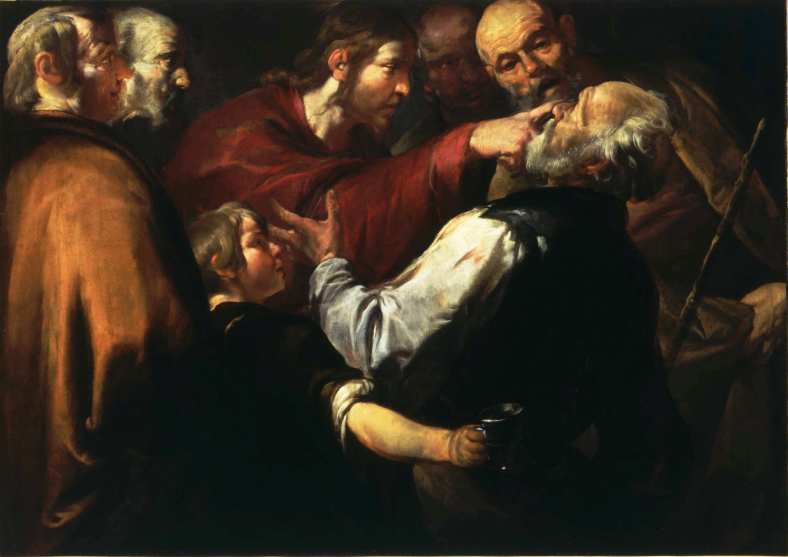
In chapter 9 of John’s gospel he records a story of Jesus healing a man who was born blind.  In John’s story, Jesus made some mud out of saliva and dirt, then put the mud on the man’s eyes.  Then Jesus tells the man to go wash off the mud in a pool.  When the man does this, his blindness is gone!

Because this man was born blind and had begged in the temple area for years, the miracle was hard to deny as a claim that Jesus was the Messiah, but many of the people put their focus on the wrong question: the how of the miracle.  Four times in the chapter someone asks how the man’s eyes were healed, as if the method of the healing was the important part.  Some of “The neighbors and those who had seen him before” asked “how were your eyes opened?[1]  Then some Pharisees asked the man how he was healed.  In both cases, the man formerly blind explained what Jesus had done.

Then, because Jesus had healed the man on the Sabbath and because practicing medicine on the Sabbath was against traditional Jewish regulations, the Pharisees asked, “How can a man who is a sinner do such signs?[2]  The Pharisees kept looking for an explanation.  A scientific or natural explanation.  Perhaps this wasn’t the same man who was born blind.  So they found his parents, “and asked them, ‘Is this your son, who you say was born blind? How then does he now see?’[3]

The better question is who healed the man born blind, but the Pharisees didn’t want to deal with that question.  They had already made up their minds that Jesus wasn’t from God.  So, they focused on the how, on the method.  People still do this today, as Warren Wiersbe wrote: “We want to understand the mechanics of a miracle instead of simply trusting the Savior, who alone can perform the miracle.”[4]

Modern people want scientific explanations because they think nothing exists outside of scientific understanding and when something doesn’t fit that worldview it is denied or explained away.  We want to fit miracles within our pre-existing understanding of the world.  And when we can’t, we resist any way we can.  In the case of the Pharisees and Jesus, “they cast him out.”[5]  Anything to avoid the real question: who is this person who can do things that don’t fit into our narrow view of the universe?  Comparing John’s gospel to modern events, we see this is nothing new.

However, if Jesus is who He said He was – God the Son – no miracle should be unbelievable because God has absolute control over His own creation.  If Jesus is God, He exists outside of our universe and so obviously can’t be explained by using scientific laws that describe this universe.  But we continue to resist.  When people want to avoid dealing with their God, they still stick to the “how” question to avoid the more important question of “who.”

If you’re struggling to understand the miraculous stories of the Bible, make sure you’re asking the right (“who”) questions.  If you’re talking to an unbeliever having the same struggles, make sure they’re asking the right questions, because: If Jesus is who God is, every how is possible, including the greatest miracle: the salvation of anyone who would believe in Him.  And, Jesus can heal anyone who is blind to this reality.


[1] John 9:8-10
[2] John 9:16
[3] John 9:19
[4] Wiersbe, Warren.  Be Alive (John 1-12) (1986).  P. 143
[5] John 9:34

It’s Never Too Late

The New Testament book of Acts is also sometimes referred to as “Acts of the Apostles” because of the book’s focus on the apostles and God’s work through them.  The book has story after story of them preaching, but also healing and performing miracles.

For example, Acts 3 has a story of a man healed by the power of Jesus through Peter and John.  They were walking to the temple for prayer, and came across a lame man begging for alms.  But instead of giving the man money, Peter says to him, “I have no silver and gold, but what I do have I give to you. In the name of Jesus Christ of Nazareth, rise up and walk!”  Then, “immediately his feet and ankles were made strong. And leaping up, he stood and began to walk, and entered the temple with them, walking and leaping and praising God.”[1]

This is already an impressive miracle, but Luke (author of Acts) adds some additional details to show us that God had sovereignly arranged this miracle for maximum effect.  First, Acts 3:2 tells us this man had been “lame from birth” and verse 10 says all the people recognized him, so there could be no denying it was the same man.  Later on, Luke adds another detail to the story, in Acts 4:22. “For the man on whom this sign of healing was performed was more than forty years old.”  If this were a hoax, one might imagine someone putting it on for a short period of time, but not for forty years!  And not from birth!  In addition, someone lame for any period of time should take months or years to gain strength enough to walk and leap, but this man was immediately healed!  This was undeniably a miracle.

However, I think the mention of the man’s age carries a couple of other lessons as well.

First, like the healed man, many people live for forty years or longer before coming to really know Christ, but Jesus found him.  Therefore, it’s never too late for someone to come to Christ.  Also, for those who already know Christ, it’s never too late to find purpose in Him.  God may reveal His purposes late in someone’s life.  Sometimes being a late bloomer only means that was God’s timing.  Many can discover gifts and ministries late in their life, meaning either their biological or Christian life.

Lastly, this miracle on a forty-year-old shows us that even great suffering can result in glory to God.  We don’t know why this man had to suffer with disability for so long, but we do know that the name of Jesus was glorified in the presence of many because he was healed.  We may never understand why there is so much suffering in this world, but God assures us with this miracle that it is inevitable that He will be glorified.  Suffering can have a purpose.

So, if you’re suffering in some way, or even struggling to overcome some specific sin, it’s never beyond Jesus’ ability to heal you.  If you’re frustrated with a lack of purpose or struggling to fit in, it’s never too late to find meaning in a walk with Christ.  If this has been going on for a long time – even forty years or longer – it’s never too late to hope in Jesus.  He will heal all our physical, emotional, and spiritual problems in His timing and in the way that will most glorify Him.  He guarantees it.

For those whom he foreknew he also predestined to be conformed to the image of his Son, in order that he might be the firstborn among many brothers.” – Romans 8:29

Soli Deo Gloria


[1] Acts 3:1-10

The Miracle of the Toothpicks

In 1989, Rain Man, a movie starring Tom Cruise and Dustin Hoffman, won the Oscar for Best Picture and Hoffman won for Best Actor in a Leading Role, playing Raymond, an autistic-savant.  Long before autism was widely recognized, Raymond showed that those with autism have amazing talents, personalities, and human dignity just like anyone else.  In the movie, Raymond wins the affection of his selfish, arrogant brother Charlie, played by Cruise, who was initially only interested in Raymond because of his inheritance.

In one of the movie’s more well-known scenes, Raymond performs what in another context might be considered a miracle.  You can watch the 1 ½ minute clip here or read my summary below it.

In the clip, a waitress drops most of a box of toothpicks on the floor and in just a couple of seconds, Raymond counts that 246 of them scattered on the floor (he also counts three groups of 82).  At this point of the movie, Charlie still sees Raymond as someone he has to put up while he chases down his inheritance.  The waitress says the box had 250 toothpicks, so Charlie says Raymond guessed “pretty close” because he just wants to leave.  But when the waitress says, “there’s 4 left in the box”, Charlie realizes something amazing has just happened.  It wasn’t a guess.

It’s easy to be skeptical of miracles, or to choose to ignore them, but some of the Bible’s miracles aren’t much different than Raymond counting toothpicks at super-human speed.  We can’t explain why some people count faster than others, or run faster than others, or have photographic memories while others don’t, yet if we call something a “miracle,” many people will demand an explanation.  Other very abnormal things we just take for granted.

One miracle is recorded in Matthew 21:18-19, which says: “In the morning, as [Jesus] was returning to the city, he became hungry.  And seeing a fig tree by the wayside, he went to it and found nothing on it but only leaves. And he said to it, ‘May no fruit ever come from you again!’ And the fig tree withered at once.”  This tree was eventually going to wither anyway, so all Jesus did was change the speed of a natural process.  True, Raymond was special because of his own speed, and Jesus controlled the speed of something other than himself, but still part of what makes it a miracle is the speed.

If the speed of a natural process, like counting or the growth of plants, can be variable and manipulated, why not also the direction of the process?  In Mark’s gospel, the word “immediately” appears in at least 5 references to healing miracles[1].  The word “immediately” means the speed was part of the miracle.  Jesus not only healed a paralytic in Mark chapter 2, but the paralytic “immediately picked up his bed and went out before them all,”[2] without months or years of physical rehabilitation therapy.  From everyday experience, we know that different people recover from injury at different rates, yet why do we demand an explanation when its immediate?  If we don’t know what process took place to make this man a paralytic, why is it hard to believe that process could go backwards, and quickly?  It’s partly a miracle of degree, not of kind.

Of course, we shouldn’t believe every miracle: some are mere hoaxes, and some signs are done in opposition to God.  But also, we should not be too quick to dismiss the possibility of miracles we didn’t expect or can’t explain.  And while Rain Man does not claim to be based on a true story[3], the Bible does.  And Jesus, the one who could control the speed and direction of what we consider “natural” processes, claimed to be the God who put those processes to work in the first place.

“As you do not know the way the spirit comes to the bones in the womb of a woman with child, so you do not know the work of God who makes everything.” – Ecclesiastes 11:5


[1] See Mark 1:42, 2:12, 5:29, 5:42, and 10:52
[2] Mark 2:12
[3] The movie was based on a novel, but Raymond’s abilities were modeled on a real person named Kim Peek, who you can read more about at this link.  https://allthatsinteresting.com/kim-peek-real-rain-man

A Surprising Picture of Salvation

Yesterday’s post discussed the healing of a leper by Jesus in Mark 1:40-42, which says: “And a leper came to [Jesus], imploring him, and kneeling said to him, ‘If you will, you can make me clean.’  Moved with pity, he stretched out his hand and touched him and said to him, ‘I will; be clean.’  And immediately the leprosy left him, and he was made clean.

However, the story continues in Mark 1:43-44 – “And Jesus sternly charged him and sent him away at once, and said to him, ‘See that you say nothing to anyone, but go, show yourself to the priest and offer for your cleansing what Moses commanded, for a proof to them.’

Jesus, while unconcerned that this leper was not following Levitical law to remain quarantined, He was concerned that he testify to the priests.  What might the priests learn from performing the cleansing rites for a recovered leper?  The procedure is detailed in Leviticus 14:1-20, which I’ve pulled from below:

if the case of leprous disease is healed in the leprous person, the priest shall command them to take for him who is to be cleansed two live clean birds and cedarwood and scarlet yarn and hyssop.  And the priest shall command them to kill one of the birds in an earthenware vessel over fresh water.  He shall take the live bird with the cedarwood and the scarlet yarn and the hyssop, and dip them and the live bird in the blood of the bird that was killed over the fresh water.  And he shall sprinkle it seven times on him who is to be cleansed of the leprous disease. Then he shall pronounce him clean and shall let the living bird go into the open field…on the eighth day he shall take two male lambs without blemish…And he shall kill the lamb…The priest shall take some of the blood of the guilt offering, and…put it on the lobe of the right ear of him who is to be cleansed and on the thumb of his right hand and on the big toe of his right foot. Then the priest shall take some of the log of oil and…shall put [it] on the lobe of the right ear of him who is to be cleansed and on the thumb of his right hand and on the big toe of his right foot, on top of the blood of the guilt offering…Thus the priest shall make atonement for him, and he shall be clean.”

While this probably seems confusing, Warren Wiersbe says that “Leviticus 14 presents a beautiful picture in type of the work of redemption.”  How?

Photo by hiva sharifi on Unsplash

“The two birds represent two different aspects of our Lord’s ministry: His incarnation and death (the bird put into the jar and then killed), and His resurrection and ascension (the bird stained with the blood and then set free). The blood was applied to the man’s right ear (God’s Word), right thumb (God’s work), and right great toe (God’s walk). Then the oil was put on the blood, symbolizing the Holy Spirit of God. The Holy Spirit cannot come on human flesh until first the blood has been applied.”[1]

After Jesus was sacrificed on the cross, died, and then was raised from the dead, perhaps Leviticus 14 made more sense to the priests who cleansed the leper healed by Jesus.  Perhaps they saw a picture of their Savior.


[1] Wiersbe, Warren.  Be Diligent (Mark) (1987).  P. 28.