Render to God

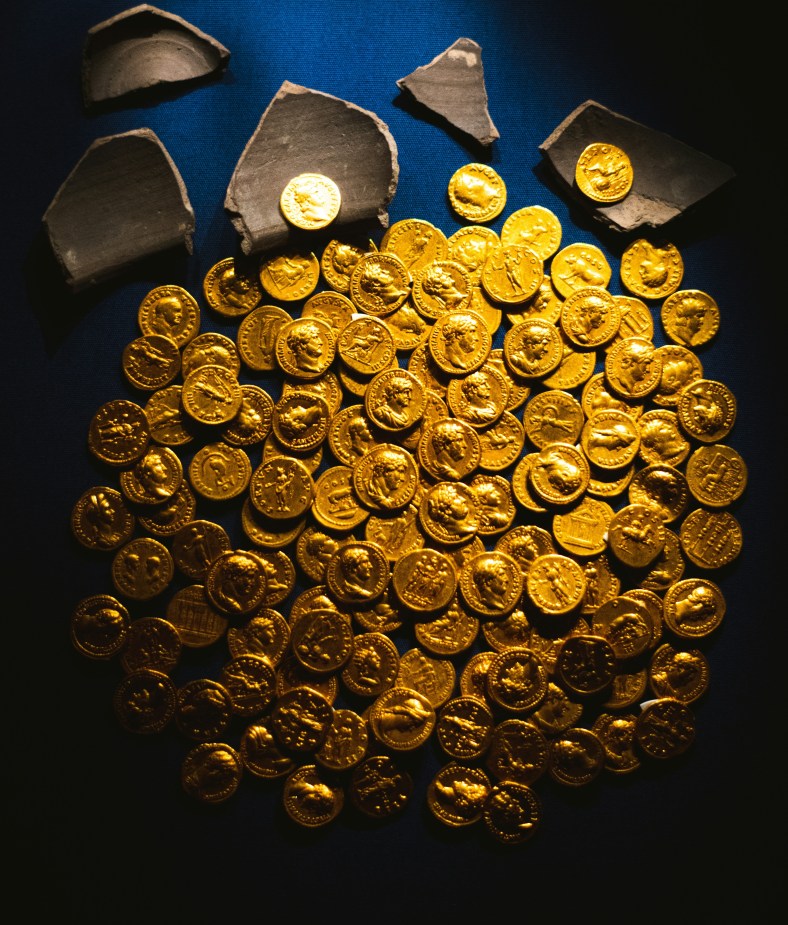
The phrase “render to Caesar the things that are Caesar’s, and to God the things that are God’s” which Jesus spoke in Luke 20:25 is likely a familiar one.  I had a friend in college who worked at Little Caesar’s pizza, and he showed up at Bible study with some pizza from there one night.  We had agreed to split the cost, so when he walked in he said “render unto Caesar!”  We all got the reference and a couple of us laughed (I admit one of them was me).

The “render to Caesar” saying comes from a time where some scribes and chief priests tried to get Jesus in trouble, as they often did, trying any means necessary to condemn Him.  In this case, they first flattered Jesus, trying to catch Him off-guard, then asked Him, “Is it lawful for us to give tribute to Caesar, or not?”  They thought if Jesus said yes, it would upset the Jews who wanted their Messiah to overthrow Rome, and that if He said no, it would upset the Romans and perhaps they would arrest Jesus as a revolutionary.  They thought they had Him trapped, but His answer quoted above was unexpected by them, yet truthful and insightful.

Often the lessons taken from this story have to do with Jesus’ ability to thwart the attempts of His enemies to catch Him in His words, or with the Christian’s obligation to pay taxes, or with something about the relationship between the Jews and Rome.  There are several good applications.

Another important application that’s key to the story, can be highlighted if we shorten the saying to “render…to God the things that are God’s.”  This last part of the quote is where Jesus subtly tells those trying to catch Him that they weren’t giving to God the things they should be.  Although they were the religious leaders of their day, they were focused on the wrong things, like their money and their resentment against the government.  Or even their obsession with arguing with Jesus.

Photo by Adi Albulescu on Unsplash

What are the things that are God’s and that we should render to Him?

Paul helps answer this in Romans 12:1, which says “I appeal to you therefore, brothers, by the mercies of God, to present your bodies as a living sacrifice, holy and acceptable to God, which is your spiritual worship.”

Here Paul says that the thing we should be rendering to God is our very selves, and Jesus implied this when He said “render…to God the things that are God’s.”  This answer said to the Jews, and everyone listening, that their Messiah wasn’t only going to overthrow Rome, but He was going to overthrow all kingdoms, including those we build in our own hearts and minds.  From an eternal perspective, the many flaws of Roman rule under which the first-century Jews lived were minor inconveniences, including the paying of taxes and other, real abuses.  Jesus wants us to focus on the real challenge: what to do about mankind’s rebellion from God?  This is the real mission of the Messiah.

Luke follows the “render to Caesar” story with a question some Sadducees asked Jesus about the resurrection, also to try and catch Him saying something wrong.  The story was not put there by accident, but in the sequence, I think we see that there is in fact a resurrection, and that our resurrected selves will be much different than our current selves.  Our new selves will be able to perfectly worship God, and we will be able to fully offer our “bodies as a living sacrifice” while we can only do so imperfectly now.

In the meantime, we don’t get a free pass to do what we want because we aren’t perfected yet.  Every day and every moment, we are to “render…to God the things that are God’s” in ways the religious leaders of Jesus’ day (as well as the audience of most of the Old Testament prophets) failed to do.

In closing, I’ll quote the OT prophet Micah, who differentiated between the animal sacrifices of ancient Israel from the “living sacrifice” God requires:

With what shall I come before the LORD,
            and bow myself before God on high?
Shall I come before him with burnt offerings,
            with calves a year old?
Will the LORD be pleased with thousands of rams,
            with ten thousands of rivers of oil?
Shall I give my firstborn for my transgression,
            the fruit of my body for the sin of my soul?”
He has told you, O man, what is good;
            and what does the LORD require of you
but to do justice, and to love kindness,
            and to walk humbly with your God?”  (Micah 6:6-8)

Today, “render…to God the things that are God’s.

The Destiny of the Wealth of Nations

Here in the United States, the year 1776 is celebrated as the political beginning of the nation, because the Declaration of Independence was approved on July 4 of that year.  Also in 1776, The Wealth of Nations by economist and philosopher Adam Smith was published and is foundational to our nation’s economy.  Its full title of An Inquiry into the Nature and Causes of the Wealth of Nations shows its purpose was to explore what makes some nations more well-off than others, with Smith concluding that capitalism, especially the elements of free trade and competition, was the best system.  I won’t argue here for capitalism or about where wealth comes from, but about where wealth is destined to end up.

Interestingly, the phrase “wealth of the nations” appears in the Bible 3 times, all in Isaiah 60 and 61, and the phrase “wealth of all the surrounding nations” appears once, in Zechariah 14.[1]  All of these references describe the future reign of the Messiah when all nations and peoples will acknowledge Him as Lord and dedicate their wealth in tribute to Him.

Isaiah 60:4-5 is the first mention of the phrase, and it says:

Lift up your eyes all around, and see;
            they all gather together, they come to you;
your sons shall come from afar,
            and your daughters shall be carried on the hip.
Then you shall see and be radiant;
            your heart shall thrill and exult,
because the abundance of the sea shall be turned to you,
            the wealth of the nations shall come to you.”

The next few verses read like an inventory of goods (camels, gold, flocks, ships, lumber) and places (Midian, Sheba, Kedar, Tarshish, Lebanon), showing that no thing and no place is excluded from the tribute to God.  Wealth from every source belongs to Him.

In the same chapter, verse 11 declares about the eternal city of God:

Your gates shall be open continually;
            day and night they shall not be shut,
that people may bring to you the wealth of the nations,
            with their kings led in procession.”

When we inquire into future of wealth, rather than its past and its sources, we find that the wealth of the nations is all His.  We own nothing.  We are only stewards and caretakers, regardless of what economic system we live in or believe in.

The earth is the LORD’S and the fullness thereof,
                        the world and those who dwell therein” – Psalm 24:1

Soli Deo Gloria


[1] It may be where Smith got his title idea, or it may just be coincidence.

Being Content: A Quint of Quotes

Dear fellow travelers,

Here is another “Quint of Quotes” from my collection on the theme of being content:

“It’s not having what you want, it’s wanting what you’ve got” – Sheryl Crow, musician

“We can but do our endeavor, and pray for a blessing, and then leave the success to God.” – Jeremy Taylor, English cleric (1613 – 1667)

“Show me someone who thinks that money buys happiness, and I’ll show you someone who has never had a lot of money.” -David Geffen, American billionaire

He who loves money will not be satisfied with money, nor he who loves wealth with his income; this also is vanity.” – Ecclesiastes 5:10

“The only true happiness comes from squandering ourselves for a noble purpose.” -William Cowper, English Poet (1731 – 1800)

How to Avoid Being the “Greater Fool”

My day job involves helping people save and invest for retirement, and every now and then it involves helping people avoid speculation.  What’s the difference between investment and speculation?  A short explanation is that speculation often means you’re trusting the “Greater fool theory” to make money.  According to Investopedia[1], “The greater fool theory states that you can make money from buying overvalued securities [stocks, bonds, currency, etc.] because there will usually be someone (i.e., a greater fool) who is willing to pay an even higher price.”  Another way to put it is that speculators buy things because they think someone else will later find them more valuable, whether they actually are or not.  Speculators seek to sell before others figure out that what they’re selling might be worthless.  Instead of trusting this, investors do some work to find out what something is worth and why it would be worth more later to someone else.

In an earlier post about saving for retirement, I noted that “Solomon did encourage us to invest for the future” but also “not to stress too much about what may or may not happen.”  So, this post is not about how to best invest for goals like college or retirement, but about how do we avoid ultimately being the greater fool?  The longer you extend the time frame – even beyond death and into eternity – any investment or speculation in this world looks very different.  In the words of Jim Elliot, an American missionary martyred in Ecuador: “He is no fool who gives what he cannot keep to gain that which he cannot lose.”  In eternity, much of what we now consider investment will look like foolish speculation.

Consider this excerpt from Ecclesiastes 2:18-21.  “I hated all my toil in which I toil under the sun, seeing that I must leave it to the man who will come after me, and who knows whether he will be wise or a fool?…sometimes a person who has toiled with wisdom and knowledge and skill must leave everything to be enjoyed by someone who did not toil for it. This also is vanity and a great evil.

Solomon is cautioning against counting on things we can’t control, such as what will be done with our worldly goods after we’re gone.  If we agonize over accumulating goods, not only are we not satisfied, but do we also teach the next generation to overvalue things, rather than their Creator, thus making our efforts futile and foolish?  Even if our goods outlive us, can we hope that they help those who receive them more than they helped us?  Or is this just speculation?

As an alternative, Solomon says in 2:24: “There is nothing better for a person than that he should eat and drink and find enjoyment in his toil. This also, I saw, is from the hand of God, for apart from him who can eat or who can have enjoyment?

Solomon argued that we can’t trust in goods to help our descendants – but what about the question of whether our goods will do us any good in eternity?  Can we trust goods to help us after we’re gone?  Jesus had this in mind in Mark 8:36, when He said: “For whoever would save his life will lose it, but whoever loses his life for my sake and the gospel’s will save it.  For what does it profit a man to gain the whole world and forfeit his soul?  For what can a man give in return for his soul?

Jesus’ question is rhetorical, because we cannot offer any goods to God which are not already His: “The earth is the LORD’s and the fullness thereof, the world and those who dwell therein.”[2] Also, nobody else can pay the cost of our soul either, because they owe their own.

Jesus, the Greater Fool
If our souls are eternal, but we’ve spoiled them by speculating on the goods of this world, who is the greater fool who will pay for them?

Fortunately, the only One who can pay the cost of our souls is also the one who values them the most – even more than we do.  This One was willing to become a fool to the world to purchase the souls of His people.  This One has a soul that was not wasted on the things of this world; therefore, He can offer it for others if He chooses to.

Fortunately, this One is also the One who values every soul the most because as Creator, He loves His people.  An old proverb says, “a thing is worth only what someone else will pay for it.”  On the cross, this One paid His own life for you, because to Him you are worth it and His own life was the price He was willing to pay.

Jesus is this One and in eternity, the only way to avoid the “greater fool theory” is to give our lives to Him and follow His command to love Him and love our neighbor.  Then we will always have everything we need, and we will never lose it.  Even after death and into eternity.

Do not lay up for yourselves treasures on earth, where moth and rust destroy and where thieves break in and steal, but lay up for yourselves treasures in heaven, where neither moth nor rust destroys and where thieves do not break in and steal.  For where your treasure is, there your heart will be also.” – Jesus, in Matthew 6:19-21


[1] https://www.investopedia.com/terms/g/greaterfooltheory.asp
[2] Psalm 24:1

The Destiny of the Wealth of Nations

Here in the United States, the year 1776 is celebrated as the political beginning of the nation, because the Declaration of Independence was approved on July 4 of that year.  Also in 1776, The Wealth of Nations by economist and philosopher Adam Smith was published and is foundational to our nation’s economy.  Its full title of An Inquiry into the Nature and Causes of the Wealth of Nations shows its purpose was to explore what makes some nations more well-off than others, with Smith concluding that capitalism, especially the elements of free trade and competition, was the best system.  I won’t argue here for capitalism or about where wealth comes from, but about where wealth is destined to end up.

Interestingly, the phrase “wealth of the nations” appears in the Bible 3 times, all in Isaiah 60 and 61, and the phrase “wealth of all the surrounding nations” appears once, in Zechariah 14.[1]  All of these references describe the future reign of the Messiah when all nations and peoples will acknowledge Him as Lord and dedicate their wealth in tribute to Him.

Isaiah 60:4-5 is the first mention of the phrase, and it says:

Lift up your eyes all around, and see;
            they all gather together, they come to you;
your sons shall come from afar,
            and your daughters shall be carried on the hip.
Then you shall see and be radiant;
            your heart shall thrill and exult,
because the abundance of the sea shall be turned to you,
            the wealth of the nations shall come to you.”

The next few verses read like an inventory of goods (camels, gold, flocks, ships, lumber) and places (Midian, Sheba, Kedar, Tarshish, Lebanon), showing that no thing and no place is excluded from the tribute to God.  Wealth from every source belongs to Him.

In the same chapter, verse 11 declares about the eternal city of God:

Your gates shall be open continually;
            day and night they shall not be shut,
that people may bring to you the wealth of the nations,
            with their kings led in procession.”

When we inquire into future of wealth, rather than its past and its sources, we find that the wealth of the nations is all His.  We own nothing.  We are only stewards and caretakers, regardless of what economic system we live in or believe in.

The earth is the LORD’S and the fullness thereof,
                        the world and those who dwell therein” – Psalm 24:1

Soli Deo Gloria


[1] It may be where Smith got his title idea, or it may just be coincidence.