The Miracle of the Toothpicks

In 1989, Rain Man, a movie starring Tom Cruise and Dustin Hoffman, won the Oscar for Best Picture and Hoffman won for Best Actor in a Leading Role, playing Raymond, an autistic-savant.  Long before autism was widely recognized, Raymond showed that those with autism have amazing talents, personalities, and human dignity just like anyone else.  In the movie, Raymond wins the affection of his selfish, arrogant brother Charlie, played by Cruise, who was initially only interested in Raymond because of his inheritance.

In one of the movie’s more well-known scenes, Raymond performs what in another context might be considered a miracle.  You can watch the 1 ½ minute clip here or read my summary below it.

In the clip, a waitress drops most of a box of toothpicks on the floor and in just a couple of seconds, Raymond counts that 246 of them scattered on the floor (he also counts three groups of 82).  At this point of the movie, Charlie still sees Raymond as someone he has to put up while he chases down his inheritance.  The waitress says the box had 250 toothpicks, so Charlie says Raymond guessed “pretty close” because he just wants to leave.  But when the waitress says, “there’s 4 left in the box”, Charlie realizes something amazing has just happened.  It wasn’t a guess.

It’s easy to be skeptical of miracles, or to choose to ignore them, but some of the Bible’s miracles aren’t much different than Raymond counting toothpicks at super-human speed.  We can’t explain why some people count faster than others, or run faster than others, or have photographic memories while others don’t, yet if we call something a “miracle,” many people will demand an explanation.  Other very abnormal things we just take for granted.

One miracle is recorded in Matthew 21:18-19, which says: “In the morning, as [Jesus] was returning to the city, he became hungry.  And seeing a fig tree by the wayside, he went to it and found nothing on it but only leaves. And he said to it, ‘May no fruit ever come from you again!’ And the fig tree withered at once.”  This tree was eventually going to wither anyway, so all Jesus did was change the speed of a natural process.  True, Raymond was special because of his own speed, and Jesus controlled the speed of something other than himself, but still part of what makes it a miracle is the speed.

If the speed of a natural process, like counting or the growth of plants, can be variable and manipulated, why not also the direction of the process?  In Mark’s gospel, the word “immediately” appears in at least 5 references to healing miracles[1].  The word “immediately” means the speed was part of the miracle.  Jesus not only healed a paralytic in Mark chapter 2, but the paralytic “immediately picked up his bed and went out before them all,”[2] without months or years of physical rehabilitation therapy.  From everyday experience, we know that different people recover from injury at different rates, yet why do we demand an explanation when its immediate?  If we don’t know what process took place to make this man a paralytic, why is it hard to believe that process could go backwards, and quickly?  It’s partly a miracle of degree, not of kind.

Of course, we shouldn’t believe every miracle: some are mere hoaxes, and some signs are done in opposition to God.  But also, we should not be too quick to dismiss the possibility of miracles we didn’t expect or can’t explain.  And while Rain Man does not claim to be based on a true story[3], the Bible does.  And Jesus, the one who could control the speed and direction of what we consider “natural” processes, claimed to be the God who put those processes to work in the first place.

“As you do not know the way the spirit comes to the bones in the womb of a woman with child, so you do not know the work of God who makes everything.” – Ecclesiastes 11:5


[1] See Mark 1:42, 2:12, 5:29, 5:42, and 10:52
[2] Mark 2:12
[3] The movie was based on a novel, but Raymond’s abilities were modeled on a real person named Kim Peek, who you can read more about at this link.  https://allthatsinteresting.com/kim-peek-real-rain-man

Don’t Leave a Hole in the World

In the holiday classic It’s a Wonderful Life, Jimmy Stewart’s character George Bailey gets an opportunity to see what the world would be like if he never existed, and it’s not good.  George had a big impact on his community and the people around him, but the broader point of the movie is that if any of us were missing, there would be a gaping hole where we should be.

At the beginning of the book of Romans, Paul introduces himself as: “Paul, a servant of Christ Jesus, called to be an apostle, set apart for the gospel of God”[1]  Most of his letters start this way.

Imagine if Paul had not been called to be an apostle, or written Romans.  There would be a hole where Romans should be, and the same is true of work for God that anyone leaves undone.  We may not be George Bailey or Paul, but everyone has a role in the church and the world by the will of God.  We are not called to be apostles as Paul was, but we are all called to something.

What’s your something?


[1] Romans 1:1

10 Movies I Like a Lot

Daily writing prompt
What are your top ten favorite movies?

As a change of pace today, I’ve decided to answer my first writing prompt: “What are your top ten favorite movies?” I don’t really have a top ten list, but I’ll share ten that I could probably watch over and over and not get tired of. So, here we go…

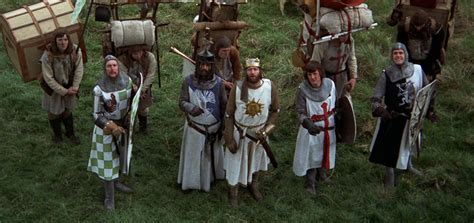
Monty Python visit the French.

Monty Python and the Holy Grail
Most of these won’t be ranked but this one is definitely #1. There’s no other movie where I’m laughing constantly before things even happen because I know what’s coming. People probably don’t like watching it with me. Sure, the ending is terrible, but it’s so much fun along the way!

Braveheart
This one is the clear #2, but the other 8 are in no particular order. Not many movies are 3 hours long, and you don’t mind it or feel it at all. There’s no wasted time in this one, and it’s a great story.
The Lord of the Rings: The Fellowship of the Ring
This is my favorite of the books, and my favorite of the movies. The scenes from Weathertop on through the Mines of Moria are probably my favorite sequence within any book or movie. None other shall pass!
The Matrix
This was so stunning when it came out in terms of special effects and also the big ideas in it. Philosophically, it’s still an ugly mess but it remains interesting long after you see it. It may seem like you’ve been living two lives.
Spider Man: No Way Home
The Marvel Cinematic Universe movies are a mixed bag, but this one was definitely made for the true Spider Man fanboys. He was my favorite for the short time I collected comics, and this movie was chock full of references without seeming contrived. I left the theater saying I wanted to walk right back in and watch it again.
Tenet
This one makes the list ahead of Inception partly because of when I saw it, in November 2020 in the theater. Times were tough during the Covid-19 pandemic and I needed to get out and escape. The complicated and bizarre premise and plot of this movie got my mind off of everything else for a while. It also made me want to borrow a fire truck.
Harry Potter and the Prisoner of Azkaban
This one is in the same camp as Fellowship above, my favorite book and movie in a series. The scenes in and around the shrieking shack part are so well-paced and move the story forward so much in a short time.
Star Wars: The Empire Strikes Back

Many other people are much bigger Star Wars fans than I am. I like only a few of the movies, but this was the first one I saw when it was new in the theater! Full of iconic moments and lines, I think this is where Star Wars peaked those many years ago.
Shawshank Redemption
A true classic and one of the best movies ever made. The sequence of revelations at the climax of the movie, while seeing how diligently Andy overcome the injustice of his situation, is fiendishly clever. Also, Red is one of Morgan Freeman’s best roles.
Singin’ in the Rain

Last but definitely not least, another true all-time classic. This movie just makes you laugh and smile all the way through it, and Make ‘Em Laugh does exactly what it says. I love that they gave Donald O’Connor a moment to shine, because Gene Kelly tends to steal every scene he’s in.

And there they are, 10 movies I really like a lot. Which of these are your favorites too?

The Meaning of the Bible in Sign Language

As a hearing child of deaf parents myself, I was thrilled in 2022 to see the movie CODA win best picture, deaf actor Troy Kotsur win best supporting actor, and Siân Heder win for best adapted screenplay.  CODA stands for Children of Deaf Adults and the story centers around Ruby Rossi, a hearing teenage girl who is an amazing singer but is the only hearing member of her family.  There are good lessons in the movie about overcoming differences and obstacles through some compassion and creativity.

It was a great movie but be aware: “Mr. Kotsur used the versatility of sign language to enhance Frank’s dialogue, which is sometimes salty enough to push the limits on the movie’s PG-13 rating.”[1]  There’s one scene in particular where Frank Rossi embarrasses his daughter Ruby in front of a boy with some improvised, erotic sign language.  Versatility has negatives but also positives…

Multiple words for love in Greek (eros, agape, etc.) conceal layers of meaning when translated to English.  After watching CODA, I was reminded of an example where the expressiveness of sign language also adds layers of meaning beyond spoken English. (maybe spoken English is just a bad language?)  Not all sign language is the same – there are many dialects – but the sign for Bible I use is actually two signs: “Jesus” followed by “book.”  Every time I sign what I would just speak as “Bible,” there’s a reminder built right in that the Bible is a book about Jesus.  From start to finish, the Bible is a record of why He needed to come, what He was like when He did, and what His followers should believe, know, and do.  Jesus Christ is described right in the sign for Bible!

But there’s still another layer.  In the book of 1 Corinthians, the apostle Paul defends his ministry saying that his message needs to focus on “Christ crucified”[2], not on performing miracles to those who want signs and impressing with fancy speech those who love wisdom.  To sign “Jesus”, I touch the middle finger of my right hand to the palm of my left hand, then the middle finger of my left to the palm of my right.  What does that signify?  It’s an expressive reminder of the crucifixion of Jesus, and the nails that were barbarically driven into his hands.  Thomas, one of the 12 main disciples of Jesus, said after the first Easter that he would not believe Jesus had risen from the dead “Unless I see in his hands the mark of the nails, and place my finger into the mark of the nails, and place my hand into his side.”  Eight days later, Jesus presented Himself to Thomas and said “Put your finger here, and see my hands; and put out your hand, and place it in my side. Do not disbelieve, but believe.”  To which Thomas replied: “My Lord and my God!”  (John 20:24-29).  I don’t know if this was intended by the person who created the sign for Jesus, but it may be a liturgy recalling this encounter, reminding us that Jesus was crucified, yet lives!

So, whenever you think of the Bible, think of it in sign language where every single time you sign it, there is a reminder that the Bible is the book about Christ crucified.  After Thomas declared who Jesus was, Jesus responded: “Have you believed because you have seen me?  Blessed are those who have not seen and yet have believed.”  Every time I sign “Bible,” it testifies to those who have not seen Jesus of what He has done for them.


One Last Thing
By the way, to sign “book” you place your hands together flat, palms facing each other, in front of you, then open them as if your hands were the front and back of a book.


[1] Jurgensen, John. “Troy Kotsur of ‘CODA’ Wins Best Supporting Actor Oscar.” The Wall Street Journal, 27 March 2022.
[2] 1 Corinthians 1:23

A Detour into the Total Perspective Vortex

In the previous post in this series on our Master’s voice, I wrote that: “We can’t see the reasons God wants us to trust Him because there is far more at work than we could ever imagine.”  Sometimes truth is stranger than fiction, but sometimes great illustrations come from strange fictional places, like Jim Carrey movies and Douglas Adams books for example.

In The Restaurant at the End of the Universe,[1] the sequel to the sci-fi comedy classic The Hitchhiker’s Guide to the Galaxy, author Douglas Adams imagines a technology that harnesses full awareness of the universe as a profoundly cruel torture device.  When Trin Tragula invented the “Total Perspective Vortex” to annoy his wife who kept accusing him of blowing things out of proportion, he found that when he tested it on her, “the shock completely annihilated her brain.”  A victim is placed in the TPV and presented with a realistic model of the entire universe, with a tiny dot on top of a tiny dot that says, “you are here.”  He concluded that “a sense of proportion” in such a massive universe would only make someone feel completely insignificant, hopeless, and insane beyond all hope of recovery.  It’s a sci-fi comedy, but still, be careful what you wish for.

Another example from a different angle is the Jim Carrey movie, Bruce Almighty.  This hilarious (but irreverent) comedy is based on Carrey’s character Bruce Nolan raging against God about his frustrating life.  God, played by Morgan Freeman, appears and challenges Bruce to do any better, giving him “the job” for a temporary period to teach him a lesson.  The 3-ish-minute video embedded here is my favorite part of the movie, where Bruce tries to figure out how to deal with his new awareness of all the prayers of the world.

If God thought it was possible, or a good idea, for us to know it all, we would.  After all, even Nipper the dog from the “His Master’s Voice” painting would be distracted and unable to get anything done if he saw this picture, even though it contains only good news:

Our Master speaks to us as our creator, knowing both our limitations, but also what we are capable of as His marvelous creatures if we trust Him!

This post is fourth in a series that started with this post on His Master’s Voice. More to come…


[1] Adams, Douglas. The Restaurant at the End of the Universe.  (1980).  P. 79