What We Need For Christmas Summary

Merry Christmas everyone!

Thank you for reading my series about what we need for Christmas.

Remember that whatever mess we find ourselves and the world in, Christmas is a reminder that God has not given up on us and on the world.  Isaiah 9:6, a prophecy from around 700 BC describes the Christ we celebrate each Christmas:

“And his name shall be called Wonderful Counselor,
Mighty God, Everlasting Father, Prince of Peace.”

To meet our deepest, most significant needs, this Christ is provided for us.
         As Wonderful Counselor, He is our source of wisdom; (covered in this post)
         As Mighty God, He will empower us to live as He did; (this post)
         As Everlasting Father, He invites us with unconditional love into His family; (this post)
         As Prince of Peace, He buys peace between us and Him, and between us and others. (this post)

“Four gifts for Christmas. They are the greatest gifts that anybody can give or we can have, and they are all in Jesus. They are for us. They are for you, if you will have them.” – James Montgomery Boice

Celebrate these gifts today!

In closing here is a video of the Royal Choral Society performing the Hallelujah Chorus from Handel’s Messiah, for He, the Christ of Christmas, shall reign forever and ever:

More than Truth

“The poor is disliked even by his neighbor, but the rich has many friends.
Whoever despises his neighbor is a sinner, but blessed is he who is generous to the poor.” – Proverbs 14:20-21
“The beginning of the gospel of Jesus Christ, the Son of God.” – Mark 1:1

In May 2021, I heard a sports update on the radio that eight members of the New York Yankees baseball organization, including players and staff, had tested positive for Covid-19.  Then the radio host raised his voice in alarm and added: “and all of them were fully vaccinated!”  The next day, I read a different report online about the Yankees that said all who tested positive were asymptomatic.  The first report didn’t mention that they were asymptomatic, and the second report didn’t mention that they were vaccinated.  Both reports were factual, but both reports were misleading.  One sounds like good news, and the other bad, but it’s the same story.  I can’t judge the intent of either source, but the point is that there is more to discernment than telling the difference between truth and lies.

While there is absolute truth, not all truth is the way, and not every way leads to life.  In the last post, I introduced a “Moral GPS”, our internal chatterbox of voices that influence our decisions.  In choosing between these, I wrote “Facts matter, but any voice can have facts.”  You can choose the wrong direction even if the signs pointing that way were “true”. A key input to that system is the media.

During the pandemic, many became increasingly frustrated with the idea of “truth”, and this has at least in part been intentionally engineered.  Bogeymen were everywhere, and you or your neighbor might be one!  Frustration is good for politicians and journalists, which is nothing new – consider these quotes and their dates:

“The biggest big business in America is not steel, automobiles, or television.  It is the manufacture, refinement and distribution of anxiety” – Eric Sevareid, CBS journalist, in 1974

“The whole aim of practical politics is to keep the populace alarmed (and hence clamorous to be led to safety) by an endless series of hobgoblins, most of them imaginary.” – H. L. Mencken, in 1923

Photo by Annie Spratt on Unsplash

Feeding this frenzy is the fiction that if journalists and others are telling the truth, they are “objective” or “unbiased”, and therefore “ethical”.  This claim of objectivity is not only light years from the truth, but also theoretically impossible for anyone but God Himself.  I studied journalism in college, and although they didn’t outright teach bias, they taught us to think about what goes into making the following decisions and others:

  • What stories do you publish “above the fold” of the newspaper, where people are most likely to see it?
  • Which quotes do you place early in an article (people usually don’t read the entire article, but please keep reading this one), and which do you place later?
  • Which sources do you work harder to get a quote from, and which do you give up on after leaving one voice mail?  The ones that support your view, or the ones that contradict?
  • Which statistics do you cite, or not cite (to save space and make deadline)?
  • What term do you use to describe a person or idea?  The term used by advocates, or by adversaries?

There is no “lying” going on behind many of these decisions, just “editorial discretion”.  There were, of course, manipulated polls and other things I learned about, but very few outright lies.  In the more modern media age, though, these things are elementary.  Now technology even allows companies to make these decisions for other people’s content!

Of course, not all journalists are unethical, which is just like any profession, but the industry trend seems to be downhill, and those who get the most attention are often the worst examples.  It’s an industry in need of a revival.

Frustration is also good for some economically.  “Big tech” businesses made a ton of money during the pandemic, partly by feeding your anxiety.  Algorithms and clickbait aren’t interested in informing you, only manipulating your emotions to draw you to advertising.  They analyze in labs how the chemical reward system of the human brain reacts to different things so that you will return for that “high” repeatedly.  They’re making you emotional on purpose.  Bad news sells.  Thoughtful news, not as much.  Again, the intent and the business model are nothing new, but technology has made it ruthlessly efficient, and a pandemic-panicked population created a captive audience with so many “normal” activities unavailable.  One of my best moments of 2020 was getting to a movie theater in November.  It was a needed distraction and a healthy sense of normalcy[1].

Consider also this quote:

“One of the most tragic events of our time is that we know more than ever before about the pains and sufferings of the world and yet are less and less able to respond to them…There appears to be a general assumption that it is good for people to be exposed to the pain and suffering of the world…If we let the full content of newscasts enter into our innermost selves, we would become so overwhelmed by the absurdities of existence that we would become paralyzed” (emphasis mine)

This comes from a book I just read titled “Compassion”[2], written in 1982.  Before the internet and smart phones.  Let that sink in.  The suffering of the world is not a yoke you want to carry, but it’s in the interest of many journalists, politicians, and computer programmers to make you feel it.

Truth + Perspective
So, how do we start to filter all of this?  Proverbs 14:20-21 quoted above provides one example of how the Bible deals with and presents truth.  Both verses are “true”, but each has its own perspective.  Verse 20 describes the world as it is: “The poor is disliked even by his neighbor, but the rich has many friends”.  No matter the economic and political system you live under, you recognize this as generally “true”.  Ancient Israel had the same “truth” as the modern world.  But what do you do with this information?  Your self-determined Moral GPS might tell you to pursue riches, because it is “good” to be liked and have friends.  Who wants to be disliked?  If this is “just the way it is”, why go against the grain?  Greed is good.  More on this later.

This isn’t the only Proverb that states things as they are, with no value judgment attached.  Another example would be Proverbs 17:8 – “A bribe is like a magic stone in the eyes of the one who gives it; wherever he turns he prospers.”  This doesn’t mean one should give bribes, but it’s “true” and helpful to know how bribes function, even if your goal is to avoid them.

Fortunately, verse 21 adds perspective in God’s value judgment on the truth of verse 20: “Whoever despises his neighbor is a sinner, but blessed is he who is generous to the poor.”  If you fear God, your course of action is not to reinforce the truth of verse 20, but to seek to correct the situation with righteousness and justice.  A Christian must be concerned about what to do, in addition to what is true.

The Illusion of Pax Romana
Also, at a higher level, there’s “Gospel Truth”, a sort of master narrative that adolescent truths and narratives want to be when they grow up.  In “Evil and the Justice of God” by N.T. Wright, he says, “the word gospel itself…was a direct confrontation with the regime of Caesar, the news of whose rule was referred to in his empire as ‘good news’, ‘gospel’”.  Before Matthew, Mark, Luke, and John, the “gospel” was an existing genre of literature, or more accurately propaganda, exalting successive Caesars as bringing in and sustaining the Pax Romana[3], or “Roman Peace” which lasted roughly the first two centuries A.D.  Wikipedia describes it “as a period and golden age of increased as well as sustained Roman imperialism, order, prosperous stability, hegemonial power and expansion”.  These gospels sometimes assigned miraculous powers to Caesar and ordered that he be revered as a god.

The Christian gospels are not “biography” by genre, but “gospel”, a narrative to challenge the existing narrative.  Jesus operated in the environment of the world’s greatest empire, which would endure no rival, no other gospel.  From this perspective, His ministry looks different.  All He had to do was walk down the street – any street – and find problems not being solved in Caesar’s great empire and He was promoting a different narrative.  Mark’s gospel says those who saw Jesus “were astonished beyond measure, saying, ‘He has done all things well. He even makes the deaf hear and the mute speak.’”[4]  Actual miracles showing that He could solve every problem He encountered, while He promised a world where all problems are solved for those who believe in Him.

However, those who were happy with the empire didn’t go quietly.  Proverbs 14:20 truth was just fine with them since they were the rich ones enforcing the rules.  “They tie up heavy burdens, hard to bear, and lay them on people’s shoulders, but they themselves are not willing to move them with their finger.”[5]  Preservation of the “Pax” often led these leaders to clash with, and ultimately crucify, Jesus.  John 11:48 records the panic of religious leaders about Jesus’ activities: “If we let Him go on like this, everyone will believe in Him, and the Romans will come and take away both our place and our nation.”  When Jesus healed on the Sabbath, they protested because it was “against the rules”, which they needed people to follow, otherwise the Romans would have to step in, re-establish order, and probably put in new leadership.  Their fear of Caesar was so strong that they determined to kill someone who was able to raise the dead. Make sense to you?

Early Christians faced similar problems.  Much of the persecution of the early church was because “The exclusive sovereignty of Christ clashed with Caesar’s claims to his own exclusive sovereignty,” according to historian Earle Cairns[6]

Conform Wisely
Back to the original topic of this post: journalism.  Part of the genius of the founding fathers of the United States was that, by granting freedom of the press, they were putting government and journalism in opposition to each other (at least in theory) and opening the way for multiple perspectives to get a hearing.  They knew that limiting distribution of “truth” to those in power was dangerous.  The powerful would be satisfied with Proverbs 14:20 truth.  In the world of Pax Romana, Caesar is god and loyalty is required for the prospering of the kingdom.  There can be only one narrative.

If you live in a country with press freedom, be thankful.  Diverse information is needed to rightly understand the broad situation of our world and immediate surroundings, but too much of that knowledge can be soul-crushing, draining us of compassion needed for the problems right in front of us.  The wrong truth can make us despise our neighbor, or to support the wrong gospel.

The Bible commands: “Do not be conformed to this world, but be transformed by the renewal of your mind, that by testing you may discern what is the will of God, what is good and acceptable and perfect” – Romans 12:2

How do we do this?  Maybe God could tell us the “right” network to watch, the “right” amount to watch, and the “right” solution.  However, nobody but God is the Answer.  Therefore, each person must practice discernment as the Spirit guides and give grace to others.  Each must learn to fear God and let Him overrule the other voices in our Moral GPS.  If we pay attention, we know the Bible is not silent.  Proverbs alone contains a lot of relevant wisdom on the subject:

“Whoever walks with the wise becomes wise, but the companion of fools will suffer harm.” (13:20)
“A fool takes no pleasure in understanding, but only in expressing his opinion.” (18:2)
“The one who states his case first seems right, until the other comes and examines him.” (18:17)
“Unequal weights and unequal measures are both alike an abomination to the LORD.” (20:10)
“Make no friendship with a man given to anger, nor go with a wrathful man,
lest you learn his ways and entangle yourself in a snare.” (22:24-25)

Find news that suits God’s purpose for you and helps you glorify Him.  The world needs Proverbs 14:21 truth, and God requires it.  Like Jesus did wandering the streets of His day, look in your circles – family, church, neighborhood, workplace, state – and have compassion for those who need good news that isn’t in the news.  For some of these people, the institutions of your particular “Pax Romana” failed them – family, community, the courts, the government, even the church.  Perhaps a judge declared against them wrongly?  Perhaps they were a victim of abuse nobody knows about?  Maybe there is some other secret struggle or sin?  A disability, either permanent or temporary?  Perhaps they just don’t fit in with the clique of your neighborhood?  Maybe their employer made a “business decision” that cost them their job?  Some might have been hurt by the pandemic in less-obvious ways: they lost their life savings when their small business went under, they struggle with mental health, they saw their college dreams fall away, and any other number of things.

You won’t hear about many of these people on the news, and often politicians aren’t interested in their problems, especially if it makes their narrative look bad.  Anyway, these lost sheep don’t want publicity.  They just want compassion first, then perhaps help and a way forward.  Or perhaps just compassion and hope.

Individual people can be understood and shown compassion; narratives and statistics can overwhelm us and shut us down.  In the book “Compassion” quoted earlier, the authors write: “When information about human suffering comes to us through a person who can be embraced, it is humanized”.  They also write that the expression “to be moved with compassion” occurs 12 times in the New Testament, always in relation to Jesus or God the Father.  The original Greek behind it suggests not just a passing feeling or sentiment, but something you feel in your guts.  When Jesus found hurting people everywhere He went, His compassion compelled Him to help them.  In feeding people, healing people, and spending time with outcasts, Jesus made it clear that the Pax Romana wasn’t “good news” for everyone.  He wasn’t necessarily trying to pick a fight, but He couldn’t help it.  God is love after all.

You may upset the “Pax Romana” of your time and place, but every “Pax Romana” is illusory and temporary.  Break some rules.  Be creative.  Don’t let anyone recruit you into a cause that isn’t yours and that isn’t God’s.  Don’t let them lay heavy burdens on your shoulders that are impossible for you to bear.  The weight of the world was on the cross, but not your cross.

I’m horrible at compassion but working to do better.  I hope that a lot of us can do better as we emerge from the pandemic more aware of the impact of only seeing the world through windows.

If you are one of the hurting people, reach out for help.  There are likely more people who care, and more resources available, than you know.  You’re not a statistic.

Thank you for reading.

Coda
If you can spare a few more minutes, check out the song, “Never Take It” by twenty øne piløts.  It’s an upbeat sounding, yet defiant, take on how media tries to “weaponize you and I”.  The lyrics are fantastic.
Lyric video
Lyric page

[1] One of the worst things about 2020 was that I knew there were people who hated me for going to a movie theater and “putting lives in danger”
[2] McNeill, Donald P.; Morrison, Douglas A.; Nouwen, Henri J. M.  Compassion: A Reflection on the Christian Life (1982).  I bought this book in 1993 but never read it until re-discovering it recently while looking for another book someone texted me about during a nap.  I decided to read it since compassion is so needed given the societal damage done by the pandemic and related trends.  Glad I did.
[3] https://en.wikipedia.org/wiki/Pax_Romana.  Yes, Wikipedia is a lousy source, but this is a blog.
[4] Mark 7:37
[5] Matthew 23:4
[6] Cairns, Earle E. Christianity Through the Centuries: A History of the Christian Church (1996).

(Originally posted June 2021)

His Master’s Voice (aka This Blog Doesn’t Need Another Mascot)

You may not know him by his name, but you’ve probably seen Nipper the dog.  He’s quite famous, although he died in 1895.  Nipper, of course, is the dog from the painting “His Master’s Voice” where he is listening intently to a gramophone.  The picture became a popular logo for many companies, including RCA to sell record players, because the dog looks like it thinks his master is in there talking to him.  The RCA recording technology is so clear!

“His Master’s Voice”, an 1898 painting by Francis Barraud. From Wikipedia Commons.

“His Master’s Voice” is also a good introduction to some posts I’m working on about hearing our Master’s voice.  We might like to be like Nipper, and every now and then we might get a glimpse of what that’s like, but we’re unlike the painting a lot of the time.

For one thing, most dogs are naturally loyal and want to please their masters.  That’s why Nipper loves the gramophone so much.  A funny thing about dogs is that they don’t care what their masters believe.  They won’t discuss philosophy with them.  Not that their master’s philosophy doesn’t matter to the dog, because if their philosophy includes cruelty to animals, that’s very bad.  Dogs just don’t think at that level.  On the other hand, dogs are very, very excited and eager to hear you tell them to do something.  Cats of course are very different – I have two of them – and they’re too often a better picture of how I really relate to my Master in heaven than Nipper is.

The other point is that dogs have great hearing.  The painting has no sound, but you get the idea that, no matter how much noise was going on around him, Nipper would be right there, trying to find his master in the gramophone.  In contrast, people are bombarded with loud voices from all directions and usually aren’t as good at filtering the good from the bad.

Centered on the story of Gideon from the book of Judges, I’ll be sharing a few posts soon about how difficult and messy listening for God’s voice really is.  I’m trying to figure it out every day.

Ebenezer, looking concerned

Lastly, if you see Ebenezer (a squirrel and the blog’s mascot), tell him Nipper is only here for a short visit.  Also remind him that in heaven, even the dogs and squirrels will lie down together in peace.

Coda
One of my favorite song lyrics of all time is:
“I’m looking past the shadows of my mind into the truth; And I’m trying to identify the voices in my head; God, which one’s you?”

It’s from a 2000 song called “Breathing” by Lifehouse.  They probably didn’t have Nipper in mind when they wrote it, but it’s about us all wishing we could pay better attention to our Lord, to know His will, or sometimes just to be present with Him.

You can read the lyrics here, or if you have 4 ½ minutes, listen here.  Apologies for any ads on these sites.


The next post in the series is here

Finding Port for the Good Ship Ambivalent

From yesterday’s post, you’ll know I am reading King’s X: The Oral History, a book chronicling the history of the rock band King’s X, by Greg Prato.  Yesterday, I dove into one of their more bizarre and unknown songs, but today is about the band’s biggest hit.  “It’s Love” got to “#6 on Billboard’s Mainstream Rock charts and #1 on the FM Radio Airplay charts. It was our highest-ranking single, ever,”[1] according to Ty Tabor, the band’s guitarist and sometimes lead singer, who wrote the song.

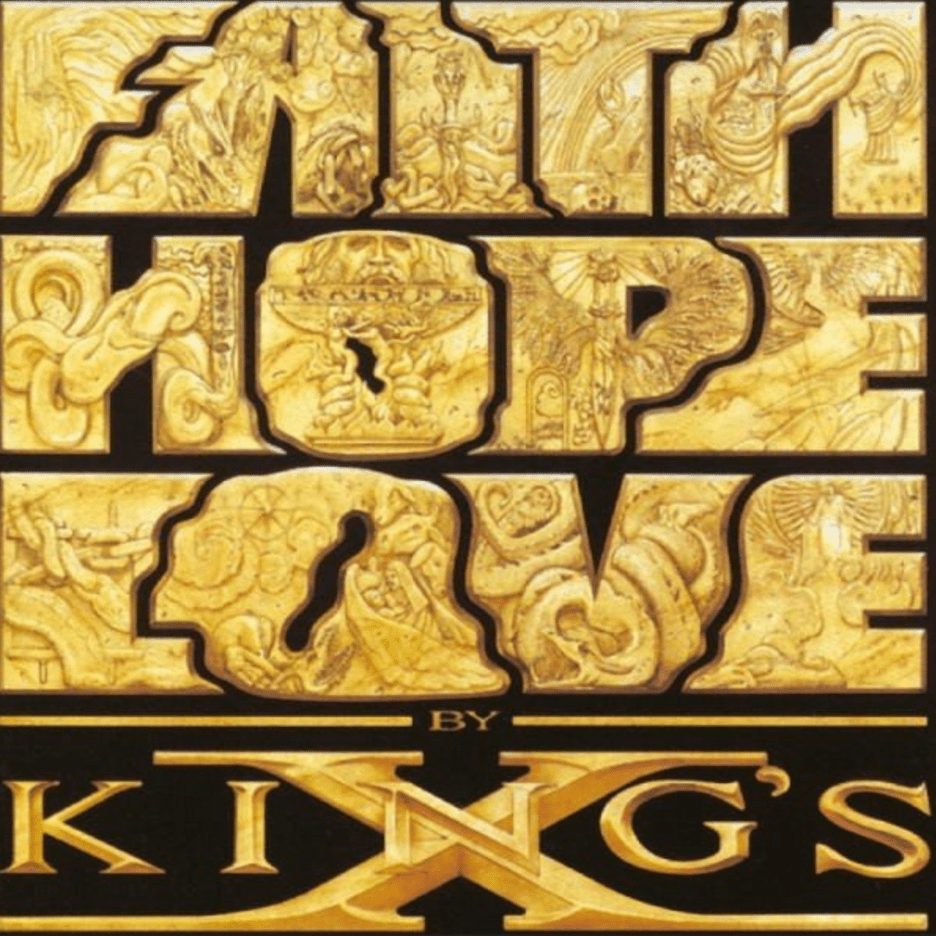
I knew both Christianity and King’s X by reputation before becoming a true fan of either, but both were growing at the same time in me during college.  Having heard of King’s X but never actually heard their music, I once saw one of their CDs in a friend’s dorm room.  My friend said it was his roommate’s but that he wasn’t much of a fan.  Before leaving I picked up the CD and looked at it.  The album, called “Faith, Hope, Love” had a cool cover, and included the song “It’s Love.”

Album cover of “Faith Hope Love” by King’s X

Later, the memory of that album cover made the triad of faith, hope, and love jump out at me whenever I saw it in the Bible, including 1 Corinthians 13:13, which says: “So now faith, hope, and love abide, these three; but the greatest of these is love.”  This triad is all over the place and there are many verses explaining the relationships between them.  Seeing these references also made me come back to the band and give them a listen. The rest, as they say, is history.

Before getting into “It’s Love”, you can find the lyrics here, or listen to the song here.  I promise it’s an easier one to listen to than “Six Broken Soldiers” and also that this post will be shorter than yesterdays.

Overall, the message is fairly simple: Ty says he doesn’t know everything, but the thing he wants to share from his experience is that love is the most important thing in life.  Love both keeps the world from falling apart (“holding back the weather”), but also eventually love is what requires a loving God to bring about a plan to fix what’s wrong with the world (“the same will let it go”).

But there’s one line in the song I didn’t really get until reading about it recently: “There’s a ship on the ocean, and I can’t decide if I like it.”

There Ty is, enjoying good company, the beach, and the ocean, but he wasn’t sure about the ship on the ocean.  There’s an ambivalence about the ship, and a suggestion that maybe it’s an exception to the overall message of “love,” but I couldn’t figure out more than that.  I wasn’t alone in not getting it.

In the book, Ty says his brother didn’t understand the line, so he explained: “my point was, man’s progress is wonderful and everything, but when the ship turns over and poisons all the fish, that’s not so wonderful. So, it was me contemplating all that we do and all that I’m happy with about it, but how much destruction it causes. It’s yet again one of those socially conscious songs. I just had to say it.”[2]  It was almost that Ty was struggling with whether love applied when someone does something that “poisons all the fish.”  In tricky, real-life situations, does love still rule?  Ty doesn’t seem sure.

Contemplating What is Crooked
Yesterday I quoted Romans about Paul’s inner conflict, but later in the same chapter, Paul wrote: “So I find it to be a law that when I want to do right, evil lies close at hand.” (Romans 7:21). This idea that even our best efforts at goodness in this world are tainted is not a new one.  Solomon referred to something similar twice in the Old Testament book of Ecclesiastes, in 1:15 – “What is crooked cannot be made straight, and what is lacking cannot be counted.”  And also in 7:13 – “Consider the work of God: who can make straight what he has made crooked?

What Paul and Solomon are getting at is that there are things in this world, including us, that will remain crooked and unfixed until God’s plan is completed in eternity.  The Bible tells us that all of creation is cursed by God because of our sin.  Some things are wrong because God has made them so.  Until a person establishes this in their own heart and mind, they will chase the wind of worldly utopia until they become hopelessly ambivalent, or continue on, highly motivated but frustrated and angry.  The phrase “under the sun” comes up 28 times in the book of Ecclesiastes (by my quick count) and refers generally to the actions of mankind done without consideration of God’s wisdom or eternal consequences.  Everything done “under the sun” is lacking, and none of it can provide the satisfaction and meaning true wisdom can deliver.

It’s Still Love
Since “under the sun”, even good things come with a cost, what do we do?  We can’t be ambivalent to those costs to the point of not caring, but we also can’t be so committed to removing these costs that our efforts become another cost.  The world is broken, but also people are broken, and how we treat them matters.

Despite any ambivalence about the ship on the ocean, it’s still “love that holds it all together.”  Therefore, the priority is always to focus on obedience and thankfulness to God, who tells us to love, not on utopian alternatives to God that tell us something is more important than loving every one of our fellow humans.  The proverbial ship on the ocean and its problems are seen by God and are part of His plan.  He cares about our conflicts and paradoxes, but still tells us to have faith, hope, and love.

However, rejection of love means prioritizing our own, temporary, interests and decide who we should love and who we should hate based on that.  One side will defend the necessity of the ship – and more ships – at all costs, because it’s good for the economy.  They can make money and enjoy what little time on earth they have.  The other side will condemn those who poison the fish, or might possibly poison fish in the future, because this earth is all they have, and they want to protect it.  “Under the sun” there is no nuance or ambivalence about the ship, but our opinion of the ship determines everything, including whether we can enjoy the beach and the ocean that we do have.

The answer lies not in some abstract move to the center politically, but in knowing that there is more than what exists “under the sun.”  Regardless of the conflicts inherent in living with broken people in a broken world, faith in God to save us, hope in His provision of a perfect future, and the priority of love for God and others, is always the right answer.  We can be a little ambivalent about the ship on the ocean, but we should have no ambivalence about love, nor about its partners, faith and hope.  We should pursue them with everything God has gifted us with and give Him the glory.  We can’t fix all the world’s problems, but we can show the world the character of its Creator and show it the way to a better world.

So now faith, hope, and love abide, these three; but the greatest of these is love.”  Always.


[1] Prato, Greg. King’s X: The Oral History (2019).  P. 105.
[2] Prato, Greg. King’s X: The Oral History (2019).  P. 95.

Do You Have a Caged-Up Gorilla in Your Trunk?

I’ve been a fan of the rock band King’s X for many years and am currently reading King’s X: The Oral History, a book by Greg Prato that chronicles the history of the band entirely through quotes from the band, those who have worked with the band, music journalists, and other musicians.  They have a musical style all their own, combining heavy rock influences with complicated arrangements and Beatle-esque vocal harmonies.  Some even credit them with inventing the “grunge” genre, not just by often tuning their instruments to a lower, heavier tone, but also through their gritty lyrics as a contrast to the “hair metal” that dominated rock in the early and mid 1980s.  On top of the musical style, I also liked that in the late 1980s and early 1990s there were a lot of Christian themes in their lyrics but written around the reality of their struggles with their faith and with aspects of Christian culture and the music industry.  Unfortunately, these struggles continue for them, and only one of the three members seems to still be a Christian.

One of the reasons I bought the book was that it promised to cover “every song” in their catalog, and since some of their lyrics are enigmatic, I wanted more of the story.  The rest of this post is about one of those songs, how the book (understandably) didn’t explain it, and what I was able to get from it anyway.

When I unwrapped the book, the first thing I did was to find the hoped-for explanation of the lyrics for “Six Broken Soldiers.”  Written by the band’s drummer, Jerry Gaskill, it’s a different style than other songs and the lyrics seem intriguingly random.  Flipping through pages, I quickly found Jerry’s only comment on the song:

“It’s always hard for me to talk about lyrics, because I don’t like to say exactly what I’m thinking, because then that takes away from anything that you may get from it. When I write, I put everything I feel and think into each line, so it comes off very ambiguous sometimes, and even unintelligible sometimes. But I have specific things I’m thinking when I wrote that. Basically, it’s just me talking about me.”[1]

Jerry Gaskill

Bummer.  Although I was hoping for more specifics, I definitely understand an artist’s desire to let the audience interpret the work in their own way.  So, if “it’s just me talking about me,” what do I see knowing that, and re-reading the lyrics?  Below I’ll go into some of the lines and my take-aways, but it might be handy to have the lyrics, which you can find here, or if you want to hear the song, click here.  There are parts of it I don’t get, and will skip in my comments, but which meant something to the author and that might mean something to you.

Us Talking About Us
In general, I think the song describes the complexity of human personality, not just Jerry’s, but everyone’s, and how little we understand it.  First, the title of the song says a lot.  Brokenness is right there, but also “six” says we are broken in many ways.  We can all identify with having problems, and more than one of them.  With “soldiers” I think of our struggle against our problems, and that even the “soldiers” we have to fight them with have their own problems.  Our brokenness affects our ability to combat it and there’s no easy fix.

The opening verse suggests that our surrounding culture and heritage are not enough to solve these problems, and often don’t even care about them.  Is all we have an “American library” to deal with our sickness?  How often do you hear something on the news, or something a politician promises, and think – that’s exactly the answer to my specific situation?  Probably rarely, and even rarer if you consider whether they can actually do it, and on time for it to help you.  A lot of what is available to us is too vague and too ineffective to be what we really need.

The next part is series of seemingly random short phrases that are metaphorically part of our personality.  For me the lyrics include these parts:

  • Among the “Six broken soldiers in the trunk of my car”, there are parts of us we share with others (“Two of them speak”) and parts we’d rather not (“four go to bars”).  If this is what it means, then it also implies the parts we hide are much larger than the parts we let others know about.  All of it is baggage we carry with us everywhere we go, as in the trunk of our car.
  • “A caged up gorilla” – There are parts of us we don’t like, that might be harmful, and that we can barely control.
  • “three local bands” – There are parts of us that are experiences that led to where we are now, for good or ill.  King’s X had multiple, earlier versions before the current one, and so do we all.

Lastly, Jerry mentions an internal parrot that speaks multiple languages, all of them unintelligible, while “the audience he scans.”  Parrots repeat what they hear without understanding it so this line could mean there’s a lot that goes on inside ourselves that we don’t understand.  This echoes Paul’s frustration with himself in Romans 7:15 where he says: “For I do not understand my own actions. For I do not do what I want, but I do the very thing I hate.”  Our internal thoughts and motivations aren’t always reliable, and we don’t always know where they come from.

The parrot scanning the audience means he is looking for confirmation from outside that he is doing the right thing.  The irony is that when we don’t understand ourselves, why would we expect others to consistently understand us better and be able to guide us?  Do other people’s internal parrots speak more intelligibly than ours?  If they don’t, is popularity or majority rule a good guide for our decisions?  He has “sixpence and a quarter,” but doesn’t know what to do with it.

Not a very hopeful song, so what to take away from it?

First, that there is far, far more diversity inside of any one individual for even that individual to understand.  How can any society, armed with only an “American library,” hope to truly deal with people as actual individuals?  We can claim to respect the individual and stand for diversity and inclusion, but are such things even possible without vastly oversimplifying the situation?

Second, that there is far, far more brokenness in each individual for anyone other than God to fully diagnose and treat.  From what vantage point can we actually see the truth we each need, know the answers to our problems, and effectively apply them?

Before moving to the last section, I must clarify that I’m not saying human efforts at solving our problems are totally wrong and useless.  Many people manage their problems well enough alone and others manage with a lot of help from different sources.  Good friends, family, and in some cases therapy and medication, are very helpful.  We know a lot more about human psychology and other related topics than we used to.  The “American library” is not a static thing, but grows and changes over time, sometimes improving and becoming more effective, but not always.  Sometimes “progress” creates more, newer, problems before the old ones are solved.   Therefore, when honestly looking at the human condition with eyes wide open, we seem doomed to always fall short of a full solution with the resources we have.  What we have is not sufficient, but we have hope.

Where Does Hope Come From?
While our Six Broken Soldiers seem hopeless, there is an answer from outside our inner confusion and from beyond our material existence.  Members of King’s X are (or were) fans of C.S. Lewis[2], who wrote this description of mankind from Aslan, the fictional kingly lion who represents Jesus, in Prince Caspian, part of the Chronicles of Narnia series:

“You come of the Lord Adam and the Lady Eve. And that is both honor enough to erect the head of the poorest beggar, and shame enough to bow the shoulders of the greatest emperor on earth.  Be content.”[3]

Against our problems, we have far, far more dignity and nobility and talent than could possibly come by some cosmic accident.  We are each individual creatures of a loving God, and we have far more than an “American library” at our disposal.  We have Someone who knows us fully as the complex people we are, who loves us completely, and who was broken so that we might be delivered from our brokenness.

Therefore, come to Jesus, bring your Six Broken Soldiers, and ask Him to heal all of them.  He is an infinite resource.  There’s nothing about you He doesn’t already know and understand, and nothing He does not have a solution for.


If you don’t know how to do that or what that means, read this earlier post about what it means to have a loving, personal relationship with our Maker and Lord Jesus, who guides and empowers us to love as He does.


[1] Prato, Greg. King’s X: The Oral History (2019).  P. 97.
[2] Their first album was titled “Out of the Silent Planet,” and they later released a song referencing a chapter in “That Hideous Strength,” two books written by Lewis.
[3] Lewis, C.S.  Prince Caspian (1951).