During His life on earth, Jesus called 12 men to special positions as His disciples or apostles. Out of these 12, at least 4 and possibly 7, were fishermen, a common trade at that time. The gospels have many fishing stories, including one in Luke 5 when Jesus is about to call His first disciples.
One morning after Simon Peter and some other fishermen had been working all night without catching anything, Jesus decided to preach from Simon’s boat to the crowd that was following Him. After teaching, Jesus told Simon: “Put out into the deep and let down your nets for a catch.”[1] Simon answered: “Master, we toiled all night and took nothing! But at your word I will let down the nets.”[2]
Simon ended up obeying, but not before objecting: “Master, we toiled all night and took nothing!” Some questions may have gone through Simon’s mind: Did this travelling rabbi just tell me how to do my job? Nighttime was the best time for fishing, and they caught nothing, so why did He tell them to try again? Maybe Jesus, as a non-professional, didn’t know that? Maybe the felt like “I’m the expert here!”
However, Jesus knew what He was doing because when they obeyed, “they enclosed a large number of fish, and their nets were breaking.” There were so many fish that, they “filled both the boats, so that they began to sink.”[3]
One lesson of this story is that Jesus can perform miracles by controlling nature. Another is that Jesus had an unlimited ability to help Simon and the others do their jobs! And if Jesus was better than professional fisherman at fishing, what does that mean for other jobs? Jesus always knows better than we do about any job!
So, whether you’ve had a productive day, or you feel like you’ve “toiled all night and took nothing” don’t hesitate to ask Jesus for career advice! As Simon (later known as Peter) wrote in his own letter, “Humble yourselves, therefore, under the mighty hand of God so that at the proper time he may exalt you, casting all your anxieties on him, because he cares for you.” – 1 Peter 5:6-7
Peter is one of the most fascinating characters in the New Testament. His struggles and flaws are written for all to see, but so is the patience and love Jesus had for him. In Peter’s two letters, we get to see examples of his growth and maturity. One of Peter’s struggles was how Jews who had become Christian should treat Gentiles. In Galatians 2:11-21 is a story of Paul rebuking Peter for his hypocrisy toward Gentiles, and in Acts 10 and 11 is a story of Peter receiving a vision from heaven telling him not to treat Gentiles as unclean, because God can make anyone clean.
Peter ponders whether the key is for letting people in or keeping them out.
In 1 Peter 2:9-10, he shares this lesson with his readers:
“But you are a chosen race, a royal priesthood, a holy nation, a people for his own possession, that you may proclaim the excellencies of him who called you out of darkness into his marvelous light. Once you were not a people, but now you are God’s people; once you had not received mercy, but now you have received mercy.” (emphasis mine)
The bolded words clearly call back to the story of the Old Testament prophet Hosea, who God told to marry a prostitute named Gomer to teach a lesson about idolatry. Hosea’s children by Gomer are named in Hosea 1:6-9 –
“She conceived again and bore a daughter. And the LORD said to him, ‘Call her name No Mercy, for I will no more have mercy on the house of Israel, to forgive them at all. But I will have mercy on the house of Judah, and I will save them by the LORD their God. I will not save them by bow or by sword or by war or by horses or by horsemen.’ When she had weaned No Mercy, she conceived and bore a son. And the LORD said, ‘Call his name Not My People, for you are not my people, and I am not your God.’” (emphasis mine)
As Peter grew in Christ, he learned the same lesson Hosea learned: that all of God’s people are like Gomer and her children: once estranged from God in spiritual prostitution and adultery, but now a beloved people, betrothed to one faithful God. Jesus, our Holy High Priest, made the necessary sacrifice for the salvation of anyone and everyone who will come to Him. Those He saves join His “royal priesthood”, proclaiming His excellent work to all people who have not received mercy, but who His blood covers.
“Judge not, that you be not judged. For with the judgment you pronounce you will be judged, and with the measure you use it will be measured to you.” – Matthew 7:1-2
As told in Genesis, Joseph served Pharaoh faithfully. Even after being wrongly accused and imprisoned, he served while in prison and eventually rose again to prominence in Pharaoh’s kingdom. When Pharaoh dreamed of famine, Joseph interpreted the dream, and under God’s direction, came up with a plan to survive it. “And Pharaoh said to his servants, “Can we find a man like this, in whom is the Spirit of God?” – Genesis 41:38
In the gospels, Peter and John began as uneducated fishermen, yet they were personally discipled by Jesus for 3 years. In Acts chapter 4, these former fishermen forcefully proclaim the gospel, and about five thousand people came to faith in Christ. “Now when they saw the boldness of Peter and John, and perceived that they were uneducated, common men, they were astonished. And they recognized that they had been with Jesus.” – Acts 4:13
Pharoah recognized the Spirit in Joseph and people noticed Peter and John were different – do people notice the Spirit in you? Can they tell you’ve been with Jesus?
“A Christian should be a striking likeness of Jesus Christ.” – Charles Spurgeon
Intimidator 305 at King’s Dominion. The first hill at the top, with the following airtime hill in the middle.
My teenage son is a roller coaster enthusiast. He memorizes how tall they all are, how many inversions they each have, who the manufacturers are, how they work, and anything else he can find out. He takes lots of pictures of roller coasters, including the one I used for this post. Fortunately, I like them too. We’ve been on well over 100 different coasters together and will ride anything, but we do have slightly different tastes. Usually, he likes airtime more than I do, and I like intensity more than he does. As an enthusiast, he’s the one who told me what a greyout is: “a transient loss of vision characterized by a perceived dimming of light and color, sometimes accompanied by a loss of peripheral vision.”[1] Caused by low brain oxygen levels, a greyout can happen on roller coasters and can be a precursor to fainting.
Intimidator 305 at King’s Dominion in Virginia was my first greyout. The ride, with a 90-mph top speed on the 300-foot first drop, is themed after NASCAR driver Dale Earnhardt, whose nickname was “The Intimidator.” At the bottom of that first drop, the track banks into a 270-degree turn to the right, and the first time on it, the edges of my vision began to fade as blood rushed to my legs and feet. I felt the intensity rising, and my field of vision gradually narrowed into a small pinpoint, and I nervously tensed up. However, before I knew it, I was fine and back to enjoying the ride.
After we got off, I mentioned my greyout and my enthusiast son explained why I recovered so quickly. It was no accident. Intimidator 305 was designed by people who knew what the ride would do to people, so after the 270-degree turn, there is a 150-foot airtime hill. As the train comes up this hill, the track bends down at a lower angle than the train would go on its own momentum, which not only gives riders “airtime” as they feel weightless, but also gives a rush of blood to the brain. So, by design, I experienced greyout, followed by an amazingly quick return to normal, without fainting.
What’s the spiritual lesson in this? There are times where our lives feel like we’re in that disorienting 270-degree turn at 90 mph. Our awareness narrows to where we can only see the problems in front of us and our body begins to feel stress. In some cases, the stress itself might become the only thing we can see, having forgotten what caused it. That intense turn can seem like it will never end, and we can’t see the relief ahead of us. Sometimes it comes after a great success, perhaps right after the thrill of dropping down a hill at high speed…Or perhaps after experiencing a miracle. Peter had such faith that he walked on water, “But when he saw the wind, he was afraid, and beginning to sink he cried out, ‘Lord, save me.’”[2] Even Apostles felt hopeless sometimes.
Like Peter, when we cry out “Lord, save me” we may need a reminder of 1 Corinthians 10:13, where Paul wrote: “No temptation has overtaken you that is not common to man. God is faithful, and He will not let you be tempted beyond your ability, but with the temptation he will also provide the way of escape, that you may be able to endure it.”
We may need a reminder from a Christian enthusiast, or maybe from our Father Himself, that we have a way of escape by design. After every sharp turn we think will never end is a refreshing moment where we feel weightless, held by our Lord in His loving embrace. In Peter’s case, “Jesus immediately reached out his hand and took hold of him, saying to him, ‘O you of little faith, why did you doubt?’ And when they got into the boat, the wind ceased.”[3] In the Father’s wisdom, relief will not always be immediate – it may take longer than we expect, but it is inevitable because He promises it.
That day, we rode Intimidator 305 three more times and every time I wasn’t as worried about the greyout because I knew that airtime hill was coming. It’s now one of my favorites. Thankfully, our lives also are in the hands of a Designer who knows how to teach us to trust Him, and also how to heal us when life’s troubles feel like they’re going to knock us out.
After a frantic period where Jesus learned of John the Baptist’s death, then was crowded by over 5,000 hungry people in the wilderness who wanted to make Him king after He miraculously fed them, He sought some time alone. Jesus told his disciples to get on a boat without Him and begin heading across the sea so He could spend time on the mountain that evening. Jesus always found time to be with His Father. This is the background for a small group study of the apostle Peter I recently led focused on Matthew 14:22-36, the story of Jesus, and then Peter, walking on water.
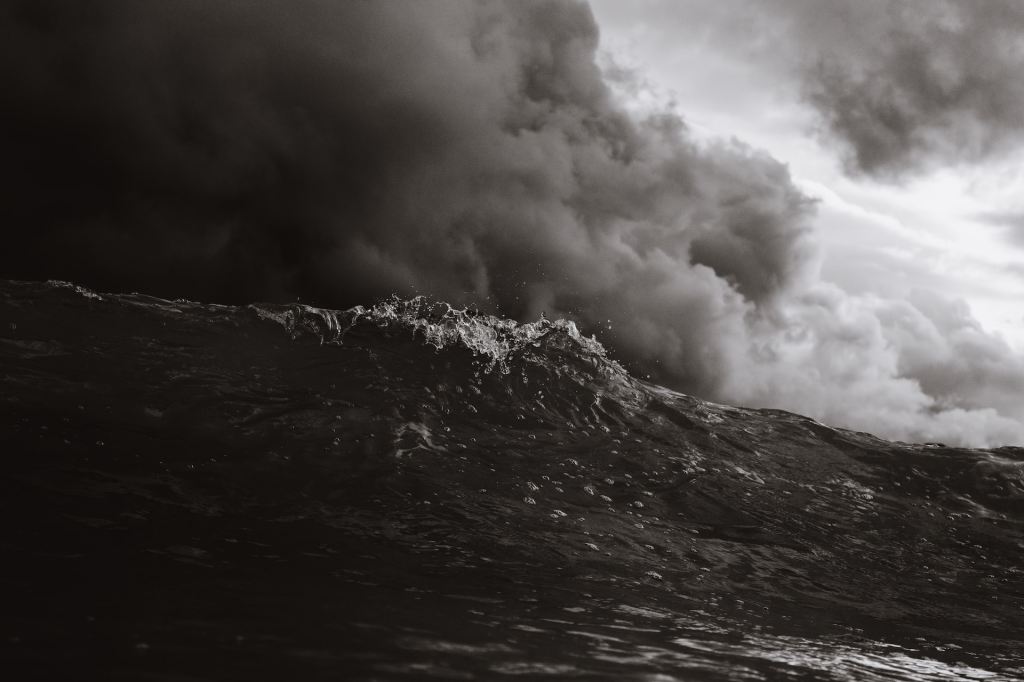
At night, probably shortly before dawn, the disciples were still rowing against the wind, being “beaten by the waves.” They should have been across by this time. In an earlier storm, recorded in Matthew 8:23-27, Jesus had been with the disciples on a boat in a storm, and He woke from a nap to quiet the storm that was terrifying them. This time, they were exactly where He had sent them: in the boat to cross ahead of Him. Even though Jesus was not with them, He knew they would be fighting a storm again, and He had taught them He is the Lord of the storms.
Amid the rain and wind and waves, the disciples saw something on the water and cried out in fear: “It is a ghost!” This was the only explanation they could come up with for something traveling over the water without sinking. But Jesus said “Take heart; it is I. Do not be afraid,” and they knew it was Him, walking on the water. He was still Lord of the storms.
In response, Peter (acting boldly as usual) exercised faith 3 times in this story. First, he believed Jesus was who He said He was. The initial shock and fear of what looked like a ghost passed when Peter heard His voice. Second, he knew Jesus was capable of walking on water, so why couldn’t He enable Peter to do it too? Third, when Peter “saw the wind, he was afraid, and beginning to sink,” he kept faith that Jesus could and would save him from drowning.
But why did Peter begin to sink? The text says he was distracted when he “saw the wind.” In that wind, he saw circumstances that he feared were more powerful than Jesus. Peter could believe Jesus could make him walk on water when he was in a boat, but when wind and waves started hitting him it was harder to trust. There’s a conflict here between faith and circumstances, doubt and trust. Faith can raise us above our circumstances, but only when we focus on Jesus to overcome our doubt. When we look away from Him, our circumstances can overwhelm us.
Peter learned that he could walk on water, but also that it was only possible by focusing his gaze on Jesus, not by relying on his own strength and ability. Only by relying on Him can we thrive. When walking by faith, hearing and obeying His Spirit, it can feel like walking on water, because “the fruit of the Spirit is love, joy, peace, patience, kindness, goodness, faithfulness, gentleness, self-control.” – Galatians 5:22-23a
Do you sometimes feel like you’re in a stormy sea, and getting across is taking longer than it should? Is there a stormy situation in your life that requires stepping out in faith? Are there circumstances you’re focusing on that make you feel you are sinking?
God sometimes knowingly sends us into storms to test our faith, just like Jesus sent the disciples into this storm to help them learn to trust Him. If you’re in a storm, seek Him and go to Him. Turn your eyes upon Jesus; He can make you walk above your circumstances.






 Driving Toward the Morning Sun