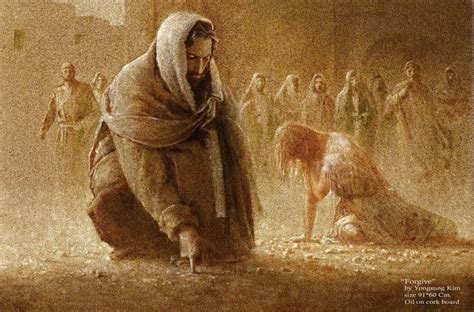
The beginning of John chapter 8 has quite an enigmatic and controversial story about a woman caught in adultery. The basics of the story are: Jesus was teaching in the temple in Jerusalem, and some Pharisees brought Him a woman they caught in the act of committing adultery. They asked Jesus whether they should stone her, and the first thing Jesus does is write something on the ground with His finger (the only recorded instance of Jesus writing I believe). Then Jesus stands and says, “Let him who is without sin among you be the first to throw a stone at her.”[1] Then He goes back to writing on the ground, and the woman’s accusers end up walking away. Jesus then tells the woman He does not condemn her, but that she should “sin no more.”[2]
One problem with the story is that it is not included in the earliest manuscripts of John’s gospel, and so it’s questionable whether it should be in the Bible at all. Another part of the story commentators talk about is what Jesus was writing on the ground. From what John (or someone else) wrote, we don’t know. We can only suspect that what was written had something to do with why the accusers went away.
I don’t like to speculate on what Scripture left out, especially on verses that may not even be inspired, but if this story actually happened, I do have my own guess at what Jesus wrote. He probably wrote more than one thing, but part of what He wrote may have been “where is the man?”
See, Old Testament law said that both parties in the adultery (it always takes 2 people to commit adultery) should be stoned (see Leviticus 20:10 and Deuteronomy 22:22). If these Pharisees truly caught the woman in the act, the man must have been present at the time or she wasn’t “in the act”. Why wasn’t he being brought before Jesus? We know the Pharisees were desperate to catch Jesus saying something wrong, so maybe, perhaps[3], the “guilty” man was in conspiracy with the Pharisees to embarrass Jesus? In a male-dominated society, did the Pharisees think it was ok for the man to get away with it, especially if it led to a situation where the Pharisees could make Jesus look bad? They may have been tired of losing arguments with Him.
In this situation, if Jesus wrote “where is the man?” on the ground it would let the Pharisees know that He was on to their scheme and knew they were being hypocritical. Jesus always knows.
My handy dandy study Bibles warn not to make doctrine from this story that may not have actually happened, but I think there’s a lesson to be learned anyway, and it is that every one of us is “caught in the act” by Jesus. Jesus knew that, under the law, both the woman that the Pharisees brought forward, and the unseen man were both guilty of adultery. Likewise, whether our own sins are brought to public attention or whether they happen in secret, Jesus knows about them. Also, not all of our sins are physical. Some may be spiritual, where we put something else in the place of God in our hearts and minds. Nothing escapes His notice. Knowing this should terrify us, except…
I read a devotional by James Boice where he said that the person we want to be in this story is the woman caught in the act of adultery. Why? Because although her sins were revealed, she was forgiven and was alone left standing with Jesus when everyone else went away. We may be too proud to admit we belong in her place, but maybe that’s because we aren’t aware enough of our won sins. See, from Jesus’ perspective we are all “caught in the act.” Not just once or twice, but many times over. We may not be physical adulterers, but we are all spiritual adulterers. Therefore, we need His grace and mercy, which He freely grants. The cross paid for all our sins.
However, the story also teaches that grace is not license. Christ died that He may give us grace and we must not scorn His sacrifice. This woman’s forgiveness was free for her, but not for Him. Our forgiveness is free to us, but not for Him. It required the ultimate sacrifice, but He was willing and able to make it.
Jesus may have done a “gotcha” with the hypocritical Pharisees, and 1 John 1:10 says “If we say we have not sinned, we make him a liar, and his word is not in us,” but the verse right before that says “If we confess our sins, he is faithful and just to forgive us our sins and to cleanse us from all unrighteousness.” As long as we admit our guilt (which He already knows about), the grace He makes available to us is endless and eternal.
“Let us then with confidence draw near to the throne of grace, that we may receive mercy and find grace to help in time of need.” – Hebrews 4:16
[1] John 8:7
[2] John 8:11
[3] Maybe and perhaps are two words I hate to use when referring to Scripture, but maybe, perhaps, today is an exception.


