Last June, I posted “More Than Truth” about how the media are “trying hard to weaponize you and I” with their own particular, filtered versions of what they call truth. Proverbs 14:21 says “Whoever despises his neighbor is a sinner, but blessed is he who is generous to the poor,” yet we are bombarded by stories grouping people into neighbors we should love and those we shouldn’t because they’re somehow causing the problems of the world through their political or other affiliation. I struggle with the right balance, and I know others do as well, especially when the voices get louder. The “Us vs. Them” mentality is everywhere, and while I generally stay away from commenting on daily news flow on this blog, this one couldn’t wait until Rewind Wednesday.
How should the gospel of the kingdom of God impact how we live in this bitter and chaotic environment? Please read “More Than Truth” which is linked below, which makes a case that we must prioritize some truths over others, and that we also must not allow ourselves to “weaponized” by particular versions of truth. Proverbs 14:20 – “The poor is disliked even by his neighbor, but the rich has many friends.” – is as true as Proverbs 14:21, but it too can weaponize if taken out of context and used as a prescription, not just a description. “The wrong truth can make us despise our neighbor, or to support the wrong gospel.”
Don’t let the daily roar of news distract you from the love God has for you and for the people you will interact with face-to-face today. Instead, pray that you may bring the eternal love of God into the pain of today’s world in a very real way.
Eternity matters, but life is hard. Therefore encourage each other today!
From yesterday’s post, you’ll know I am reading King’s X: The Oral History, a book chronicling the history of the rock band King’s X, by Greg Prato. Yesterday, I dove into one of their more bizarre and unknown songs, but today is about the band’s biggest hit. “It’s Love” got to “#6 on Billboard’s Mainstream Rock charts and #1 on the FM Radio Airplay charts. It was our highest-ranking single, ever,”[1] according to Ty Tabor, the band’s guitarist and sometimes lead singer, who wrote the song.
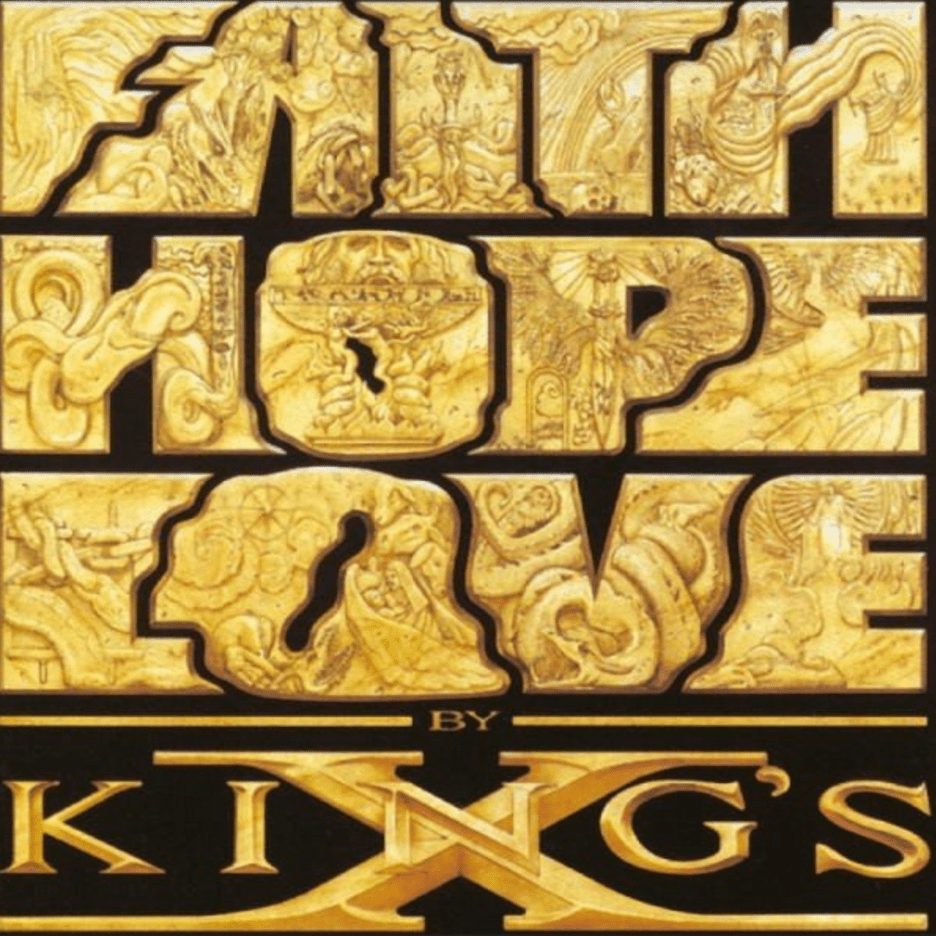
I knew both Christianity and King’s X by reputation before becoming a true fan of either, but both were growing at the same time in me during college. Having heard of King’s X but never actually heard their music, I once saw one of their CDs in a friend’s dorm room. My friend said it was his roommate’s but that he wasn’t much of a fan. Before leaving I picked up the CD and looked at it. The album, called “Faith, Hope, Love” had a cool cover, and included the song “It’s Love.”
Album cover of “Faith Hope Love” by King’s X
Later, the memory of that album cover made the triad of faith, hope, and love jump out at me whenever I saw it in the Bible, including 1 Corinthians 13:13, which says: “So now faith, hope, and love abide, these three; but the greatest of these is love.” This triad is all over the place and there are many verses explaining the relationships between them. Seeing these references also made me come back to the band and give them a listen. The rest, as they say, is history.
Before getting into “It’s Love”, you can find the lyrics here, or listen to the song here. I promise it’s an easier one to listen to than “Six Broken Soldiers” and also that this post will be shorter than yesterdays.
Overall, the message is fairly simple: Ty says he doesn’t know everything, but the thing he wants to share from his experience is that love is the most important thing in life. Love both keeps the world from falling apart (“holding back the weather”), but also eventually love is what requires a loving God to bring about a plan to fix what’s wrong with the world (“the same will let it go”).
But there’s one line in the song I didn’t really get until reading about it recently: “There’s a ship on the ocean, and I can’t decide if I like it.”
There Ty is, enjoying good company, the beach, and the ocean, but he wasn’t sure about the ship on the ocean. There’s an ambivalence about the ship, and a suggestion that maybe it’s an exception to the overall message of “love,” but I couldn’t figure out more than that. I wasn’t alone in not getting it.
In the book, Ty says his brother didn’t understand the line, so he explained: “my point was, man’s progress is wonderful and everything, but when the ship turns over and poisons all the fish, that’s not so wonderful. So, it was me contemplating all that we do and all that I’m happy with about it, but how much destruction it causes. It’s yet again one of those socially conscious songs. I just had to say it.”[2] It was almost that Ty was struggling with whether love applied when someone does something that “poisons all the fish.” In tricky, real-life situations, does love still rule? Ty doesn’t seem sure.
Contemplating What is Crooked Yesterday I quoted Romans about Paul’s inner conflict, but later in the same chapter, Paul wrote: “So I find it to be a law that when I want to do right, evil lies close at hand.” (Romans 7:21). This idea that even our best efforts at goodness in this world are tainted is not a new one. Solomon referred to something similar twice in the Old Testament book of Ecclesiastes, in 1:15 – “What is crooked cannot be made straight, and what is lacking cannot be counted.” And also in 7:13 – “Consider the work of God: who can make straight what he has made crooked?”
What Paul and Solomon are getting at is that there are things in this world, including us, that will remain crooked and unfixed until God’s plan is completed in eternity. The Bible tells us that all of creation is cursed by God because of our sin. Some things are wrong because God has made them so. Until a person establishes this in their own heart and mind, they will chase the wind of worldly utopia until they become hopelessly ambivalent, or continue on, highly motivated but frustrated and angry. The phrase “under the sun” comes up 28 times in the book of Ecclesiastes (by my quick count) and refers generally to the actions of mankind done without consideration of God’s wisdom or eternal consequences. Everything done “under the sun” is lacking, and none of it can provide the satisfaction and meaning true wisdom can deliver.
It’s Still Love Since “under the sun”, even good things come with a cost, what do we do? We can’t be ambivalent to those costs to the point of not caring, but we also can’t be so committed to removing these costs that our efforts become another cost. The world is broken, but also people are broken, and how we treat them matters.
Despite any ambivalence about the ship on the ocean, it’s still “love that holds it all together.” Therefore, the priority is always to focus on obedience and thankfulness to God, who tells us to love, not on utopian alternatives to God that tell us something is more important than loving every one of our fellow humans. The proverbial ship on the ocean and its problems are seen by God and are part of His plan. He cares about our conflicts and paradoxes, but still tells us to have faith, hope, and love.
However, rejection of love means prioritizing our own, temporary, interests and decide who we should love and who we should hate based on that. One side will defend the necessity of the ship – and more ships – at all costs, because it’s good for the economy. They can make money and enjoy what little time on earth they have. The other side will condemn those who poison the fish, or might possibly poison fish in the future, because this earth is all they have, and they want to protect it. “Under the sun” there is no nuance or ambivalence about the ship, but our opinion of the ship determines everything, including whether we can enjoy the beach and the ocean that we do have.
The answer lies not in some abstract move to the center politically, but in knowing that there is more than what exists “under the sun.” Regardless of the conflicts inherent in living with broken people in a broken world, faith in God to save us, hope in His provision of a perfect future, and the priority of love for God and others, is always the right answer. We can be a little ambivalent about the ship on the ocean, but we should have no ambivalence about love, nor about its partners, faith and hope. We should pursue them with everything God has gifted us with and give Him the glory. We can’t fix all the world’s problems, but we can show the world the character of its Creator and show it the way to a better world.
“So now faith, hope, and love abide, these three; but the greatest of these is love.” Always.
[1] Prato, Greg. King’s X: The Oral History (2019). P. 105. [2] Prato, Greg. King’s X: The Oral History (2019). P. 95.
With another history post coming up, I set out this week to write about this blog’s approach to history and politics, knowing that with these topics, the hardest part can be how to say what you want to say. Imitating David in Psalm 3, I write to testify that “salvation belongs to the LORD,”[1] to some an inherently political statement, in a way that obeys God in approach and tone. What does that mean? 1 Peter 4:15-16 says: “in your hearts honor Christ the Lord as holy, always being prepared to make a defense to anyone who asks you for a reason for the hope that is in you; yet do it with gentleness and respect, having a good conscience, so that, when you are slandered, those who revile your good behavior in Christ may be put to shame.” This means it is not as simple as just yelling the right story from the rooftops, or in my case, from an unfiltered blog. “Gentleness and respect” matter.
Last time, I wrote that “Jesus isn’t on the ballot this fall, but flawed candidates of many types will be. Some more like David, and some more like Absalom.” David, even as God’s appointed king of Israel, knew that not every problem was in his power to solve. However, David was at peace with his limits in an imperfect world, knowing that his salvation came from God alone. But Absalom hated David’s inability, or unwillingness, to solve all his problems. Absalom harbored angry resentment against David for years before violently overthrowing him. During this rebellion, David was calm and able to sleep because the kingdom of God was real to him, even when it didn’t look like it. Then he wrote Psalm 3 to let us know about it.
This conflict between David and Absalom echoes in broad narratives or stories told throughout history: 1) we can and should perfect ourselves, or 2) we are dependent on God to save us.[2]
In the 1 Peter quote above, he says that we defend our eternal hope with “gentleness and respect.,” meaning that those who trust God’s salvation should use not only their words, but also their attitudes and very lives. The story must be real to us to be convincing to others, and those who hope in God’s kingdom should show obedience to that kingdom. Easier said than done.
Fortunately, when we truly believe, experience, and stand for God’s salvation, our brokenness and failure is part of the testimony. When we know God’s salvation is the only solution, we can approach people with different worldviews with our common need for salvation, in “gentleness and respect,” instead of fighting over solutions we know are imperfect. David was able to sleep at night even when chased out of Jerusalem by his own son, because he had “a good conscience,” showing gentleness and respect toward Absalom. The kingdom of God was real in his heart, and he believed God would prevail no matter what. Circumstances could not shake his faith, and God ultimately delivered and restored him.
If, on the other hand, our brokenness and God’s solution for it is not part of our story, we may be left defending an imperfect political solution to those who demand perfection. In David’s case, he may have insisted that God was unjust in allowing Absalom to succeed. After all, he could argue, he was a humble king after God’s own heart, while Absalom was bitter and unreasonable. If David had done this, it may have ironically helped Absalom’s case for tyranny. In addition, David would not have been able to find peace and sleep at night until Absalom was overthrown. However, if the starting point is that weakness is common to all of mankind, then the imperfection of the system is both part of the “reason for the hope” and a reason for even the unbeliever to resist tyranny. In this case, imperfection is not hypocrisy, but a condition common to mankind.
Declaring “salvation belongs to the LORD” with actions, along with words, gives evidence that worldly utopia is not the answer. But when words or actions fall short, we can still point to the One who is perfect since we aren’t trying to prove worldly utopia is possible. The two lessons from Absalom’s rebellion are reconciled in a life lived with “gentleness and respect.” Because God does not rely on political systems to work His salvation, tyranny is just another “temporary and provincial authority” subject to the greater authority of God. We can have a clear conscience based on the sacrifice of Christ and not on worldly success.
A life lived in hope for the eternal kingdom of God is one lived in love for those left behind by every imperfect system of this world, but also one that testifies that all systems, including our own individual wills, are not perfectible by human effort. Peter wrote that those who hope in God will be slandered, but also that those who live humble lives based on hope in God and not themselves will ultimately be proved right. Until then, by their example as they follow Christ, they can show the futility of tyranny. By God’s grace, His people will inherit a real utopia by learning to love those who hope in a false one with gentleness and respect.
Our failure is part of our testimony as we drive toward morning, but “Seek first the kingdom of God and his righteousness, and all these things will be added to you.” – Matthew 6:33
[1] Psalm 3:8 [2] There’s also a third common story: “If the dead are not raised, ‘Let us eat and drink, for tomorrow we die.’” (1 Corinthians 15:32) Today, we focus on the other two.
The U.S. midterm elections are later this year, and some are already considering turning off their social media feeds until its over. Jesus is not on any ballot for the elections, but this does not mean His people are without hope and comfort. It also doesn’t mean Christians should ignore it all. Last fall, I wrote a two–part series partly about not over-reacting to the threats of worldly kingdoms because “He who sits in the heavens laughs.” (Psalm 2:4) When recently reading Psalm 3, which is “A Psalm of David, when he fled from Absalom his son,” I saw that this Psalm may not have come after Psalm 2 by accident and may also comfort us in the face of political bad news.
Absalom’s Rebellion The story of King David in the Bible is a very condensed version of his life but does not shy away from David’s serious failures and flaws. The story of his adulterous relationship with Bathsheba is not swept under the rug, and eventually, Absalom’s rebellion against his father David was justified in his mind by those flaws. Absalom harbored resentment for years after David’s lack of punishment for Absalom’s brother Amnon, who raped his sister Tamar. One can imagine Absalom thinking about his father: “You’re the king of Israel, so why didn’t you protect Tamar, or at least punish Amnon? If my sister and I don’t get justice, you don’t deserve to be king!”
David, on the other hand, was quite aware of the limits of being king. In Psalm 131:1, David wrote:
“O LORD, my heart is not lifted up; my eyes are not raised too high; I do not occupy myself with things too great and too marvelous for me.”
Even while writing as divinely selected king of Israel, David knew many things were “too great and too marvelous” even for him. Instead, David focused his heart on the God-given task before him, which did not include achieving perfection in this world. That task belonged elsewhere. Later, Psalm 131 was included in the Psalms of Ascent[1], which served as a liturgy for pilgrims traveling to Jerusalem for three annual festivals. In those Psalms are reminders of God’s provision for things the world can’t provide, including salvation for our souls and a way to perfect righteousness. The pilgrims did not go to Jerusalem to worship the earthly king, but to encounter God, and including Psalm 131 in that liturgy would always be a reminder that our worldly aims should always be rooted in humility.
When Absalom raised several hundred supporters and entered Jerusalem to violently overthrow his father David, “a messenger came to David, saying, ‘The hearts of the men of Israel have gone after Absalom.’ Then David said to all his servants who were with him at Jerusalem, ‘Arise, and let us flee, or else there will be no escape for us from Absalom. Go quickly, lest he overtake us quickly and bring down ruin on us and strike the city with the edge of the sword.’” (2 Samuel 15:13-14)
David’s Response After surrendering the throne and fleeing, David wrote Psalm 3, “A Psalm of David, when he fled from Absalom his son,” which says in full:
“O LORD, how many are my foes! Many are rising against me; many are saying of my soul, “There is no salvation for him in God.” Selah
But you, O LORD, are a shield about me, my glory, and the lifter of my head. I cried aloud to the LORD, and he answered me from his holy hill. Selah
I lay down and slept; I woke again, for the LORD sustained me. I will not be afraid of many thousands of people who have set themselves against me all around.
Arise, O LORD! Save me, O my God! For you strike all my enemies on the cheek; you break the teeth of the wicked.
Salvation belongs to the LORD; your blessing be on your people! Selah”
Knowing the background of this Psalm and its placement after Psalm 2 make it far more interesting. David had suffered a massive political defeat, being humiliated and tossed out of Jerusalem by his own son. Instead of despairing, he turned to God for his salvation because he knew even the king of Israel could not save the people. He was only a temporary and provincial authority. Even though God had promised David the throne, God was able to save David, and Israel, without David on the throne. With the murderous and vengeful Absalom on the throne, was God defeated? No, instead we have this Psalm as a reminder of God’s presence and provision of salvation in spite of whatever situation we find ourselves in.
David, having cultivated over years an awareness of his own limitations as king of Israel, and the limitless power of God, “lay down and slept,” then “woke again, for the LORD sustained me.” Surrounded by foes and removed from his throne, David slept soundly! In contrast, Absalom is shown as one who broods upon every imperfection, plotting ways to force justice as he sees it on others, even if he must dishonor God. You could say he is driven by the “utopian impulse,” belief in a government that can solve all of our problems and shouldn’t rest until it does.
Democracy and Tyranny Jesus isn’t on the ballot this fall, but flawed candidates of many types will be. Some more like David, and some more like Absalom. A lesson from Psalm 3 is that we should be able to sleep at night in good conscience because no matter the world looks like, God says “I have set my King on Zion, my holy hill” (Psalm 2:6) even when king David was on the run for his life. The success of God’s plan does not rely on our political success. But a second lesson from the story of Absalom is that a ruler driven by achieving worldly perfection can be the worst kind, even if they seem to have good intentions.
Absalom’s story reminds me of this quote from C.S. Lewis:
“Of all tyrannies, a tyranny sincerely exercised for the good of its victims may be the most oppressive. It would be better to live under of robber barons than under omnipotent moral busybodies. The robber barons cruelty may sometimes sleep, his cupidity may at some points be satiated; but those who torment us for their own good will torment us without end for they do so with the approval of their own conscience. They may be more likely to go to heaven yet at the same time likely to make a Hell of earth.”[2]
How do we reconcile the two lessons?
Coming This Week This week, I’m hoping to squeeze in a short series of posts on narratives, history, and (gasp!) politics. I’m very much figuring this out myself every day and learning how to engage without following my own utopian impulse to cut off Malchus’ ear[3] but I also know that waiting for a perfect answer guarantees failure. This blog is part of that process for me. This week’s posts will lead up to the next “History Bits” post I have planned for April 9th and give some background on that series.
Hope you’ll join me and let me know what you think.
[1] I’m currently writing about those Psalms in a series, which began here. [2] From “The Humanitarian Theory of Punishment.” C.S. Lewis. God in the Dock: Essays on Theology and Ethics. (1970). P. 292. [3] See John 18:10
A prominent feature of the culture I live in is the demand that everyone must respect the “individualism” of everyone else. Pressure to affirm whatever anyone else wants affirmed about them has ballooned all over the news, social media, corporate policy, and even in churches. There’s an assumption built into this, which is that the sincere ability to love someone can be the result of someone else threatening us to do it. Exert enough legal, social, cultural, or even physical pressure and someone’s fundamental nature can be changed by coercion. The coal turns into a diamond.
Tomorrow is Sunday, so today we return to the Psalms of Ascent, a liturgy used in ancient Israel to prepare for worship at the annual festivals in Jerusalem. What does this have to do with the last paragraph? In Psalm 120, the first Psalm of Ascent, we read (post here) that no matter where we live, or where we come from, no matter our genealogy, we live among people with “lying lips” who can’t get along with each other. In Psalm 121, we are encouraged to find the answer outside of our current place:
“A Song of Ascents.
I lift up my eyes to the hills. From where does my help come? My help comes from the LORD, who made heaven and earth.
He will not let your foot be moved; he who keeps you will not slumber. Behold, he who keeps Israel will neither slumber nor sleep.
The LORD is your keeper; the LORD is your shade on your right hand. The sun shall not strike you by day, nor the moon by night.
The LORD will keep you from all evil; he will keep your life. The LORD will keep your going out and your coming in from this time forth and forevermore.”
The Psalm asks us to take our eyes off of the world around us and look upward for our hope. Not just talk about the idea of it, but to actually do it. To turn off the outside world and its circumstances and seek God’s help. It takes effort because the idea that we can solve our own problems is so powerful. The fall of Adam and Eve was driven by a curiosity that there may be a better system than the one they already had. In a literally perfect society, they wanted something else. If we aren’t intentional about avoiding this trap, it’s easy to not realize we are in it.
We’re All Messed Up I’ve written much about Tyler Joseph, the songwriter of the band twenty øne piløts, and his campaign to create music and stories that help people deal with mental illness. In an interview years ago, the interviewer criticized Tyler for calling himself “messed up.” Was Tyler being too hard on himself? This was Tyler’s response:
“I know I’m messed up. I think to myself I should be able to control myself. I look at a lamp and I decide that I’m going to stand up and not hit that lamp. Why can’t I make decisions like that about everything in life. I’m not going to get angry at my brother. I want to be the best brother. Why can’t I do what I want to do? That’s messed up. Something is broken in the way we live. It’s proof that something is not right.”
Tyler is explaining Romans 7:13-21, especially verses 15 and 21, but in a way that’s as plain as day to anyone being honest with themselves. Romans 7:15 and 21 say: “For I do not understand my own actions. For I do not do what I want, but I do the very thing I hate.” And “So I find it to be a law that when I want to do right, evil lies close at hand.”
What if the problem with every person individually is that they are unable, no matter how much external pressure is put on them, to treat other individuals the way they should be treated? If true, it puts the first paragraph into an entirely different light.
In this exact moment as I write this, I’m being very careful not to spill my drink on my laptop. I have no desire to do anything violent to the couch I’m sitting on but just to enjoy having a place to sit. If I stop writing to check something on my phone, I make sure I put it down gently in a spot where it won’t fall off and hit the floor. But at the same time, I know I don’t always treat people with the same respect. I know if I’m interrupted in the middle of what I think is a great thought or phrase I could get irritated and rude. Not always, but I could. I know I could be a better son, husband, father, employee, and friend. So why don’t I?
Why do we treat our furniture better than our family, even in a culture that increasingly demands with all its strength that we prioritize every individual? Because we are broken in a way that no political or economic system, no culture or tradition, can fix. One may be better or worse than another, but none of them has the power to solve the real problem that we can’t consistently love people more than we love our furniture. We have to go somewhere else to find the answer.
Therefore, “I lift up my eyes to the hills. From where does my help come? My help comes from the LORD, who made heaven and earth.”
As pilgrims traveling to Jerusalem, the Israelites were telling a story by making the effort to move. A story that the towns they leave behind – no matter where they are coming from – don’t have the answer to their most important problems. On the long journey, they travelled in large groups and slowly, sometimes by foot. They probably had constant reminders of their own inability to treat the family they traveled with better than whatever furniture or baggage they brought along for the trip. While togetherness is sometimes uncomfortable, together we must lift up our eyes and look for the answer outside of everything we know.
We’re broken and can’t fix ourselves, but “The LORD will keep you from all evil; He will keep your life.” Take some time out of your week and each day to look up to the hills and seek Him. To set aside everything else. To focus on the LORD, because He alone loves us in the way we need to be loved and can help us love others the way they need to be loved. He won’t seek to break you to make you do it, but He Himself was broken to provide us a way.
This post continues a series on the Psalms of Ascent. To start at the beginning, click here, and for the next post click here
 Driving Toward the Morning Sun