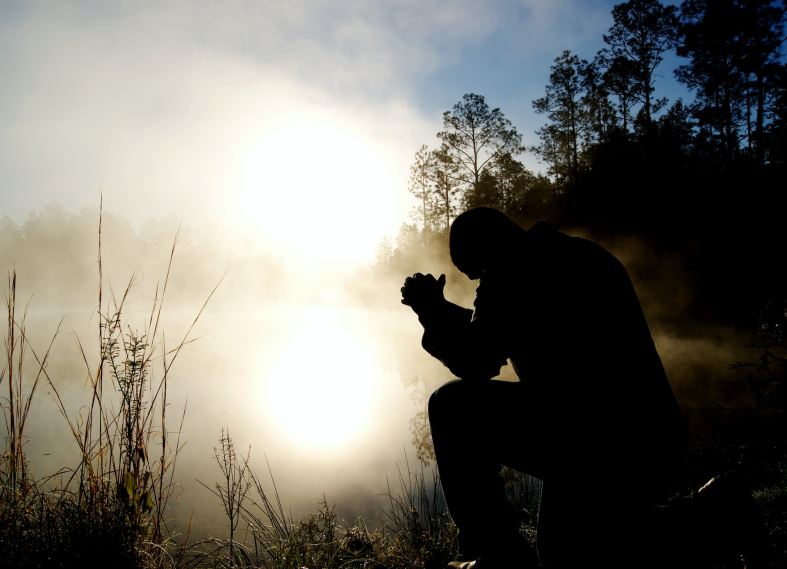
The Priestly Blessing

What comes to mind when you think of Old Testament priests?  Fancy robes?  Their handling of sacrifices?  Their separation to service of Yahweh?  The corrupt priests Jesus later confronted in the New Testament?

What we sometimes forget is that everything the Old Testament priests did was done to allow God to be present with and bless His people, as a preview of how Christ makes us acceptable to God so He can live in us.  In Numbers 6, God commands Aaron and his sons to proclaim this blessing to the people of Israel:

The LORD bless you and keep you;
the LORD make his face to shine upon you and be gracious to you;
the LORD lift up his countenance upon you and give you peace.[1]

John Calvin makes this comment on the blessing: “This doctrine is especially profitable, that believers may confidently assure themselves that God is reconciled to them, when He ordains the priests to be witnesses and heralds of His paternal favor towards them. The word to bless is often used for to pray for blessings, which is the common duty of all pious persons; but this rite…was an efficacious testimony of God’s grace; as if the priests bore from His own mouth the commandment to bless.”

May we be blessed today by our Lord, whose face shines like the sun and whose grace gives us peace!


[1] Numbers 6:24-26

The Law of the Medes and Persians Has Been Revoked

During the Old Testament book of Daniel, God’s people were in exile in Babylon, and a group of Babylonian officials really wanted to make a point.  They wanted to do this so badly, that it’s recorded several times in just a few verses of the book of Daniel, chapter 6:

Verse 8: “Now, O king, establish the injunction and sign the document, so that it cannot be changed, according to the law of the Medes and the Persians, which cannot be revoked.”
Verse 12: “Then they came near and said before the king, concerning the injunction, “O king! Did you not sign an injunction, that anyone who makes petition to any god or man within thirty days except to you, O king, shall be cast into the den of lions?” The king answered and said, “The thing stands fast, according to the law of the Medes and Persians, which cannot be revoked.
Verse 15: “Then these men came by agreement to the king and said to the king, “Know, O king, that it is a law of the Medes and Persians that no injunction or ordinance that the king establishes can be changed.”
Verse 17: “And a stone was brought and laid on the mouth of the den, and the king sealed it with his own signet and with the signet of his lords, that nothing might be changed concerning Daniel.” [bold emphasis mine]

What provoked them to insist on this law that “cannot be revoked”?

They decided Daniel (of the book’s name) needed to be persecuted for successfully contributing to the welfare of Babylon, while humbly giving God the glory for all his gifts, abilities, and success.  He was making them, and their gods, look bad.  It is remarkably similar to the reasons Jesus saw opposition.  Daniel, a Jewish exile, was about to get a big promotion and they wanted to sabotage it.  Knowing Daniel openly prayed three times a day, the officials conspired and convinced the king to sign a law “that whoever makes petition to any god or man for thirty days, except to you, O king, shall be cast into the den of lions.” (Verse 7).  Either Daniel gives glory to Babylon, or he dies.  Forcing Daniel to change his worship would prove that an unjust law was more important to him than his God.

What did Daniel do in response?  Nothing new.  He continued his standard practice of worship, praying in front of his open windows, probably including prayers for the welfare of Babylon[1].  Verse 10 says Daniel acted “as he had done previously,” which indicates he wasn’t snubbing his nose at his government or its new rule.  His faithfulness was more important to him than an unjust law, even when he didn’t know God would deliver him from the lions.  Daniel didn’t just come to God when he thought he needed God; he knew he needed God at all times.

Therefore, when the officials were provoked, it was an outcome of Daniel’s success and prayer, not Daniel’s intent.  Basic, consistent faithfulness to a higher power can sometimes irritate people, especially lower powers who think their rule “cannot be revoked,” even when it’s not very effective.

Following the law, the king had Daniel thrown into the den of lions, but “God sent his angel and shut the lions’ mouths.”  Daniel said he was saved because he had faithfully served his God and the king (verse 22), not because he was a provocative protester.

Seeing Daniel delivered by God, King Darius tore up the law that “cannot be revoked,” but even if Daniel had not been rescued from the lions, the laws would still have been revoked.  The kingdom of the Medes and Persians no longer exists.  Likewise at the end of time every law of every Babylon will be no more.  However, God’s promise of blessing for all who will worship Him and seek His will still stands.  On this promise Daniel stood, or rather, kneeled, and served his God and his countrymen, even in exile.

The law of loving service to neighbor will never be revoked, wherever and whenever you live, and even in heaven!  In the words of G.K. Chesterton, “Men did not love Rome because she was great. She was great because they had loved her.”[2]


[1] Jeremiah 29:7 says: “But seek the welfare of the city where I have sent you into exile, and pray to the LORD on its behalf, for in its welfare you will find your welfare,” referring to Babylon.
[2] Chesterton, G.K. Orthodoxy (1908).  P. 103.

Prayer Before Study

If you’re a writer, or creative in some other way, how do you prepare to work and dedicate the work to God?  Surely there are as many ways to do this as there are people doing it!  If you don’t already have a routine, the prayer below from St. Thomas Aquinas (originally in Latin) is an excellent place to start.  I use this “Prayer Before Study,” or some other form of it often, especially if I’m struggling to write.

“Ineffable Creator,
You are proclaimed the true font of light and wisdom,
and the primal origin raised high beyond all things.

Pour forth a ray of your brightness into the darkened places of my mind;
disperse from my soul the twofold darkness into which I was born:
sin and ignorance.

You make eloquent the tongues of infants.
Refine my speech and pour forth upon my lips
the goodness of your blessing.

Grant to me keenness of mind,
capacity to remember,
skill in learning,
subtlety to interpret,
and eloquence in speech.

May you guide the beginning of my work,
direct its progress,
and bring it to completion.

You who are true God and true Man,
who live and reign, world without end. Amen.”

He is Always Abba, Father

Fellow travelers,

Just before being betrayed by Judas and arrested, Jesus sought some solitude in the garden of Gethsemane, where “he fell on the ground and prayed that, if it were possible, the hour might pass from him.  And he said, ‘Abba, Father, all things are possible for you. Remove this cup from me. Yet not what I will, but what you will.’” (Mark 14:35-36). Jesus knew He was soon to die.

Donald McKim notes that “In Aramaic, the language Jesus spoke, Abba is the word for ‘Father.’ It is a term that expresses the closest and deepest intimacy of the relationship of parent and child.”[1]  Jesus knew this intimacy even on the way to the cross.

McKim also quotes Philip Melanchthon, who said: “’Abba, Father’. By this he taught us that these two things are required in prayer, namely, the ardent affection of the mind and the faithful trust of children toward God: these two words testify that both of these aspects were present in Christ.”

The Father loves us always, even on our most difficult days.  Trust Him in prayer today.


[1] McKim, Donald K.  Everyday Prayer with the Reformers (2020).  P. 73.

A Psalm of God’s Strength and Power

The Bible software I use (Accordance) has the ability to highlight text, but so far I’ve only used it once, for Psalm 21.  In just 13 verses, David wrote “you” or “your” 25 times, referring to God as the source of his success and blessings, past, present, and future.  The short 13 verses of Psalm 21 provide a plethora of praises we can offer to confess that God is powerful, faithful and just.  Here is the entire Psalm, and I’ve bolded all the “you”s and “your”s, which I highlighted in Accordance:

“To the choirmaster. A Psalm of David.

O LORD, in your strength the king rejoices,
            and in your salvation how greatly he exults!
You have given him his heart’s desire
            and have not withheld the request of his lips. Selah
For you meet him with rich blessings;
            you set a crown of fine gold upon his head.
He asked life of you; you gave it to him,
            length of days forever and ever.
His glory is great through your salvation;
            splendor and majesty you bestow on him.
For you make him most blessed forever;
            you make him glad with the joy of your presence.
For the king trusts in the LORD,
            and through the steadfast love of the Most High he shall not be moved.

Your hand will find out all your enemies;
            your right hand will find out those who hate you.
You will make them as a blazing oven
            when you appear.
The LORD will swallow them up in his wrath,
            and fire will consume them.
You will destroy their descendants from the earth,
            and their offspring from among the children of man.
Though they plan evil against you,
            though they devise mischief, they will not succeed.
For you will put them to flight;
            you will aim at their faces with your bows.

Be exalted, O LORD, in your strength!
            We will sing and praise your power.”

What statements did you focus on while reading this?  Did you take the time to think about all 25 “you” statements (and the rest of the Psalm)?  Read it again.

The first section in this Psalm describes how our God is “faithful” in some ways, and the second describes “just.”  The first may come easier, with David giving God credit for all of his strength and success, but the middle section on justice may come across as harsh and harder to swallow.  However, it reminds us that only He knows for sure who His (and our) enemies are.  “Your hand will find out all your enemies.”  Only He determines the fates of others, including some who look like enemies now, but will come to faith in Him later.  With any enemy we can “wait upon the Lord”, as David often urges us, knowing God will either save them, or their plans will come to ruin by His design.

Yet, for those in Christ, “he is faithful and just to forgive us our sins and to cleanse us from all unrighteousness.”  Therefore, we echo David:

“Be exalted, O LORD, in your strength!
            We will sing and praise your power.”