There Goes John Bradford (to Paradise): History for February 24

Born in 1510, John Bradford was a rising Protestant minister during the reign of King Edward VI in England and was well known for his pious dedication and unselfish nature.  After studying at Cambridge and preaching regularly around London, he was appointed as Chaplain to the King in 1551.  The common expression “There but for the grace of God go I” is often attributed to him and was a reminder to himself that grace alone has saved him.  An 1822 book on prayer says that:

“The pious Martyr Bradford, when he saw a poor criminal led to execution, exclaimed, ‘there, but for the grace of God, goes John Bradford’. He knew that the same evil principles were in his own heart which had brought the criminal to that shameful end.”[1]

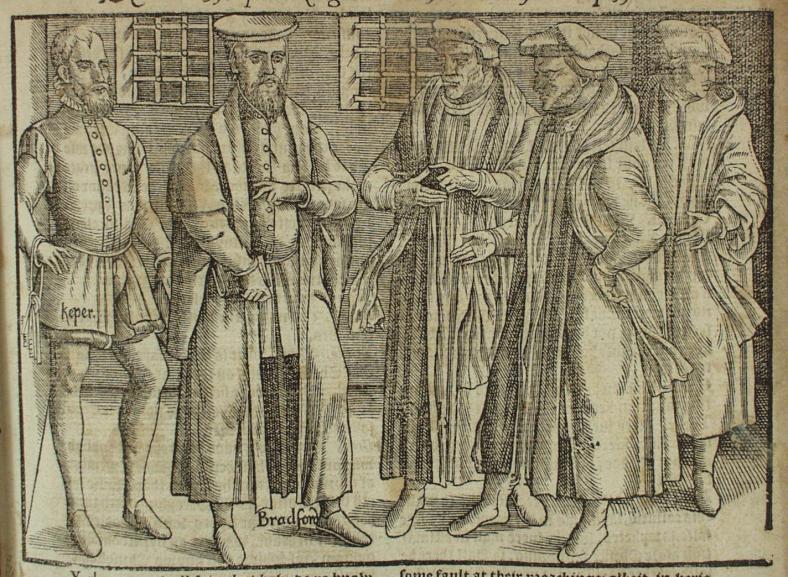
Bradford and others in the Tower of London, from John Foxe’s Book of Martyrs (1563). Public Domain.

His worldly fortunes changed in 1553 when the Catholic Mary I became Queen, and one of her first priorities was persecution of prominent Protestants.  Bradford was arrested within a month, imprisoned in the Tower of London, and sentenced to death.  While in the Tower, he wrote a letter to his mother on this date, February 24, in 1554, that included a powerful statement about prayer: God “doth put off our prayers, that he might recompense it with abundance, that is, that he might more plentifully pour upon us the effect of our petitions.” [2]  On July 1, Bradford was burned alive at the stake.

In another book on prayer, Donald McKim wrote about Bradford’s letter:
“We can imagine that no one would seek an answer to his prayers more ardently than Bradford while awaiting death. Yet he believed that even with no apparent answers to prayers, God plentifully pours abundance on those who pray!
At the end of his letter Bradford mentions God’s promise-which believers receive and anticipate, even in the midst of their sufferings and afflictions. Paul recorded the promise: “What no eye has seen, nor ear heard, nor the human heart conceived, what God has prepared for those who love him” (1 Cor. 2:9) Plentiful abundance! Now and forever!”[3]

In John Bradford’s story, there is a terrible irony between two things he is known for – a common phrase and his martyrdom – but in the end, God is faithful, and I hope to meet Bradford someday in Paradise, where the grace of God has bought me a place.


[1] Bickersteth, Edward.  A Treatise on Prayer.  (1822).  Sourced from https://en.wikipedia.org/wiki/John_Bradford
[2] McKim, Donald K.  Everyday Prayer with the Reformers (2020).  P. 92.
[3] Ibid.

The Desires He Delights to Give

Does God give us what we desire, or does He decide what we desire?  Some of my earliest prayers I remember (I was probably about 6) are ones asking to wake up the next day with my room full of all the toys I wanted.  Naturally, I never woke up to a room full of toys.  God probably knew I would only ask for more, and if I kept up that attitude toward prayer, there would never be enough.  That doesn’t mean I only prayed that prayer once…I learn slowly, but He is patient.

This sort of prayer isn’t limited to minor things like toys, nor do I think it is unusual.  While his mother was suffering from cancer, a nine-year-old C.S. Lewis prayed earnestly for her to be healed.  When she wasn’t, and cancer took her from him, his faith was shaken for years.

In my case, in later life, after understanding Christianity somewhat better, one of the first Bible verses I set out to memorize was Psalm 37:4, which says:

Delight yourself in the LORD,
       and he will give you the desires of your heart.

But I still wondered: are the desires what He gives us, or is the fulfillment of desires what He gives us?  I now believe it is both.  In the times I genuinely seek Him, I find that He molds my desires, so they become more aligned with His character.  I also find that He directs those desires toward what will fulfill them.  While that fulfillment is not always immediate, I learn to trust from what He does fulfill that all will be made right in eternity, and I also learn patience and peace.

When we truly delight in Him, we end up finding out that what we desire is righteousness; we also find out that He provides all the righteousness we desire and need.  We find those desires fulfilling rather than frustrating, we find that fulfillment durable rather than fleeting, and therefore find ourselves content rather than anxious.

However, we don’t always delight in Him, or seek to desire what He desires, and we find ourselves conflicted and unfulfilled.  Reflecting on his prayers for his mother’s healing, C.S. Lewis later wrote what he had wrong:

“I had approached God, or my idea of God, without love, without awe, even without fear. He was, in my mental picture of this miracle, to appear neither as Savior nor as Judge, but merely as a magician; and when He had done what was required of Him I supposed He would simply – well, go away.”[1]

Elsewhere Lewis wrote: “God allows us to experience the low points of life in order to teach us lessons that we could learn in no other way.”  By experiencing disappointment and death in this world, perhaps He is teaching us that death and disappointment are all that this world has to offer.  Sometimes this is the only way to get us to let go of the world and embrace eternity with Him, even while we sojourn here. Sometimes He lets us down easy when the toys do not appear; sometimes He lets us experience significant pain.  All in His wisdom.

Therefore, since He is both Savior and Judge, as well as all-wise:

“Commit your way to the LORD;
         trust in him, and he will act.
He will bring forth your righteousness as the light,
         and your justice as the noonday.” – Psalm 37:5-6

Keep Driving Toward Morning, dear fellow travelers, and today, pray we will find our delight in Him.

[Version 1.0 of this was posted 4/19/22]


[1] Lewis, C.S.  Surprised by Joy (1955).  P. 21

Praying for Our Leaders

King David was known as a man who sought God’s will in all things, even though he often failed.  The Psalms record many of his prayers for God to guide him and make him a good leader.  Psalm 26 is one of these prayers, and verses 8-10 include good objectives for any leader:

O LORD, I love the habitation of your house
            and the place where your glory dwells.
Do not sweep my soul away with sinners,
            nor my life with bloodthirsty men,
in whose hands are evil devices,
            and whose right hands are full of bribes.”

Sometimes we may not know how to pray “for kings and all who are in high positions,[1] as Paul suggests, but in this cry to God, David gives us at least 3 things to pray about.  He lists qualities he wanted to pursue, and some he wanted to avoid, but which are good for any leader.  Therefore, on the model of Psalm 26, we can pray for the leaders of our countries and communities today.

We can pray for political leaders who:

  • worship God (who “love the habitation of your house”)
  • do not seek violence and vengeance (who are not “bloodthirsty men”), and
  • are not corrupted by money (whose hands are not “full of bribes”)

All leaders can use our prayers today!


[1] 1 Timothy 2:2

A Psalm of God’s Strength and Power

The Bible software I use (Accordance) has the ability to highlight text, but so far I’ve only used it once, for Psalm 21.  In just 13 verses, David wrote “you” or “your” 25 times, referring to God as the source of his success and blessings, past, present, and future.  The short 13 verses of Psalm 21 provide a plethora of praises we can offer to confess that God is powerful, faithful and just.  Here is the entire Psalm, and I’ve bolded all the “you”s and “your”s, which I highlighted in Accordance:

“To the choirmaster. A Psalm of David.

O LORD, in your strength the king rejoices,
            and in your salvation how greatly he exults!
You have given him his heart’s desire
            and have not withheld the request of his lips. Selah
For you meet him with rich blessings;
            you set a crown of fine gold upon his head.
He asked life of you; you gave it to him,
            length of days forever and ever.
His glory is great through your salvation;
            splendor and majesty you bestow on him.
For you make him most blessed forever;
            you make him glad with the joy of your presence.
For the king trusts in the LORD,
            and through the steadfast love of the Most High he shall not be moved.

Your hand will find out all your enemies;
            your right hand will find out those who hate you.
You will make them as a blazing oven
            when you appear.
The LORD will swallow them up in his wrath,
            and fire will consume them.
You will destroy their descendants from the earth,
            and their offspring from among the children of man.
Though they plan evil against you,
            though they devise mischief, they will not succeed.
For you will put them to flight;
            you will aim at their faces with your bows.

Be exalted, O LORD, in your strength!
            We will sing and praise your power.”

What statements did you focus on while reading this?  Did you take the time to think about all 25 “you” statements (and the rest of the Psalm)?  Read it again.

The first section in this Psalm describes how our God is “faithful” in some ways, and the second describes “just.”  The first may come easier, with David giving God credit for all of his strength and success, but the middle section on justice may come across as harsh and harder to swallow.  However, it reminds us that only He knows for sure who His (and our) enemies are.  “Your hand will find out all your enemies.”  Only He determines the fates of others, including some who look like enemies now, but will come to faith in Him later.  With any enemy we can “wait upon the Lord”, as David often urges us, knowing God will either save them, or their plans will come to ruin by His design.

Yet, for those in Christ, “he is faithful and just to forgive us our sins and to cleanse us from all unrighteousness.”  Therefore, we echo David:

“Be exalted, O LORD, in your strength!
            We will sing and praise your power.”

Thanksgiving is a Habit

“Continue steadfastly in prayer, being watchful in it with thanksgiving.” – Colossians 4:2

The purpose of celebrating Thanksgiving yesterday was to remind us to be thankful today and every day. What was worth being thankful for yesterday is still with you today!

If Christianity is true, this is not “being a Pollyanna” or seeing the world through rose-colored glasses. Live like it is true by making thanksgiving a habit, not a holiday.