Is everything a matter of life and death? In Deuteronomy 30:19, Moses said to the people of Israel about God’s law: “I call heaven and earth to witness against you today, that I have set before you life and death, blessing and curse. Therefore choose life, that you and your offspring may live.” This idea of things being a choice between life and death also shows up in wisdom literature, like the Proverbs, and elsewhere. Paul wrote in Romans 5:12, “as sin came into the world through one man, and death through sin, and so death spread to all men because all sinned.” These verses don’t mean that every time you sin lightning will come down from heaven and strike you dead. They also don’t mean that whether you choose to have corn or peas with dinner is a life-or-death decision. But they do mean that, absent God’s grace, the necessary, inevitable consequence of sin is death.
Paul also wrote, in Romans 6:23, “For the wages of sin is death, but the free gift of God is eternal life in Christ Jesus our Lord.” Because of this gift, our bad choices and bad intentions don’t have to lead to eternal death, but we still make bad choices, and the verse(s) I’m going to highlight today is(are) a good reminder that we get tricked into bad choices.
In response to a reader suggestion, I’m writing a series about the verses I’ve quoted the most on this blog. Today’s post is #4 of the series, covering the verse(s) quoted the 4th least out of the 10 most quoted:
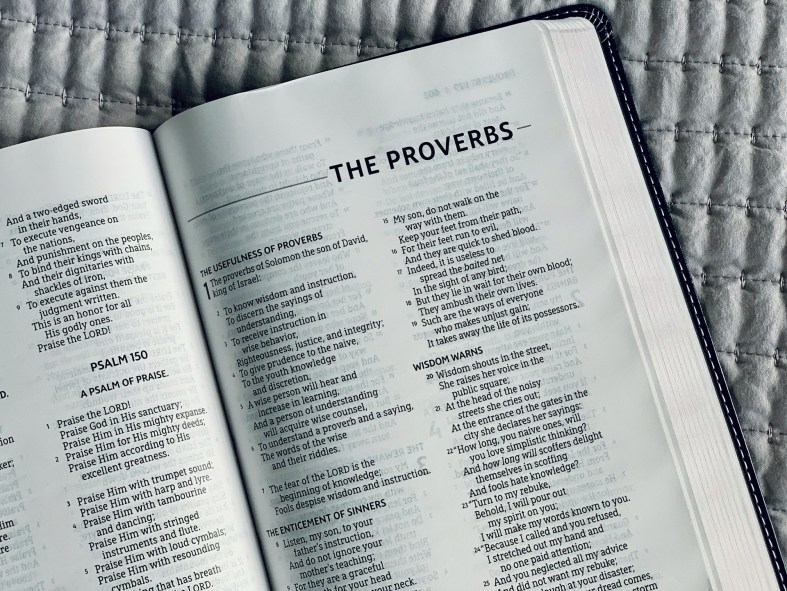
“There is a way that seems right to a man,
but its end is the way to death.” – Proverbs 14:12 and 16:25
Yes, Proverbs 14:12 and 16:25 say exactly the same thing, as if the point being made was so important that it needed repeating. This Proverb tells us that we make bad choices because they seem right. Here I’ve used this verse a few times and in a few different ways, which I’m listing below:
Sometimes what “seems right” is physically bad for us
In one post, I explained the famous “Marlboro Man” advertising campaign begun in 1954, where a cigarette with a red filter designed for women was changed overnight into a cigarette for “manly” men, who usually had a cowboy hat and a horse. I wrote “To make Philip Morris money, the ads declared that smoking was not a “way to death,” but that it was “right to a man” to be like the Marlboro Man.” However, smoking can literally kill you. Not a very spiritual point, but still true!
What’s right is not always what we’ve always done
I’ve also written about the dual Proverb that what “seems right” might be keeping us stuck in a rut and not progressing in life or in holiness. Rather than do what’s actually right, “It’s easier to do what others have done before, or to continue what you’ve already done before, especially if repeated for a long period of time.” While what’s comfortable may be the easy thing to do, 1 Peter 1:14-16 says (quoting Leviticus 11:44), “As obedient children, do not be conformed to the passions of your former ignorance, but as he who called you is holy, you also be holy in all your conduct, since it is written, “You shall be holy, for I am holy.”” Since none of us are holy yet, getting there requires change, and therefore staying where we are can be “the way to death.”
What’s right is not always what’s popular
In most (maybe all) cultures there are popular assumptions and ideas that just go unchallenged. Anyone who speaks against them suffers some kind of consequence, from being shunned to even being killed in some places. I wrote a list of quotes called “Popular Orthodoxy” about this, which included today’s Proverbs. Popularity and peer pressure can be powerful things, giving us constant signals about what “seems right to a man”, but I’ve also written that “Sometimes wisdom flashes a red light while others are flashing green.”
What’s right is not always what we think is in our own best interest
For this one, I used an extreme example, where Herod ordered the killing of every child under 2 that lived where Jesus was born. He didn’t want any rivals to his rule, and he didn’t want a populist uprising, so as I wrote: “Herod saw [the killings] as in his own best interest, and in the interest of Rome, but this is one of many examples of “a way that seems right to a man, but its end is the way to death.”” As I said this was an extreme example, but if you study economics, you usually learn that it assumes that people are “rational,” meaning they act in their best interest. So, the economic theory of what “seems right to a man” is self-interest.
However, the Bible teaches us that what’s best for us is to defer our judgement of what’s best to God. Too often we’re wrong, and Proverbs 1:7 declares:
“The fear of the LORD is the beginning of knowledge;
fools despise wisdom and instruction.”
This “fear” doesn’t mean we are afraid of God, but that we feel a reverent awe toward Him. This fear leads to wisdom and leads us to choose the way that is right to God, not what “seems right” to us. Only the omniscient God has the perspective needed to know what’s right. Psalm 25:12 says:
“Who is the man who fears the LORD?
Him will he instruct in the way that he should choose.”
As Proverbs 14:12 and 16:25 tell us, we are easily misled to believe there is a better path than the one God chooses for us. It’s so important that Proverbs tells us this twice, and I agree, which is why it/they make my list of most-quoted verses.