Below are the chapters to read this week if you’re following along in my Bible in a year schedule, divided into morning and evening readings. Follow along any way you want: you can just do the evening reading, flip the morning and evening, or read it all. Whatever works for you and your schedule! It doesn’t have to be Bible in a Year for everyone.
Monday, June 3 Morning: Proverbs 6, Matthew 8 Evening: Deuteronomy 2
Tuesday, June 4 Morning: Proverbs 7, Matthew 9 Evening: Deuteronomy 3
Wednesday, June 5 Morning: Proverbs 8, Matthew 10 Evening: Deuteronomy 4
Thursday, June 6 Morning: Proverbs 9, Matthew 11 Evening: Deuteronomy 5
Friday, June 7 Morning: Proverbs 10, Matthew 12 Evening: Deuteronomy 6
Saturday, June 8 Morning: Proverbs 11, Matthew 13-14 Evening: Deuteronomy 7
Sunday, June 9 Morning: Proverbs 12, Matthew 15-16 Evening: Deuteronomy 8
Below are the chapters to read this week if you’re following along in my Bible in a year schedule, divided into morning and evening readings. If you’re interested in jumping in late, this week isn’t a bad time. On Wednesday, we finish Psalms and Nehemiah and begin Proverbs and Matthew, our first New Testament book. Sunday we move from Numbers to Deuteronomy in the evening reading.
Follow along any way you want: you can just do the evening reading, flip the morning and evening, or read it all. Whatever works for you and your schedule! It doesn’t have to be Bible in a Year for everyone.
I’ve had some sort of working definition of “wisdom” for most of my life. I think most of us have. As a teenager, I remember joking that it was the ability to learn from other people’s mistakes. It sounded teenager-wise, but how do I know what’s a mistake? Later, I read somewhere about wisdom being something like “skill at living life”. Also sounds useful, but perhaps vague and worldly feeling. Even later in life, I started thinking of it as “being able to make decisions based on facts, instead of based on wishful thinking.” This has been even more useful, but which facts do you follow? How do you choose between two “true” options? What if you don’t have all the needed facts?
I think my current definition is better: Wisdom is the ability to choose between the path of righteousness and the path of the wicked. In the Psalms and the Biblical wisdom literature like Proverbs, there is a contrast between these two paths, and the idea that moral decisions are like choosing a route between places. You can be on one path or the other, and with wisdom, “you will understand righteousness and justice and equity, every good path”[1]
Moving down a path is an action, and therefore, wisdom is about taking the right action, not about what we know, believe, or say. It’s not about accumulating facts. Facts matter, but they aren’t wisdom all by themselves. Adding the context of the Great Commandments[2], wisdom is what tells us how to love God and others actively, and in a way based on obedience that leaves the results to God. For example, in the book of Acts, Ananias didn’t minister to Saul, the notorious persecutor of Christians, because Ananias thought it would end up well for himself[3], he did it because God told him to, and God knew that future Saul was Paul, the author of much of the New Testament. Ananias didn’t decide based on the facts as he knew them, but he adjusted the facts in light of revelation from God. Also, wisdom might sometimes tell you the best action is to do nothing, to not to do something specific. Sometimes wisdom flashes a red light while others are flashing green. “There is a way that seems right to a man, but its end is the way to death” – Pr. 14:12 and 16:25.
This way of thinking about wisdom explains why the Way, the Truth and the Life must be a Person, not a set of rules or a philosophy. Truly, only each of us, in our individual relationships with God through the Holy Spirit, can learn wisdom. Only in a relationship with this Person can we figure out what our purpose and identity in the body of Christ is. This wisdom is proactive and specific to each of us. Nobody else’s situation is your situation, and nobody else has the same relationships, abilities, and resources. Books, advice, and experience can be helpful, but we each need to “taste and see”[4] the Holy Spirit in us, working at our very core where only He can reach, and directing us down the right paths at the right times.
True wisdom will put us on a path that provides us, and this world, a taste of heaven through us. It is informed by a justice and righteousness – God’s law and Christ’s character – that is not of this world. With wisdom we can build and create new things on the cornerstone of Christ. The world might not like it, but the world is not your Creator who is all wise. Therefore, pray for and seek God’s wisdom as the immensely valuable treasure that it is!
[1] Proverbs 2:9 [2] Matthew 22:37-39. In short, love God and love your neighbor. [3] Acts 9:13 [4] Psalm 34:8
In the ESV Bible, the phrase “but God” appears 43 times, changing the direction of the story. An Ebenezer is a “stone of help,” or reminder of God’s benefit to His people in the past, providing strength for the present and future. Ebenezer the squirrel, this blog’s mascot, represents these “but God” memorials the Bible records of God’s intervention in the world and in our lives. As a squirrel can unexpectedly draw our attention, I write about these moments to draw our attention to God as a reminder that adding God to our circumstances can change everything. One of these instances comes at a key point in David’s life.
Prior to becoming Israel’s second king, David may have spent a decade in exile, running from Saul, Israel’s first king. Saul was extremely insecure and jealous of David and sought to kill him for years. In 1 Samuel 23 there is a story about Keilah, a border town in Judah that was near the Philistine city of Gath. Bands of Philistines were stealing grain from Keilah and David heard of it. This small border town may not have interested Saul, but David prayed to God about whether to rescue it. After getting affirmation from God, David and his men rescued the town.
Saul, with spies everywhere, heard that David was staying in Keilah and planned to besiege the town, probably to starve the people until they gave David up. In other words, Saul hated David so much and wanted him dead that he would attack a town in his own territory. Saul was persistent and not interested in seeking (or following) God’s guidance.
David, informed by God that the people of Keilah would give him up to Saul, fled into the wilderness again, then we get to verse 14 of the chapter:
“And David remained in the strongholds in the wilderness, in the hill country of the wilderness of Ziph. And Saul sought him every day, but God did not give him into his hand.” (emphasis added)
Saul sought David “every day,but God” was on David’s side, and “did not give him into his hand.” It wouldn’t matter how hard Saul tried – hunting David while he should have been minding his kingdom – David would not be caught unless God allowed it.
As the story continues, Saul is informed that David is hiding in the wilderness of Maon (verse 25). Then, “As Saul and his men were closing in on David and his men to capture them, a messenger came to Saul, saying, ‘Hurry and come, for the Philistines have made a raid against the land.’ So Saul returned from pursuing after David and went against the Philistines. Therefore that place was called the Rock of Escape.” (verses 26b-28)
While the news of this Philistine raid may seem like mere coincidence, I don’t believe it was. First, the timing worked out just right, as David seemed cornered by Saul and his men. Second, Saul was not concerned about raids on Keilah – why is he concerned this time? “The king’s heart is a stream of water in the hand of the LORD; he turns it wherever he will,” says Proverbs 21:1. Perhaps this was one of God’s ways to “not give him into his hand.” While Ebenezer means “stone of help,” David found a “Rock of Escape,” and God can be our escape as well. When we feel threatened by enemies – physical or spiritual – remember that God watches over His people. Those enemies may seem overwhelming, “but God” will not give us into their hand unless He knows it will benefit us and our faith, for “we know that for those who love God all things work together for good, for those who are called according to his purpose” (Romans 8:28). God changes every story for the betterment of His people.
Sometimes Proverbs seems like a collection of sayings in a random order but sometimes taking one out of context can change the meaning entirely. Take for example Proverbs 15:15 –
“All the days of the afflicted are evil, but the cheerful of heart has a continual feast.”
One way of reading this might be that if we have a continual feast, we will of course be cheerful, while affliction will sour our attitude. However, the following two verses tell us that what we consider to be a feast is a matter of the perspective we bring to it, not the contents of the meal:
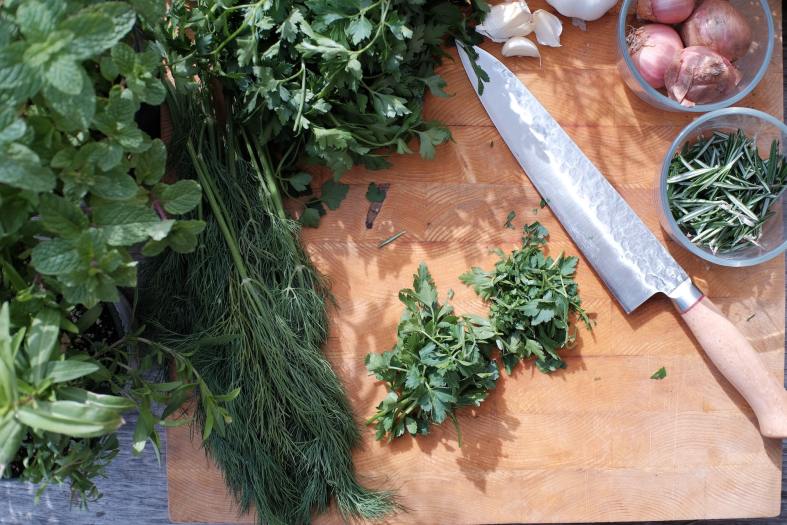
“Better is a little with the fear of the LORD than great treasure and trouble with it. Better is a dinner of herbs where love is than a fattened ox and hatred with it.”
When we choose the fear of the Lord, and to live in love for those we feast with, even a small meal of herbs can be a feast! From a heart of thankfulness, we can be satisfied with whatever manna and daily bread the Lord provides, instead of begging Him for quail.
Therefore, “the cheerful of heart has a continual feast” not because of an elaborate, expensive, multi-course meal, but because of a heart of love that reveres the Lord. If today serves you nothing but herbs, be thankful instead of being like this sad dwarf.



 Driving Toward the Morning Sun