Godly Habits for Leaders and Others

All the people benefit from leaders and rulers who fear God.  In Deuteronomy, when God reluctantly says Israel may set a king over them in the future[1], He also required the king to have specific habits to cultivate a fear of God in them:

“And when he sits on the throne of his kingdom, he shall write for himself in a book a copy of this law, approved by the Levitical priests.  And it shall be with him, and he shall read in it all the days of his life, that he may learn to fear the LORD his God by keeping all the words of this law and these statutes, and doing them, that his heart may not be lifted up above his brothers, and that he may not turn aside from the commandment, either to the right hand or to the left, so that he may continue long in his kingdom, he and his children, in Israel.”  (Deuteronomy 17:18-20, emphasis mine)

These requirements have several parts.  First, the king was to “write for himself in a book a copy of this law.”  “This law” refers to what we now think of as the first five books of the Bible – all 187 chapters of it.  Imagine the time that would take, but this tedious exercise was designed to help the king internalize the message.  Quickly skimming over the Bible would not do.

Second, the king had to get this copy “approved by the Levitical priests,” to make sure nothing was added or left out, but also to remind the king that His authority is subject to God’s authority, as intermediated by the priests at that time.  Regardless of what laws the king might pass, God’s laws would always reign supreme and eternal.

Third, the king was to “read in it all the days of his life,” because it takes time and effort to dig the treasures of wisdom out of the Bible.  However, it is worth the effort because Psalm 19:10 tells us these truths are:

“More to be desired are they than gold,
                        even much fine gold;
sweeter also than honey
                        and drippings of the honeycomb.”

Also, the king would be surrounded by reminders of his worldly greatness every day, so constant meditation on the law would show him his reliance on God.  The king needs a constant reminder that he is under God, whose law applies to everyone.

These habits exist “that he may learn to fear the LORD,” which leads to “doing” the law.  Even the king is expected to do what God commands, not just tell others to.  With “doing” as the objective, the king will remain humble and learn the fear of God, because we may be able to know God’s word, but doing it is the real challenge and we can only succeed by His grace.
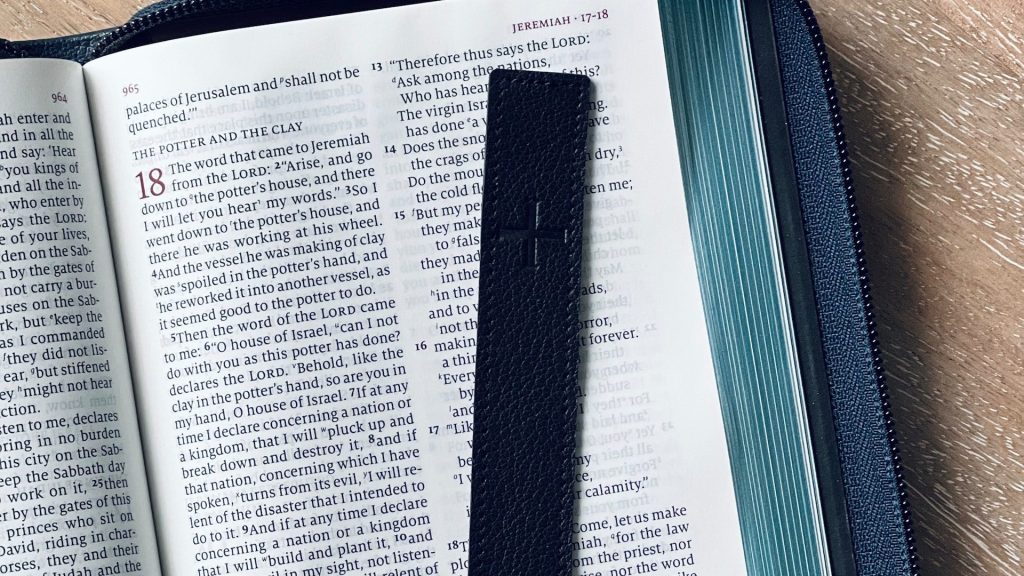
These habits also exist to make sure the king does not err “either to the right hand or to the left.”  This encouragement is later echoed in Moses’ words in Joshua 1:7-8, but what does it mean?  I think it means that without constant saturation in God’s word, we can fall into a trap of not following God’s positive will, but instead defining ourselves by what we’re against.  In trying to avoid one sin, we drift too far in the opposite direction and into another, equally destructive, sin.  Instead, positive obedience coming from the fear of God should be better than fine gold and “sweeter also than honey.”  Truth is often subtle and not as black-and-white as we’d like it to be.

Most of us aren’t kings, but we can apply the passage from Deuteronomy in our prayers.  1 Timothy 2:1-2 “First of all, then, I urge that supplications, prayers, intercessions, and thanksgivings be made for all people, for kings and all who are in high positions, that we may lead a peaceful and quiet life, godly and dignified in every way.”  But what shall we pray for them?  As Deuteronomy suggests, we should pray that they know God, fear God, and obey God, that they may be humble, and we may prosper.

Also, are you a leader?  Do you serve in a position of authority at your church, workplace, or other organization?  These habits will benefit you and those you serve anywhere.  (In societies where we can easily get a Bible, we don’t need to create our own copies of it, but we should seek to internalize as much of the Bible as possible, through memorization and other means.)  As Solomon wrote in Psalm 127:1 –

“Unless the LORD builds the house,
            those who build it labor in vain.
Unless the LORD watches over the city,
            the watchman stays awake in vain.”

If you’re not a leader, these habits are beneficial for you as well, as Psalm 128:1 says:

“Blessed is everyone who fears the LORD,
                        who walks in his ways!”

Amen.


[1] Deuteronomy 17:14-15

God Rules in His Sleep

In Mark’s Gospel, he tells a story of Jesus taking a nap, causing His disciples to panic.  Does it ever seem like God is asleep, leaving you feeling adrift the world’s circumstances?  When Jesus walked the earth, there were times when God literally was asleep.

One story comes from Mark 4:35-41.

On that day, when evening had come, [Jesus] said to them, “Let us go across to the other side.”  And leaving the crowd, they took him with them in the boat, just as he was. And other boats were with him.  And a great windstorm arose, and the waves were breaking into the boat, so that the boat was already filling.  But he was in the stern, asleep on the cushion. And they woke him and said to him, “Teacher, do you not care that we are perishing?”  And he awoke and rebuked the wind and said to the sea, “Peace! Be still!” And the wind ceased, and there was a great calm.  He said to them, “Why are you so afraid? Have you still no faith?”  And they were filled with great fear and said to one another, “Who then is this, that even the wind and the sea obey him?”

At the beginning of the story, Jesus told His disciples they were going to cross the Sea of Galilee, then knowing what was coming, “He who keeps Israel”[1] took a nap.  Had the disciples understood Jesus, His napping should have reassured them that they were safe, since He was not concerned about the storm.  Instead, they thought He didn’t care, which showed that fear of the storm had overcome whatever faith they had.  Jesus said they were going across, but they doubted.

Which brings up a very important question.

When did the wind and the sea obey Jesus?  At the beginning of the story, at the end, or both?  Or at all times?  Before Jesus calmed the storm, was the sea being disobedient to God’s laws and will?

Photo by Matt Hardy on Unsplash

I believe Jesus calmed this storm so that next time He wouldn’t have to.  He was teaching them that He always cares, regardless of what the circumstances seem to say.  He was teaching them that even when it seems like He’s asleep, He is still in control of our circumstances no matter how chaotic they look and feel to us.  During the next storm, He wanted them not to panic, but to trust Him because He showed them no circumstance escapes His notice.  The storm does not control us; He controls the storm.

When Jesus calmed the storm, He did not create a hedge (See Job 1:10) around His disciples, He just demonstrated that it existed all along.  God was not going to let His Son drown before His mission was complete and neither will He let His other children drown before their work is done!

Sometimes when God seems distant and we feel we are sinking, in reality we are being given a divinely designed opportunity to learn to trust that:

The LORD will keep you from all evil;
            he will keep your life.
The LORD will keep
            your going out and your coming in
            from this time forth and forevermore[2]

He knows sometimes we have to learn the hard way, and He knows best.  Even when He is sleeping.“Let us go across to the other side.”


[1] Psalm 121:4
[2] Psalm 121:7-8

In Pursuit of Fruit

What fruitful habits do you have for spending time with God?  Are there personal patterns in your relationship with Him through prayer, Bible study or other means?  Note that I write “fruitful” instead of “enjoyable” because although we’d like to enjoy every moment with God, as our Father He sometimes has to tell us things we won’t like immediately.  As Jesus said in John 15:2 – “Every branch in me that does not bear fruit he takes away, and every branch that does bear fruit he prunes, that it may bear more fruit.”

One example of a fruitful habit for me has been to study more than one book of the Bible at a time.  What do I mean by this?  For example, I currently have a goal to read 1-2 chapters each of the Psalms and the Pentateuch[1] daily, along with study Bible notes.  The idea came from a recent sermon, where the 5 books of Psalms were described as similar in theme to the 5 books of the Pentateuch.  Shortly after, I read that: “Just as Genesis tells how mankind was created, fell into sin, and was then promised redemption, many of these psalms [book 1, or Psalms 1-41] discuss humans as blessed, fallen, and redeemed by God.”[2]  With a little work, I was able to map out a schedule lining up the Psalm readings with the other readings and I’m trying to follow it.  Reading different parts together can help make connections I wouldn’t otherwise.  One connection recently led me to post about frustration with my cat and how it relates to Noah and the ark.

At other times, I’ve been reading a Gospel along with the Psalms, or one of the prophets because changing the pattern over time helps reveal unexpected context or connections.  I wouldn’t talk to a friend the same way over and over again, so why do it with God?  Years ago, when reading Psalm 46:10 and Matthew 21:15-16 on the same day led to a stark reminder that God is worthy of, and will receive, all praise.  These are those verses that nailed the point home:

“Be still, and know that I am God.
            I will be exalted among the nations,
            I will be exalted in the earth!”

“But when the chief priests and the scribes saw the wonderful things that he did, and the children crying out in the temple, “Hosanna to the Son of David!” they were indignant, and they said to him, “Do you hear what these are saying?” And Jesus said to them, “Yes; have you never read,
             “‘Out of the mouth of infants and nursing babies
                        you have prepared praise’?”

I know I can’t require God to speak to me in a certain way, but these occasional “accidents” from different parts of Scripture have reinforced each other in ways I might have never seen or might even have resisted.  Sometimes, we might prefer to keep certain truths away from certain parts of our lives, but when we make time to be quiet, listen and allow different parts of God’s word to collide in ways we didn’t expect, we may uncover an encouragement or a challenge that bears fruit.

What creative and fruitful habits do you have for spending time with God?


[1] The first five books of the Bible, sometimes called the books of Moses (Genesis, Exodus, Leviticus, Numbers, and Deuteronomy)
[2] Life Application Study Bible, introduction to the Psalms.

Cats are Not the Only Things I’m Allergic To

Although highly allergic to cats, I love the two we have, but sometimes wonder if it’s worth the trouble.  This past Saturday night, one of the cats, named Misty, was up crying much of the night, waking us up regularly.  Eventually, I realized she must have been upset about her litter.  The store was out of the “usual,” so I tried to get away with a replacement, even though I know how finicky cats are.  Sure enough, once I changed it to what I had left of the usual stuff (kept in reserve in case of finicky cat trouble), she stopped complaining.

Why am I telling you this?  Because what happened next reminded me that God is concerned about even the most minor details of our lives, and about every living creature He has made.  Sunday morning my reading schedule began with Psalm 8, which includes this:

“You have given [man] dominion over the works of your hands;
            you have put all things under his feet,
all sheep and oxen,
            and also the beasts of the field,
the birds of the heavens, and the fish of the sea,
            whatever passes along the paths of the seas.”- Psalm 8:6-8

Misty, an indoor cat who may feel like she’s trapped in the ark.

Under the mandate given in Genesis, mankind is supposed to take care of whatever God has given us – the earth and everything in it.  My study Bible helpfully noted that this includes pets, which reminded me of Misty’s crying!  I thought maybe our cats were worth the trouble after all, but God wasn’t finished making the point.

Also on my reading schedule was Genesis 7, which includes: “And the waters prevailed on the earth 150 days.” – Genesis 7:24

During the flood, Noah and his family were flooded in the ark for 150 days with two of each kind of animal (but seven of each kind of clean animal, because provision was made not only for the survival of Noah’s family, but also provision for continued worship of God).  After the 150 days, they had to wait months longer for the waters to recede and the land to dry before coming out of the ark.  Noah’s family took care of an ark full of animals for more than 150 days.  They probably lost a lot of sleep!  As for me, I only have two cats and get to leave the house.  I also have allergy medicine to make it more tolerable.

Looking back at Psalm 8, the last verse declares: “O LORD, our Lord, how majestic is your name in all the earth!”

This Lord is the same one who brought Noah, his family, and those animals through the flood.  He also cares about my family and even my pets.  In seemingly small acts like taking care of pets God has given us, we can declare the majesty of God’s name!  In whatever influence we have, big or small, God wants us to participate faithfully in the work started at creation, with the authority He has given us.

In addition to perhaps cats, what else might we be allergic to? Sin is not just a list of things we shouldn’t do, but it is our allergy to God’s dominion over the world and the way we each should have dominion over it and under him. We’re too often allergic to loving this world the way he did on the cross, yet we claim to hope for a world where that sacrificial love governs 100% of all actions.

Our Lord wants nothing more than to greet us in Paradise and say “‘Well done, good servant! Because you have been faithful in a very little, you shall have authority over ten cities.’”[1]  He literally died to make such a greeting possible.  Therefore, consider what creatures or people our Sovereign God has delegated to each of us.  What tasks or roles?  Jobs or ministries?  Do some of those things irritate and annoy us, as if we were allergic?

In aggregate, the church’s role is to have dominion over His entire creation, but not in the way the world would, exploiting everything for our own benefit and casting aside what doesn’t seem useful, but as a servant would.  Like a God who abhors all our sin as if He were allergic but decided to cover our sin with His own precious blood.  The same blood that covers us so that, like a compassionate Father, our Lord can gently say on a Sunday morning after a bad night of interrupted sleep:

“Be thankful you aren’t stuck in an ark for 150 days with thousands of animals.”


[1] Luke 19:17

Politics Didn’t Keep King David Up at Night

In the United States, we just had midterm elections, those falling between the presidential elections that happen every 4 years.  The end result of government divided between Democrats and Republicans likely has many wishing their preferred side had more power.  This post is a slightly edited version of one from this April, when anxiety about these elections began to heat up.  While in Psalm 2, God declares “As for me, I have set my King on Zion, my holy hill,” where He laughs at the kings and rulers of the world who stand against Him, that declaration may be harder to take when events don’t appear to go our way.  Psalm 3, “A Psalm of David, when he fled from Absalom his son,” follows, and I don’t think it’s an accident because it records God’s king at the time, David, lamenting about being chased from power by his own son.  The story may provide comfort when things don’t look to be going God’s way here on earth.

Absalom’s Rebellion
The story of King David in the Bible is a very condensed version of his life but does not shy away from David’s serious failures and flaws.  The story of his adulterous relationship with Bathsheba is not swept under the rug, and eventually, Absalom’s rebellion against his father David was justified in his mind by those flaws.  Absalom harbored resentment for years after David’s lack of punishment for Absalom’s brother Amnon, who raped his sister Tamar.  One can imagine Absalom thinking about his father: “You’re the king of Israel, so why didn’t you protect Tamar, or at least punish Amnon?  If my sister and I don’t get justice, you don’t deserve to be king!”

David, on the other hand, was quite aware of the limits of being king.  In Psalm 131:1, David wrote:

“O LORD, my heart is not lifted up;
            my eyes are not raised too high;
I do not occupy myself with things
            too great and too marvelous for me.”

Even while writing as divinely selected king of Israel, David knew many things were “too great and too marvelous” even for him.  Instead, David focused his heart on the God-given task before him, which did not include achieving perfection in this world.  That task belonged elsewhere.  Later, Psalm 131 was included in the Psalms (or Songs) of Ascent[1], which served as a liturgy for pilgrims traveling to Jerusalem for the three annual festivals.  In those Psalms are reminders of God’s provision for things the world can’t provide, including salvation for our souls and a way to perfect righteousness.  The pilgrims did not go to Jerusalem to worship the earthly king, but to encounter God, and including Psalm 131 in that liturgy would always be a reminder that our worldly aims should always be rooted in humility.

When Absalom raised several hundred supporters and entered Jerusalem to violently overthrow his father David, “a messenger came to David, saying, ‘The hearts of the men of Israel have gone after Absalom.’ Then David said to all his servants who were with him at Jerusalem, ‘Arise, and let us flee, or else there will be no escape for us from Absalom. Go quickly, lest he overtake us quickly and bring down ruin on us and strike the city with the edge of the sword.’”  (2 Samuel 15:13-14)

David’s Response
After surrendering the throne and fleeing, David wrote Psalm 3, “A Psalm of David, when he fled from Absalom his son,” which says in full:

“O LORD, how many are my foes!
            Many are rising against me;
many are saying of my soul,
            “There is no salvation for him in God.” Selah
But you, O LORD, are a shield about me,
            my glory, and the lifter of my head.
I cried aloud to the LORD,
            and he answered me from his holy hill. Selah
I lay down and slept;
            I woke again, for the LORD sustained me.
I will not be afraid of many thousands of people
            who have set themselves against me all around.
Arise, O LORD!
            Save me, O my God!
For you strike all my enemies on the cheek;
            you break the teeth of the wicked.
Salvation belongs to the LORD;
            your blessing be on your people! Selah”

Knowing the background of this Psalm and its placement after Psalm 2 make it far more interesting.  David had suffered a massive political defeat, being humiliated and tossed out of Jerusalem by his own son.  Instead of despairing, he turned to God for his salvation because he knew even the king of Israel could not save the people.  He was only a temporary and provincial authority.  Even though God had promised David the throne, God was able to save David, and Israel, without David on the throne.  With the murderous and vengeful Absalom on the throne, was God defeated?  No, instead we have this Psalm as a reminder of God’s presence and provision of salvation in spite of whatever situation we find ourselves in.

David, having cultivated over years an awareness of his own limitations as king of Israel, and the limitless power of God, “lay down and slept,” then “woke again, for the LORD sustained me.”  Surrounded by foes and removed from his throne, David slept soundly!  In contrast, Absalom broods upon every imperfection, plotting ways to force justice as he sees it on others, even if he must dishonor God.  You could say he is driven by a belief in a government that can solve all of our problems and shouldn’t rest until it does.

Conclusion
Jesus was not our midterm ballots, but flawed candidates of many types were.  Some more like David, and some more like Absalom.  A lesson from Psalm 3 is that we should be able to sleep at night in good conscience because no matter what the world looks like, God says “I have set my King on Zion, my holy hill” (Psalm 2:6) even when king David was on the run for his life.

The success of God’s plan does not rely on our political success. “Salvation belongs to the LORD” and He deserves our vote every time.


[1] I’m currently writing about those Psalms in a series, which began here.