God’s people – His church – are the living temple in which He chooses to dwell by His grace and mercy. While nobody but Jesus will consistently “hit the mark” of holy perfection until eternity, Paul urges us to “cleanse ourselves from every defilement of body and spirit, bringing holiness to completion in the fear of God.”[1] But this fear should not be a dissatisfied, joyless obedience. Instead, look at Psalm 149:1-4 for an example of how to build life in Christ:
“Praise the LORD! Sing to the LORD a new song, his praise in the assembly of the godly! 2 Let Israel be glad in his Maker; let the children of Zion rejoice in their King! 3 Let them praise his name with dancing, making melody to him with tambourine and lyre! 4 For the LORD takes pleasure in his people; he adorns the humble with salvation.
The 2nd verse says to be glad! But why should we be glad? Because we have a loving Maker and King who died that we might live as His children. None of us are random accidents with no creator and no purpose. In response (3rd verse), we offer our creativity and energy to God as worship, in all forms available to us (including but not limited to dancing and music!) and within our area of influence. Accepting us in Christ as we humbly are (4th verse), the Lord takes pleasure as we offer what we have to His service and rewards us with His blessings. This verse reminds us that God likes us; He wants to be with His people and see them succeed. He takes pleasure in our praise and enjoyment of Him.
When we acknowledge our Maker and King as the protagonist of our life story, we know that we have an origin, a purpose, and a destiny, and that our lives can have eternal value, beyond all “random acts of kindness”. Whether our community and culture are crumbling or thriving, the call of God to live in the Spirit can bring “love, joy, peace, patience, kindness, goodness, faithfulness, gentleness, [and] self-control.”[2]
However, if we insist on being the protagonist and following the idols we create, our worldly altruism and good intentions will never be enough, and our works will always fall short of the mark. God has better in store for us.
A New Song Now we return to the 1st verse of Psalm 149: “Praise the LORD! Sing to the LORD a new song, his praise in the assembly of the godly!”
The Psalmist asks us to publicly sing “a new song”: something that’s creative and offered in praise. It’s an invitation from God to think expansively under the Spirit’s guidance, not restrictively under laws and regulations. It doesn’t mean we all need to be extroverts, or become what people consider a “creative” person. You might be a tax collector or a soldier[3]. You might be a clerk, accountant, lawyer, politician, engineer, housewife, mechanic, or anything else. It doesn’t matter. It’s about knowing who you are and dedicating that to the Lord and to others.
Therefore, “Whatever you do, work heartily, as for the Lord and not for men, knowing that from the Lord you will receive the inheritance as your reward. You are serving the Lord Christ.” – Colossians 3:23-24
Soli Deo Gloria
[1] 2 Corinthians 7:1 [2] Galatians 5:22b-23a [3] See Luke 3:12-14
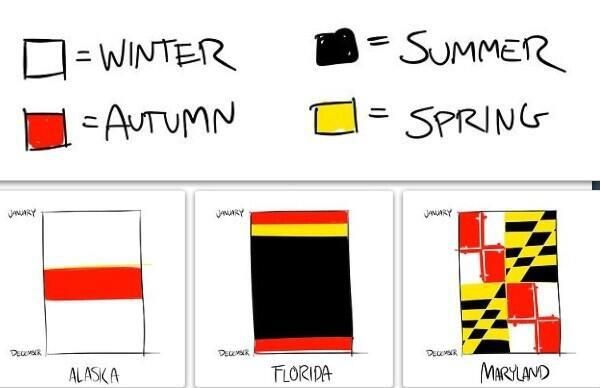
Marylanders like to joke about how unpredictable our weather is. People here sometimes say “if you don’t like the weather right now, wait 5 minutes.” The weather might be different then. There’s also this funny “chart” using the Maryland flag to make the same point:
We don’t get long, consistent seasons, only a few days or a couple weeks of the same weather at a time. Maybe for Marylanders, Psalm 148:7-8 is harder to swallow. It says:
“Praise the LORD from the earth, you great sea creatures and all deeps, fire and hail, snow and mist, stormy wind fulfilling his word!”
The second half of these verses describe weather, mostly bad weather, and says the different kinds of weather are all “fulfilling his word”! To God, the weather isn’t unpredictable at all. It’s doing exactly what He knows it will do. I’m not saying we should praise God for devastating wildfires and hurricanes, but the Psalm is saying that the weather itself should praise the Lord. Therefore, we should praise the Lord for the weather, whatever it is!
Also consider that the weather we might consider so unpredictably annoying is obeying God better than we do. If we’re frustrated by the weather, imagine how frustrating we must be to God. Fortunately, God is more than willing to forgive us for all the things we do or don’t do that dishonor Him. Through the death of Jesus, God’s wrath is fulfilled, and through His resurrection we are given new life and in the future world, we will always be “fulfilling his word.”
Whether you’re frustrated with the weather today or not, remember that God loves you even if you’re as unpredictable as the weather (or more). So, praise God today for the weather and praise God for the sacrifice of Jesus that reconciles us to Him.
Psalm 71 was likely written by an old man, looking back over his life and the many instances of God’s faithfulness. Looking back over a lifetime of walking with God strengthens his current faith, and he writes to strengthen ours. Although some might expect a testimony of God’s faithfulness to talk about uninterrupted good fortune and all the good times the Psalmist has had, in verse 20, they write:
“You who have made me see many troubles and calamities will revive me again; from the depths of the earth you will bring me up again.”
This man’s life, like most people’s lives, was filled with “many troubles and calamities,” yet these only strengthen his faith because God has rescued him every time in the past. Without allowing us to experience trouble, how could God develop a track record of rescuing us? John Calvin comments on this verse that:
“Had he always enjoyed a uniform course of prosperity, he would no doubt have had good reason to rejoice; but in that case he would not have experienced what it is to be delivered from destruction by the stupendous power of God. We must be brought down even to the gates of death before God can be seen to be our deliverer.”
God is always faithful, but we experience it especially in bad times.
I am on vacation this week, so I’ve collected some old posts about James 1:27 for the week. I’m reposting them as is, but they definitely need some editing!
It’s become cliché to say social media brings out the worst of people, since they can hide from consequences behind internet anonymity and distance. Mike Tyson, one of the greatest heavyweight boxers of all time, said “Social media made y’all way too comfortable with disrespecting people and not getting punched in the face for it.” But disrespect and wanting to punch people in the face who disagree with us is nothing new. Just one generation after Adam and Eve were made in the image of God and living in perfect love, their son Cain killed his brother Abel for uncertain reasons. Genesis also doesn’t tell us exactly how Cain killed Abel, but we can be sure social media wasn’t involved. Hate doesn’t require an internet connection or working Wi-Fi, only one person deciding that another person is a thing to be defeated, not as a person made in God’s image. Sometimes by focusing on what we are disagreeing about, we can lose sight of the fact that the person disagreeing with us is inherently valuable.
Today, after months away, we return to a series on James 1:27, which says: “Religion that is pure and undefiled before God the Father is this: to visit orphans and widows in their affliction, and to keep oneself unstained from the world.” James gave careful thought to this phrase, not as hyperbole, but as an example of what perfect religion – worship of God the Father – looks like. Eternal life is for people who love when there’s nothing more at stake than the person being loved, but putting issues above people is one way we get stained by the world and fail to represent Christ. Note that I didn’t say ignore the issues – it’s a question of priority.
The Singular Person Psalm 113 is a Psalm about praising God and making Him known throughout the world, and ends with a very specific praise:
“He gives the barren woman a home, making her the joyous mother of children. Praise the LORD!”
To me, what’s most striking here is that this is a singular barren woman, not barren women as a group. It doesn’t say that God ends all barrenness (although He might). The Psalmist chose as a climactic ending to this poem about the heart of God and how He wants to be known a praise to God for giving a home and family to one barren woman. This means that the sovereign God of all the universe is concerned about individuals, their specific circumstances, and their specific need for salvation. He does not respond to an “issue” of the barrenness of women but responds in a way that satisfies the needs of individual people. People are not statistics to Him, to be counted and divided into opposing sides until one prevails over the other. Each person’s needs and path to redemption are unique in God’s eyes, and only He can provide for all. He is the only way to a perfect world.
Similar to the “barren woman”, James 1:27 is about visiting specific “orphans and widows,” not fighting for the end of all afflictions for all widows and orphans. He is fighting for people, not total victory in an argument. While this might seem obvious to some, it’s so easy to exalt issues over people that we don’t always notice when we do it.
The Issue of Family A common issue today is “family,” which I put in quotes because as an issue it doesn’t mean the same thing to everyone. A lot of time and energy is put into fighting for “family values,” defined many different ways, and James 1:27, “Religion that is pure and undefiled before God the Father is this: to visit orphans and widows in their affliction, and to keep oneself unstained from the world,” is relevant in multiple ways.
First, an earlier post of this series, said “whatever its source, civil law is a provision for a fallen world, not a pathway to a perfect world.” In both the Old and New Testaments, God tells us there will always be poor in the land and that every civil law is inherently limited in a broken world. Christians should “defend the family,” but in what way? James 1:27 says to stand for individuals for whom the institution of family has already failed – widows and orphans. “Pure and undefiled religion” succeeds where law fails, filling the gap with the heart of God, who cares for the specific “barren woman” of Psalm 113:9. There is no perfect law that solves the issue of “family values,” therefore “visit orphans and widows in their affliction.” Affliction comes in many forms and is too complex and diverse for any government to deal with entirely.
Second, when we fight for perfection in our laws, taking absolute stands on either side of an “issue,” we risk elevating law to a level it’s not possible of achieving, and we also may justify hurting people in the process, thinking the end result will be worth it somehow. Once we see the world in fully black/white, either/or terms, it becomes easy to think that if only the right side came out ahead, the issue would be resolved, any collateral damage can be explained, and everyone would be happy. However, consider the extreme example of violence around both abortion clinics and crisis pregnancy centers. In that case and many smaller ones, when we cause harm to opponents, we prove that there are cracks in our own system, creating new victims on top of the existing ones. Those left behind haven’t been helped, but new affliction has been added by those hoping it will be somehow worth it to win the “issue” battle.
Third, ministering to widows and orphans keeps us from the pollution of the world which insists that our salvation is political and based on power. James 1:27 encourages us to reject a world that wants to put laws, culture, even hashtags above actual people. The world too often believes the ends justify the means because belief in worldly utopia depends on a 100% solution, but also believes it’s ok to ignore concrete problems while fighting for a solution that will never arrive. Salvation comes from only one source: the cross.
In the start of this post, I wrote that it’s become cliché to say social media brings out the worst of people, and its cliché because massive amounts of time and energy go into fighting over abstract issues and dividing into groups of “us” and “them”. James 1:27 says that we are not defined by which side of an issue we support, and what we’re willing to do to achieve victory for our side, but by how we love those individuals for whom this world has failed.
It is better to minister to the ones who have been punched by this world than to add another punch to the damage.
Therefore, “Let us hold fast the confession of our hope without wavering, for he who promised is faithful. And let us consider how to stir up one another to love and good works, not neglecting to meet together, as is the habit of some, but encouraging one another, and all the more as you see the Day drawing near.” – Hebrews 10:23-25
And what are “good works”? “Religion that is pure and undefiled before God the Father is this: to visit orphans and widows in their affliction, and to keep oneself unstained from the world.”
Many people, both Christian and non-Christian, think of obedience to God as a dreadful chore, something that robs us of our autonomy and joy. Sometimes people refuse to believe in God because they reject His requirements, and sometimes people resent God because they see Him as making them labor in futility for the perfection He requires. However, we know that salvation does not come from our obedience, but Christ’s, and through God’s grace He reveals Himself to us. Then we learn that the rules we should follow come from a God who loves us and perfectly knows what is good and bad for us – far beyond our own knowledge. Therefore, those rules become our freedom and joy when we follow them willingly. He always knows the best and right choice to make.
Psalm 119 (the longest chapter in the Bible) is a meditation on the benefits of God’s laws for us, and verses 44-45 give us a picture of those benefits:
“I will keep your law continually, forever and ever, and I shall walk in a wide place, for I have sought your precepts.”
The central idea here is that when we are obedient to God, we “shall walk in a wide place,” but what does that mean? How does that benefit us?
Think about walking along a mountain path, or on stones crossing a river. Does it make a difference how wide that path is, or how big and flat the stones are? If we trip and fall on a narrow place, we may fall into a river or off a cliff. However, if we fall in a wide place on a mountain path or on a very large rock, we may scrape a knee or our hands, but the consequences won’t be as severe as falling off a cliff!
The idea of walking in a wide place brings to mind the contrast between the consequences of following our own way versus following God’s. Going our own way can not only have worse consequences now, in this world, but it can also have consequences in eternity. Never repenting of going our own way at all leads to an eternity banished from God’s presence and blessings. But even if we are saved, failure to follow God can rob others of God’s blessings for them that He intends through us and can influence our experience in heaven. Paul teaches in 1 Corinthians 3:12-15 that there are rewards in heaven for those who follow Him, as well as “loss” for not doing so. So, doing whatever we please has consequences, some of which may be eternal.
In contrast, obedience to God is like walking in a safe place, where any negative consequence is temporary, or comes with a corresponding blessing. We may get a scraped knee, but we don’t fall off a cliff, suffering permanent damage, death or other loss. Following God’s word can’t keep all bad things from happening to you, but it can limit the worldly consequences, and eliminate the eternal consequences.
Therefore, seek God’s guidance and follow it, and we “shall walk in a wide place, for I have sought your precepts.”






 Driving Toward the Morning Sun