Sustaining the Wonder

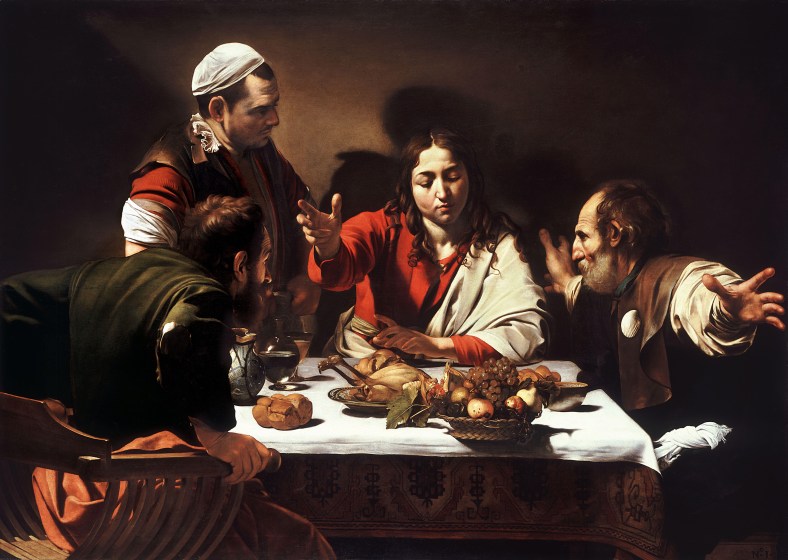
My knowledge of art and art history is just a bit above zero.  I appreciate good art, but it’s just never been a significant interest of mine.  However, that doesn’t mean I don’t have favorite works, and I’m pretty sure my number one is Supper at Emmaus by Caravaggio, painted in 1602 and posted below.  The original can be found in the National Gallery in London, where I’ve seen it in person twice.

It’s truly a great work of art.  Stylistically, I’m fascinated by the realism and the use of shadow and depth.  But what really brings it to life for me is the shocked expressions on the two disciples at the right and left, who had doubts, but suddenly realized they were talking to the resurrected Christ.

The story behind the painting can be found in Luke chapter 24, verses 13-35, where the two disciples in the painting were walking from Jerusalem to Emmaus and were joined by Jesus after His resurrection, but they didn’t realize it was Him.  They shared with Him that “some women of our company” had visited His tomb, where they did not find His body, but instead found angels who told them Jesus was alive.  Then Luke tells us:

And he said to them, “O foolish ones, and slow of heart to believe all that the prophets have spoken!  Was it not necessary that the Christ should suffer these things and enter into his glory?”  And beginning with Moses and all the Prophets, he interpreted to them in all the Scriptures the things concerning himself.

The two disciples invited this “stranger” to stay with them, still not realizing who He was, and during dinner when Jesus blessed and broke the bread, “their eyes were opened and they recognized Him.”  This is the moment captured in Caravaggio’s painting, where you can see both their shock and their excitement, preserved for all time in oil on canvas.

What strikes me when I consider this moment and this painting is whether my shock and excitement that Jesus is alive is as permanent as the disciples in the painting.  I don’t consistently have the feelings these two men had at realizing Jesus Christ is alive.  I almost never have the uncontrollable, physical response that they had, one jumping out of his seat and the other with arms spread wide in wonder.  Granted, those two are permanently captured in paint, but isn’t their reaction as real as it should be?

Also, after Jesus “vanished from their sight” (we don’t know how), the two disciples said, “Did not our hearts burn within us while he talked to us on the road, while he opened to us the Scriptures?”  Through His Spirit, He communicates to us through His Word whenever we are willing to pay attention about how “Moses and all the Prophets” testify to Him and His glory.  Does my heart “burn within” me when I study the Bible?  Most often not.

While the two disciples in the painting were real people, what was captured there was not all that those men were.  Those men weren’t always that excited about Jesus.  They surely had doubts at times and weren’t perfect.  They were more like you and me than the moment represented by Caravaggio could show us.  When they were weak, God’s grace was there for them, and it is there for us in our weakness.  We’d love to always have the passion these two men had on, or shortly after, that first Easter when He rose from the dead, but the truth is we are inconsistent in our devotion and excitement.

Today let’s pray for God to give us more of what we see in Caravaggio’s painting.  A more sustained sense of wonder at God’s work accomplished through the life, death and resurrection of Jesus.  Let’s pray for the uncontrollable emotional and physical response of those two disciples.  Let’s pray for God to carry us during the inevitable times when we don’t feel that way.  And let’s pray that He would remove the things in our life that distract us.

Amen.

The Part of Us That Matters

The Apostle Paul wrote an amazing contrast in 2 Corinthians 4:16-18, which says:

So we do not lose heart. Though our outer self is wasting away, our inner self is being renewed day by day. For this light momentary affliction is preparing for us an eternal weight of glory beyond all comparison, as we look not to the things that are seen but to the things that are unseen. For the things that are seen are transient, but the things that are unseen are eternal.

Photo by Aaron Burden on Unsplash

On the one hand, there are things that are transient, described as: outer, wasting away, light, momentary, affliction, and seen.

On the other hand, what is eternal is: inner, being renewed, weighty, glorious, beyond all comparison, and unseen.

These things are part of each of us, but what is eternal matters infinitely more than the other. Don’t confuse the two, or you may lose heart because Paul earlier assured us in verse 14 that “he who raised the Lord Jesus will raise us also with Jesus and bring us with you into his presence.”  At that time, only what is eternal will remain.

Amen.

Only Resurrection Will Satisfy

Dear fellow travelers,

When the apostle Paul wrote in 1 Corinthians 10:11-12 – “Now these things happened to them as an example, but they were written down for our instruction, on whom the end of the ages has come.  Therefore let anyone who thinks that he stands take heed lest he fall” – he was referring to the story of Israel’s 40 years of wandering in the wilderness between Egypt and the Promised Land.  In verse 5, Paul wrote “with most of them God was not pleased, for they were overthrown in the wilderness.”  Paul assures us that “these things” help keep us from temptation and strengthen our faith in these last days.

But what are these lessons?  One of them can be found in the only Psalm written by Moses – Psalm 90.  A key verse in that Psalm is verse 12, which says:

So teach us to number our days
            that we may get a heart of wisdom.”

And what is wisdom?  One way I describe it is: the ability to choose paths that lead to life, over paths that lead to death, paths that Moses unfortunately was very, very familiar with.  He may have understood the consequences of neglecting God in our daily lives better than anyone for three reasons.

First, in recording the events of Genesis, Moses knew that ever since Adam and Eve, mankind has been facing, and mourning, the consequences of sin.  The repetition of “and he died” in the genealogy of Genesis 5 and elsewhere reminded Moses of the result of missing the mark of God’s righteousness.  Centuries before Paul, Moses knew that “sin came into the world through one man, and death through sin, and so death spread to all men because all sinned.[1]

Second, Moses also saw the consequences of sin very clearly in the shortening of lifespans.  In Psalm 90:10, he wrote:

The years of our life are seventy,
            or even by reason of strength eighty;
yet their span is but toil and trouble;
            they are soon gone, and we fly away.”

This same Moses wrote about early patriarchs who were said to live hundreds of years[2], but by Moses’ day 80 years was considered a long life.

And also, Moses is known as author of the book of Numbers, which as the 4th book in the Pentateuch, lines up with Psalm 90, the first Psalm in book 4 of the Psalms.  Numbers tells of the consequences of Israel’s disobedience and grumbling on their journey to the Promised Land, and why it took 40 years and the entire generation that left Egypt (except Joshua and Caleb) died.  Psalm 90 is almost a summary of what Moses learned from that experience:

So teach us to number our days
            that we may get a heart of wisdom.”

Photo by Kelly Sikkema on Unsplash

What does this have to do with the resurrection?  Psalm 90 starts with these 2 verses:

Lord, you have been our dwelling place
            in all generations.
 Before the mountains were brought forth,
            or ever you had formed the earth and the world,
            from everlasting to everlasting you are God.”

Moses, who led Israel out of Egypt, through the wilderness for decades, and to the threshold of the Promised Land, says the only dwelling place of God’s people is not a specific place, but it is the Lord Himself.  When we are with Him, we are home.

Moses concluded Psalm 90 with verses 16 and 17:

Let your work be shown to your servants,
            and your glorious power to their children.
Let the favor of the Lord our God be upon us,
            and establish the work of our hands upon us;
            yes, establish the work of our hands!

While Moses’ understanding of a resurrection and an afterlife was likely very minimal and vague, he was able to conclude that the best way to spend our short lives here is to do work that matters in eternity, which God has laid out for us to do[3].  We should let Him “establish the work of our hands.”  All through the Pentateuch, Moses recorded the choices between life and death made by Israel, and one of his conclusions is: life is short; live for God!

However, a life truly dedicated to God only makes sense if there is a life to come.  Only resurrection will satisfy because Paul wrote: “If in Christ we have hope in this life only, we are of all people most to be pitied.”[4]  However, since there was an Easter resurrection and there is a resurrection to come, we may look forward to our Promised Land of a new heaven and a new earth.  Moses knew our only other option is a long, purposeless meandering on this earth ending in death.

Therefore, let us pray as Moses wrote in Psalm 90:14 –

Satisfy us in the morning with your steadfast love,
            that we may rejoice and be glad all our days.”

May we – in wisdom – choose the paths that lead to life everlasting! Amen.


[1] Romans 5:12
[2] Genesis 5:27 and 9:29, for example
[3] Ephesians 2:10
[4] 1 Corinthians 15:19


The Only Difference That Matters – Sunday Share from Pastor David Garrison

This Sunday Share is from David Garrison, pastor of Northminster Evangelical Presbyterian Church in Madison Heights, Virginia.  David also happens to be an old friend of mine, and I’m delighted to share this Easter-appropriate post – “The Only Difference That Matters” – from his Pastor’s Corner blog.  From 1 Corinthians 15:12-19, he explains why the resurrection is essential to Christianity.

You’ll find it at the link below – it’s worth the short read!

The Part of Us That Matters

The Apostle Paul wrote an amazing contrast in 2 Corinthians 4:16-18, which says:

So we do not lose heart. Though our outer self is wasting away, our inner self is being renewed day by day. For this light momentary affliction is preparing for us an eternal weight of glory beyond all comparison, as we look not to the things that are seen but to the things that are unseen. For the things that are seen are transient, but the things that are unseen are eternal.

Photo by Aaron Burden on Unsplash

On the one hand, there are things that are transient, described as: outer, wasting away, light, momentary, affliction, and seen.

On the other hand, what is eternal is: inner, being renewed, weighty, glorious, beyond all comparison, and unseen.

These things are part of each of us, but what is eternal matters infinitely more than the other. Don’t confuse the two, or you may lose heart because Paul earlier assured us in verse 14 that “he who raised the Lord Jesus will raise us also with Jesus and bring us with you into his presence.”  At that time, only what is eternal will remain.

Amen.

[Revised from a December 2021 post]