Surprising Answers to Prayer

Jesus told many parables, often in response to situations or people He came across.  These parables are full of great lessons, but sometimes there’s also a lesson in the prelude to the parable.  One such example happens in Luke 12:13-15, which says:

Someone in the crowd said to him, “Teacher, tell my brother to divide the inheritance with me.”   But he said to him, “Man, who made me a judge or arbitrator over you?”  And he said to them, “Take care, and be on your guard against all covetousness, for one’s life does not consist in the abundance of his possessions.”

Jesus goes on to tell the “parable of the rich fool,” who loses his soul because he only cares about worldly goods.  The parable is a lesson about coveting, greed and priorities, but I believe there’s also a broader lesson about prayer in the 3 verses above before the parable even starts.

We can put ourselves in the place of the “someone in the crowd,” who wants something, and brings it to Jesus.  Unlike him, we don’t meet Jesus physically on the street, but we come to Him in prayer all the time.  We want something and we pray about it.  When we pray, we often we want to get a particular answer, hopefully giving us what we want.

In the case of “someone” in the Luke 12 story, he wanted part of the family inheritance.  In our case, we could want any number of things like financial gain, an end to a societal problem, better governance from our leaders, success for our children or others, a safe business trip or vacation, etc.  God wants us to pray to Him about all things, and we do.  “Humble yourselves, therefore, under the mighty hand of God so that at the proper time he may exalt you, casting all your anxieties on him, because he cares for you.”  (1 Peter 5:6-7)
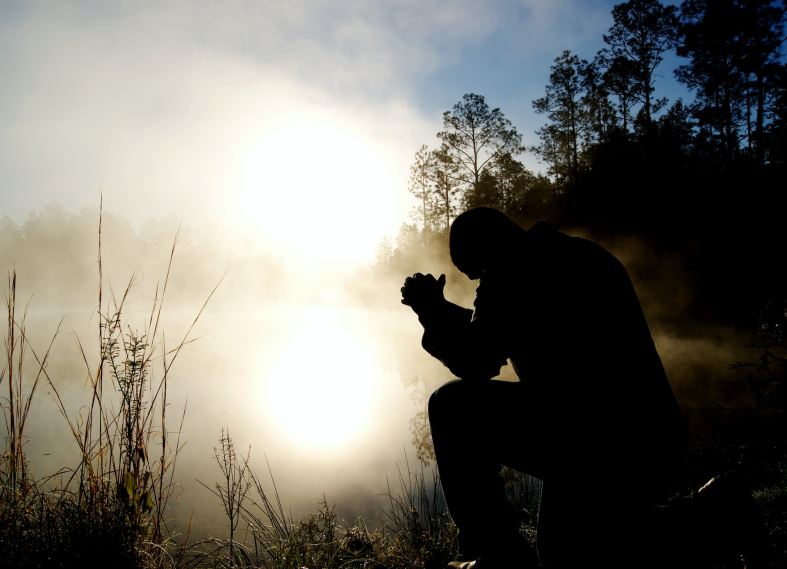
However, we often aren’t ready to listen to a different answer than the one we want.  In the story, Jesus didn’t respond to “someone” with a direct answer, but with an answer that challenged the attitude behind the question.  “You shall not covet[1] is one of the Ten Commandments after all, and Jesus was letting “someone” know the condition of his heart was more important than the condition of his bank account.

God can respond to our prayers in the same way.  Instead of solving what we think is the problem, He may try to reveal to us a deeper problem we need to deal with.  But if we’re focused on the answer we want, we might miss the point He wants to make.  To God, our sanctification is more important than our gratification but often get that backwards.

When we pray for financial gain, God may respond by challenging our priorities, our diligence, our spending habits, etc.  In the Luke story, Jesus confronted the man’s covetousness.

When we pray for an end to societal problems, God may respond by telling us to care for a single mother[2], or support a homeless ministry, or volunteer at a food bank.

When we pray for better governance from our leaders, God may respond by telling us to control what we can control, by reminding us of His sovereignty, or by giving us practical means to work on the problems we want the politicians to solve, but on a smaller scale.

And so on.  Sometimes we do get what we ask for in prayer, but sometimes God will use prayer to do what He promises to do: make us more like Jesus.  Again, our sanctification is more important than our gratification, but sometimes we miss the point because we’re focused on our needs.

It’s ok to bring all of our needs and concerns to God in prayer, and sometimes we get what we want. However, don’t be surprised if He responds in surprising ways, but how?  He can speak to us any way He chooses, but in my experience, He usually points things out in His word, through our circumstances, and through other believers.

Listen and be open to His answers.  No matter what they might be.

“The majority of us begin with the bigger problems outside and forget the one inside.  A man has to learn ‘the plague of his own heart’ before his own problems can be solved” – Oswald Chambers

“The heart of every problem is the problem in the heart.” – Warren Wiersbe


[1] Exodus 20:17; Deuteronomy 5:21
[2] James 1:27

Religion That Puts People Before Issues

I am on vacation this week, so I’ve collected some old posts about James 1:27 for the week.  I’m reposting them as is, but they definitely need some editing!

It’s become cliché to say social media brings out the worst of people, since they can hide from consequences behind internet anonymity and distance.  Mike Tyson, one of the greatest heavyweight boxers of all time, said “Social media made y’all way too comfortable with disrespecting people and not getting punched in the face for it.”  But disrespect and wanting to punch people in the face who disagree with us is nothing new.  Just one generation after Adam and Eve were made in the image of God and living in perfect love, their son Cain killed his brother Abel for uncertain reasons.  Genesis also doesn’t tell us exactly how Cain killed Abel, but we can be sure social media wasn’t involved.  Hate doesn’t require an internet connection or working Wi-Fi, only one person deciding that another person is a thing to be defeated, not as a person made in God’s image.  Sometimes by focusing on what we are disagreeing about, we can lose sight of the fact that the person disagreeing with us is inherently valuable.

Today, after months away, we return to a series on James 1:27, which says: “Religion that is pure and undefiled before God the Father is this: to visit orphans and widows in their affliction, and to keep oneself unstained from the world.”  James gave careful thought to this phrase, not as hyperbole, but as an example of what perfect religion – worship of God the Father – looks like.  Eternal life is for people who love when there’s nothing more at stake than the person being loved, but putting issues above people is one way we get stained by the world and fail to represent Christ.  Note that I didn’t say ignore the issues – it’s a question of priority.

The Singular Person
Psalm 113 is a Psalm about praising God and making Him known throughout the world, and ends with a very specific praise:

He gives the barren woman a home,
            making her the joyous mother of children.
Praise the LORD!”

To me, what’s most striking here is that this is a singular barren woman, not barren women as a group.  It doesn’t say that God ends all barrenness (although He might).  The Psalmist chose as a climactic ending to this poem about the heart of God and how He wants to be known a praise to God for giving a home and family to one barren woman.  This means that the sovereign God of all the universe is concerned about individuals, their specific circumstances, and their specific need for salvation.  He does not respond to an “issue” of the barrenness of women but responds in a way that satisfies the needs of individual people.  People are not statistics to Him, to be counted and divided into opposing sides until one prevails over the other.  Each person’s needs and path to redemption are unique in God’s eyes, and only He can provide for all.  He is the only way to a perfect world.

Similar to the “barren woman”, James 1:27 is about visiting specific “orphans and widows,” not fighting for the end of all afflictions for all widows and orphans.  He is fighting for people, not total victory in an argument.  While this might seem obvious to some, it’s so easy to exalt issues over people that we don’t always notice when we do it.

The Issue of Family
A common issue today is “family,” which I put in quotes because as an issue it doesn’t mean the same thing to everyone.  A lot of time and energy is put into fighting for “family values,” defined many different ways, and James 1:27, “Religion that is pure and undefiled before God the Father is this: to visit orphans and widows in their affliction, and to keep oneself unstained from the world,” is relevant in multiple ways.

First, an earlier post of this series, said “whatever its source, civil law is a provision for a fallen world, not a pathway to a perfect world.”  In both the Old and New Testaments, God tells us there will always be poor in the land and that every civil law is inherently limited in a broken world.  Christians should “defend the family,” but in what way?  James 1:27 says to stand for individuals for whom the institution of family has already failed – widows and orphans.  “Pure and undefiled religion” succeeds where law fails, filling the gap with the heart of God, who cares for the specific “barren woman” of Psalm 113:9.  There is no perfect law that solves the issue of “family values,” therefore “visit orphans and widows in their affliction.”  Affliction comes in many forms and is too complex and diverse for any government to deal with entirely.

Second, when we fight for perfection in our laws, taking absolute stands on either side of an “issue,” we risk elevating law to a level it’s not possible of achieving, and we also may justify hurting people in the process, thinking the end result will be worth it somehow.  Once we see the world in fully black/white, either/or terms, it becomes easy to think that if only the right side came out ahead, the issue would be resolved, any collateral damage can be explained, and everyone would be happy.  However, consider the extreme example of violence around both abortion clinics and crisis pregnancy centers.  In that case and many smaller ones, when we cause harm to opponents, we prove that there are cracks in our own system, creating new victims on top of the existing ones.  Those left behind haven’t been helped, but new affliction has been added by those hoping it will be somehow worth it to win the “issue” battle.

Third, ministering to widows and orphans keeps us from the pollution of the world which insists that our salvation is political and based on power.  James 1:27 encourages us to reject a world that wants to put laws, culture, even hashtags above actual people.  The world too often believes the ends justify the means because belief in worldly utopia depends on a 100% solution, but also believes it’s ok to ignore concrete problems while fighting for a solution that will never arrive.  Salvation comes from only one source: the cross.

In the start of this post, I wrote that it’s become cliché to say social media brings out the worst of people, and its cliché because massive amounts of time and energy go into fighting over abstract issues and dividing into groups of “us” and “them”.  James 1:27 says that we are not defined by which side of an issue we support, and what we’re willing to do to achieve victory for our side, but by how we love those individuals for whom this world has failed.

It is better to minister to the ones who have been punched by this world than to add another punch to the damage.

Therefore, “Let us hold fast the confession of our hope without wavering, for he who promised is faithful.  And let us consider how to stir up one another to love and good works, not neglecting to meet together, as is the habit of some, but encouraging one another, and all the more as you see the Day drawing near.” – Hebrews 10:23-25

And what are “good works”?  “Religion that is pure and undefiled before God the Father is this: to visit orphans and widows in their affliction, and to keep oneself unstained from the world.

Religion That Puts People Before Issues

It’s become cliché to say social media brings out the worst of people, since they can hide from consequences behind internet anonymity and distance.  Mike Tyson, one of the greatest heavyweight boxers of all time, said “Social media made y’all way too comfortable with disrespecting people and not getting punched in the face for it.”  But disrespect and wanting to punch people in the face who disagree with us is nothing new.  Just one generation after Adam and Eve were made in the image of God and living in perfect love, their son Cain killed his brother Abel for uncertain reasons.  Genesis also doesn’t tell us exactly how Cain killed Abel, but we can be sure social media wasn’t involved.  Hate doesn’t require an internet connection or working Wi-Fi, only one person deciding that another person is a thing to be defeated, not as a person made in God’s image.  Sometimes by focusing on what we are disagreeing about, we can lose sight of the fact that the person disagreeing with us is inherently valuable.

Today, after months away, we return to a series on James 1:27, which says: “Religion that is pure and undefiled before God the Father is this: to visit orphans and widows in their affliction, and to keep oneself unstained from the world.”  James gave careful thought to this phrase, not as hyperbole, but as an example of what perfect religion – worship of God the Father – looks like.  Eternal life is for people who love when there’s nothing more at stake than the person being loved, but putting issues above people is one way we get stained by the world and fail to represent Christ.  Note that I didn’t say ignore the issues – it’s a question of priority.

The Singular Person
Psalm 113 is a Psalm about praising God and making Him known throughout the world, and ends with a very specific praise:

He gives the barren woman a home,
            making her the joyous mother of children.
Praise the LORD!”

To me, what’s most striking here is that this is a singular barren woman, not barren women as a group.  It doesn’t say that God ends all barrenness (although He might).  The Psalmist chose as a climactic ending to this poem about the heart of God and how He wants to be known a praise to God for giving a home and family to one barren woman.  This means that the sovereign God of all the universe is concerned about individuals, their specific circumstances, and their specific need for salvation.  He does not respond to an “issue” of the barrenness of women but responds in a way that satisfies the needs of individual people.  People are not statistics to Him, to be counted and divided into opposing sides until one prevails over the other.  Each person’s needs and path to redemption are unique in God’s eyes, and only He can provide for all.  He is the only way to a perfect world.

Similar to the “barren woman”, James 1:27 is about visiting specific “orphans and widows,” not fighting for the end of all afflictions for all widows and orphans.  He is fighting for people, not total victory in an argument.  While this might seem obvious to some, it’s so easy to exalt issues over people that we don’t always notice when we do it.

The Issue of Family
A common issue today is “family,” which I put in quotes because as an issue it doesn’t mean the same thing to everyone.  A lot of time and energy is put into fighting for “family values,” defined many different ways, and James 1:27, “Religion that is pure and undefiled before God the Father is this: to visit orphans and widows in their affliction, and to keep oneself unstained from the world,” is relevant in multiple ways.

First, an earlier post of this series, said “whatever its source, civil law is a provision for a fallen world, not a pathway to a perfect world.”  In both the Old and New Testaments, God tells us there will always be poor in the land and that every civil law is inherently limited in a broken world.  Christians should “defend the family,” but in what way?  James 1:27 says to stand for individuals for whom the institution of family has already failed – widows and orphans.  “Pure and undefiled religion” succeeds where law fails, filling the gap with the heart of God, who cares for the specific “barren woman” of Psalm 113:9.  There is no perfect law that solves the issue of “family values,” therefore “visit orphans and widows in their affliction.”  Affliction comes in many forms and is too complex and diverse for any government to deal with entirely.

Second, when we fight for perfection in our laws, taking absolute stands on either side of an “issue,” we risk elevating law to a level it’s not possible of achieving, and we also may justify hurting people in the process, thinking the end result will be worth it somehow.  Once we see the world in fully black/white, either/or terms, it becomes easy to think that if only the right side came out ahead, the issue would be resolved, any collateral damage can be explained, and everyone would be happy.  However, consider the extreme example of violence around both abortion clinics and crisis pregnancy centers.  In that case and many smaller ones, when we cause harm to opponents, we prove that there are cracks in our own system, creating new victims on top of the existing ones.  Those left behind haven’t been helped, but new affliction has been added by those hoping it will be somehow worth it to win the “issue” battle.

Third, ministering to widows and orphans keeps us from the pollution of the world which insists that our salvation is political and based on power.  James 1:27 encourages us to reject a world that wants to put laws, culture, even hashtags above actual people.  The world too often believes the ends justify the means because belief in worldly utopia depends on a 100% solution, but also believes it’s ok to ignore concrete problems while fighting for a solution that will never arrive.  Salvation comes from only one source: the cross.

In the start of this post, I wrote that it’s become cliché to say social media brings out the worst of people, and its cliché because massive amounts of time and energy go into fighting over abstract issues and dividing into groups of “us” and “them”.  James 1:27 says that we are not defined by which side of an issue we support, and what we’re willing to do to achieve victory for our side, but by how we love those individuals for whom this world has failed.

It is better to minister to the ones who have been punched by this world than to add another punch to the damage.

Therefore, “Let us hold fast the confession of our hope without wavering, for he who promised is faithful.  And let us consider how to stir up one another to love and good works, not neglecting to meet together, as is the habit of some, but encouraging one another, and all the more as you see the Day drawing near.” – Hebrews 10:23-25

And what are “good works”?  “Religion that is pure and undefiled before God the Father is this: to visit orphans and widows in their affliction, and to keep oneself unstained from the world.

Advice for “Our Strange New World”

A long but worthwhile read for the weekend. Carl Trueman argues the massive change to attitudes about gay marriage and LGBT+ recently are symptoms of changes in attitudes about what it means to be a person.

Regardless of what you believe about these issues, this is for Christians struggling to understand, and love, this world that Christ died for. Trueman’s 6 suggestions for Christians and the church largely fall under what C.S. Lewis might call Mere Christianity, and applicable to many situations.

This was shared by my former pastor on his personal page. It took me a few days to find the time to read it, but I didn’t give up…

(Estimated reading time 20 minutes, but worth it!)