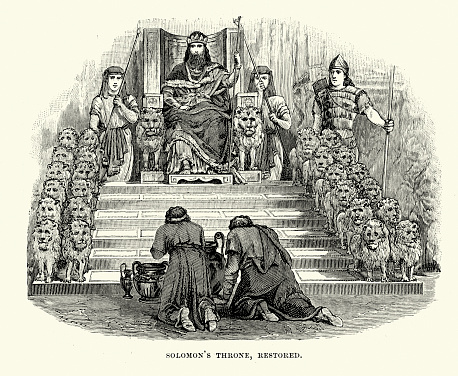
Peacemaking Stones

In the Old Testament, King David wanted to build a temple for God, reasoning that people lived in houses, but God has only ever lived in a tabernacle (tent).  Why should people live in a nicer place than God?  However, David was not allowed to build the temple, but God said his son Solomon would build it.  David gives the reason in a speech to Israel from 1 Chronicles 28:2-3:

I had it in my heart to build a house of rest for the ark of the covenant of the LORD and for the footstool of our God, and I made preparations for building.  But God said to me, ‘You may not build a house for my name, for you are a man of war and have shed blood.’” (emphasis mine)

Since becoming king, David had to fight many of Israel’s neighbors in order to establish peace, which was accomplished by Solomon’s time as king.  But David was not idle regarding the temple; he made many preparations to make Solomon’s job easier when the time came.  After David’s death, Solomon, preparing for construction, worked with Hiram king of Tyre to secure lumber.  In his letter to Hiram, Solomon wrote:

You know that David my father could not build a house for the name of the LORD his God because of the warfare with which his enemies surrounded him, until the LORD put them under the soles of his feet.  But now the LORD my God has given me rest on every side. There is neither adversary nor misfortune.” – 1 Kings 5:3-4

God wanted His temple – His dwelling place – built under peaceful conditions, by a peaceful leader, not by a warrior.  Under Solomon’s leadership, God’s temple was completed.

Solomon’s temple is no more, but God is now building another temple – another dwelling place – His church.  How do we know this?  Peter wrote that Christians as “living stones are being built up as a spiritual house[1] and Paul that Christians “also are being built together into a dwelling place for God by the Spirit.[2]  God now spiritually lives in and among His people, not in a physical building.

What does David and Solomon’s experience teach us about the temple God is now building?  We know that Solomon’s temple had to be built by peaceful people, and Jesus said in the Sermon on the Mount, in Matthew 5:9, that:

Blessed are the peacemakers, for they shall be called sons of God.”

In the Greek language used in the New Testament, the word for peace comes from the verb “to join,” so peacemaking has to do with joining people together.  Between believers, this means that the more we live like Christ, the more we are able to join together in unity.  From believers to unbelievers, this “joining” means we offer them the love Christ gave us and hope and pray they will join with Him.  When discussing all issues non-essential to salvation, this means we seek to join and not separate, to promote peace instead of discord.

So, with God now building a temple of peacemakers, Paul urges us to be “eager to maintain the unity of the Spirit in the bond of peace.[3]  Pray that this Spirit can grow in each of us and in His people worldwide!

Blessed are the peacemakers, for they shall be called sons of God.”


[1] 1 Peter 2:5
[2] Ephesians 2:22
[3] Ephesians 4:3

An Audience With Our King

Do you ever feel like God wouldn’t listen to someone like you?  Who has done what you’ve done or thought what you’ve thought?  Or that He just doesn’t have time for you?  There’s an Old Testament story which shows that a good king, our King, is willing to listen to anybody.

This well-known story of King Solomon comes from 1 Kings 3, in two parts.  In the first part, Solomon asks God for wisdom to rule Israel instead of asking for “long life or riches or the life of your enemies,”[1]so God grants him wisdom, but also the riches and honor he didn’t ask for.  In the second part, an example is given of the wisdom God gave to Solomon.

This example comes in a story of two women who came to Solomon, both claiming that a newborn baby belongs to them.  One claims the other took their child after killing their own child by lying on him in her sleep.  The other claims the living child is their own.

Solomon’s judgement?  “Bring me a sword…Divide the living child in two, and give half to the one and half to the other.[2]  Surprisingly, only one of the women objected to killing the baby, saying the other woman could take him.  Solomon announces that this woman must be the mother instead of the woman who just said, “He shall be neither mine nor yours; divide him.”[3]  In his wisdom, Solomon preserves this child’s life, gives justice to the mother, and demonstrated the great gift God had given Solomon and his people.

But there’s another important detail in this story.  These women were “two prostitutes,[4] and therefore both babies were probably illegitimate.  There are many conclusions I could draw from this, but for now, just notice that King Solomon (surely a very, very busy king) found time to give audience to two prostitutes and provide justice between them.  He did not send them away because of who they are.

Our king Jesus is similar.  No matter who you are or what you’ve done, He will give you an audience.  You could be a prostitute, an unwanted child, or maybe you look like a model citizen, and God will listen to you, because the blood of Jesus shed on the cross covers all sins, not just some of them.

Anyone, really anyone, who sincerely comes to Him looking for wisdom and justice will find it in God’s kingdom.

Let us then with confidence draw near to the throne of grace, that we may receive mercy and find grace to help in time of need.” – Hebrews 4:16


[1] 1 Kings 3:11
[2] 1 Kings 3:24-25
[3] 1 Kings 3:26
[4] 1 Kings 3:16

Wisdom for the Task

What are the most challenging parts of your life?  Maybe your job has been difficult recently.  Maybe you have a ministry that has been exhausting or frustrating.  There may be difficult people or relationships in your life.  It could be anything, but we all have difficult tasks at times.

Photo by Adrian Swancar on Unsplash

King Solomon was given a very difficult task by God, to govern His people Israel as their king.  Solomon knew this job was too big for him, saying in 1 Kings 3:7-8, “O LORD my God, you have made your servant king in place of David my father, although I am but a little child. I do not know how to go out or come in.  And your servant is in the midst of your people whom you have chosen, a great people, too many to be numbered or counted for multitude.”

Solomon’s response was not to despair or give up, but to rely on God, in verse 9 asking him to “Give your servant therefore an understanding mind to govern your people, that I may discern between good and evil, for who is able to govern this your great people?”  God answered Solomon’s prayer and gave him wisdom that made him world-famous.  The wisdom that only comes from God.

But this wisdom isn’t just for kingly or other grand duties.  Just as Solomon did, we can all pray for God to give us wisdom to manage our lives better – those hard jobs, difficult relationships, challenging ministries, and other things.  God doesn’t always solve our problems or remove our difficulties, but He does want to help us live wisely in the midst of them.  If He has given us things to manage, He will also give us the resources to manage them, including wisdom.

Therefore, “If any of you lacks wisdom, let him ask God, who gives generously to all without reproach, and it will be given him.”  (James 1:5)

The Queen of Sheba’s Example

King Solomon, son of Israel’s greatest king David, was also a famous and renowned king.  God asked Solomon what he wanted, and Solomon asked for wisdom to rule the people. In addition, the Lord also gave him “riches and honor, so that no other king shall compare with you, all your days.[1]  His rule was likely the high point of Israel’s kingdom in terms of wealth.  Surely Solomon was bound to draw the attention of other nations and their rulers.

One such ruler is the Queen of Sheba, and we learn about her visit to Solomon in 1 Kings 10.  Sheba was apparently “Sabea,” far away from Jerusalem in southwestern Arabia.  Visiting Solomon was a long and difficult trip for her, especially since she brought many people and gifts along.  Why did she bother?  She came because of reports she had heard of Solomon’s wealth, but also of his wisdom.  1 Kings 10:1 says “she came to test him with hard questions” to see if he was as wise as the reports said.  Solomon answered all of her questions, and she responded that “Your wisdom and prosperity surpass the report that I heard.”[2]

Like the Queen of Sheba, we also hear reports of a King of Israel who surpasses all in wisdom: God Himself.  But like the Queen, do we put as much effort into learning about this King?  She traveled for days, maybe weeks, in order to meet Solomon in person.  Do we set aside enough time to really get to know our King?  Do we engage Him in tough conversations about our lives, testing Him with the hard questions we have?  Or do we keep Him at a distance because we’re not sure how He is relevant for our lives?

Solomon’s father, King David, wrote in Psalm 34:8 –

Oh, taste and see that the LORD is good!
            Blessed is the man who takes refuge in him!

David’s words don’t tell us to sit back and passively learn about God; they tell us to “taste” of God to see that He is “good.”  God does not shower us with blessing upon blessing trying to convince us that He is good while we selfishly go about our lives.   We must learn that He is good by trusting Him and learning to walk with Him.  We turn to Him by learning that repentance is a good thing.  That He is a God worthy of our attention.

When the Queen of Sheba became convinced that Solomon was a good and wise king, in 1 Kings 10:9 she proclaimed:

Blessed be the LORD your God, who has delighted in you and set you on the throne of Israel! Because the LORD loved Israel forever, he has made you king, that you may execute justice and righteousness.

Think of how much more blessed we are to have a King who is infinitely wiser and greater than Solomon!  Learning more of Solomon caused the Queen to burst forth in praise for God, who loved Israel enough to give them a king that will “execute justice and righteousness.”  God still loves His people and has given them a King, our Lord Jesus, who will “execute justice and righteousness” perfectly and for eternity. James 4:8 tells us to “Draw near to God, and he will draw near to you.” 

Even if it requires taking a long, difficult trip, like the Queen of Sheba’s.  He is worth the effort.


[1] 1 Kings 3:13
[2] 1 Kings 10:7

Grandpa Solomon’s Retirement Advice

Have you ever asked yourself what Solomon, son of David, king of Israel, and author of much Biblical wisdom, would have to say about modern retirement?  Probably not, but I’m going to write about it anyway, because Solomon actually had some relevant advice.

Since this blog is not a source of income, I have a day job which happens to involve helping companies help their employees save and invest for retirement.  In American culture, retirement has in some ways replaced heaven as the future we hope for.  Advertisements promise retirees can do all the things they dreamed of doing during their working years.  Travel.  Relax.  Read those books you’ve been putting off reading.  If you can, buy a yacht.  After all, if you’ve worked so hard for it, you deserve it, they say.  Like many marketing schemes, something good and prudent (saving for retirement) is wrapped in a lot of gloss to get you to do something you might not do otherwise.  Sacrifices made now are worthwhile because of a later reward.

A photo I took from a Florida beach over the Atlantic near sunrise. I’d like to retire here, but heaven is better.

Thinking about this, I made the connection that Solomon[1] when writing Ecclesiastes was acting in the role of a wise, Godly grandfather in a way that offers a sharp contrast to the story of retirement that goes unchallenged in our culture.

In Ecclesiastes, Solomon lays out an argument that he lived almost the exact life pictured in our retirement ads but learned to regret it.  While still a very young man, he had the power and wealth to try anything he wanted.  He planted vineyards and drank a lot of wine.  He built gardens and pools and acquired many servants and property.  He also had 700 wives and 300 concubines.[2]  He could have everything he desired – everything the retirement ads would show you if they could be R-rated – but he ended up disappointed.  Ecclesiastes is his advice to those who come after to not repeat his mistakes.

While a blog post can’t cover all of Ecclesiastes, I must add that Solomon did encourage us to invest for the future, but also not to place all our bets on one specific vision of the future: “Cast your bread upon the waters, for you will find it after many days.  Give a portion to seven, or even to eight, for you know not what disaster may happen on earth.”  (Ecclesiastes 11:1-2).  A long, healthy and prosperous retirement is one possible future among many, but eternity with God is a future certainty.  Earlier in the book, Solomon writes: “He has made everything beautiful in its time. Also, he has put eternity into man’s heart, yet so that he cannot find out what God has done from the beginning to the end.” (Ecclesiastes 3:11)  God gives us a sense of what He has planned for us, but not many of the details.  We should not foolishly ignore the future, but we should not cling to one future we desire at the cost of the present God has given us and the future He already knows everything about.

Solomon encourages everyone – young and old – to live more in their own moment, enjoying the gifts God has given them and sharing those gifts with the people around them.  While Solomon is encouraging the young to not repeat his own mistakes, he is also encouraging the old to share their perspective.  In both cases, Solomon is telling us not to stress too much about what may or may not happen, but to invest what we have in light of what will be meaningful in eternity.  Joy comes from enjoying the relationships and things God has blessed us with now, not from sacrificing the now in light of a false vision of retirement.

Solomon recommends joy in God’s provision, and so I close with this quote, and pray that we all experience joy and thankfulness in the gifts God has given us today.  Don’t keep them to yourself.

Go, eat your bread with joy, and drink your wine with a merry heart, for God has already approved what you do.  Let your garments be always white. Let not oil be lacking on your head.  Enjoy life with the wife whom you love, all the days of your vain life that he has given you under the sun, because that is your portion in life and in your toil at which you toil under the sun. Whatever your hand finds to do, do it with your might, for there is no work or thought or knowledge or wisdom in Sheol, to which you are going.” – Ecclesiastes 9:7-10


[1] I’m going to proceed for the sake of argument that Solomon is the author of Ecclesiastes, although I know some debate that and it’s not explicitly stated.
[2] 1 Kings 11:3