The Spirit of Craftmanship

After God redeemed His people Israel from slavery in Egypt, He wanted to impart a further lesson to them: that He was always with them.  At first, His presence was signified “by day in a pillar of cloud to lead them along the way, and by night in a pillar of fire to give them light, that they might travel by day and by night.”[1]  Later, including after Israel entered the Promised Land, the Lord’s presence was especially known as dwelling in the tabernacle, and even later in the temple.

The pillars of cloud and fire simply manifested themselves by God’s will, but in the case of the tabernacle and temple, someone had to build them.  After revealing to Moses the intricate design of the tabernacle and all its component parts, Moses may have been concerned about how this was all to get done.  Therefore, God said to Moses in Exodus 31:2-4 how He would provide for that:

See, I have called by name Bezalel the son of Uri, son of Hur, of the tribe of Judah, and I have filled him with the Spirit of God, with ability and intelligence, with knowledge and all craftsmanship, to devise artistic designs, to work in gold, silver, and bronze, in cutting stones for setting, and in carving wood, to work in every craft.”

Since the construction of the tabernacle would require many skills and techniques, including working with wood, metal and cloth, someone with all of these skills would be needed.  But note where the “ability and intelligence,” “knowledge and all craftmanship” come from – the Spirit of God!  They didn’t just appear out of nowhere.  God’s Spirit personally enabled Bezalel to do the needed work.

Also note that God said, “I have called by name Bezalel.”  He didn’t say to Moses “go find someone, anyone, who you think can do the work, and I will enable them to do it.”  No, He called Bezalel “by name.”  This calling was to belong to Him, and no other, by God’s Spirit and grace.

Now Moses might have asked, “how can one man do all this, even with God’s Spirit?”  In verse 6 the answer is provided:

And behold, I have appointed with him Oholiab, the son of Ahisamach, of the tribe of Dan. And I have given to all able men ability, that they may make all that I have commanded you

Oholiab was also called by name, but God also provided many others with the ability to build the tabernacle.  Each person had their part to play, and God knew every one of them personally, even if Exodus doesn’t name them.

Which brings us to the topic of Spiritual gifts, those abilities described by Paul and others in the New Testament as being given to each believer for the building up of the church.  Were all the skills needed to construct the tabernacle “Spiritual gifts” given to Bezalel, Oholiab and others?  I think so, since God clearly says these men were filled with God’s Spirit to do these things.[2]  The lesson here is that every Christian has Spiritual gifts, but that many of those gifts may not seem “spiritual” as we often think of that word.  Not everyone is a pastor, elder, deacon, Sunday school leader, or other church roles you can think of.  In fact, some people will be more like Bezalel and Oholiab, filled with the ability to make beautiful and/or useful things that glorify God.

If you’ve found your place in the church and in the world to use your gifts, praise God!  If not, it doesn’t mean you don’t have gifts to use in God’s service.  Paul wrote in Ephesians 2:10, “For we are his workmanship, created in Christ Jesus for good works, which God prepared beforehand, that we should walk in them,” and when he says “we” he means every Christian.  We all have our own tabernacles to build, and God will give us the means and ability to do them, including the help of other “able men” if needed to get the job done.

What skills and interests do you have?  Can they be used to help build up the church?  Can they be used as a witness to the world?  Ask for God’s guidance and keep an open mind about what He might say.  In Bezalel’s case, it included building a massive curtain!  God calls each of us “by name” to do specific things – are we listening to whatever He might say?  He is always with us, ready to lead.


[1] Exodus 13:21
[2] There are differences between the OT and NT concepts of being filled with the Spirit, but for space I’m leaving that out here.
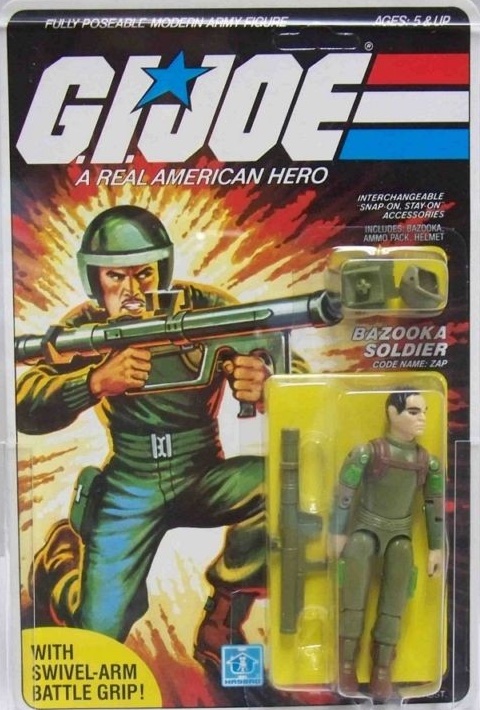

Zap! The Best Action Figures for Christmas

Dear fellow travelers,

A hot Christmas gift when I was a kid were G.I. Joe toys.  These “Real American Heroes” were a line of action figures, vehicles and other accessories that fought against the evil Cobra organization which was trying to take over the world (of course).  In 1982, they were even hotter, after Hasbro added “Swivel Arm Battle Grip” to the design to differentiate G.I. Joe from the also-popular Star Wars figures.

Zap looks much better in action than in the box.

The swivel in the middle of the figure’s bicep allowed 360-degree rotation.  The swivel isn’t a shoulder, elbow, or hand, but without it, bazooka soldier (Code Name: Zap) can’t pose as modeled on the package pictured here.  I had “Zap” and tried it for myself.  It took some experimentation, but eventually the way the shoulder, swivel, and elbow were made worked together and Zap looked like Zap should look.

Why so much detail about action figures in a Christian blog?  Because the Christian church is described in the Bible as the body of Christ, and in 1 Corinthians 12:14-16, the apostle Paul assures us that, without every single member of the church participating, the body of Christ is incomplete:

For the body does not consist of one member but of many.  If the foot should say, ‘Because I am not a hand, I do not belong to the body,’ that would not make it any less a part of the body.  And if the ear should say, ‘Because I am not an eye, I do not belong to the body,’ that would not make it any less a part of the body.

Like Zap without “Swivel Arm Battle Grip,” the church will not perform as God intended unless all parts of the body participate, but sometimes it’s not clear to each of us what part of the body of Christ we are.  To some of us, others may clearly look like a shoulder, elbow, or hand, but we don’t know our part.  To some of us, others may look like the “hands and feet of Jesus” (to use a common phrase), but people don’t say the same about us.  Remember that Paul says “that would not make it any less a part of the body.”

Today, let’s return to one of this blog’s key verses, Hebrews 10:24, “And let us consider how to stir up one another to love and good works.”  When we don’t clearly know the specifics of our part, maybe we are the “Swivel Arm Battle Grip” – the innovative, new part with a weird name that helps the other parts fit together and work as God intended.  But also, when we do know our part, is the objective any different?

Obscure Spiritual Gifts

Do you know what your spiritual gift or gifts are?  The topic of spiritual gifts has always been interesting to me.  These gifts are Spirit-enabled talents or abilities that Christians have for serving others, usually the church.  While the apostle Paul wrote multiple lists of these gifts (see 1 Corinthians 12:8-10, Romans 12:6-8, and Ephesians 4:11 for example), all the lists are different which indicates to me that none of these lists is complete.  Therefore, there are spiritual gifts Christians have that are not listed by Paul.  This means that if your talents or abilities aren’t in the lists it doesn’t mean you don’t have a spiritual gift.

In Acts 9, there’s a very interesting example of what I think is a spiritual gift even though it isn’t called that there.  In the apostle Peter’s travels, he came to Joppa, and “Now there was in Joppa a disciple named Tabitha, which, translated, means Dorcas. She was full of good works and acts of charity.”[1]  She had become ill and died, but in God’s power she was raised from the dead by Peter.  Before that, while Peter was on the way there, Luke, the author of Acts, notes:

So Peter rose and went with them. And when he arrived, they took him to the upper room. All the widows stood beside him weeping and showing tunics and other garments that Dorcas made while she was with them.” – Acts 9:39

Tabitha/Dorcas was known among the Christians as one who “was full of good works and acts of charity” and had made many “tunics and other garments” for others.  She was clearly skilled at making clothes and she used this skill in the service of the church.  Gifts like these may be included when Paul wrote in Romans 12:7 that we can have gifts of “service.”  What kind of service?  He doesn’t say, but it can probably take many, many forms, even including making clothes for others.

I’ve met and known people who have an uncanny ability that defies explanation, or an activity they do tirelessly that helps others and brings them joy.  In many cases, these abilities aren’t in Paul’s lists but provide a great service for the church.  I know someone whose gift seems to be finding things people have that they don’t want or need and getting them to someone who needs that exact thing.  It happens with such regularity that it doesn’t make sense if it’s just a “natural” ability.

God isn’t limited to any lists, and He can use whatever we have, because whatever we have we got from Him.  Paul wrote several epistles and founded churches, and Peter brought someone back from the dead, but The Life Application Study Bible notes on Acts 9:39: “God uses great preachers like Peter and Paul, but he also uses those who have gifts of kindness like Tabitha. Rather than wishing you had other gifts, make good use of the gifts God has given you.”

If your gifts are obvious, then thank God, but if not, don’t be discouraged.  God can use whatever we have if we offer it to Him, and He can bless it with the power of His Spirit if He chooses.  Even if it seems all you have is “five loaves and two fish[2]

Offer whatever you have to Him and to the church and see what happens.


[1] Acts 9:36
[2] Luke 9:13