What Wisdom Means to Me

I’ve had some sort of working definition of “wisdom” for most of my life.  I think most of us have.  As a teenager, I remember joking that it was the ability to learn from other people’s mistakes.  It sounded teenager-wise, but how do I know what’s a mistake?  Later, I read somewhere about wisdom being something like “skill at living life”.  Also sounds useful, but perhaps vague and worldly feeling.  Even later in life, I started thinking of it as “being able to make decisions based on facts, instead of based on wishful thinking.”  This has been even more useful, but which facts do you follow?  How do you choose between two “true” options?  What if you don’t have all the needed facts?

I think my current definition is better: Wisdom is the ability to choose between the path of righteousness and the path of the wicked.  In the Psalms and the Biblical wisdom literature like Proverbs, there is a contrast between these two paths, and the idea that moral decisions are like choosing a route between places.  You can be on one path or the other, and with wisdom, “you will understand righteousness and justice and equity, every good path[1]

Moving down a path is an action, and therefore, wisdom is about taking the right action, not about what we know, believe, or say.  It’s not about accumulating facts.  Facts matter, but they aren’t wisdom all by themselves.  Adding the context of the Great Commandments[2], wisdom is what tells us how to love God and others actively, and in a way based on obedience that leaves the results to God.  For example, in the book of Acts, Ananias didn’t minister to Saul, the notorious persecutor of Christians, because Ananias thought it would end up well for himself[3], he did it because God told him to, and God knew that future Saul was Paul, the author of much of the New Testament.  Ananias didn’t decide based on the facts as he knew them, but he adjusted the facts in light of revelation from God.  Also, wisdom might sometimes tell you the best action is to do nothing, to not to do something specific.  Sometimes wisdom flashes a red light while others are flashing green.  “There is a way that seems right to a man, but its end is the way to death” – Pr. 14:12 and 16:25.

Photo by Alex Shute on Unsplash

This way of thinking about wisdom explains why the Way, the Truth and the Life must be a Person, not a set of rules or a philosophy.  Truly, only each of us, in our individual relationships with God through the Holy Spirit, can learn wisdom.  Only in a relationship with this Person can we figure out what our purpose and identity in the body of Christ is.  This wisdom is proactive and specific to each of us.  Nobody else’s situation is your situation, and nobody else has the same relationships, abilities, and resources.  Books, advice, and experience can be helpful, but we each need to “taste and see[4] the Holy Spirit in us, working at our very core where only He can reach, and directing us down the right paths at the right times.

True wisdom will put us on a path that provides us, and this world, a taste of heaven through us.  It is informed by a justice and righteousness – God’s law and Christ’s character – that is not of this world.  With wisdom we can build and create new things on the cornerstone of Christ.  The world might not like it, but the world is not your Creator who is all wise.  Therefore, pray for and seek God’s wisdom as the immensely valuable treasure that it is!


[1] Proverbs 2:9
[2] Matthew 22:37-39.  In short, love God and love your neighbor.
[3] Acts 9:13
[4] Psalm 34:8

Popular Orthodoxy: A Quint of Quotes

Fellow travelers,

Here is another “Quint of Quotes” from my collection.  These five somewhat related sayings suggest the particular time and place we live in may not be very different from every other time and place.  I hope you find them interesting and thought-provoking.

Now the serpent was more crafty than any other beast of the field that the LORD God had made.  He said to the woman, “Did God actually say, ‘You shall not eat of any tree in the garden’?…the serpent said to the woman, “You will not surely die.” – Genesis 3:1,4

“Every age has some ostentatious system to excuse the havoc it commits. Conquest, honour, chivalry, religion, balance of power, commerce, no matter what, mankind must bleed, and take a term for a reason” – Horace Walpole, British politician, in 1762

There is a way that seems right to a man, but its end is the way to death.” – Proverbs 14:12, 16:25

“At any given moment there is an orthodoxy, a body of ideas of which it is assumed that all right-thinking people will accept without question. It is not exactly forbidden to say this, that or the other, but it is ‘not done’ to say it… Anyone who challenges the prevailing orthodoxy finds himself silenced with surprising effectiveness. A genuinely unfashionable opinion is almost never given a fair hearing, either in the popular press or in the high-brow periodicals”. – George Orwell, in the 1945 introduction to ‘Animal Farm.’

For the time is coming when people will not endure sound teaching, but having itching ears they will accumulate for themselves teachers to suit their own passions, and will turn away from listening to the truth and wander off into myths.  As for you, always be sober-minded, endure suffering, do the work of an evangelist, fulfill your ministry.” – 2 Timothy 4:3-5

What is Our Conscience?

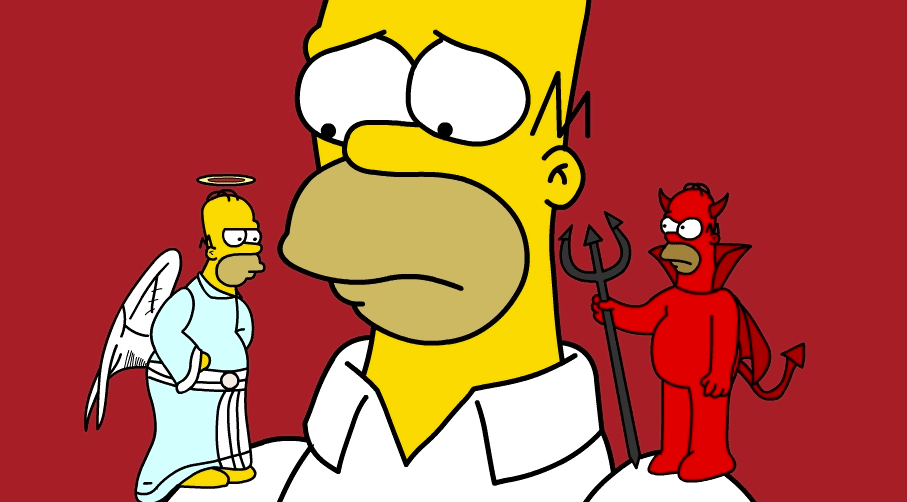
What do you think of when you think of a conscience?  For some it’s the image from old cartoons of a person with an angel on one shoulder and a devil on the other, each giving competing moral advice.  That image is funny partly because it might not be far from the truth.

For some, a conscience is a “moral compass” – that internal voice that helps us distinguish right from wrong.  While this is another good image for a conscience, we have new technology now.  We use GPS now, and when I think of a conscience, the voice of my GPS comes to mind.  Let me explain.

A compass is too simple a metaphor.  The voice of our conscience is not usually like a clear sign or bright, flashing lights pointing the way (although God can use whatever means He chooses).  In my experience, a conscience is more like a broken GPS system, that has many voices, not just one, like a real GPS.  Not that we’re all “hearing voices,” but since our conscience is giving us directions, a voice seems a good metaphor.  You could call it an influence or something else.  Anyway, some of the voices tell us to go places we shouldn’t and not to go places we should, and some of them lead us the right way.  We find ourselves weighing the pros and cons of these multiple voices.  For every decision we make, there’s a reason we make it, and often we don’t explicitly think about why.  It could be something we learned from our culture, our family, our education, or from anything we’ve experienced.  It might come from something we saw or listened to recently, or many years ago.  It could also be something we just invented ourselves.  But it’s there, trying to influence us.

Now not everyone has the same voices in their conscience.  For someone who isn’t a Christian, their GPS considers all the factors it has, and they make decisions as they see fit by prioritizing among the influences.  But for a Christian, salvation requires realizing our GPS is fundamentally broken, trusting someone who knows how to fix it, and then striving to follow the new instructions.  When this happens, a Christian gets an added feature in their internal GPS – a new voice.  This voice is the Holy Spirit, but it doesn’t become the only voice, it just adds one more competing voice to the cacophony. However, the Spirit is the only voice that can be trusted to guide us to the right destination 100% of the time.

As we make decisions in the world, each of us try to follow the advice of our conscience, but we must remember that our consciences are broken until we reach heaven.  Many voices work hard to influence us, and any voice that we follow into disobedience from God can be considered an idol for us.  Only the Holy Spirit speaks with the wisdom needed for us to fulfill our purpose as individuals made in God’s image.

However you think of what a conscience is, let Him rule it, and “in your hearts honor Christ the Lord as holy” – 1 Peter 3:15a

Then you can have a clean conscience, whatever you do.

Is Democracy Good? A Quint of Quotes

Fellow travelers,

In the United States, today is “Super Tuesday,” when citizens in 15 of the 50 states vote in their state primaries, which decide who will be the nominee for President from each political party.  15 states in one day are far more than on any other day, and why the day gets a special name.  In observance of this day, here is another “Quint of Quotes” from my collection, on the theme of democracy:

“Democracy is the recurrent suspicion that more than half of the people are right more than half of the time.” – E.B. White

“Democracy is the theory that the common people know what they want, and deserve to get it good and hard.” – H.L. Mencken

“Mankind will in time discover that unbridled majorities are as tyrannical and cruel as unlimited despots.” – John Adams

“Your representative owes you, not his industry only, but his judgment; and he betrays instead of serving you if he sacrifices it to your opinion.” – Edmund Burke

“No one pretends that democracy is perfect or all-wise. Indeed it has been said that democracy is the worst form of Government except for all those other forms that have been tried from time to time.…” – Winston S. Churchill

An Audience With Our King

Do you ever feel like God wouldn’t listen to someone like you?  Who has done what you’ve done or thought what you’ve thought?  Or that He just doesn’t have time for you?  There’s an Old Testament story which shows that a good king, our King, is willing to listen to anybody.

This well-known story of King Solomon comes from 1 Kings 3, in two parts.  In the first part, Solomon asks God for wisdom to rule Israel instead of asking for “long life or riches or the life of your enemies,”[1]so God grants him wisdom, but also the riches and honor he didn’t ask for.  In the second part, an example is given of the wisdom God gave to Solomon.

This example comes in a story of two women who came to Solomon, both claiming that a newborn baby belongs to them.  One claims the other took their child after killing their own child by lying on him in her sleep.  The other claims the living child is their own.

Solomon’s judgement?  “Bring me a sword…Divide the living child in two, and give half to the one and half to the other.[2]  Surprisingly, only one of the women objected to killing the baby, saying the other woman could take him.  Solomon announces that this woman must be the mother instead of the woman who just said, “He shall be neither mine nor yours; divide him.”[3]  In his wisdom, Solomon preserves this child’s life, gives justice to the mother, and demonstrated the great gift God had given Solomon and his people.

But there’s another important detail in this story.  These women were “two prostitutes,[4] and therefore both babies were probably illegitimate.  There are many conclusions I could draw from this, but for now, just notice that King Solomon (surely a very, very busy king) found time to give audience to two prostitutes and provide justice between them.  He did not send them away because of who they are.

Our king Jesus is similar.  No matter who you are or what you’ve done, He will give you an audience.  You could be a prostitute, an unwanted child, or maybe you look like a model citizen, and God will listen to you, because the blood of Jesus shed on the cross covers all sins, not just some of them.

Anyone, really anyone, who sincerely comes to Him looking for wisdom and justice will find it in God’s kingdom.

Let us then with confidence draw near to the throne of grace, that we may receive mercy and find grace to help in time of need.” – Hebrews 4:16


[1] 1 Kings 3:11
[2] 1 Kings 3:24-25
[3] 1 Kings 3:26
[4] 1 Kings 3:16