Here is another “Quint of Quotes” from my collection, five quotes on the theme of popular opinion when it goes wrong:
“Those who call for Nonsense will find that it comes.” – C.S. Lewis
“We find that whole communities suddenly fix their minds upon one object, and go mad in its pursuit; that millions of people become simultaneously impressed with one delusion, and run after it, till their attention is caught by some new folly more captivating than the first.” – Charles Mackay
“The struggle for freedom is ultimately not resistance to autocrats or oligarchs but resistance to the despotism of public opinion.” – Ludwig von Mises
“At any given moment there is an orthodoxy, a body of ideas of which it is assumed that all right-thinking people will accept without question. It is not exactly forbidden to say this, that or the other, but it is “not done” to say it… Anyone who challenges the prevailing orthodoxy finds himself silenced with surprising effectiveness. A genuinely unfashionable opinion is almost never given a fair hearing, either in the popular press or in the high-brow periodicals.” – George Orwell
“Woe to those who call evil good and good evil, who put darkness for light and light for darkness, who put bitter for sweet and sweet for bitter!” – Isaiah 5:20
The Apostle Paul wrote in Philippians 4:13 “I can do all things through him who strengthens me,” yet he also wrote in 2 Corinthians 12:7-9 that “to keep me from becoming conceited,” a “thorn was given me in the flesh.” He writes: “Three times I pleaded with the Lord about this, that it should leave me. But he said to me, ‘My grace is sufficient for you, for my power is made perfect in weakness.’ Therefore I will boast all the more gladly of my weaknesses, so that the power of Christ may rest upon me.”
The nature of Paul’s “thorn” has been disputed for centuries, but Galatians 4:13 suggests it was a physical problem, a “bodily ailment” rather than a moral shortcoming. So, the lesson of the “thorn” is not that God prevented Paul from overcoming some specific sin to keep him humble – He wants Paul (and us) to be satisfied with nothing less than righteousness.
However, one lesson of the “thorn” is that Paul didn’t mean by “I can do all things” that he could do whatever he wanted and succeed. Instead, the “thorn” is an example of a battle Paul would not win, because this “thorn” had a purpose in bringing Paul closer to God’s grace and power. In God’s wisdom, Paul was better off with this ailment than without it.
Yesterday’s post said “Picking your battles, rather than trying to fight and win every fight that comes your way, is a good piece of advice. However, who should pick which battles to fight?” In the case of the “thorn”, God picked a battle for Paul not to fight, telling him instead to focus on growing in faith. The thorn had a purpose in Paul’s striving toward righteousness, which was more important than any physical ailment. Had Paul continued to insist to God that the thorn should be removed, he would still have the thorn, but he would also not grow in his relationship with his Lord.
Sometimes there are battles He wants us to fight in His strength for His glory, and sometimes there are battles He tells us not to fight so we can focus on His grace and power while in this life, in light of His promises to heal our physical ailments in Paradise.
Today’s post closes the same way as yesterdays: “Sometimes life is hard on purpose, so that God alone may be glorified in victory, and also so that we may grow in our faith in His strength. When we let Him pick our battles, we learn that His righteousness is the only thing that will satisfy us. Nothing less will do.”
Picking your battles, rather than trying to fight and win every fight that comes your way, is a good piece of advice. However, who should pick which battles to fight? The Old Testament book of Judges is a record of the consequences of Israel’s failure to completely conquer the promised land, a battle God gave them to fight and win. Judges also shows more generally what happens when anyone picks the wrong battles to fight: they end up with less than what God intended for them.
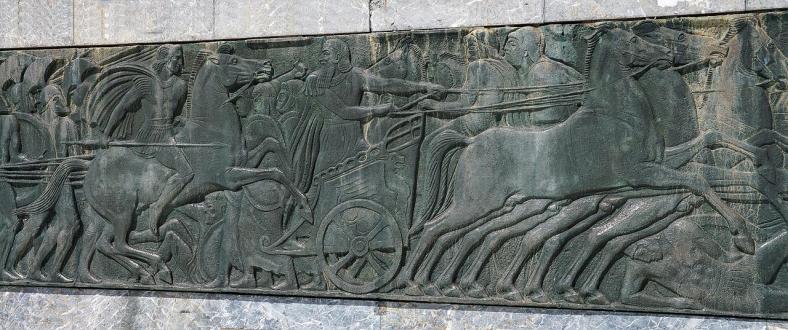
For example, Judges 1:19 tells us: “And the LORD was with Judah, and he took possession of the hill country, but he could not drive out the inhabitants of the plain because they had chariots of iron.”
This verse, especially the second part, is written from a human perspective. God did not tell Israel to conquer all of the promised land, except for the plains. God is not afraid of chariots. He told them to conquer all of it, but Israel thought that chariots couldn’t be defeated, so they decided not to fight in the plain. By using their own judgement and preferring to fight in hills or forests where chariots were less effective, they failed to fully receive what God had promised them.
An application to us is that our inheritance is Christ’s righteousness, and Jesus tells us “Blessed are those who hunger and thirst for righteousness, for they shall be satisfied.”[1] Jesus is telling us that righteousness is like food and drink. We can never have enough because no matter how much we eat and drink, our hunger and thirst soon return. We are all in different places, at different levels of knowledge and maturity, but in Christ we are all on the same path and have an appetite only He can satisfy.
To be satisfied, we cannot settle for what we have already accomplished, the hill country we have already taken. To be satisfied, we must fight the chariots in the plains if that is what God wants us to do, so that we learn to rely on His strength. To be satisfied, we move from only fighting battles we choose based on our own wisdom and ability to choosing the battles we will win in His strength.
Sometimes life is hard on purpose, so that God alone may be glorified in victory, and also so that we may grow in our faith in His strength. When we let Him pick our battles, we learn that His righteousness is the only thing that will satisfy us. Nothing less will do.
Actual disaster footage. Viewer discretion advised.
A doctor friend of mine said there’s an inside joke that “if you put two bones alone in a room together, they’ll find each other.” I heard this after breaking my left collarbone in the summer of 2011. Even when I was young, I wasn’t a great athlete, but I did always hustle. So after a decade of not doing much athletically, I joined my work softball league and thought at least I would try hard and have fun. But when I hit a weak ground ball to the shortstop and decided to “hustle,” disaster saw its opportunity. The fields we played on were poorly maintained, with holes where the hitters stand. Instead of doing the smart thing and stopping after I tripped in this hole, I tried to keep running (because hustle!) and soon ended up falling hard on my shoulder with a loud snapping sound. The picture above is my actual X-ray from that night.
This isn’t a great memory, but it’s also a reminder of the miracle of healing. I had the option of surgery or just letting it grow back together, and I chose letting it heal. However, it didn’t “just” get fixed. It was by design and no accident.
My collarbone was broken clean through, with the two sides of the bone not even touching any more. I could feel them moving around independently. When I think about the millions of “decisions” the cells in these bones, interacting with the tissue around them, had to make to do something they’ve never done before, I have to be convinced something beyond my own anatomy and genetic history was at work. An impersonal evolution may have never seen these bones break in just this way before, so how did the bones know what to do? I certainly wasn’t aware of telling these bones what to do. They didn’t “just” fix themselves.
I can only credit the creative power of my Maker, along with David, who wrote: “For you formed my inward parts; you knitted me together in my mother’s womb. I praise you, for I am fearfully and wonderfully made. Wonderful are your works; my soul knows it very well. My frame was not hidden from you, when I was being made in secret, intricately woven in the depths of the earth. Your eyes saw my unformed substance; in your book were written, every one of them, the days that were formed for me, when as yet there was none of them.” – Psalm 139:13-14
Everyday Miracles Miracles happen every single day in every human body, yet we often miss them or refuse to call them miracles. Maybe we do that because calling them miracles would mean we have to give credit to the power behind the miracle, and we’d rather not. Ever since Adam and Eve looked at God’s good creation and decided they’d rather make their own decisions, mankind has persisted in acting like bones that would rather grow apart than follow their Creator’s design. As a result, the world is broken into billions of personalities that don’t know how to connect, that don’t know how to knit agape love into the trillions of decisions they make, and interactions they have, each day.
We all have a choice in every moment: do we “just” do whatever we think is best and expect the right outcome to “just” happen, or do we look at nature and think that maybe the Person who knows how to make bones fix themselves knows how to guide our lives to the best outcome.
Our heavenly Father wants to knit us together once again, in a world that isn’t broken and where we aren’t broken. None of us are beyond repair, and our Maker will restore us if we let Him. Every human being in history has been bad at love, except One, and He is calling to every one of us to trust Him. “Just Do It” is not a good motto.
“Many are the afflictions of the righteous, but the LORD delivers him out of them all. He keeps all his bones; not one of them is broken.” – Psalm 34:19-20
Sometimes the Bible surprises us by explaining things differently than how our natural instincts would like. In the case of Psalm 119:75, there are two words that we might not think of together:
“I know, O LORD, that your rules are righteous, and that in faithfulness you have afflicted me.”
How often do we associate God’s faithfulness with affliction? Don’t we usually associate it with our blessings? Yet there it is: “in faithfulness you have afflicted me.”
Earlier, in verse 71, David wrote:
“It is good for me that I was afflicted, that I might learn your statutes.”
Then he says the benefit he gets from learning this is more than “thousands of gold and silver pieces”. Since we benefit from discipline, would God be unfaithful if He did not discipline us? Or do we only consider Him faithful when things seem to go well?
“My son, do not despise the LORD’S discipline or be weary of his reproof, for the LORD reproves him whom he loves, as a father the son in whom he delights.” – Proverbs 3:11-12
He is faithful, always. Even in affliction. Perhaps especially.





 Driving Toward the Morning Sun