
Religion That Applies to Every Society, in Every Time and Place

Photo by Free Walking Tour Salzburg on Unsplash

If Christianity is a message of salvation to all people, in all times and places, then the religious practices it recommends must be broad enough, and also flexible enough, to apply in every situation.  The political and cultural societies we each live in today have only existed for a blink of an eye in the grand scheme of history, and people reading this post may be living in societies entirely different from the one I’m writing this in.

What are these religious practices?  When the apostle James wrote in James 1:27 – “Religion that is pure and undefiled before God the Father is this: to visit orphans and widows in their affliction, and to keep oneself unstained from the world” he didn’t just mean “pure and undefiled” right here and right now, but that to an eternal God whose character doesn’t change, there is a religion that remains pure and undefiled in all circumstances.  There is no expiration date or limited jurisdiction on James 1:27.

To apply James’ words that way doesn’t mean he was using “orphans and widows” only as a metaphor for something other than actual orphans.  He does mean to take care of them.  But he was also using them as the best example of people unloved in his society and by the world – the ones who fell through the cracks of society, and that “to keep oneself unstained from the world” means that pure religion leaves nobody behind the way the world does.

The world has many people who believe perfect society is only a matter of time, effort, and ingenuity, and it also has many people whose very existence shows the folly of that belief.  This tension reflects human history all the way back to Adam and Eve, who had to decide whether the kingdom of God they already lived in was what they wanted, or whether they wanted to build a kingdom based on their own ideas.  This tension existed when Jesus ministered on earth in the Pax Romana, or “Roman Peace” of the society He lived in.  The Caesars declared in what they called “gospel,” or “good news,” messages that they should be revered as gods for producing the most peaceful and prosperous society the world had ever known.  But when Jesus came, all He had to do was walk down the street – any street – and find problems not being solved in Caesar’s great empire. [1]  Jesus didn’t shake his fist at the utopians in protest, He just loved those in need of love, exposing the immensity of the flaws that exist in any human system, and proving by example that His kingdom is better.

WWJD

So, when James says “visit orphans and widows in their affliction” he means to do as Jesus did – to seek out and care for those left behind by the utopian imaginings of the world, and its related denials that these abandoned people matter.  This does include literal windows and orphans, but it’s also whoever is left behind in your area of the world.  The people in your neighborhood, country, organization, or even your church that the system doesn’t notice because there is nothing worldly to be gained by noticing them.  In Jesus’ eyes, even Zacchaeus, a wealthy Jew in a Jewish society that valued wealth, was one of “the lost sheep of the house of Israel” because nobody saw him as a person with a personal and spiritual need.[2]  These “lost sheep” Jesus referred to in Matthew 10:6 and 15:24 need to know “the kingdom of heaven is at hand[3] because this world’s kingdoms have failed them.

Each and every world system leaves some behind, proof that Adam and Eve made the wrong decision to go their own way.  There are always those who it is unpopular or uncool to pay attention to, even in churches.  Therefore, James calls us to love the unloved and the genuinely oppressed, whoever they are, wherever you are.  By definition, there’s no program to reach these people, because they are the ones who were missed.  It takes the actions of individual, loving people to reach them and that’s kind of the point.  Christianity is about the restoring of people and relationships, not the building of theoretical systems.

But does this really apply in every time?  How is the ethic of James 1:27 eternal, while other ethics are not?

At the risk of oversimplifying (inevitable in a blog!), the difference is that worldly ethics depend entirely on “progress” toward a solution that is theoretical and in the future.  Those pursuing worldly utopia hope they will progress to a solution for the orphans and widows’ problem, but what about the widows and orphans of the past?   Or right now?  In a framework of Darwinian evolution, death is just part of the process and an inevitable circumstance we must accept until we find a solution.  Death itself is Darwin’s philosophical orphan and widow they don’t want us to notice.  A solution in the future has no real hope for people in the past or present.

In Christianity the solution already exists – it was available even to our first ancestors – and death is only the result of refusing to accept it. And in all times places and situations “love God and love neighbor” is the right ethic, epitomized by James 1:27 and to be consummated in Heaven.  All those who have ever turned to God and accepted His solution, in the past, present, and future, will see His salvation.  We don’t have to hope that someday our children, or their children, and so on, will be loved, and know love, perfectly.

Until mankind actually produces a utopia, it is unscientific to believe utopia is possible, but because Jesus exists and walked among us, it is scientific to say perfect love is possible, even in this world.  From this perspective, Christianity is only horrendous if false; other systems are horrendous if true.

Today you may live in the greatest empire the world has ever known, or the worst tyrannical state, or you may live in a country most people on the world couldn’t find on a map.  In every case, and all cases in between, there are orphans and widows among you because only the kingdom of God is a perfect solution, and it will only be fully realized in Heaven.  Find them in their affliction and visit them, “And proclaim as you go, saying, ‘The kingdom of heaven is at hand.’” – Matthew 10:7

This is the 2nd post in a series on James 1:27, which began here.


[1] For more on this, see an earlier post, More Than Truth
[2] See an earlier post, A Man in Need of an Ally, for more on Jesus and Zacchaeus
[3] Matthew 10:7

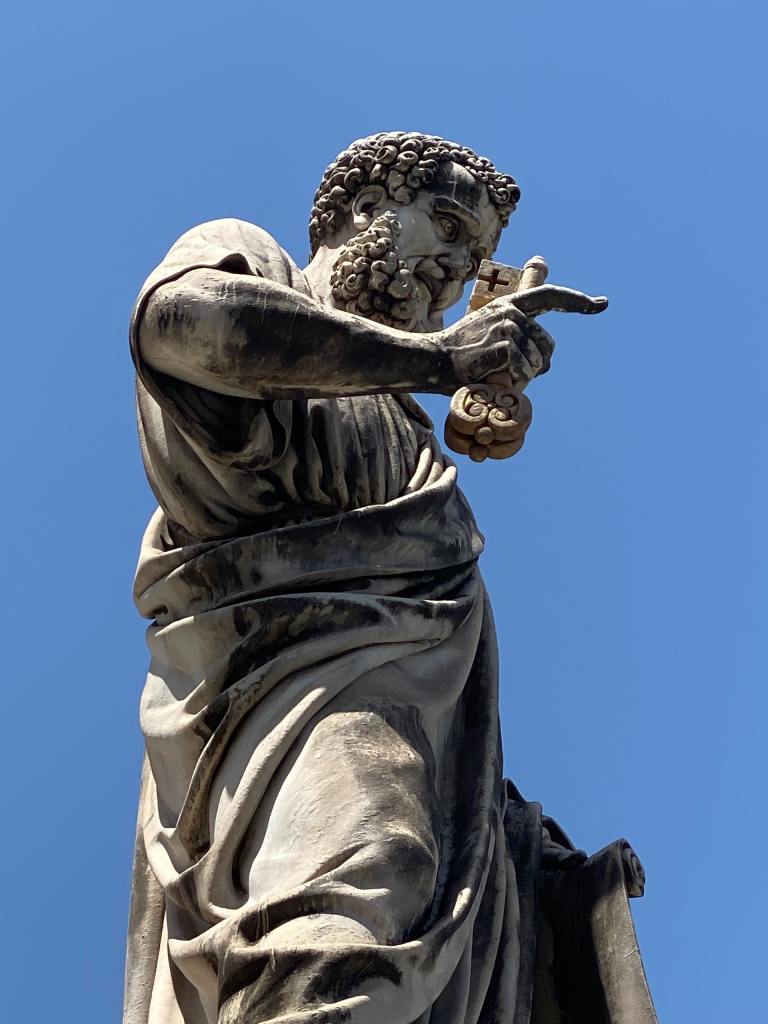
Who is the Apostle Peter?

Dear fellow travelers,

Recently, I began facilitating a study of the apostle Peter with a small group at my church.  In the first meeting, we brainstormed whatever words or phrases came to mind when we thought of Peter.  No right or wrong answers, just whatever came to mind.  Here’s what ended up on the whiteboard:

ImpulsiveDenied Jesus 3 times
Man of actionBold
FishermanMarried
RockAndrew’s brother
Author of 2 EpistlesApostle to the Jews
Jesus’ right-hand manTight with John and James
Seen as commonPrejudiced
Rebuked as “Satan” by JesusFearless
Preached at PentecostBoastful
Walked on waterHelped write Mark
FaithfulHumble
Vocal & Decisive, often before thinkingConfident
Cut off Malchus’ earLearns from mistakes

One of the reasons Peter is so interesting to study is that he’s clearly as full of contradictions and spiritual immaturity as anyone is.  There are plenty of struggles and times of growth for us to identify with.  Few New Testament personalities, other than Jesus, are so fully revealed for all to see.  He’s a fellow traveler along with us as we strive to follow Jesus.

What words or phrases would you use to describe Peter?  What do you identify with from the above list?

As our study of Peter progresses, I’ll be summarizing some of it here, with the next one covering Jesus’ call of Simon, who became Peter.

What You Have Forgotten Today He Can Supply

The Gospel of Mark records two miraculous feedings of multitudes.  The first was mainly a Jewish crowd of about 5,000 in Mark 6:30-44; the second was a mainly Gentile group of about 4,000 in Mark 8:1-9.  These two stories are very well known, but if you read on Mark adds this about Jesus’ disciples in 8:14 – “Now they had forgotten to bring bread, and they had only one loaf with them in the boat.

On this verse Warren Wiersbe remarks: “It must have grieved Jesus that His hand-picked helpers were so spiritually obtuse. The fact that He had multiplied bread on two occasions and fed over ten thousand people had apparently made little impression on them! Why worry and argue over one loaf of bread when you have Jesus in the boat with you?”[1]

When well-known Bible stories have little impact on us, remember that these disciples knew the story even better than we do – they were there!  Jesus did not give up on them and will not give up on us.

Have you forgotten to trust Jesus with something today?  He desires to be “in the boat with you” in constant fellowship.  Ask Him to take your anxiety and to supply your daily bread.  He never forgets.


[1] Wiersbe, Warren.  Be Diligent (Mark) (1987).  P. 97.

God Offers More Than Bread and Circuses

Fans of the dystopian Hunger Games novels and movies know that the story takes place in a country called Panem.  There, the extravagantly wealthy Capitol district holds an annual, televised battle royale, The Hunger Games, where children from each of the 12 desperately poor districts fight to the death until there is only one remaining.  The purpose of these demented Games is to remind the people of the power of the Capitol, but also to provide entertainment.  But why is the country called Panem?

Panem is likely a reference to the Latin phrase “panem et circenses,” or “bread and circuses,” which “means to generate public approval, not by excellence in public service or public policy, but by diversion, distraction, or by satisfying the most immediate or base requirements of a populace, by offering a palliative: for example food (bread) or entertainment (circuses).”[1]  Under this way of thinking, for a government to remain in power it needs to provide the basic needs of its people.  For an especially cynical government, it would mean they need only provide just enough bread and just enough circuses to keep the population from overthrowing them.

The Colosseum in Rome – a site of ancient “circuses.” Photo by Federico Di Dio photography on Unsplash

In the case of The Hunger Games, the Capitol reminded the other districts that they could have no bread (panem) without the Capitol’s “benevolence,” and that the only entertainment (circuses) they get is to watch their children kill each other.  Talk about a government providing the very bare minimum!

The Hunger Games is obviously an extreme example, but fortunately, Christianity offers a better answer than just the bare minimum of “panem et circenses.”   What benefits does it offer?  Psalm 103 in the Bible begins in the first 2 verses with a call to:

Bless the LORD, O my soul,
            and all that is within me,
            bless his holy name!
Bless the LORD, O my soul,
            and forget not all his benefits

And what are these benefits?  Is it just more “bread and circuses”?  It is, as verses 3-5 tell us that the Lord is the one:

who forgives all your iniquity,
            who heals all your diseases,
who redeems your life from the pit,
            who crowns you with steadfast love and mercy,
who satisfies you with good
            so that your youth is renewed like the eagle’s.”

This Psalm says He can take care of both our spiritual and physical maladies.  Jesus performed many miracles, so we “may know that the Son of Man has authority on earth to forgive sins,”[2] solving our spiritual alienation from God and each other.  Likewise, the body’s diseases do not heal magically or by chance; they heal because God created us with that ability.  He is the Great Physician.[3]

Also, He is the One who can save us “from the pit” – from ourselves and the punishment that our sin deserves, replacing our banishment from God’s presence with “love and mercy.”  He is the One who has the perspective needed to define what is good, and as our Maker, knows what we need to thrive and be renewed.  He offers many benefits we cannot find anywhere else.

Not just the fictional Panem, but all the nations of the real world, have nothing to offer but varying degrees of bread and circuses, various diversions and distractions and palliatives.  No government in the world can provide the benefits God provides – those listed in Psalm 103 – and therefore only God offers what can truly satisfy.  Therefore,

“Bless the LORD, O my soul,
            and forget not all his benefits


[1] https://en.wikipedia.org/wiki/Bread_and_circuses
[2] Matthew 9:6, Mark 2:20, Luke 5:24
[3] Matthew 9:12, Mark 2:17, Luke 5:31

Religion That Epitomizes Love for God and Neighbor

What is religion?  In the Bible we get one definition from James 1:27, which says: “Religion that is pure and undefiled before God the Father is this: to visit orphans and widows in their affliction, and to keep oneself unstained from the world.”  This may sound like a nice sentiment for a Hallmark card instead of a religion, but James was not resorting to hyperbole for mere effect.  He meant what he said, but what does he mean?

Photo by Robert Guss on Unsplash

Jesus Himself said that to love God and to love your neighbor were the greatest commandments, in a way the highest form of religion, so James is probably using “to visit orphans and widows in their affliction” as the purest, most undefiled form of love.  In James’ time, orphans and widows were the people genuinely unloved by the world – the ones who fell through the cracks of society.  Not only were they without a husband or parents, but society was not providing for them either and they were truly abandoned “in their affliction.”  Anyone caring for them would get no credit or recognition for it.  Therefore, the only motive for visiting them is love for them.  Pure love, with no impurity or stain from a desire to get something in return.

James specifically refers to “God the Father,” who has always taken His own, and His people’s, responsibility to widows and orphans seriously.  He wants to take care of them, but Psalm 94:6-7 says about the rulers of the nations, including Israel: “They kill the widow and the sojourner, and murder the fatherless; and they say, ‘The LORD does not see; the God of Jacob does not perceive.’”  They preyed on those nobody cared about, and also boasted that not even God cared.

When any group of people – even one with God’s institutions of His law, temple, priests, prophets, and kings ruling the literal promised land – neglects the oppressed, their religion is impure and defiled.  All institutions – including ones provided by God – are useless outside of God’s purpose for them.  The temple was a way to approach God by sacrifice, foreshadowing Jesus’ death on the cross, but Judah used it as a way to appease Him so they could do their own thing.  Jeremiah criticized the religious leaders of his day, who thought they were free from judgement, repeating “This is the temple of the LORD, the temple of the LORD, the temple of the LORD,”[1] treating the temple as more important than God Himself and a reason God would always bless them.  However, God doesn’t want us to follow a checklist of religious observance – He wants us to be His loving family.

Because they replaced love with empty religion, Israel was cast into exile under the Babylonians, and Jeremiah cries in Lamentations 5:3 that “We have become orphans, fatherless; our mothers are like widows.”  Perhaps God would teach compassion to His people through painful discipline and experience, having to live like those they ignored.

Unstained
Visiting widows and orphans keeps one unstained from the world when society thinks it’s ok to leave some behind.  That it’s ok to think we can’t do any better and that God doesn’t see, and that He doesn’t have an answer for it.  That if we follow the letter of the law, or rely on institutions, but not on the spirit of love, God will just look the other way because we tried our best.

Therefore, don’t visit widows and orphans because its popular, because a law tells you to, or for any reason besides Godly love, because when we mix in worldly motives, we risk loving only those who are popular to love or who our government and culture have put in favored positions.  Maybe we even reduce love to a comment about distant people trending on social media at the time, and not those individuals who are actually suffering the most.  These people are often right in front of us.

It is by ministering to specific widows and orphans in their need that the Christian retains the preservative power of salt and the illuminating power of light to the world.[2]  It’s not the idea, but the actual visiting that is pure and undefiled.  Me writing this and you reading this is only an idea.  But it is a beginning.

Blessed are the pure in heart, for they shall see God.
Heaven is for people who love when there’s nothing more at stake than the person being loved.  Only Jesus has met the standard of this love, but He has made a Way to Life for those willing to accept His Truth.  Jesus willingly takes our stain on the cross, and gives us His righteousness as a free gift, but only if we actually want His righteousness more than we want our stained world.  In Christ, the Father will change His people into people who care for widows and orphans.  People like that don’t need anything else to make a perfect society.  It’s loving people that make a perfect society, not rules and institutions, and certainly not good intentions that leave people behind.  Paradise will be a society that is pure, undefiled, and unstained, and where the only Institution needed is Jesus, our Prophet, Priest, and King.

No better solution exists than God the Father’s plan to build a family where everyone loves Him and loves their neighbor as themselves, and when we visit widows and orphans, we illustrate the truth that God sees them and cares for them, even when nobody else does.

Visiting widows and orphans is Religion that epitomizes love for God and neighbor.

—–

Look for more posts based on James 1:27 in the coming Saturdays.  The more I think about the verse, the more implications of it I see.  Next Up: Religion That Applies in all Places and Times.  There are always widows and orphans.


[1] Jeremiah 7:4
[2] Matthew 5:13-16