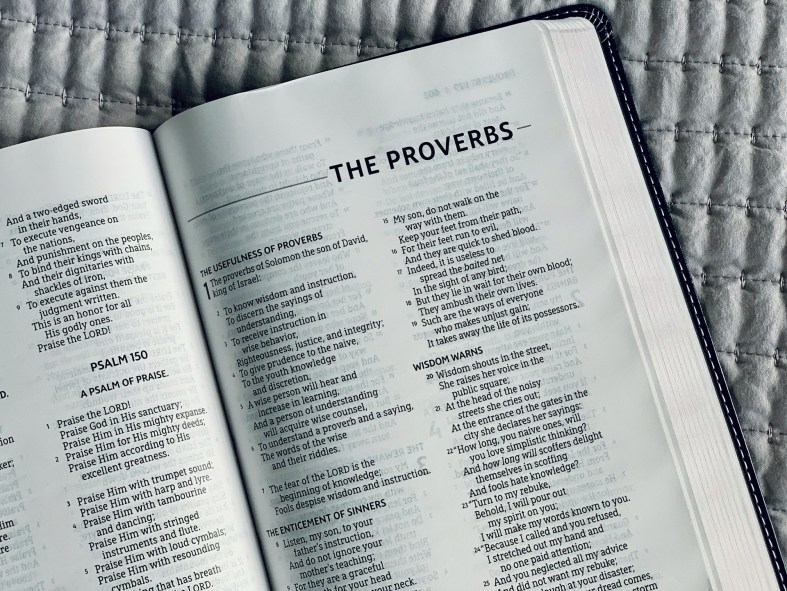
Daily Readings for March 23 – 29

Fellow travelers:

For those looking for a Bible reading plan, each week I post 2 chapters to read per day as a main reading plan, and for anyone who wants to read the whole Bible in 2026, I’ll post the extra chapters to read that week.  The main readings will include nearly all of the New Testament, plus Psalms, Proverbs, Ecclesiastes, the Prophets, and a few other Old Testament books.

Reading 3 chapters a day on weekdays and 4 on weekends almost exactly covers the 1,189 chapters of the Bible, so the “extra” readings will be about 9 chapters per week.  These readings will cover the Pentateuch, the OT histories, a few other OT books, plus Jude and Revelation from the NT.

This week the Bible in a Year plan almost finishes Leviticus.  I’m not even halfway through Exodus, but there’s a lot of time to catch up!

I hope this encourages others to read and study their Bible more, whatever parts they decide to read.  Follow along (or not) any way you choose!

2 chapter a day plan:

Monday, March 23: Psalm 82, Luke 18
Tuesday, March 24: Psalm 83, Luke 19
Wednesday, March 25: Psalm 84, Luke 20
Thursday, March 26: Psalm 85, Luke 21
Friday, March 27: Psalm 86, Luke 22
Saturday, March 28: Psalm 87, Luke 23
Sunday, March 29: Psalm 88, Luke 24

Extra chapters for those reading the whole Bible in 2026:
Leviticus 16-24

Separating Good and Evil

I like to collect quotes, and I have many favorites, but (outside of the Bible) the most influential quote to me is this one from Aleksandr Solzhenitsyn:

“The line separating good and evil passes, not through states, not between political parties either, but right through all human hearts.”

Much of the conflict in history, and in modern times, comes from a human tendency to group people into separate groups, where one is “evil”, and the other is “good.”  There are probably thousands of examples throughout history, but some that come to mind are religious categories like Catholic versus Protestant, political categories like Republican versus Democrat, or Marxist categories like “oppressed” versus “oppressor.”  Humanity follows a pattern over and over again, where we lump people into categories, then attack our enemies accordingly.  If someone belongs to the “other” group, they are evil, and if someone belongs to our own group, they are good.

In opposition to this, the Solzhenitsyn quote calls to attention Romans 3:23, which declares: “for all have sinned and fall short of the glory of God.”  This verse, and the quote, tear down the idea that people can be easily separated into “good” and “evil.”  That nations can be divided into good and evil.  That political parties can be categorized as good and evil.  Because every single person included in every single one of these categories is themselves a mix of good and evil, each of the groups themselves is a mix of good and evil.

Therefore, the quote calls us to treat people as individuals, dealing with them according to their specific situation and needs.  Without accepting that each person is imperfect (at best), societies may pretend to treat people as individuals, but they’re really stereotyping people according to their groups and pitting them in battle against each other.

For the Christian church, the quote doesn’t demand that we withdraw from politics altogether, but it does demand that we act with more compassion toward those we disagree with.  All too often, and especially on social media, we see category-based name calling and condemnation coming from Christians who categorize people and work hard to defeat those enemies that belong to other groups.

However, Jesus said in Matthew 5:43:
You have heard that it was said, ‘You shall love your neighbor and hate your enemy.’  But I say to you, love your enemies and pray for those who persecute you.

Imagine if we followed Jesus’ words.  Imagine if everyone could be humble based on the evil that lives within them, and therefore treat the people who we view as evil as equals before God, and just as in need of grace as we are.  The church, and the world, would be much better off if Christians were as good at loving their enemies as they are at identifying them.

“The line separating good and evil passes, not through states, not between political parties either, but right through all human hearts.”

Daily Readings for March 16 – 22

Fellow travelers:

For those looking for a Bible reading plan, each week in 2026 I will post 2 chapters to read per day as a main reading plan, and for anyone who wants to read the whole Bible in 2026, I’ll post the extra chapters to read that week.  The main readings will include nearly all of the New Testament, plus Psalms, Proverbs, Ecclesiastes, the Prophets, and a few other Old Testament books.

Reading 3 chapters a day on weekdays and 4 on weekends almost exactly covers the 1,189 chapters of the Bible, so the “extra” readings will be about 9 chapters per week.  These readings will cover the Pentateuch, the OT histories, a few other OT books, plus Jude and Revelation from the NT.

I hope this encourages others to read and study their Bible more, whatever parts they decide to read.  Follow along (or not) any way you choose!

2 chapter a day plan:
Monday, March 16: Psalm 75, Luke 11
Tuesday, March 17: Psalm 76, Luke 12
Wednesday, March 18: Psalm 77, Luke 13
Thursday, March 19: Psalm 78, Luke 14
Friday, March 20: Psalm 79, Luke 15
Saturday, March 21: Psalm 80, Luke 16
Sunday, March 22: Psalm 81, Luke 17

Extra chapters for those reading the whole Bible in 2026:
Leviticus 7 – 15

Daily Readings for March 9 – 15

Fellow travelers:

For those looking for a Bible reading plan, each week in 2026 I will post 2 chapters to read per day as a main reading plan, and for anyone who wants to read the whole Bible in 2026, I’ll post the extra chapters to read that week.  The main readings will include nearly all of the New Testament, plus Psalms, Proverbs, Ecclesiastes, the Prophets, and a few other Old Testament books.

Reading 3 chapters a day on weekdays and 4 on weekends almost exactly covers the 1,189 chapters of the Bible, so the “extra” readings will be about 9 chapters per week.  These readings will cover the Pentateuch, the OT histories, a few other OT books, plus Jude and Revelation from the NT.

I hope this encourages others to read and study their Bible more, whatever parts they decide to read.  Follow along (or not) any way you choose!

2 chapter a day plan:

Monday, March 9: Psalm 68, Luke 4
Tuesday, March 10: Psalm 69, Luke 5
Wednesday, March 11: Psalm 70, Luke 6
Thursday, March 12: Psalm 71, Luke 7
Friday, March 13: Psalm 72, Luke 8
Saturday, March 14: Psalm 73, Luke 9
Sunday, March 15: Psalm 74, Luke 10

Extra chapters for those reading the whole Bible in 2026:
Exodus 38 – 40, Leviticus 1-6

Faith: A Practical, Living Teacher

Photo by Thomas Somme on Unsplash

Years ago, I saw a drawing of a child suspended in the air, clutching the string of a single balloon, with the caption: “Faith isn’t faith until it’s all you’re holding on to.”  It was a very simple picture, but it made me think: Where does this kind of faith come from?  A faith that turns intellectual trust into action, especially potentially dangerous action?

One way is that we can learn it from others.  I’ve read a lot of Christian apologetics – or writings in defense of Christian faith.  Writers such as Josh McDowell and Ravi Zacharias were held in reverent awe by many in my college years, the logic being that “if someone that smart can be a Christian, it must be reasonable to believe!”  While there is definitely value in learning from others, there is also the hazard of learning to trust our teachers (instead of our Teacher).  Then when they fall, it hurts us personally and can damage our witness.  We know what ended up happening to Ravi Zacharias[1].

There is also the testimony of the Bible.  In the book of Hebrews, chapter 11 chronicles the faith of many in the Bible, and Hebrews 12:1 calls these our “cloud of witnesses.”  We can learn a lot from these people, but they don’t just teach us facts about God.  The writer of Hebrews adds that because of these witnesses, we should “lay aside every weight, and sin which clings so closely, and let us run with endurance the race that is set before us, looking to Jesus, the founder and perfecter of our faith, who for the joy that was set before him endured the cross, despising the shame, and is seated at the right hand of the throne of God.[2] He is our Lord, and these witnesses tell us to follow Him, not just be able to describe Him.

One of the best lessons on this comes from G.K. Chesterton, who is well-known for his arguments in defense of the reasonableness of Christianity.  However, near the end of his book Orthodoxy, he says that he has a better idea: “And that is this: ‘that the Christian Church in its practical relation to my soul is a living teacher, not a dead one. It not only certainly taught me yesterday, but will almost certainly teach me tomorrow.’”  Apologetics is not about winning arguments, but about growing our ability to trust Him and learning to explain that to others.

While we can learn from others and from the Bible to build up our faith, what God has done for us personally is the best testimony because it is the most real to us.  Everything else is hearsay, as they say in court.  We are all learning to let Him tell us where to go and what to do.  To discern not only His truth, but His will, in the testimony of modern apologists and in the Bible.  To make our own Ebenezers, or memorials to His faithfulness to us when we’ve acted in faith in Him, even if it meant holding on to nothing else.  Therefore:

“Oh, taste and see that the LORD is good!
Blessed is the man who takes refuge in him!” – Psalm 34:8

The best way to know that He is good is to try for ourselves, even when it’s hard or doesn’t make sense.


[1] If you don’t know, after Ravi died it was revealed that he had inappropriate relationships with massage therapists and others.  A once-influential ministry ended up in tatters, and some of Ravi’s followers ended up embarrassed and wondering what to believe.
[2] Hebrews 12:1b-2