It’s very early to write about 2024 plans, but have you ever read the Bible in a year? If you haven’t, have you ever wanted to? I’ve read, or at least listened to, all of the Bible in some years and find it a valuable practice. In addition to doing it myself in 2024, I’m considering blogging each Sunday what I plan to cover the following week in case anyone wants to follow along.
If you cover 3 chapters a day on weekdays and 4 on weekends, it almost exactly comes to the 1,189 total chapters over a full year. 2024 is a leap year, so there’s an extra day. My personal approach is to study 2-3 per day with a study bible or commentary, and just read or listen to audio for the remaining chapter. It doesn’t always work out that way, but that’s the plan.
Readers could follow along any way they want. They could just read the one chapter per day (the “PM” reading), or just the 2-3 chapters (the “AM” reading). They could use an audio Bible for all or part of it. They could swap the AM and PM times if that’s a better schedule. Everyone knows best what works for them and what they’re likely to stick with, even if it’s not the whole Bible in a year.
Daily: Mon, Jan 1: Psalm 1, 1 Samuel 1, Genesis 1 Tue, Jan 2: Psalm 2, 1 Samuel 2, Genesis 2 Wed, Jan 3: Psalm 3, 1 Samuel 3, Genesis 3 Thu, Jan 4: Psalm 4, 1 Samuel 4, Genesis 4 Fri, Jan 5: Psalm 5, 1 Samuel 5, Genesis 5 Sat, Jan 6: Psalm 6, 1 Samuel 6-7, Genesis 6 Sun, Jan 7: Psalm 7, 1 Samuel 8-9, Genesis 7
Once the Psalms, Proverbs, Ecclesiastes, and Song of Solomon are done, the AM reading would come from only one book. If anyone thinks this would be helpful, I can work up or find a schedule and make this a regular post in 2024!
October 10 is World Mental Health Day, a time to raise awareness globally about its importance. In his commentary on 2 Corinthians 1, Warren Wiersbe wrote on the subject of depression:[1]
“’You seem to imagine that I have no ups and downs, but just a level and lofty stretch of spiritual attainment with unbroken joy and equanimity. By no means! I am often perfectly wretched and everything appears most murky.’ So wrote the man who was called in his day ‘The Greatest Preacher in the English-speaking World’ – Dr. John Henry Jowett. He pastored leading churches, preached to huge congregations, and wrote books that were best sellers.
‘I am the subject of depressions of spirit so fearful that I hope none of you ever get to such extremes of wretchedness as I go to.’ Those words were spoken in a sermon by Charles Haddon Spurgeon whose marvelous ministry in London made him perhaps the greatest preacher England ever produced.”
Depression is real and is not a sign of spiritual failure, as shown by these quotes by people we might consider spiritual giants. Therefore, how should we respond? This next quote points us in a good direction:
“People don’t fake depression…they fake being ok. Remember that. Be kind.” – unknown
[1] Wiersbe, Warren. Be Encouraged (2 Corinthians) (1994).
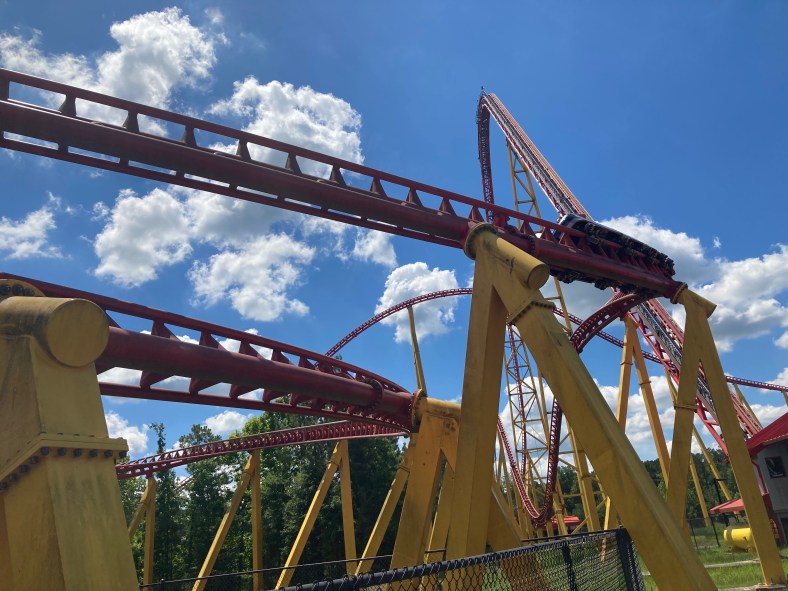
Intimidator 305 at King’s Dominion. The first hill at the top, with the following airtime hill in the middle.
My teenage son is a roller coaster enthusiast. He memorizes how tall they all are, how many inversions they each have, who the manufacturers are, how they work, and anything else he can find out. He takes lots of pictures of roller coasters, including the one I used for this post. Fortunately, I like them too. We’ve been on well over 100 different coasters together and will ride anything, but we do have slightly different tastes. Usually, he likes airtime more than I do, and I like intensity more than he does. As an enthusiast, he’s the one who told me what a greyout is: “a transient loss of vision characterized by a perceived dimming of light and color, sometimes accompanied by a loss of peripheral vision.”[1] Caused by low brain oxygen levels, a greyout can happen on roller coasters and can be a precursor to fainting.
Intimidator 305 at King’s Dominion in Virginia was my first greyout. The ride, with a 90-mph top speed on the 300-foot first drop, is themed after NASCAR driver Dale Earnhardt, whose nickname was “The Intimidator.” At the bottom of that first drop, the track banks into a 270-degree turn to the right, and the first time on it, the edges of my vision began to fade as blood rushed to my legs and feet. I felt the intensity rising, and my field of vision gradually narrowed into a small pinpoint, and I nervously tensed up. However, before I knew it, I was fine and back to enjoying the ride.
After we got off, I mentioned my greyout and my enthusiast son explained why I recovered so quickly. It was no accident. Intimidator 305 was designed by people who knew what the ride would do to people, so after the 270-degree turn, there is a 150-foot airtime hill. As the train comes up this hill, the track bends down at a lower angle than the train would go on its own momentum, which not only gives riders “airtime” as they feel weightless, but also gives a rush of blood to the brain. So, by design, I experienced greyout, followed by an amazingly quick return to normal, without fainting.
What’s the spiritual lesson in this? There are times where our lives feel like we’re in that disorienting 270-degree turn at 90 mph. Our awareness narrows to where we can only see the problems in front of us and our body begins to feel stress. In some cases, the stress itself might become the only thing we can see, having forgotten what caused it. That intense turn can seem like it will never end, and we can’t see the relief ahead of us. Sometimes it comes after a great success, perhaps right after the thrill of dropping down a hill at high speed…Or perhaps after experiencing a miracle. Peter had such faith that he walked on water, “But when he saw the wind, he was afraid, and beginning to sink he cried out, ‘Lord, save me.’”[2] Even Apostles felt hopeless sometimes.
Like Peter, when we cry out “Lord, save me” we may need a reminder of 1 Corinthians 10:13, where Paul wrote: “No temptation has overtaken you that is not common to man. God is faithful, and He will not let you be tempted beyond your ability, but with the temptation he will also provide the way of escape, that you may be able to endure it.”
We may need a reminder from a Christian enthusiast, or maybe from our Father Himself, that we have a way of escape by design. After every sharp turn we think will never end is a refreshing moment where we feel weightless, held by our Lord in His loving embrace. In Peter’s case, “Jesus immediately reached out his hand and took hold of him, saying to him, ‘O you of little faith, why did you doubt?’ And when they got into the boat, the wind ceased.”[3] In the Father’s wisdom, relief will not always be immediate – it may take longer than we expect, but it is inevitable because He promises it.
That day, we rode Intimidator 305 three more times and every time I wasn’t as worried about the greyout because I knew that airtime hill was coming. It’s now one of my favorites. Thankfully, our lives also are in the hands of a Designer who knows how to teach us to trust Him, and also how to heal us when life’s troubles feel like they’re going to knock us out.
In the holiday classic It’s a Wonderful Life, Jimmy Stewart’s character George Bailey gets an opportunity to see what the world would be like if he never existed, and it’s not good. George had a big impact on his community and the people around him, but the broader point of the movie is that if any of us were missing, there would be a gaping hole where we should be.
At the beginning of the book of Romans, Paul introduces himself as: “Paul, a servant of Christ Jesus, called to be an apostle, set apart for the gospel of God”[1] Most of his letters start this way.
Imagine if Paul had not been called to be an apostle, or written Romans. There would be a hole where Romans should be, and the same is true of work for God that anyone leaves undone. We may not be George Bailey or Paul, but everyone has a role in the church and the world by the will of God. We are not called to be apostles as Paul was, but we are all called to something.





 Driving Toward the Morning Sun