John the Baptist announced the coming of Jesus, baptized Him, and led the way for His ministry to begin. This John was identified with “The voice of one crying in the wilderness: ‘Prepare the way of the Lord; make his paths straight’”[1] prophesied in Isaiah 40:3-5, which says:
“A voice cries: ‘In the wilderness prepare the way of the LORD; make straight in the desert a highway for our God. Every valley shall be lifted up, and every mountain and hill be made low; the uneven ground shall become level, and the rough places a plain. And the glory of the LORD shall be revealed, and all flesh shall see it together, for the mouth of the LORD has spoken.’”
Is Isaiah talking about a massive, miraculous geological event, creating an easier route for Jesus to take to His kingdom? Perhaps in the future something like this will happen, but I think Isaiah is saying that God’s power over nature is a symbol of His power to reform and perfect us into the character of His Son Jesus.
Before Jesus comes into our lives, we are a spiritual wilderness full of uneven ground and rough places. The path of our salvation begins in this wilderness, an unorganized chaos of thoughts and desires. We are like “children, tossed to and fro by the waves and carried about by every wind of doctrine, by human cunning, by craftiness in deceitful schemes.” However, the power of the LORD enters our low valleys – our guilty secrets, shame and depression – which will be raised up. It progresses through our mountains and hills – areas of pride, self-sufficiency, and our desire for power – which will be made low. God, with the same power that created the universe, removes all obstacles to the coming of His kingdom to us, and to the world. He has given us His word, His Spirit, and fellow believers to strengthen us, “until we all attain to the unity of the faith and of the knowledge of the Son of God, to mature manhood, to the measure of the stature of the fullness of Christ, so that we may no longer be children, tossed to and fro by the waves and carried about by every wind of doctrine, by human cunning, by craftiness in deceitful schemes.” (Ephesians 4:13-14)
John the Baptist called his followers to confession and repentance. In announcing the coming of the kingdom of God, John anticipated a time when our internal and external wildernesses will become a paradise. Until then, we each have different hills and valleys, different uneven and rough areas. Until then, the world remains full of false doctrine, cunning, craftiness and deceit.
Today, pray that the powerful voice of our LORD will reach into your wilderness and remove obstacles on the path to His kingdom. Pray that His word and His Spirit will reveal His glory. Pray that all believers will answer the call of “the voice of one crying in the wilderness” to build up His church.
The Covid-19 pandemic had many effects, one of which became known as the “Great Resignation,” a massive cultural shift in attitudes toward work and the workplace. Many were finding less satisfaction and purpose in their vocation, and either quit or became less motivated, leading to another catchphrase: “Quiet Quitting.” Of those who actually quit, some did because they were able to retire early, some quit to move to a workplace that provided a sense of purpose beyond their job description and the paycheck it provides, and some quit for various other reasons. In response, some workplaces took stances on political or social issues not related to their business to attract those looking for purpose, which attracted some workers, but also alienated others, who might have become Quiet Quitters.
With so many changes happening, some Christians may feel increasingly like they are in exile at their workplace, but in truth, Christians everywhere were in exile in their workplace pre-pandemic and pre-Great Resignation. This world is not our home, including where we work, so don’t expect it to be heaven.
When Judah found itself exiled in Babylon in the Old Testament, the prophet Jeremiah encouraged them in Jeremiah 29:7 – “But seek the welfare of the city where I have sent you into exile, and pray to the LORD on its behalf, for in its welfare you will find your welfare.” So, whatever workplace we find ourselves in, God has called us to seek the welfare of those around us, and pray for them, for in doing so we will find our welfare. Even if we eventually intend to leave, we must seek the welfare of our companies and coworkers while there. (When we are retired or not working with an employer, then we should seek the welfare of our families and communities.)
Similarly, in 1 Corinthians 7:17 & 23-24, Paul encouraged the Corinthian church to serve God in the place they are:
“Only let each person lead the life that the Lord has assigned to him, and to which God has called him. This is my rule in all the churches…You were bought with a price; do not become bondservants of men. So, brothers, in whatever condition each was called, there let him remain with God.”
God has called us to our specific workplaces, not as servants of our employers, but as servants of Him. Maybe there needs to be another cultural shift in the workplace – “The Great Consecration” – where we dedicate our work, whatever it is, to God. Even if your employer doesn’t seem to care, or pay more for, harder work or higher quality work, the Lord notices and He is who we should care about pleasing.
As Paul wrote to the church in Colossae: “Whatever you do, work heartily, as for the Lord and not for men, knowing that from the Lord you will receive the inheritance as your reward. You are serving the Lord Christ.” – Colossians 3:23-24
If Christianity is a message of salvation to all people, in all times and places, then the religious practices it recommends must be broad enough, and also flexible enough, to apply in every situation. The political and cultural societies we each live in today have only existed for a blink of an eye in the grand scheme of history, and people reading this post may be living in societies entirely different from the one I’m writing this in.
What are these religious practices? When the apostle James wrote in James 1:27 – “Religion that is pure and undefiled before God the Father is this: to visit orphans and widows in their affliction, and to keep oneself unstained from the world” he didn’t just mean “pure and undefiled” right here and right now, but that to an eternal God whose character doesn’t change, there is a religion that remains pure and undefiled in all circumstances. There is no expiration date or limited jurisdiction on James 1:27.
To apply James’ words that way doesn’t mean he was using “orphans and widows” only as a metaphor for something other than actual orphans. He does mean to take care of them. But he was also using them as the best example of people unloved in his society and by the world – the ones who fell through the cracks of society, and that “to keep oneself unstained from the world” means that pure religion leaves nobody behind the way the world does.
The world has many people who believe perfect society is only a matter of time, effort, and ingenuity, and it also has many people whose very existence shows the folly of that belief. This tension reflects human history all the way back to Adam and Eve, who had to decide whether the kingdom of God they already lived in was what they wanted, or whether they wanted to build a kingdom based on their own ideas. This tension existed when Jesus ministered on earth in the Pax Romana, or “Roman Peace” of the society He lived in. The Caesars declared in what they called “gospel,” or “good news,” messages that they should be revered as gods for producing the most peaceful and prosperous society the world had ever known. But when Jesus came, all He had to do was walk down the street – any street – and find problems not being solved in Caesar’s great empire. [1] Jesus didn’t shake his fist at the utopians in protest, He just loved those in need of love, exposing the immensity of the flaws that exist in any human system, and proving by example that His kingdom is better.
WWJD
So, when James says “visit orphans and widows in their affliction” he means to do as Jesus did – to seek out and care for those left behind by the utopian imaginings of the world, and its related denials that these abandoned people matter. This does include literal windows and orphans, but it’s also whoever is left behind in your area of the world. The people in your neighborhood, country, organization, or even your church that the system doesn’t notice because there is nothing worldly to be gained by noticing them. In Jesus’ eyes, even Zacchaeus, a wealthy Jew in a Jewish society that valued wealth, was one of “the lost sheep of the house of Israel” because nobody saw him as a person with a personal and spiritual need.[2] These “lost sheep” Jesus referred to in Matthew 10:6 and 15:24 need to know “the kingdom of heaven is at hand”[3] because this world’s kingdoms have failed them.
Each and every world system leaves some behind, proof that Adam and Eve made the wrong decision to go their own way. There are always those who it is unpopular or uncool to pay attention to, even in churches. Therefore, James calls us to love the unloved and the genuinely oppressed, whoever they are, wherever you are. By definition, there’s no program to reach these people, because they are the ones who were missed. It takes the actions of individual, loving people to reach them and that’s kind of the point. Christianity is about the restoring of people and relationships, not the building of theoretical systems.
But does this really apply in every time? How is the ethic of James 1:27 eternal, while other ethics are not?
At the risk of oversimplifying (inevitable in a blog!), the difference is that worldly ethics depend entirely on “progress” toward a solution that is theoretical and in the future. Those pursuing worldly utopia hope they will progress to a solution for the orphans and widows’ problem, but what about the widows and orphans of the past? Or right now? In a framework of Darwinian evolution, death is just part of the process and an inevitable circumstance we must accept until we find a solution. Death itself is Darwin’s philosophical orphan and widow they don’t want us to notice. A solution in the future has no real hope for people in the past or present.
In Christianity the solution already exists – it was available even to our first ancestors – and death is only the result of refusing to accept it. And in all times places and situations “love God and love neighbor” is the right ethic, epitomized by James 1:27 and to be consummated in Heaven. All those who have ever turned to God and accepted His solution, in the past, present, and future, will see His salvation. We don’t have to hope that someday our children, or their children, and so on, will be loved, and know love, perfectly.
Until mankind actually produces a utopia, it is unscientific to believe utopia is possible, but because Jesus exists and walked among us, it is scientific to say perfect love is possible, even in this world. From this perspective, Christianity is only horrendous if false; other systems are horrendous if true.
Today you may live in the greatest empire the world has ever known, or the worst tyrannical state, or you may live in a country most people on the world couldn’t find on a map. In every case, and all cases in between, there are orphans and widows among you because only the kingdom of God is a perfect solution, and it will only be fully realized in Heaven. Find them in their affliction and visit them, “And proclaim as you go, saying, ‘The kingdom of heaven is at hand.’” – Matthew 10:7
This is the 2nd post in a series on James 1:27, which began here.
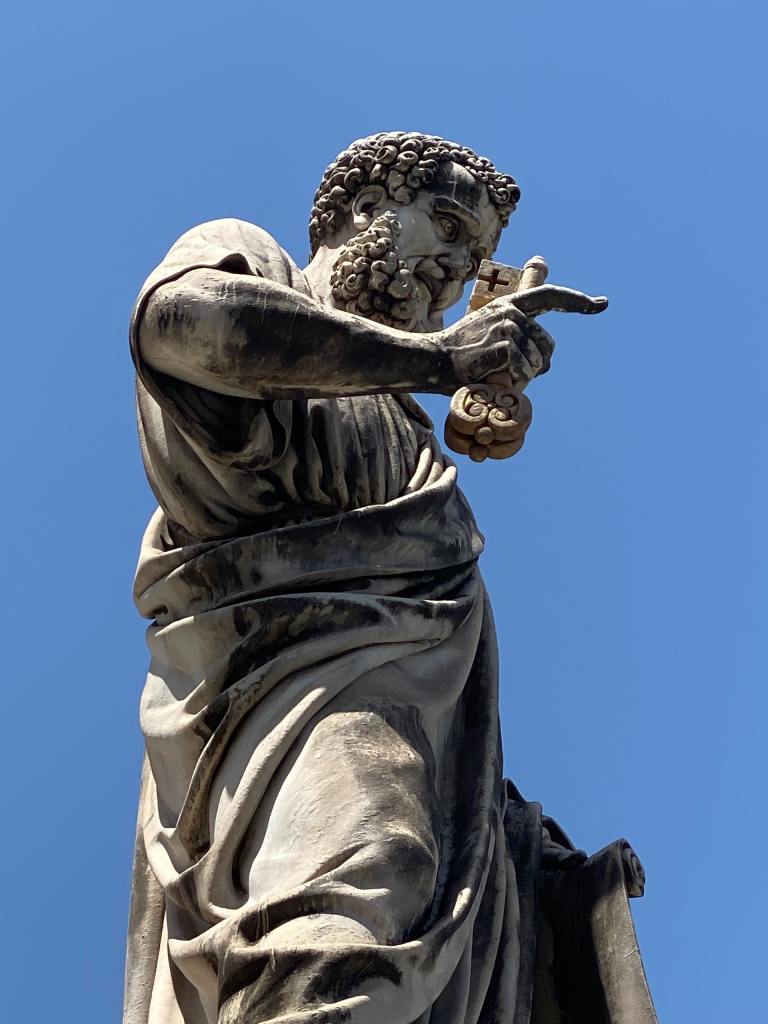
Recently, I began facilitating a study of the apostle Peter with a small group at my church. In the first meeting, we brainstormed whatever words or phrases came to mind when we thought of Peter. No right or wrong answers, just whatever came to mind. Here’s what ended up on the whiteboard:
Impulsive
Denied Jesus 3 times
Man of action
Bold
Fisherman
Married
Rock
Andrew’s brother
Author of 2 Epistles
Apostle to the Jews
Jesus’ right-hand man
Tight with John and James
Seen as common
Prejudiced
Rebuked as “Satan” by Jesus
Fearless
Preached at Pentecost
Boastful
Walked on water
Helped write Mark
Faithful
Humble
Vocal & Decisive, often before thinking
Confident
Cut off Malchus’ ear
Learns from mistakes
One of the reasons Peter is so interesting to study is that he’s clearly as full of contradictions and spiritual immaturity as anyone is. There are plenty of struggles and times of growth for us to identify with. Few New Testament personalities, other than Jesus, are so fully revealed for all to see. He’s a fellow traveler along with us as we strive to follow Jesus.
What words or phrases would you use to describe Peter? What do you identify with from the above list?
As our study of Peter progresses, I’ll be summarizing some of it here, with the next one covering Jesus’ call of Simon, who became Peter.
The Gospel of Mark records two miraculous feedings of multitudes. The first was mainly a Jewish crowd of about 5,000 in Mark 6:30-44; the second was a mainly Gentile group of about 4,000 in Mark 8:1-9. These two stories are very well known, but if you read on Mark adds this about Jesus’ disciples in 8:14 – “Now they had forgotten to bring bread, and they had only one loaf with them in the boat.”
On this verse Warren Wiersbe remarks: “It must have grieved Jesus that His hand-picked helpers were so spiritually obtuse. The fact that He had multiplied bread on two occasions and fed over ten thousand people had apparently made little impression on them! Why worry and argue over one loaf of bread when you have Jesus in the boat with you?”[1]
When well-known Bible stories have little impact on us, remember that these disciples knew the story even better than we do – they were there! Jesus did not give up on them and will not give up on us.
Have you forgotten to trust Jesus with something today? He desires to be “in the boat with you” in constant fellowship. Ask Him to take your anxiety and to supply your daily bread. He never forgets.
[1] Wiersbe, Warren. Be Diligent (Mark) (1987). P. 97.







 Driving Toward the Morning Sun