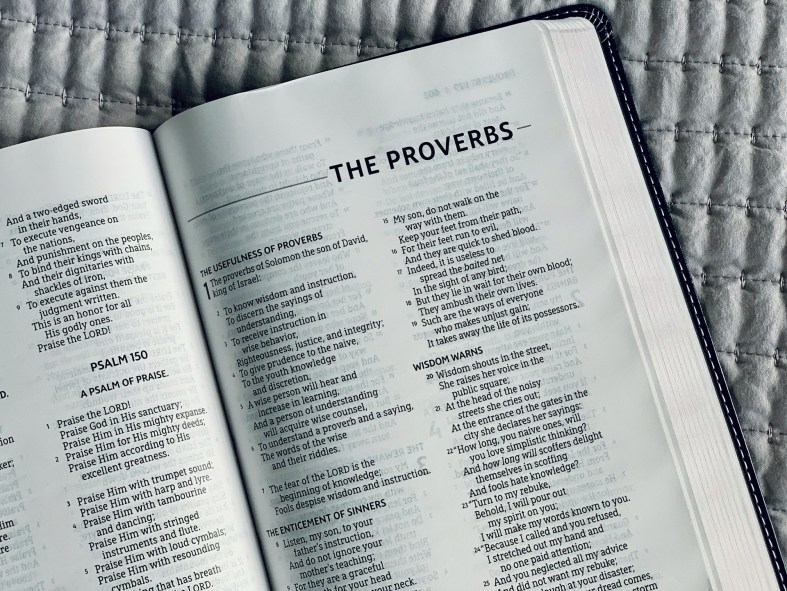
For those looking for a Bible reading plan, each week I post 2 chapters to read per day as a main reading plan, and for anyone who wants to read the whole Bible in 2026, I’ll post the extra chapters to read that week. The main readings will include nearly all of the New Testament, plus Psalms, Proverbs, Ecclesiastes, the Prophets, and a few other Old Testament books.
Reading 3 chapters a day on weekdays and 4 on weekends almost exactly covers the 1,189 chapters of the Bible, so the “extra” readings will be about 9 chapters per week. These readings will cover the Pentateuch, the OT histories, a few other OT books, plus Jude and Revelation from the NT.
Regardless, I hope this schedule encourages others to read and study their Bible more, whatever parts they decide to read. Follow along (or not) any way you choose!
2 chapter a day plan: Monday, June 29: Proverbs 30, Acts 25 Tuesday, June 30: Proverbs 31, Acts 26 Wednesday, July 1: Acts 27 – 28 Thursday, July 2: Joel 1 – 2 Friday, July 3: Joel 3, Amos 1 Saturday, July 4: Amos 2 – 3 Sunday, July 5: Amos 4 – 5
Extra chapters for those reading the whole Bible in 2026: Judges 21, 1 Samuel 1 – 8
The Old Testament prophet Jeremiah lived in a time full of false prophets, where the true word of God was rarely heard. It was also a time where idolatry and sin ran wild among the people of Judah, Jeremiah’s audience, a nation headed for destruction by Babylon, God’s chosen agent to discipline them. Yet the false prophets told the people: “You shall not see the sword, nor shall you have famine, but I will give you assured peace in this place.’”[1] Later, “They say continually to those who despise the word of the LORD, ‘It shall be well with you’; and to everyone who stubbornly follows his own heart, they say, ‘No disaster shall come upon you.’”[2]
These false prophets were essentially telling the people they can do whatever they want, so they don’t need a savior since God was not going to judge them. The false prophets also said that the people don’t need God as Lord, since there would be no negative consequences no matter what they chose to do.
Jeremiah fearlessly confronts these prophets and worked hard to get the people to take him seriously. At one point, God tells Jeremiah to proclaim: “Am I a God at hand, declares the LORD, and not a God far away?”[3] With this question, the LORD lets the people know that they can’t just set him aside as if He doesn’t exist. While God is a God of love, He is also a God of justice, and sin will not be ignored.
Both the Old and New Testaments warn that those who ignore God can infect the broader population. In Deuteronomy 29:18-19, Moses wrote: “Beware lest there be among you a man or woman or clan or tribe whose heart is turning away today from the LORD our God to go and serve the gods of those nations. Beware lest there be among you a root bearing poisonous and bitter fruit, one who, when he hears the words of this sworn covenant, blesses himself in his heart, saying, ‘I shall be safe, though I walk in the stubbornness of my heart.’ This will lead to the sweeping away of moist and dry alike.” [emphasis mine]. The whole church, the “moist and dry alike” can suffer from the influence of members who cast God aside as irrelevant or inconvenient. People who stubbornly insist on their own way.
The New Testament picks up the “root” image from Deuteronomy in Hebrews 12:15 – “See to it that no one fails to obtain the grace of God; that no “root of bitterness” springs up and causes trouble, and by it many become defiled”. This verse is in the context of God’s discipline, of understanding that when He judges His own people, it is not a final judgement, but one that is meant to refine them and make them holy. But it is also a reminder that we need to accept God as Lord, by His grace, in order for Him to be our Savior.
Like the false prophets of Jeremiah’s day, modern preachers can also teach that we don’t need Jesus as Lord and Savior. Some of them declare that we are free to do whatever we want because He is a God of love and therefore will never judge us no matter what. These ministers fail to see God’s loving, disciplining hand in our difficulties, feeding the “root of bitterness”.
Other preachers declare that God is a God of love, and therefore if we follow Him, we will be showered with blessings. These ministers see suffering not as discipline, but as a failure on our part to love God, thus making God’s love conditional. This also feeds the “root of bitterness” because there is no way we can meet God’s standard. We will always fall short and without grace all we can experience is frustration. There will never be enough material blessing to keep us satisfied under this theology.
However, we do need Jesus as Savior, and we do need Jesus as Lord, and we also have Jesus as Savior and Lord. We need to live like God is “at hand” and not “far away.” R.C. Sproul used to say Christians need to live “coram Deo” which means “before the face of God” in Latin. Always knowing that we live in God’s presence, that He is “at hand” reminds us not only of our need for Him as Lord and Savior, but also that He more than meets our need because He is a perfect Lord and Savior.
So, when Jeremiah tells us that God asks, “Am I a God at hand, declares the LORD, and not a God far away?” we can reply that we know we always live coram Deo because He is near. Only then can we pull up bitterness by its roots and experience true joy in His presence.
Mahatma Gandhi apparently said this: “I like your Christ; I do not like your Christians. Your Christians are so unlike your Christ.” Unfortunately, sometimes I think he had a point. For example, someone I know with diabetes was told by members of their church that it happened because he was such a sinner. What? It’s shameful that church members would treat the unfortunate this way, but it happens, and it is one of the most inappropriate and discouraging things I can imagine.
In this post, I’ll share 2 examples from the Gospels that show Jesus would never speak, or even think, this way. In fact, His attitude was almost the exact opposite.
The first story comes from John 9:1-7, which says:
“As he passed by, he saw a man blind from birth. And his disciples asked him, “Rabbi, who sinned, this man or his parents, that he was born blind?” Jesus answered, “It was not that this man sinned, or his parents, but that the works of God might be displayed in him. We must work the works of him who sent me while it is day; night is coming, when no one can work. As long as I am in the world, I am the light of the world.” Having said these things, he spit on the ground and made mud with the saliva. Then he anointed the man’s eyes with the mud and said to him, “Go, wash in the pool of Siloam” (which means Sent). So he went and washed and came back seeing.”
This example is relevant to my story about the diabetic because the disciples in the story are making the same connection between a person’s specific sin and their specific illness that the people talking about the diabetic made. Jesus gave a surprising answer to why the man was born blind – to glorify God by showing His healing power. Although people are too often hasty to assign blame, Jesus’ answer shows that there’s an alternative to drawing a straight line from specific sins to specific problems. And interestingly, the answer could apply to any disabled or sick person: all sicknesses will be gone in paradise, and God will be glorified by all of it. Illness is not evidence of sin; there could be other causes.
Another story comes from Luke 13:1-5, which says:
“There were some present at that very time who told him about the Galileans whose blood Pilate had mingled with their sacrifices. And he answered them, “Do you think that these Galileans were worse sinners than all the other Galileans, because they suffered in this way? No, I tell you; but unless you repent, you will all likewise perish. Or those eighteen on whom the tower in Siloam fell and killed them: do you think that they were worse offenders than all the others who lived in Jerusalem? No, I tell you; but unless you repent, you will all likewise perish.””
In this story, Jesus is questioning the assumption that very bad things happen to very bad people, and that if something very bad happens to you, you must be a very bad person. The lesson Jesus is illustrating is that we should never think that the punishment of other sinners should be worse than the punishment we deserve ourselves. Put another way, if we think someone was punished with diabetes because of their sin, what makes someone think they don’t also deserve diabetes (or worse)?
As John Calvin wrote in his commentary on this story:
“This passage is highly useful, were it for no other reason than that this disease is almost natural to us, to be too rigorous and severe in judging of others, and too much disposed to flatter our own faults. The consequence is, that we not only censure with excessive severity the offenses of our brethren; but whenever they meet with any calamity, we condemn them as wicked and reprobate persons.”
Or as the late pastor and author James Boice said about the story:
“We are asking the wrong question. We are saying, ‘God, how could you let this happen to them?’ When the real question should be, ‘God, why hasn’t it happened to me? Why am I still living, sinner that I am?’”
Whether a person suffers calamity or doesn’t isn’t because of anyone’s righteousness, and Jesus doesn’t offer us an explanation about why. He doesn’t have to. Instead, he said “unless you repent, you will all likewise perish”, and implied that one of the things to repent of is thinking that others are “worse sinners” than we are.
Some people who appear righteous end up suffering terribly in this world, while some who are flagrant sinners live prosperous lives. Which brings me to another quote by our Lord Jesus, from Matthew 9:12b-13.
“Those who are well have no need of a physician, but those who are sick. Go and learn what this means: ‘I desire mercy, and not sacrifice.’ For I came not to call the righteous, but sinners.”
Jesus showed mercy to those who are sick, both physically and spiritually, and so should all of His people. Jesus went out of His way to seek and love the sick and the lost, and so should we.
The Apostle Paul wrote an amazing contrast in 2 Corinthians 4:16-18, which says:
“So we do not lose heart. Though our outer self is wasting away, our inner self is being renewed day by day. For this light momentary affliction is preparing for us an eternal weight of glory beyond all comparison, as we look not to the things that are seen but to the things that are unseen. For the things that are seen are transient, but the things that are unseen are eternal.”
On the one hand, there are things that are transient, described as: outer, wasting away, light, momentary, affliction, and seen.
On the other hand, what is eternal is: inner, being renewed, weighty, glorious, beyond all comparison, and unseen.
These things are part of each of us, but what is eternal matters infinitely more than the other. Don’t confuse the two, or you may lose heart because Paul earlier assured us in verse 14 that “he who raised the Lord Jesus will raise us also with Jesus and bring us with you into his presence.” At that time, only what is eternal will remain.
40 years after God first made a covenant with Israel, promising to be their God and bless them if they would love and obey Him, the covenant had to be renewed. Israel had been led through wilderness for decades after refusing to enter the Promised Land, but Moses eventually gathered them again to finally cross the Jordan River and take the Land. Moses prepared them by renewing the covenant, but before that, Moses reviewed blessings and curses from God that would come with obedience or disobedience.
We know that “all have sinned and fall short of the glory of God,”[1] and therefore any blessing is an act of grace because only Jesus lived a life of full obedience. However, the choices of the ancient Israelites, and modern people, have consequences, and these blessings and curses carry a lesson about God’s sovereignty. God would not make promises or threats that He is unable to carry out and therefore He must have the power and control to deliver on all of them. Consider these parallel verses in Deuteronomy 28 showing God’s control over…
…all places, rural or urban: “Blessed shall you be in the city, and blessed shall you be in the field.” (verse 3) “Cursed shall you be in the city, and cursed shall you be in the field.” (verse 16)
…reproductive and agricultural success: “Blessed shall be the fruit of your womb and the fruit of your ground and the fruit of your cattle, the increase of your herds and the young of your flock.” (verse 4) “Cursed shall be the fruit of your womb and the fruit of your ground, the increase of your herds and the young of your flock.” (verse 18)
…military success: “The LORD will cause your enemies who rise against you to be defeated before you. They shall come out against you one way and flee before you seven ways.” (verse 7) “The LORD will cause you to be defeated before your enemies. You shall go out one way against them and flee seven ways before them. And you shall be a horror to all the kingdoms of the earth.” (verse 25)
…the weather and its related benefits: “The LORD will open to you his good treasury, the heavens, to give the rain to your land in its season and to bless all the work of your hands.” (verse 12a) “And the heavens over your head shall be bronze, and the earth under you shall be iron. The LORD will make the rain of your land powder. From heaven dust shall come down on you until you are destroyed.” (verse 23-24)
There are further curses, without parallel blessings, where God is declared as sovereign over…
…disease: “The LORD will make the pestilence stick to you until he has consumed you off the land that you are entering to take possession of it. The LORD will strike you with wasting disease and with fever, inflammation and fiery heat, and with drought and with blight and with mildew. They shall pursue you until you perish.” (verse 21-22)
…human psychology: “The LORD will strike you with madness and blindness and confusion of mind.” (verse 28)
…nature, including the smallest worms and crickets: “You shall plant vineyards and dress them, but you shall neither drink of the wine nor gather the grapes, for the worm shall eat them.” (verse 39) “The cricket shall possess all your trees and the fruit of your ground.” (verse 42)
…and even over the fates of nations: “The LORD will bring a nation against you from far away, from the end of the earth, swooping down like the eagle, a nation whose language you do not understand.” (verse 49)
As we know, Israel was eventually carried away into captivity by Assyria in 722 B.C., and Judah to Babylonia in 586 B.C. because of their ongoing unfaithfulness to God, however God fulfilled His covenant through Jesus Christ, descended from the tribe of Judah, centuries after they returned from Babylonian exile. In Christ, people from all nations can be His people, and He will be their God.
We are all in exile, sojourning on this earth, but our God, sovereign over all, has Promised a new Land, a new heaven and a new earth, and we know He is faithful, even if it takes centuries. Therefore, praise God for the blessings He gives His people in all of the areas under His control, which is everything!
Nothing escapes His notice and nothing is beneath Him to be concerned about. Pray for His blessings in all areas of life, no matter how large or small.