Praying for Our Leaders

King David was known as a man who sought God’s will in all things, even though he often failed.  The Psalms record many of his prayers for God to guide him and make him a good leader.  Psalm 26 is one of these prayers, and verses 8-10 include good objectives for any leader:

O LORD, I love the habitation of your house
            and the place where your glory dwells.
Do not sweep my soul away with sinners,
            nor my life with bloodthirsty men,
in whose hands are evil devices,
            and whose right hands are full of bribes.”

Sometimes we may not know how to pray “for kings and all who are in high positions,[1] as Paul suggests, but in this cry to God, David gives us at least 3 things to pray about.  He lists qualities he wanted to pursue, and some he wanted to avoid, but which are good for any leader.  Therefore, on the model of Psalm 26, we can pray for the leaders of our countries and communities today.

We can pray for political leaders who:

  • worship God (who “love the habitation of your house”)
  • do not seek violence and vengeance (who are not “bloodthirsty men”), and
  • are not corrupted by money (whose hands are not “full of bribes”)

All leaders can use our prayers today!


[1] 1 Timothy 2:2

The King of Glory Shall Come In

Tradition suggests that Psalm 24 was used at the start of temple services in ancient Jerusalem, possibly commemorating the Ark of the Covenant moving from Obed-edom’s house to Jerusalem, an event recorded in 2 Samuel 6:10-12:

So David was not willing to take the ark of the LORD into the city of David. But David took it aside to the house of Obed-edom the Gittite.  And the ark of the LORD remained in the house of Obed-edom the Gittite three months, and the LORD blessed Obed-edom and all his household.  And it was told King David, “The LORD has blessed the household of Obed-edom and all that belongs to him, because of the ark of God.” So David went and brought up the ark of God from the house of Obed-edom to the city of David with rejoicing.

This was the second attempt to move the ark, the first attempt having ended in disaster, in 1 Samuel 6:6-8:

And when they came to the threshing floor of Nacon, Uzzah put out his hand to the ark of God and took hold of it, for the oxen stumbled.  And the anger of the LORD was kindled against Uzzah, and God struck him down there because of his error, and he died there beside the ark of God.  And David was angry because the LORD had broken out against Uzzah. And that place is called Perez-uzzah, to this day.”

God gave detailed instructions for moving the ark in the book of Numbers 4:9-20.  It was supposed to be carried on the shoulders of Levites descended from Kohath.  Instead, they moved the ark as the Philistines did (1 Sam 6).  The judgment of Uzzah reminded Israel that God is not to be taken lightly or for granted.

Today’s post is a flashback to the 1989 song by Christian rock band Petra, “The King of Glory Shall Come In,” which is based on Psalm 24.  When Psalm 24:3, referenced in the song’s verse, says “Who shall ascend the hill of the LORD? And who shall stand in his holy place?”  David, the author, is asking who is worthy to be in God’s presence.  However, the chorus of the song is my favorite part.  Some believe verses 7 to 10 of Psalm 24 were a call-and-response between the priests and the people, who cried out for God to be among them.  Knowing they are unworthy; they still need and desire His presence among them.  The song imagines what that call-and-response might have been like, but in 80’s praise-rock style!

Call for the King of Glory to come into you today!  By the sacrifice of Jesus you can “stand in his holy place” with “clean hands and a pure heart.”

For just the lyrics, go here, but for the audio of the full song, click below:

Ebenezer in the Wilderness

In the ESV Bible, the phrase “but God” appears 43 times, changing the direction of the story.  An Ebenezer is a “stone of help,” or reminder of God’s benefit to His people in the past, providing strength for the present and future.  Ebenezer the squirrel, this blog’s mascot, represents these “but God” memorials the Bible records of God’s intervention in the world and in our lives.  As a squirrel can unexpectedly draw our attention, I write about these moments to draw our attention to God as a reminder that adding God to our circumstances can change everything.  One of these instances comes at a key point in David’s life.

Prior to becoming Israel’s second king, David may have spent a decade in exile, running from Saul, Israel’s first king.  Saul was extremely insecure and jealous of David and sought to kill him for years.  In 1 Samuel 23 there is a story about Keilah, a border town in Judah that was near the Philistine city of Gath.  Bands of Philistines were stealing grain from Keilah and David heard of it.  This small border town may not have interested Saul, but David prayed to God about whether to rescue it.  After getting affirmation from God, David and his men rescued the town.

Saul, with spies everywhere, heard that David was staying in Keilah and planned to besiege the town, probably to starve the people until they gave David up.  In other words, Saul hated David so much and wanted him dead that he would attack a town in his own territory.  Saul was persistent and not interested in seeking (or following) God’s guidance.

David, informed by God that the people of Keilah would give him up to Saul, fled into the wilderness again, then we get to verse 14 of the chapter:

And David remained in the strongholds in the wilderness, in the hill country of the wilderness of Ziph. And Saul sought him every day, but God did not give him into his hand.” (emphasis added)

Saul sought David “every day, but God” was on David’s side, and “did not give him into his hand.”  It wouldn’t matter how hard Saul tried – hunting David while he should have been minding his kingdom – David would not be caught unless God allowed it.

As the story continues, Saul is informed that David is hiding in the wilderness of Maon (verse 25).  Then, “As Saul and his men were closing in on David and his men to capture them, a messenger came to Saul, saying, ‘Hurry and come, for the Philistines have made a raid against the land.’  So Saul returned from pursuing after David and went against the Philistines. Therefore that place was called the Rock of Escape.” (verses 26b-28)

While the news of this Philistine raid may seem like mere coincidence, I don’t believe it was.  First, the timing worked out just right, as David seemed cornered by Saul and his men.  Second, Saul was not concerned about raids on Keilah – why is he concerned this time?  “The king’s heart is a stream of water in the hand of the LORD; he turns it wherever he will,” says Proverbs 21:1.  Perhaps this was one of God’s ways to “not give him into his hand.” While Ebenezer means “stone of help,” David found a “Rock of Escape,” and God can be our escape as well.  When we feel threatened by enemies – physical or spiritual – remember that God watches over His people.  Those enemies may seem overwhelming, “but God” will not give us into their hand unless He knows it will benefit us and our faith, for “we know that for those who love God all things work together for good, for those who are called according to his purpose” (Romans 8:28).  God changes every story for the betterment of His people.

Amen.

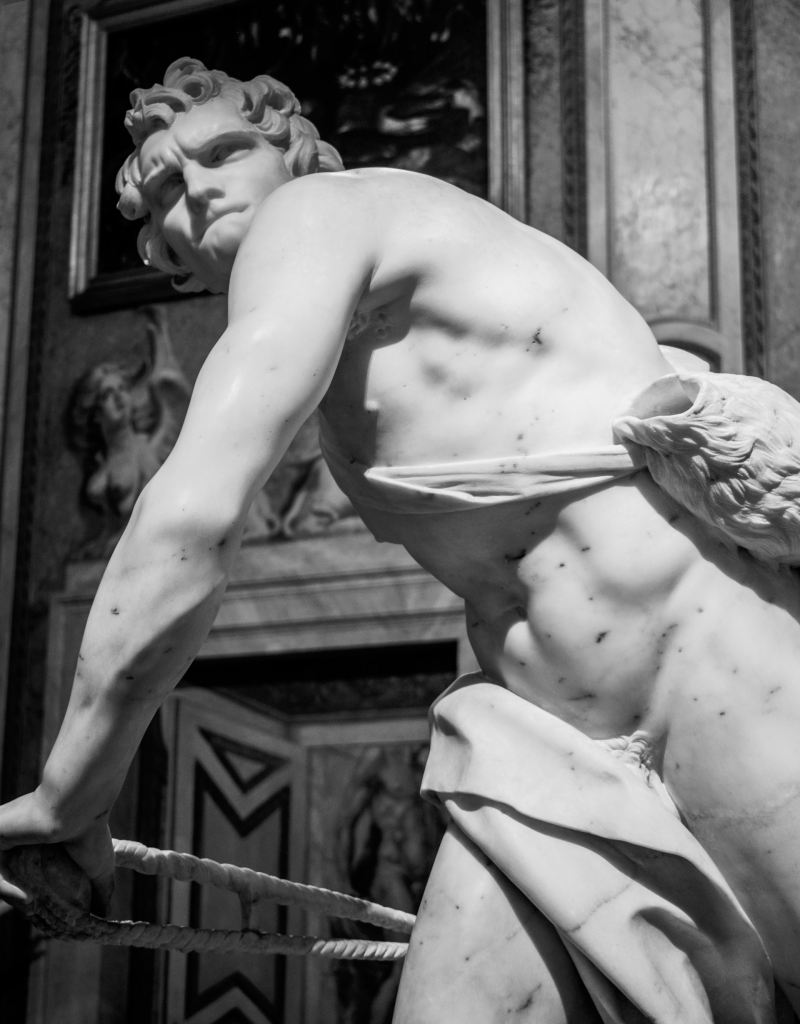
David’s Spiritual Battle with Goliath

David’s defeat of Goliath is such a popular story that it has become a cliché.  For example, unbalanced games in sports where one team is much better than the other are referred to as “David vs. Goliath.”  In these cases, the storyline is about whether a seemingly physically inferior opponent can beat a physically superior one.  However, this misses the point of the story – that it was a spiritual battle.

On one side of the battle, we have false gods.  After David decided to fight and was approaching Goliath, 1 Samuel 17:43 says: “And the Philistine [Goliath] said to David, ‘Am I a dog, that you come to me with sticks?’ And the Philistine cursed David by his gods.”  But even though Goliath invoked his gods in curses, he was counting on his size and strength advantage to win the battle.  He was not actually relying on “gods,” and did not expect to win “by his gods”, but by the god of worldly strength and dominance.

On the other hand, David was clear that this was a battle between true and false gods.  In 1 Samuel 17:26, David says “What shall be done for the man who kills this Philistine and takes away the reproach from Israel? For who is this uncircumcised Philistine, that he should defy the armies of the living God?” and also in verse 37 David says “The LORD who delivered me from the paw of the lion and from the paw of the bear will deliver me from the hand of this Philistine.”  David was actually trusting in and relying on his God for victory, unlike Goliath who just used his gods’ names in vain.  David knew his relative physical weakness against Goliath was not relevant.

So, to Goliath the battle was David vs. Goliath, but to David it was the true God vs. false gods.  And that’s why David won. David wanted to beat Goliath so “that all this assembly may know that the LORD saves not with sword and spear. For the battle is the LORD’S, and he will give you into our hand.” (verse 47)

People also curse us by their gods when we refuse to live by those gods’ standards.  These may be gods of wealth or convenience or rebellion, and many of our spiritual battles are against this world’s gods.

Does it sometimes seem foolish not to make choices based only on what’s best financially?  Is it sometimes inconvenient to worship?  Is it sometimes inconvenient to love our families, congregations, and neighbors?  Is it tempting sometimes to sin “only once” or if we think nobody will find out?

These are battles we all face, but we’re not going to win by doing better by the world’s gods’ standards, but by relying on the true God.  So, a question for us is: do we see these challenges as spiritual battles between true and false gods?  Or do we invoke God in name only like Goliath did, and then rely on our own strength?

The key to the battle between David and Goliath is that David won because 1) he knew his God is real, and 2) because he actually relied on Him.  We can win the same way and overcome the giants that seek to overthrow us.

For we do not wrestle against flesh and blood, but against the rulers, against the authorities, against the cosmic powers over this present darkness, against the spiritual forces of evil in the heavenly places.” – Ephesians 6:12

The Lord is Not Looking For “The Good Face”

One of my favorite books is Moneyball, which is about Billy Beane’s career as General Manager of the Oakland Athletics baseball team in the late 1990s and early 2000s.  Beane ran a winning team on a shoestring budget by pioneering the use of precise measurement, data, and analytics, in contrast to sometimes-arbitrary eyewitness reports from talent scouts.  Author Michael Lewis notes that in the late 1990s, “Some of the scouts still believed they could tell by the structure of a young man’s face not only his character but his future in pro ball. They had a phrase they used: ‘the Good Face.’”[1]  Billy Beane himself had “the Good Face” when he was a prospect and yet had a mediocre career as a player; therefore, his own career arc suggested that there might be a better way to find good players.

Reliance on “The Good Face” isn’t just a baseball phenomenon.  Many politicians, celebrities, businesspeople, news personalities, and others succeed by having “The Good Face,” but the Bible warns us not to rely on “The Good Face.”  One such warning is the story of King Saul, who was “a handsome young man. There was not a man among the people of Israel more handsome than he.  From his shoulders upward he was taller than any of the people.”[2]

Samuel, the LORD’s prophet, was impressed by Saul and was led to anoint him Israel’s king.  However, when Samuel called the people together to announce Saul’s rule, something strange happened: “So they inquired again of the LORD, ‘Is there a man still to come?’ and the LORD said, ‘Behold, he has hidden himself among the baggage.’”[3]  Saul should have responded “Here am I”, but instead shamefully hid.  Being so large, it must have taken some effort to find a place to hide, but he managed it in an attempt to avoid God’s call.  This became a pattern with Saul, because when Israel’s army was challenged by the giant Goliath, “Saul and all Israel heard these words of the Philistine, they were dismayed and greatly afraid.”[4]  Saul, while having “The Good Face,” was unwilling to trust God when He called.  He was faithless and a coward.  Perhaps “tall, dark, and handsome” but not useful to God, and not a good leader for God’s people.

When looking for Saul’s successor, Samuel, as God’s talent scout, almost repeated the mistake of picking “The Good Face.”  Samuel was to pick as king one of the sons of Jesse, and he wanted to pick Eliab after he “looked on” him.  “But the LORD said to Samuel, “Do not look on his appearance or on the height of his stature, because I have rejected him. For the LORD sees not as man sees: man looks on the outward appearance, but the LORD looks on the heart.[5]  After this warning, David, the youngest son of Jesse, is chosen as the next king.  David also had many admirable qualities, being not only handsome, but also “skillful in playing [the lyre], a man of valor, a man of war, prudent in speech, and a man of good presence,” but most importantly, others reported that “the LORD is with him[6] and it was true.  David knew that everything that really mattered about him came from God (see Psalm 139:13-16 for example) and he could only succeed by relying on Him.  If God called, he would come, and if the world challenged God, David would defend Him.  David slew Goliath without hesitation.

Today, the power of Christ living through us is what matters, not having “The Good Face.”  Therefore, be concerned about having “The Good Heart.”  Be not concerned about whether you are photogenic, or handsome, or tall, or well-dressed, or anything else the world may value.  According to the prophet Isaiah, even Jesus didn’t have “The Good Face”: “He had no form or majesty that we should look at Him, and no beauty that we should desire Him.” – Isaiah 53:2b

When God calls, come, and you will have “The Good Heart.”  When you fail, God, whose heart is perfect, will create in you a new clean heart[7], as David learned time and time again.

Therefore do not be anxious, saying, ‘What shall we eat?’ or ‘What shall we drink?’ or ‘What shall we wear?’  For the Gentiles seek after all these things, and your heavenly Father knows that you need them all.  But seek first the kingdom of God and his righteousness, and all these things will be added to you.” – Matthew 6:31-33


[1] Lewis, Michael.  Moneyball (2003).  P. 7.
[2] 1 Samuel 9:2
[3] 1 Samuel 10:22
[4] 1 Samuel 17:11
[5] 1 Samuel 16:7
[6] 1 Samuel 16:18
[7] Psalm 51:10