[This is a repost of my first post from May 2021, for the blog’s 3rd anniversary tomorrow. Enjoy!]
“You shall have no other gods before me” – Exodus 20:3
“The carpenter…plants a cedar and the rain nourishes it…He takes a part of it and warms himself; he kindles a fire and bakes bread. Also he makes a god and worships it; he makes it an idol and falls down before it. Half of it he burns in the fire…And the rest of it he makes into a god, his idol, and falls down to it and worships it. He prays to it and says, ‘Deliver me, for you are my god!’” – Isaiah 44:13-17 (abbreviated)
Meet Deep Thought
Even if you’ve never read Douglas Adams’ classic science fiction comedy novel The Hitchhiker’s Guide to the Galaxy, chances are you’ve heard that the number 42 is The Answer to the Ultimate Question of Life, The Universe, and Everything.
In the story, a supercomputer called Deep Thought is built, specifically designed to do one thing: calculate the answer to Life, The Universe, and Everything. Deep Thought’s creators planned to re-build all of society around this answer. The benefit to society would be worth the 7 ½ million years it took to calculate it. “Never again will we wake up in the morning and think: Who am I? What is my purpose in life?” Deep Thought completes its work. The world awaits.
Deep Thought says the answer to Life, The Universe, and Everything is 42.
Deep Thought also reveals that his creators didn’t know what the question was and although the answer was right, 42 was not useful if they didn’t know the question. Of course, Deep Thought also says he’s not powerful enough to produce the question.
So, instead of giving up after 7 ½ million years of effort, Deep Thought is tasked with helping to create another, stronger supercomputer to come up with the question. But, after 8 million years of calculation, the new computer is destroyed 5 minutes before it was finished.
So, instead of giving up after 15 ½ million years of effort, those in charge of the project know they need to provide some sort of question to their superiors to salvage the situation. They consider possible questions. “What do you get when you multiply six by seven?” was considered, but not very useful or philosophical enough. They consider a few more and settle on “How many roads must a man walk down?”, a Bob Dylan lyric, and report that to their bosses as the computer’s question. (Which, I suppose is giving up after 15 ½ million years of effort.) They sought a guiding principle to organize a utopia around and ended up with a song lyric. The universe continued with no sense of meaning. But the questions remain, like a “splinter in our mind” as Morpheus says in the Matrix, another story where Artificial Intelligence fails to fulfill our desire for meaning and purpose.
In the real world, many are working – across the political and ideological spectrum – to satisfy the market for answers.
Jordan Peterson, perhaps one of the most misunderstood thinkers of our current time, has published some brilliant best-selling books trying to answer these questions, or at least to provide a path forward in the absence of those answers: “In the West, we have been withdrawing from our tradition-, religion- and even nation-centered cultures, partly to decrease the danger of group conflict. But we are increasingly falling prey to the desperation of meaninglessness, and that is no improvement at all.” His books sell because people are searching, and he has a ton of good advice.
But Jordan Peterson is stuck in a paradox: he knows something like Deep Thought is needed to prevent humanity from destroying itself under the weight of meaninglessness, but also that what Deep Thought represents is a grave threat to humanity. “This is what totalitarian means: Everything that needs to be discovered has been discovered. Everything will unfold precisely as planned. All problems will vanish, forever, once the perfect system is accepted”. Thus, he is tenaciously anti-utopian in his thinking. In fact, the walls of his house are covered in totalitarian propaganda as a constant reminder of the horrors of the 20th century.
See, what’s missing in the Hitchhiker’s story is any explanation of why all the people of the universe could reasonably be expected to do what Deep Thought says. What do we do with those who don’t agree with Deep Thought’s advice? What do they do in the Kingdom of Deep Thought to the Shadrach, Meshach and Abednego[1] who conscientiously object? What do they do with the blind, the deaf and the lame, if Deep Thought says you need to see, hear, and walk? After all, 15 ½ million years of effort can’t go to waste because a few inconvenient people got in the way. You might say it was a blessing that Deep Thought failed.
While these concepts and questions aren’t new – Adam and Eve themselves got the answer wrong[2] – what’s new is that in our current American culture, more are boldly saying: “We tried Christianity and that didn’t work, so now we’re trying something else” and they fully expect the support of everyone and everything. Resistance is futile, as they say in Star Trek. While all past attempts at worldly utopia have utterly failed, momentum seems to be rising to make us all guinea pigs in the next attempt at building an idol, which is what Deep Thought, and its ideological brethren clearly are. If Bob Dylan met Deep Thought at the crossroads, he might say we’ve been down this road before 42 times. While we might take heart that G.K. Chesterton said: “When I fancied that I stood alone I was really in the ridiculous position of being backed up by all of Christendom”, we ask what can we do?
Which brings us back to Jordan Peterson. He is highly aware of Christianity as a force that has shaped culture and civilization over centuries. He finds value in the Bible as a collection of useful and profound stories, pulling from that a lot of helpful insight. However, he falls short of saying Christianity is true. He is always careful not to get “metaphysical”. If Jesus is actually real, isn’t that utopian and rigidly ideological?
I pray Jordan makes the leap of faith because what if Jesus really is the Answer? We’ve all seen the “Jesus is the Answer” bumper stickers. What if it’s that simple? Ok, maybe, but what’s the question? What about “Who am I? What is my purpose in life?” If we claim this Jesus is the Answer, who is this person and what does He have to do with me and my problems?
Now we get to the section of the post where I literally had a placeholder in the draft saying: “Insert Christology Here”. If I say too little, it won’t make sense, but if I say too much not only do my odds of blasphemy increase, but my first “blog post” will take years, and multiple volumes, to write. But I’ve painted myself into this corner…
So, here goes (after a multitude of re-writes) …
Meet Jesus
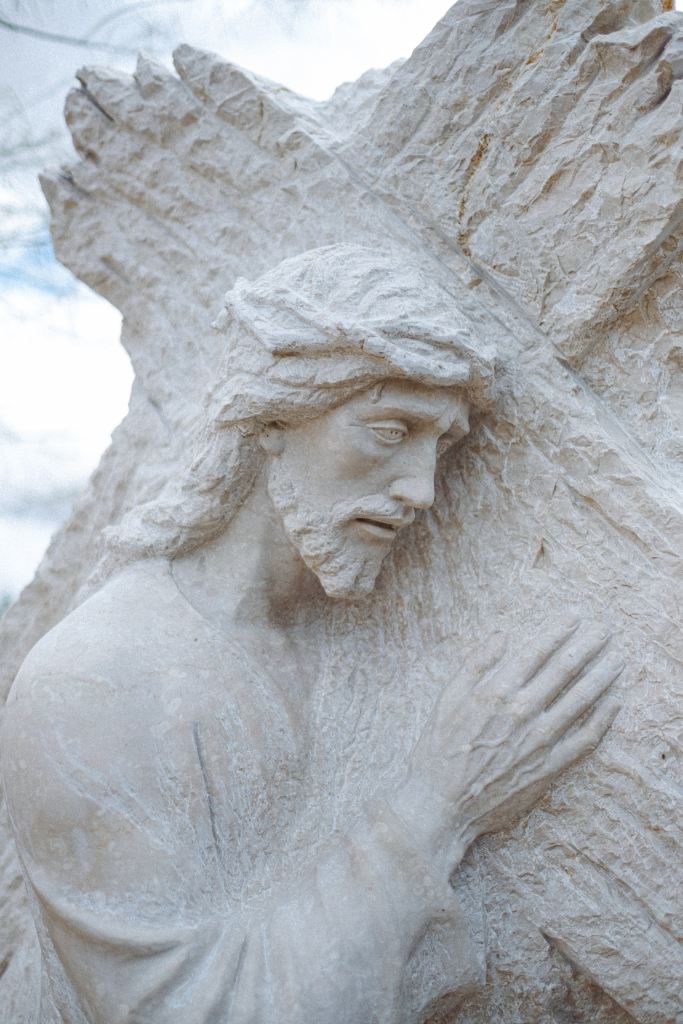
Jesus is God the Son. He is the Messiah, the Christ, foretold in the Old Testament as the perfect prophet, priest, and king. Where the leaders of the Old Testament failed, He would succeed. Jesus eternally holds these offices of prophet, priest, and king, who also announces Himself as the Way, the Truth, and the Life – the representation of God the Father and the way to Him. These attributes show Him as superior to all the Deep Thoughts of the world:
Truth: As omniscient God, he is our prophet, communicating to us His revelation. He has no gaps in his knowledge or biases and therefore His utopia – His New Jerusalem – is not an inadequate abstraction or wishful thinking. He alone is perfectly trustworthy.
Way: As our perfect priest, He is our unblemished sacrifice, putting to death our spiritual rebellion on the cross. This priest does not sacrifice others in pursuit of earthly goals but sacrifices Himself to free us to pursue heavenly goals in service of others. The perfect world is not only available to some lucky few in the future, but to everyone in all times who follow Him by sacrificing themselves for the truth.
Life: He offers us eternal life in His Kingdom. His resurrection shows He has conquered death itself, and His people will be resurrected with Him, with new bodies, His law written on our hearts, enabling us to implement the answer. Shadrach, Meshach, and Abednego[3] – and everyone else – will have clear consciences. The blind will see, the deaf will hear, the lame will walk[4], and everyone will be fully able to realize their purpose.
Thinking of Jesus as creator may also be a clue to our purpose. As shown in the introductory quote, it makes no sense than man could create something that transcends man, something that could know better than man himself what man should do. But the prophet cries out to those who would build Deep Thought and seek their own way in Isaiah 29:15-16:
“Ah, you who hide deep from the LORD your counsel,
whose deeds are in the dark,
and who say, “Who sees us? Who knows us?”
You turn things upside down!
Shall the potter be regarded as the clay,
that the thing made should say of its maker,
“He did not make me”;
or the thing formed say of him who formed it,
“He has no understanding”?”
Jesus as creator is, however, adequate to the task of being our Answer. He is the “Word” of John 1:1 – the “logos” – or logic behind all of creation. He knows us better than we know ourselves. He could snap His fingers and start over, but He chooses not to. He chooses to make us co-creators, to work through, and overcome, all our weaknesses.
Tying these ideas together with Matthew 6:10: “Your kingdom come, your will be done, on earth as it is in heaven”, I propose 2 principles in passing now, which will be ongoing themes of this blog:
- Our Life’s purpose is to witness to the future kingdom, to bring glory to our King, to bring Truth about the next world into this world lovingly and creatively, to point others to Jesus, who is the Way to that world
- We model the hierarchy of the next world, where the Creator is over all of creation, and man, unique among the creation as God’s image, implements a perfect world
So, in summary: where does purpose come from? From One greater than us, who loves us.
Why do we create to find purpose? Because He created us like Himself and shares His work with us.
What does this look like? Here is an interesting example:
Meet Tyler
Tyler Joseph is the singer, multi-instrumentalist, and songwriter for the genre-bending music group twenty øne piløts. Tyler, raised in a Christian home but struggling with depression and anxiety, started writing songs in his basement and before long was performing shows with friends in the Columbus, Ohio area. Early songs[5] included a lot of Christian symbols and references, hinting at Jesus as an answer for people with similar struggles and the band cultivated a following at Christian music festivals. Now their fans are known as the “Skeleton Clique”, one of the most rabid fan bases in music. If you spend any time on their social media or at their shows, you will find people who say Tyler saved their life, and others sharing their struggles. “Stay alive, fren” is the response, often with “the clique loves you” tagged on too.
One early song is “Isle of Flightless Birds,” which I believe is about the pointlessness of life without God. Tyler says without God we’re like birds who can’t fly, so we “find our worth in giving birth and stuff” as the “demons and angels” manipulate us. Our lives are “frustrating and so degrading” and “we repeat the same routines” ignoring what “our soul is really thinking”
Tyler suggests a solution is to “wake up every morning and decide what we believe”, and ends the song with this: “It’s time you pick your battle, and I promise you, this is mine”
He doesn’t spell it out, but it seems Tyler’s battle is an answer (lower case) that points to the Answer (upper case)? What if his triumph over depression was discovering that music was his way of creating something in this world that both improves this world and points to the next? What if his battle is to minister to an immediate need – compassion and understanding in the face of despair – while dropping breadcrumbs pointing the Way to eternal life? If he can help people survive a bit longer, perhaps they find God – “And He is waiting, oh, so patiently”
Tyler transparently chooses to deliver a veiled message, using layered metaphors containing both spiritual and secular meanings. He struggles with how explicit to be about his faith in the song “Clear” – “I wish that I had two faces to prove which theory works: Yelling on the street corner, or cleverly masking your words”. In another song, “Ode to Sleep”, Tyler sings “I’m afraid to tell you who I adore; won’t tell you who I’m singing towards” amid a verse including a reference to Peter’s triple-denial of Christ[6]. Why go to the trouble of intentionally identifying what you’re denying? It’s puzzling, but that might be his way of drawing more people in with curiosity. He even wrote an entire song, “Heathens”, that seems to be about asking his Christian fans to accept his other fans who benefit from the secular message of the music.
Tyler’s battle is not my battle, and it’s probably not your battle. We all have different experiences, talents, and desires. Therefore, his answer is different than our answer. But all our battles are fought under our King, with the tools He provides. “For we are his workmanship, created in Christ Jesus for good works, which God prepared beforehand, that we should walk in them.” – Ephesians 2:10
We’re not all going to be successful rock stars, but we can all do something. We’re not all going to be artistic, but each of us has value, an answer that wouldn’t exist without us. “Use what talents you possess: the woods would be very silent if no birds sang there except those that sang best,” said Henry Van Dyke, a presbyterian minister and writer.
“Are you searching for purpose?”, asks Tyler in the song “Kitchen Sink”, where he suggests that everyone has their own demons and that finding purpose through creating something could be a first step toward victory over those demons. “Write something, yeah it might be worthless; Then paint something then, it might be wordless; Pointless curses, nonsense verses; You’ll see purpose start to surface”. I hope this blog won’t be worthless, but it’s a step and I hope you’ll take one too.
God’s ceiling for each of us is in the heavens, much higher than the ceiling we manifest for ourselves[7] when we choose not to act. My prayer is that someday we will no longer be flightless birds, but “mount up with wings like eagles”[8] and never come down.
[1] Daniel 3:20
[2] Genesis 3:6
[3] Daniel 3:28
[4] Matthew 11:5
[5] The name of this blog is taken from a line of an early twenty øne piløts song. More on that in a later post (maybe)
[6] Matthew 26:75
[7] Easter egg alert!
[8] Isaiah 40:31






 Driving Toward the Morning Sun