Two Words That Might Save Your Soul

Being human is difficult, but sometimes a pause to reflect can make a big difference.  Ephesians 2:4 says: “But God, being rich in mercy, because of the great love with which he loved us…”  Pastor James Boice jumps on those first two words as a key turning point: “But God! Here is where the beauty and wonder of the Christian gospel comes in.”

Ephesians 2 begins with people following “the course of this world,” chasing whatever “passions” and “desires” came to mind.  Before “but God”, we were all “dead” (v 1) and “by nature children of wrath” (v 3).  All of our efforts are doomed to failure.

The story does not stop there.  For God’s people it never does.  After “but God”, we have been made alive together with Christ (v 5), we are shown the immeasurable riches of His grace (v 7), and we are enabled to do the good, meaningful works He has prepared for us (v 10).

When we wonder whether this world is all there is and that this is the best we can do, we respond “But God…” When frustrated with yourself, with others, or with the world in general, bring to mind the words “but God.”  These words are relevant to every situation because He has not left things as they are, but He intervened through Jesus on the cross and through His Spirit in our lives every day.  “The words ‘but God’ show what God has done. If you understand those two words – ‘but God’ – they will save your soul. If you recall them daily and live by them, they will transform your life completely.”[1]

Call the words “but God…” to mind whenever you’re overcome with negativity.  Say “but God…” to others who are struggling.  For every situation, He can fill the “…” with hope if you pause and give Him the opportunity.  But also, when you see God’s blessings in your daily life, think “but God” because He has not left us alone.


[1] From “November 7.” James Montgomery Boice and Marion Clark. Come to the Waters: Daily Bible Devotions for Spiritual Refreshment.  (2017).

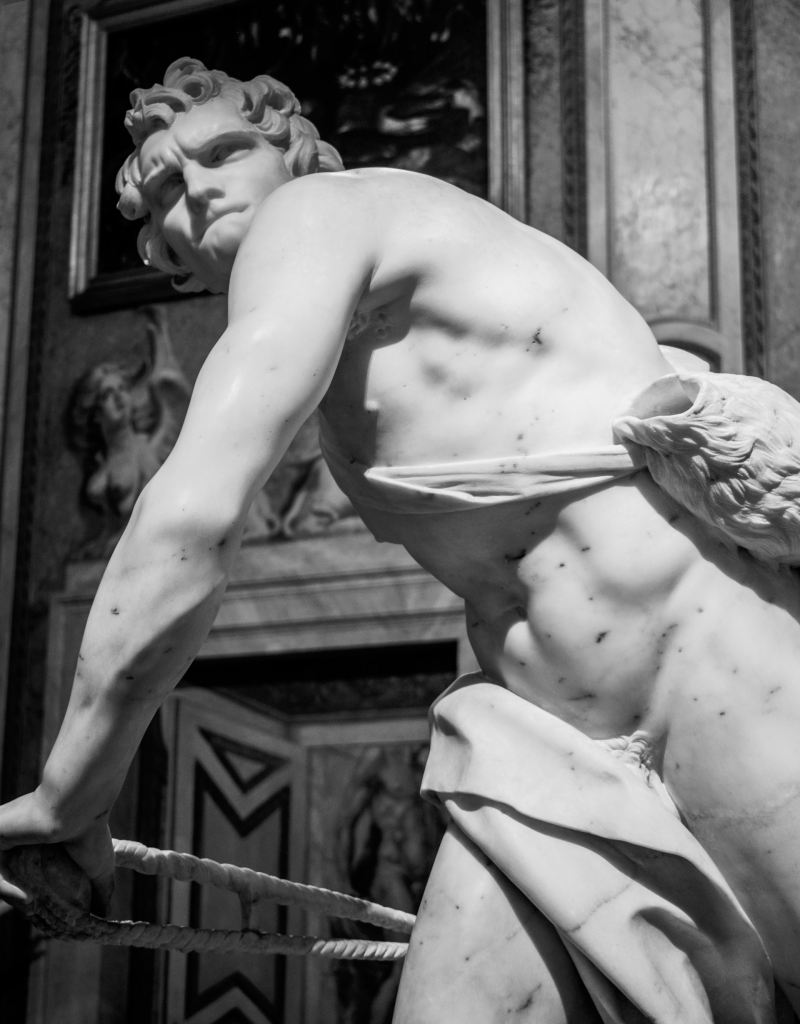
David’s Spiritual Battle with Goliath

David’s defeat of Goliath is such a popular story that it has become a cliché.  For example, unbalanced games in sports where one team is much better than the other are referred to as “David vs. Goliath.”  In these cases, the storyline is about whether a seemingly physically inferior opponent can beat a physically superior one.  However, this misses the point of the story – that it was a spiritual battle.

On one side of the battle, we have false gods.  After David decided to fight and was approaching Goliath, 1 Samuel 17:43 says: “And the Philistine [Goliath] said to David, ‘Am I a dog, that you come to me with sticks?’ And the Philistine cursed David by his gods.”  But even though Goliath invoked his gods in curses, he was counting on his size and strength advantage to win the battle.  He was not actually relying on “gods,” and did not expect to win “by his gods”, but by the god of worldly strength and dominance.

On the other hand, David was clear that this was a battle between true and false gods.  In 1 Samuel 17:26, David says “What shall be done for the man who kills this Philistine and takes away the reproach from Israel? For who is this uncircumcised Philistine, that he should defy the armies of the living God?” and also in verse 37 David says “The LORD who delivered me from the paw of the lion and from the paw of the bear will deliver me from the hand of this Philistine.”  David was actually trusting in and relying on his God for victory, unlike Goliath who just used his gods’ names in vain.  David knew his relative physical weakness against Goliath was not relevant.

So, to Goliath the battle was David vs. Goliath, but to David it was the true God vs. false gods.  And that’s why David won. David wanted to beat Goliath so “that all this assembly may know that the LORD saves not with sword and spear. For the battle is the LORD’S, and he will give you into our hand.” (verse 47)

People also curse us by their gods when we refuse to live by those gods’ standards.  These may be gods of wealth or convenience or rebellion, and many of our spiritual battles are against this world’s gods.

Does it sometimes seem foolish not to make choices based only on what’s best financially?  Is it sometimes inconvenient to worship?  Is it sometimes inconvenient to love our families, congregations, and neighbors?  Is it tempting sometimes to sin “only once” or if we think nobody will find out?

These are battles we all face, but we’re not going to win by doing better by the world’s gods’ standards, but by relying on the true God.  So, a question for us is: do we see these challenges as spiritual battles between true and false gods?  Or do we invoke God in name only like Goliath did, and then rely on our own strength?

The key to the battle between David and Goliath is that David won because 1) he knew his God is real, and 2) because he actually relied on Him.  We can win the same way and overcome the giants that seek to overthrow us.

For we do not wrestle against flesh and blood, but against the rulers, against the authorities, against the cosmic powers over this present darkness, against the spiritual forces of evil in the heavenly places.” – Ephesians 6:12

“Consider Well Her Ramparts”: Participating in the Psalms

Reading the Psalms is a great devotional habit, and every now and then a Psalm or a section of a Psalm gives instructions to its reader.  The author is inviting us to participate in something about God that they have experienced by taking specific actions.  Earlier posts on participating in the Psalms (here, here, and here) have covered Psalms 96 and 100, which asked us to sing a new song and to give thanks, respectively.  Today’s post is about Psalm 48, which is a little harder to see how to participate.  Most of the Psalm praises God by talking about His city, Jerusalem, and His mountain, Mount Zion.  If our God’s dwelling place is worthy of praise, then He must be as well.  The “participating” part comes at the end, with verses 12-14:

Walk about Zion, go around her,
            number her towers,
consider well her ramparts,
            go through her citadels,
that you may tell the next generation
            that this is God,
our God forever and ever.
            He will guide us forever.

The Psalmist wrote in ancient times that it was worth it to take the time to walk around Zion, to consider the things of God and not just gloss over them quickly, but how do we do that when Christians do not consider Jerusalem and Mount Zion to be the dwelling place of God?  How do we “consider well her ramparts”?

Photo by Boris Izmaylov on Unsplash

Currently, what was represented by the temple in Jerusalem on Mount Zion is represented by His body of believers, indwelt by His Holy Spirit.  Peter wrote that members of the church, “like living stones are being built up as a spiritual house, to be a holy priesthood, to offer spiritual sacrifices acceptable to God through Jesus Christ.”[1]  Therefore, do we participate in this Psalm by considering God’s strength through the church throughout history?  When we consider the “towers”, “ramparts”, and “citadels” of the church, do we consider the great “cloud of witnesses” listed in Hebrews 12, in addition to the faithful members of the church through the centuries since then?

Do we consider well not only the strength God has given His church through history, but also the strength that He protects it with even now?  Do we consider our own “ramparts” – the armor of God listed in Ephesians 6:13-17 –

Therefore take up the whole armor of God, that you may be able to withstand in the evil day, and having done all, to stand firm.  Stand therefore, having fastened on the belt of truth, and having put on the breastplate of righteousness, and, as shoes for your feet, having put on the readiness given by the gospel of peace.  In all circumstances take up the shield of faith, with which you can extinguish all the flaming darts of the evil one; and take the helmet of salvation, and the sword of the Spirit, which is the word of God.

Consideration takes time, so to participate in this Psalm take some time, if not today then soon, to consider God’s strength as shown through a person in the Bible, in church history, or even your own community or family.  Praise God for His strength and protection over His faithful!

As the “Sons of Korah” who wrote Psalm 48 believed, it’s worth the time and effort to:

Walk about Zion, go around her,
            number her towers,
consider well her ramparts,
            go through her citadels,
that you may tell the next generation
            that this is God,
our God forever and ever.
            He will guide us forever.

Many of this blog’s posts on History (click here) are a decent starting point.


[1] 1 Peter 2:5

What are We Willing to Leave on the Cutting Room Floor?

From earliest times, debate has raged over whether God’s word can be taken literally.  Since the serpent asked, “Did God actually say, ‘You shall not eat of any tree in the garden’?[1] people have debated if the world was created in 6 days.  If Moses really parted the Red Sea.  If Jonah really spent 3 days inside a great fish.  And so on.  Talk about whether the Bible means what it says often focuses on the miraculous events within.

But what about verses like Ephesians 4:29?  “Let no corrupting talk come out of your mouths, but only such as is good for building up, as fits the occasion, that it may give grace to those who hear.”  When Paul wrote that, did he literally mean “no corrupting talk,” or just to aim for less crude language than the average person?  Did Paul mean each word needs to “fit the occasion,” or to repeat whatever catchphrase seems to work in most situations?  Did Paul mean everything we say should “give grace” to others, or is it ok if sometimes we want to look good or only appear gracious?  Do we need to always build up those who hear us?  Did Paul “actually say” what he wrote in Ephesians 4:29?

Failure to meet our ideals
does not mean that
we should change them.

We might reply that this is an impossible standard, but Jesus in Luke 18:19 said “Why do you call me good? No one is good except God alone.”  In that one statement, Jesus testifies that no one is good (everyone misses the mark), and also that He is God in the flesh, come to save us from failing to meet the standard.

So yes, Ephesians 4:29 should be taken literally, but we should also take literally that only Jesus can meet the standard, and that He did meet the standard.  Failure to meet our ideals does not mean they are the wrong ideals and that we should change them.  Holiness is holiness.

G.K. Chesterton wrote in his book Orthodoxy that “it does not matter (comparatively speaking) how often humanity fails to imitate its ideal; for then all its old failures are fruitful. But it does frightfully matter how often humanity changes its ideal; for then all its old failures are fruitless.”[2]

In film editing, “the cutting room floor” refers to pieces of physical film that (in pre-digital times) were cut out of the movie and left lying on the floor.  When writing this blog, one of the hardest things to do is to cut out parts or phrases I care deeply about, but sometimes it’s necessary, because my words aren’t always Ephesians 4:29 words.  Finding these failures can be fruitful if I learn from them and move closer to the ideal.  In real-time, daily conversation it’s even harder, but to take Ephesians 4:29 literally, we all have to figuratively ask:

What are we willing to leave on the cutting room floor today?


[1] Genesis 3:1
[2] Chesterton, G.K. Orthodoxy (1908).  P. 163.

Bible in a Year: Week of September 23 – 29

Fellow travelers:

Below are the chapters to read this week if you’re following along in my Bible in a year schedule, divided into morning and evening readings.  Follow along any way you want: you can just do the evening reading, flip the morning and evening, or read it all.  Whatever works for you and your schedule!  It doesn’t have to be Bible in a Year for everyone.

This week we finish Jeremiah and move to Ephesians.  Most of the rest of the morning readings this year will alternate between the minor prophets (and Ezekiel) and the rest of the New Testament.

Monday, September 23
Morning: Jeremiah 44-45
Evening: Job 21

Tuesday, September 24
Morning: Jeremiah 46-47
Evening: Job 22

Wednesday, September 25
Morning: Jeremiah 48-49
Evening: Job 23

Thursday, September 26
Morning: Jeremiah 50-52
Evening: Job 24

Friday, September 27
Morning: Ephesians 1-2
Evening: Job 25

Saturday, September 28
Morning: Ephesians 3-4
Evening: Job 26

Sunday, September 29
Morning: Ephesians 5-6
Evening: Job 27