My 3 Rules of Writing

Dear fellow travelers,

Around the time I launched this blog, I decided on 3 criteria for what I write here to keep myself disciplined not just to regular writing, but to the type of content I wanted to post.  It’s my blog, after all.

My objective is that every post should be these 3 things: Compelling, Clear, and Charitable, meaning:

Is it about something that matters eternally, and is written in a way that connects emotionally and is worth reading? (Compelling)
Is it logical and makes sense, or is it likely to be misunderstood? (Clear)
Is it written in love, to build up whoever reads it? (Charitable)

In a way, these criteria are just a modified version of Ephesians 4:15-16, which says:
Rather, speaking the truth in love, we are to grow up in every way into him who is the head, into Christ, from whom the whole body, joined and held together by every joint with which it is equipped, when each part is working properly, makes the body grow so that it builds itself up in love.” – Ephesians 4:15-16

The compelling and clear parts are the “speaking the truth,” and the charitable part is the “in love” part.  However, the three criteria are not equal.  If I am compelling and clear, I might come across as clever, smart or a good writer, but without charity, “I am a noisy gong or a clanging cymbal” (1 Corinthians 13:1).  Without love, I’ve done it wrong.  Therefore, being compelling and clear should be tools used in service of being charitable.

Although I’ve been posting very regularly recently, including re-using old posts, I know a blog doesn’t have to fill endless airtime like a 24/7 news cycle, where passion and (often faulty) logic dominate in an attempt to draw as many viewers as possible, but I like the daily rhythm when I can do it.  However, love is more important than keeping a daily schedule, so posting daily isn’t one of my rules.  Quality over quantity, I guess.

I’m not perfect and don’t always live up to my own 3 rules, but that doesn’t mean I shouldn’t try!

Do you have rules for your blog, or other social media presence?

And let us consider how to stir up one another to love and good works” – Hebrews 10:24

The Economic Solution?

What if only one verse from the Bible could solve all of the world’s economic problems?  If one could, it would probably be Ephesians 4:28, where Paul wrote:

Let the thief no longer steal, but rather let him labor, doing honest work with his own hands, so that he may have something to share with anyone in need.”

What if everyone followed the three rules suggested by this one verse?

A fig tree. Photo by Jametlene Reskp on Unsplash

First, imagine if there was no crime.  “Let the thief no longer steal.”  The Bible tells us that in a perfect world, God’s people “shall sit every man under his vine and under his fig tree, and no one shall make them afraid[1]  Every person will reap the rewards of their effort – their own wine and figs – with no concern for it being taken away from them.

Next, imagine if everyone’s job was productive and meaningful; that each person did “honest work with his own hands.”  What if everyone approached their job as an act of worship, offered to God who sees and knows all?  No dishonesty, no scandal, no nasty office politics, no slacking.

Last, imagine if everyone’s needs were taken care of from the surplus of others.  Imagine if we had the mindset that working in order to have more to share is better than working in order to accumulate for ourselves.

What a world that would be!  So, let’s make these rules into law, enforce them strictly, and we will have a perfect society, right?  Wrong, because rules and laws are not the solution to the world’s problems.  People don’t consistently follow rules, especially when they require that we abandon our selfish ways.  At the root of Adam and Eve’s sin – the sin that taints us all – is that they wanted to do things their own way, making their own choices between good and evil, rather than trusting God to know it for them.  When rebellion is the problem, more or better rules can’t solve it.  Rebellion against God can’t be solved from the outside of us, only from the inside.

However, while sin will always taint us in this world, we are called to, and able to, live differently.  Paul declares in 2 Corinthians 5:17 that “if anyone is in Christ, he is a new creation. The old has passed away; behold, the new has come.”  The principles of Ephesians 4:28 apply to God’s people now.

Christians are called not to follow this world’s economic models and incentives, but to “but lay up for yourselves treasures in heaven, where neither moth nor rust destroys and where thieves do not break in and steal.[2]  Because in heaven the thief will “no longer steal” and we should desire that God’s “will be done, on earth as it is in heaven,” we should no longer steal now.  We should know that in any job we should “work heartily, as for the Lord and not for men[3] and we should share with those in need because Jesus told us “Truly, I say to you, as you did it to one of the least of these my brothers, you did it to me.”[4]

Is this possible?  Yes, and Paul modeled some of this for us in his own life.  In Acts 20:34 he said, “You yourselves know that these hands ministered to my necessities and to those who were with me.”  While as an apostle he could have asked each church he founded to fully support his ministry and cover his costs, instead he worked as a tentmaker to show us the principles of Ephesians 4:28 at work.

Maybe one verse can solve all of our economic problems, but only when everyone lives like God knows best.  Our Savior Jesus offers us a world just like that.  All good things are possible.

Let the thief no longer steal, but rather let him labor, doing honest work with his own hands, so that he may have something to share with anyone in need.”


[1] Micah 4:4
[2] Matthew 6:20
[3] Colossians 3:23
[4] Matthew 25:40

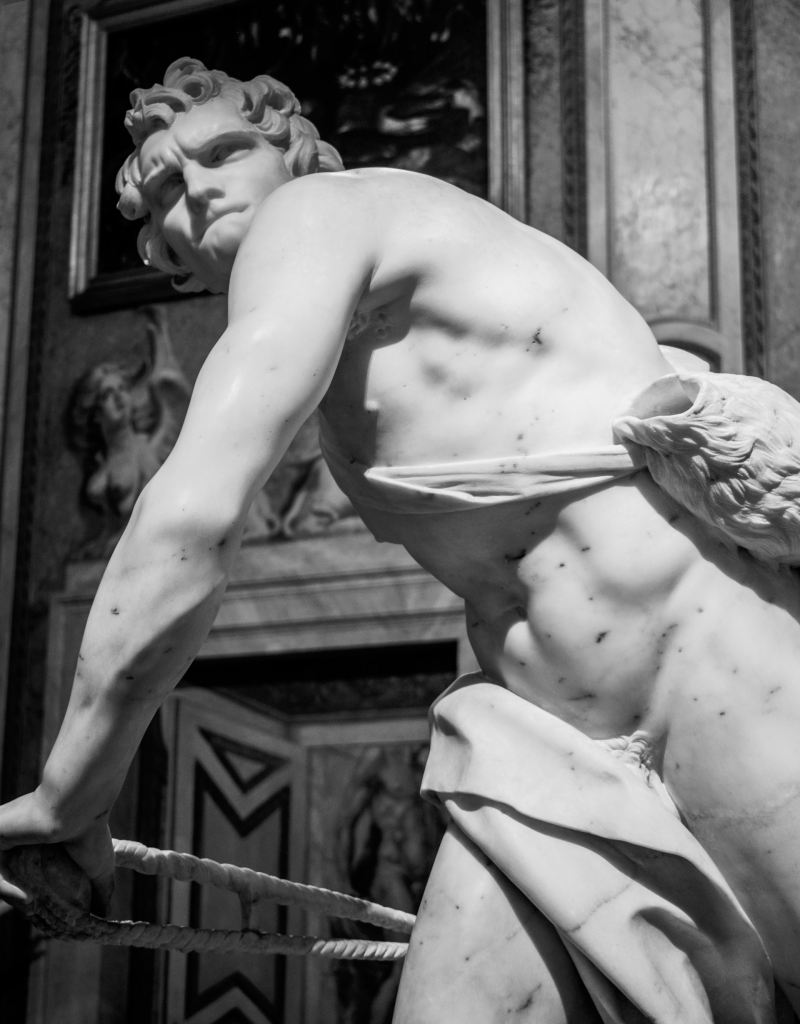
David’s Spiritual Battle with Goliath

David’s defeat of Goliath is such a popular story that it has become a cliché.  For example, unbalanced games in sports where one team is much better than the other are referred to as “David vs. Goliath.”  In these cases, the storyline is about whether a seemingly physically inferior opponent can beat a physically superior one.  However, this misses the point of the story – that it was a spiritual battle.

On one side of the battle, we have false gods.  After David decided to fight and was approaching Goliath, 1 Samuel 17:43 says: “And the Philistine [Goliath] said to David, ‘Am I a dog, that you come to me with sticks?’ And the Philistine cursed David by his gods.”  But even though Goliath invoked his gods in curses, he was counting on his size and strength advantage to win the battle.  He was not actually relying on “gods,” and did not expect to win “by his gods”, but by the god of worldly strength and dominance.

On the other hand, David was clear that this was a battle between true and false gods.  In 1 Samuel 17:26, David says “What shall be done for the man who kills this Philistine and takes away the reproach from Israel? For who is this uncircumcised Philistine, that he should defy the armies of the living God?” and also in verse 37 David says “The LORD who delivered me from the paw of the lion and from the paw of the bear will deliver me from the hand of this Philistine.”  David was actually trusting in and relying on his God for victory, unlike Goliath who just used his gods’ names in vain.  David knew his relative physical weakness against Goliath was not relevant.

So, to Goliath the battle was David vs. Goliath, but to David it was the true God vs. false gods.  And that’s why David won. David wanted to beat Goliath so “that all this assembly may know that the LORD saves not with sword and spear. For the battle is the LORD’S, and he will give you into our hand.” (verse 47)

People also curse us by their gods when we refuse to live by those gods’ standards.  These may be gods of wealth or convenience or rebellion, and many of our spiritual battles are against this world’s gods.

Does it sometimes seem foolish not to make choices based only on what’s best financially?  Is it sometimes inconvenient to worship?  Is it sometimes inconvenient to love our families, congregations, and neighbors?  Is it tempting sometimes to sin “only once” or if we think nobody will find out?

These are battles we all face, but we’re not going to win by doing better by the world’s gods’ standards, but by relying on the true God.  So, a question for us is: do we see these challenges as spiritual battles between true and false gods?  Or do we invoke God in name only like Goliath did, and then rely on our own strength?

The key to the battle between David and Goliath is that David won because 1) he knew his God is real, and 2) because he actually relied on Him.  We can win the same way and overcome the giants that seek to overthrow us.

For we do not wrestle against flesh and blood, but against the rulers, against the authorities, against the cosmic powers over this present darkness, against the spiritual forces of evil in the heavenly places.” – Ephesians 6:12

Letting God Set the Agenda

One of the most significant ways the media influence us is by what’s called “agenda setting,” which means is that they tell us what is important and what we should care about by choosing what issues or topics to cover most often and most prominently.  For example, if a topic appears regularly on the front pages of newspapers or the covers of magazines or in the “Breaking News” of a TV news program, those editors have decided those items are more important, and want us to feel the same.  Unfortunately, there’s also an old saying in journalism that “if it bleeds, it leads,” meaning that bad news should get more coverage because it’s good for the business of journalism.

Related, but not the same, is “framing” which means the way the media covers something (the words they use, the sources they cite, etc.) affects our attitudes about it.  When the media consistently use words like “radical” or “extreme” to represent only the other side, or if they lump all the news that bleeds to a specific group of people and not another, they’re employing framing.

The problem is that the same issues aren’t always as important to all people, and often the media’s agendas don’t align with what should be each person’s agenda.  It’s like news coverage is designed to make us think the world is so evil that we can’t do anything about it, but also that very little is our own responsibility (or fault).  As Corrie ten Boom wrote about her time in a Nazi concentration camp: “this was the great ploy of Satan in that kingdom of his: to display such blatant evil that one could almost believe one’s own secret sins didn’t matter.”

Is it really good or healthy to feel all the world’s problems are on our shoulders? However, all media have to make choices about what to cover and how to cover it, so there is no avoiding these problems…unless you have another source for your agenda and the framing of it.  That source is God, and here are some verses from His word that can guide us:

Cast Your Anxieties
Humble yourselves, therefore, under the mighty hand of God so that at the proper time he may exalt you, casting all your anxieties on him, because he cares for you.” – 1 Peter 5:6-7

We can recognize that there is a sovereign God, and ultimately His agenda is the only one that matters.  With that knowledge, we know that there are many times where all we can do is pray to the One who sees all the bad news we do, and much more.  He is in control.

If It’s Worthy, It Leads
Finally, brothers, whatever is true, whatever is honorable, whatever is just, whatever is pure, whatever is lovely, whatever is commendable, if there is any excellence, if there is anything worthy of praise, think about these things.” – Philippians 4:8

We can recognize that good news isn’t always easy to find, but we should seek it out, even if it’s in our own homes, families, or neighborhoods.  There is always something worthy of praise to pay attention to.

Frame Your Responsibility Locally
For we are his workmanship, created in Christ Jesus for good works, which God prepared beforehand, that we should walk in them.” – Ephesians 2:10

Too much attention to the big picture problems of the world can distract us from the work God has put right in front of us, which we were created to do.  God wants us to be faithful, not to save the world (He has already done that!)

I agree with C.S. Lewis, who wrote: “I think each village was meant to feel pity for its own sick and poor whom it can help and I doubt if it is the duty of any private person to fix his mind on ills which he cannot help. This may even become an escape from the works of charity we really can do to those we know. God may call any one of us to respond to some far away problem or support those who have been so called. But we are finite and he will not call us everywhere or to support every worthy cause. And real needs are not far from us.”

Yes, global problems matter and there is always a lot of bad news, but today let God set your agenda and frame it through the lens of His eternal victory in Christ.

“Consider Well Her Ramparts”: Participating in the Psalms

Reading the Psalms is a great devotional habit, and every now and then a Psalm or a section of a Psalm gives instructions to its reader.  The author is inviting us to participate in something about God that they have experienced by taking specific actions.  Earlier posts on participating in the Psalms (here, here, and here) have covered Psalms 96 and 100, which asked us to sing a new song and to give thanks, respectively.  Today’s post is about Psalm 48, which is a little harder to see how to participate.  Most of the Psalm praises God by talking about His city, Jerusalem, and His mountain, Mount Zion.  If our God’s dwelling place is worthy of praise, then He must be as well.  The “participating” part comes at the end, with verses 12-14:

Walk about Zion, go around her,
            number her towers,
consider well her ramparts,
            go through her citadels,
that you may tell the next generation
            that this is God,
our God forever and ever.
            He will guide us forever.

The Psalmist wrote in ancient times that it was worth it to take the time to walk around Zion, to consider the things of God and not just gloss over them quickly, but how do we do that when Christians do not consider Jerusalem and Mount Zion to be the dwelling place of God?  How do we “consider well her ramparts”?

Photo by Boris Izmaylov on Unsplash

Currently, what was represented by the temple in Jerusalem on Mount Zion is represented by His body of believers, indwelt by His Holy Spirit.  Peter wrote that members of the church, “like living stones are being built up as a spiritual house, to be a holy priesthood, to offer spiritual sacrifices acceptable to God through Jesus Christ.”[1]  Therefore, do we participate in this Psalm by considering God’s strength through the church throughout history?  When we consider the “towers”, “ramparts”, and “citadels” of the church, do we consider the great “cloud of witnesses” listed in Hebrews 12, in addition to the faithful members of the church through the centuries since then?

Do we consider well not only the strength God has given His church through history, but also the strength that He protects it with even now?  Do we consider our own “ramparts” – the armor of God listed in Ephesians 6:13-17 –

Therefore take up the whole armor of God, that you may be able to withstand in the evil day, and having done all, to stand firm.  Stand therefore, having fastened on the belt of truth, and having put on the breastplate of righteousness, and, as shoes for your feet, having put on the readiness given by the gospel of peace.  In all circumstances take up the shield of faith, with which you can extinguish all the flaming darts of the evil one; and take the helmet of salvation, and the sword of the Spirit, which is the word of God.

Consideration takes time, so to participate in this Psalm take some time, if not today then soon, to consider God’s strength as shown through a person in the Bible, in church history, or even your own community or family.  Praise God for His strength and protection over His faithful!

As the “Sons of Korah” who wrote Psalm 48 believed, it’s worth the time and effort to:

Walk about Zion, go around her,
            number her towers,
consider well her ramparts,
            go through her citadels,
that you may tell the next generation
            that this is God,
our God forever and ever.
            He will guide us forever.

Many of this blog’s posts on History (click here) are a decent starting point.


[1] 1 Peter 2:5